
The evolution from structured factory floors to dynamic, unstructured environments marks a pivotal shift in robotics, driven by the demands of Industry 4.0 and intelligent service robots. A core challenge in this transition is endowing machines with fine manipulation and adaptive grasping capabilities that approach human dexterity. As the ultimate physical interface between a robot and its environment, the end-effector’s performance is paramount. Traditional two-fingered grippers, while simple and easy to control, are fundamentally limited by their lack of flexibility, struggling with the vast diversity of shapes, materials, and weights encountered in daily life. Consequently, the dexterous robotic hand, which mimics the structure and function of the human hand, has become a focal point of research. Its advancement is decisive for achieving genuine general-purpose autonomous manipulation.
“Dexterity,” originally describing the human ability to perform complex motions quickly and precisely, is now a key metric in robotics. It applies not only to robotic arms but also to the fine motor skills of a robotic hand, as robotic fingers can be seen as miniature versions of robotic arms with similar kinematic properties. A dexterous robotic hand, through multi-joint coordination, can replicate complex actions like pinching, enveloping, and hooking, vastly expanding a robot’s task boundaries. However, the journey from laboratory prototype to widespread application is fraught with significant challenges: reliability, durability, and cost issues stemming from high mechanical complexity; control difficulties in high-dimensional motion planning, fine force control, and multi-modal sensory fusion; and bottlenecks in the generalization and safety of grasping strategies for novel objects. This article systematically reviews the technological status and development trends of dexterous robotic hands, discussing their system architecture, core components, product ecosystem, key technologies, application scenarios, challenges, and future directions, aiming to provide a comprehensive reference for researchers in the field.
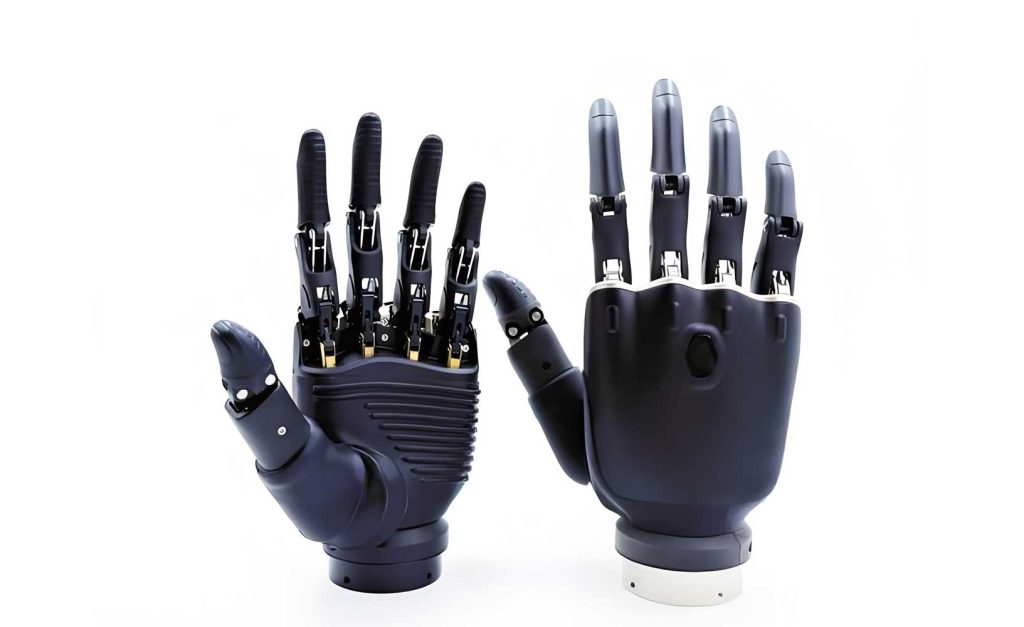
System Architecture and Core Characteristics
The dexterous robotic hand is a synergistic integration of mechanical engineering, sensing technology, and intelligent control. Its goal is to replicate human grasping and manipulation capabilities through a highly fused mechanical structure and control system. Such systems typically feature multiple degrees of freedom (DoF) and multi-joint structures, enabling stable grasping and flexible manipulation of objects with varying forms and materials in unstructured environments. This represents a key step in transitioning robots from mere tools to embodied intelligent agents.
The technical essence of a dexterous robotic hand lies not merely in morphological imitation but in functional and intelligent anthropomorphism. Its core capabilities are reflected in three areas: kinematic dexterity, environmental adaptability, and operational intelligence. A multi-joint cooperative structure provides a rich repertoire of grasp types and manipulation forms. A multi-modal perceptual system, fusing force, tactile, and visual information, allows for real-time perception and response to environmental states and contact changes, enabling compliant and safe interaction. At the intelligence level, the dexterous robotic hand is evolving from a system reliant on pre-programmed routines to an intelligent platform with autonomous perception, decision-making, and control, capable of strategic planning and adaptive learning in complex tasks.
System Composition
The overall architecture of a dexterous robotic hand typically comprises four integrated subsystems: actuation, transmission, perception, and control.
- Actuation System: The power source. Common methods include micro-motors, pneumatic elements, and novel smart materials. Electric motors are widely used for their fast response and ease of control. Pneumatic and shape memory alloy actuation offer unique advantages in lightweight design and inherent compliance.
- Transmission System: Responsible for accurately transmitting power to each joint. Tendon-driven transmission is prevalent due to its compactness and flexible layout. Gear and linkage mechanisms excel in high-stiffness, high-precision scenarios. Recently, rigid-soft coupling and hybrid transmission schemes show promise in balancing precision and compliance.
- Perception System: The critical interface for environmental interaction, now evolving from single-mode force sensing to multi-modal fusion. By integrating tactile, force, visual, and proximity sensing units on fingertips, finger pads, and palms, the dexterous robotic hand can perceive contact state, force distribution, and object properties in real-time, providing essential feedback for closed-loop control and adaptive operation.
- Control System: The intelligent core, handling motion planning, dynamic adjustment, and coordinated control. Traditional model-based methods are increasingly supplemented or replaced by strategies combining visual servoing, hybrid force-position control, and learning-based control, enabling stable, compliant operation in uncertain environments. Modular and distributed control architectures enhance system scalability and maintainability.
Typical Characteristics
The defining characteristics of a dexterous robotic hand highlight its breakthrough value in robotic manipulation:
- High Degree of Biomimetic Motion and Operational Generality: Through multi-phalangeal, multi-DoF design, it can replicate the continuous spectrum of human hand motions from precision pinch to power grasp.
- Intelligent Perception-Action Closed Loop: Modern dexterous robotic hands achieve real-time monitoring and dynamic adjustment by fusing multi-modal sensory information (vision, force, touch).
- Safety and Compliance in Human-Robot Interaction (HRI): Advanced force control algorithms and compliant mechanical designs enable “soft contact” during physical interaction with the environment and humans.
- High System Integration Complexity: Integrating actuation, transmission, perception, and control modules within the limited volume of a palm presents immense engineering challenges, impacting weight, power consumption, reliability, and cost.
Technological Development Status
The development of dexterous robotic hands has progressed through distinct phases globally, from early structural exploration to the current era of intelligent and bio-hybrid systems.
International Research Trajectory
International research can be broadly categorized into three stages:
- Early Exploration & Foundational Research (1980s-1990s): Focus on mechanical structure, actuation (direct drive, tendons), and basic control algorithms. Representative systems were often proof-of-concept platforms with limited DoF.
- Okada Hand (1974): Often considered the first multi-fingered hand (3 fingers, 11 DoF, tendon-driven).
- Stanford/JPL Hand (1980s): A 3-fingered, 9-DoF tendon-driven hand for space robotics concepts.
- Utah/MIT Hand (1980s): A 4-fingered, 16-DoF hand combining tendon and pneumatic actuation for foundational grasping research.
- Technological Breakthrough & Sensory Integration (2000s-2010s): Increased system integration, improved actuation, and the incorporation of advanced sensing.
- DLR Hand I/II: Developed by the German Aerospace Center, featuring modular fingers with integrated actuators and sensing.
- UB Hand Series (I-IV): From the University of Bologna, contributed significantly to tendon-drive design, tactile sensing, and the study of postural synergies for control simplification.
- iCub Hand: From the Italian Institute of Technology, featured high-density tactile sensing networks (108 taxels) integrated with joint sensing.
- Intelligence & Bio-Hybrid Fusion (2020s onward): Convergence of novel mechanical structures (soft robotics), advanced sensory fusion, and learning-based control.
- Pisa/IIT SoftHand: Demonstrated the concept of “adaptive synergies,” embedding control intelligence into the mechanical structure for underactuated, robust grasping.
- RBO Hand 3: A highly biomimetic, pneumatically actuated soft dexterous robotic hand with 16 independent DoF, showcasing remarkable in-hand manipulation and generalization.
Commercial Products
Several dexterous robotic hand designs have transitioned to commercial products, each with distinct features:
| Product Name | Developer | Key Features |
|---|---|---|
| Shadow Hand | Shadow Robot Company (UK) | High-fidelity anthropomorphism (20 DoF), available in electric and pneumatic variants. |
| BarrettHand | Barrett Technology (USA) | Modular design, flexible grasping, widely used in industrial automation. |
| Schunk SVH | Schunk (Germany) | 5-finger electric hand, durable, designed for industrial grasping tasks. |
| DoraHand | Dorabot (China) | Modular design with hot-swappable fingers, integrates thin-film force/tactile sensors. |
| RH56F1 Series | INNFOS (China) | High integration of multi-source sensors (force, touch, position, temperature). |
| Optimus Hand | Tesla (USA) | Reportedly used in internal factory applications, details are proprietary. |
| Linker Hand | Lingxin Qiaoshou (China) | Claims high DoF count at a relatively low cost. |
| DexH13 | Paxini (China) | Emphasizes high-density multi-dimensional tactile sensing combined with AI vision. |
Key Enabling Technologies
The performance of a dexterous robotic hand is determined by the synergistic development of its hardware and software systems. This section analyzes the core technological pillars.
Hardware Infrastructure
1. Actuation Methods
Electric motors remain the most prevalent solution for dexterous robotic hands due to high control precision and fast response. Brushless DC motors are favored for their high power density. Pneumatic actuation offers inherent compliance and safety, ideal for soft hands and safe HRI. Hydraulic actuation provides high force density but adds system complexity. Smart materials (Shape Memory Alloys, Dielectric Elastomers) are explored for their compact, compliant nature but face challenges in response speed and force output.
| Actuation Type | Advantages | Disadvantages | Typical Application |
|---|---|---|---|
| Electric Motor | High precision, fast response, easy control | Weight, heat dissipation, requires transmission | Most high-DoF dexterous robotic hands (e.g., Shadow Hand) |
| Pneumatic | Inherent compliance, lightweight, safe | Lower precision/bandwidth, requires air supply | Soft dexterous robotic hands (e.g., RBO Hand 3) |
| Hydraulic | Very high force/power density | Complex, heavy, sealing issues | Specialized heavy-duty or compact high-force hands |
| Smart Materials | Compact, silent, direct motion | Low force, slow response, nonlinear control | Exploratory biomimetic and wearable devices |
2. Transmission Mechanisms
The transmission system efficiently transfers actuation force to the joints. Tendon-drive is dominant in high-DoF hands for its flexibility and low inertia at the endpoint, though it introduces friction and hysteresis. Gear drives offer high stiffness and precision. Linkage and differential mechanisms enable underactuation, allowing complex motions with fewer actuators. Flexible/continuum transmission is key for soft robotics, providing natural compliance.
| Transmission Type | Principle | Pros & Cons |
|---|---|---|
| Tendon-Driven | Remote force transmission via cables/wires | + Flexible layout, low endpoint inertia. – Friction, stretch, maintenance. |
| Gear-Driven | Direct mechanical coupling via gears | + High stiffness, precision, back-drivable. – Backlash, weight, less compliant. |
| Linkage/Underactuated | Mechanical coupling to distribute motion | + Fewer actuators, adaptive grasping. – Limited independent control of joints. |
| Differential | Mechanically couples multiple outputs | + Enables underactuation with single input. – Complex design, fixed coupling ratios. |
3. Sensory Systems
Modern perception is multi-modal, encompassing force, position, vision, touch, and temperature sensing.
- Force Sensing: Measures contact/grasping forces for control. Evolving towards miniaturized, flexible, multi-axis sensors using piezoresistive, capacitive, or optical principles.
- Position Sensing: Measures joint angles and fingertip pose. Moving from rigid encoders to flexible bending sensors and embedded magnetic sensors for soft or tendon-driven hands.
- Visual Sensing: Critical for object recognition and hand-eye coordination. Trends include embedding micro-cameras in the palm/fingertips for localized perception and vision-tactile fusion.
- Tactile Sensing: Mimics human skin to sense pressure distribution, texture, slip. High-density flexible arrays using capacitive or optical principles are enabling sophisticated touch perception.
- Temperature Sensing: Emerging modality for material identification, safety, and richer environmental interaction.
4. Other Hardware Considerations
Overall performance also depends on structural materials (lightweight composites, 3D printing), joint design (rigid vs. compliant), end-effector adaptability (underactuated, soft fingertips), and embedded control/communication hardware (distributed real-time processing).
Control Algorithms & Perception
The control paradigm is shifting from model-based methods to intelligent systems integrating perception, decision-making, and learning.
1. Intelligent Control Paradigms
Early methods relied on kinematics/dynamics models using position, force, or impedance control. Modern approaches combine these into hybrid control strategies for robustness. The most significant shift comes from Deep Learning (DL) and Reinforcement Learning (RL). End-to-end learning maps sensory inputs (vision, touch) directly to control commands. Imitation Learning and Meta-RL enable adaptive skill acquisition and task transfer, reducing dependence on precise models.
A fundamental control challenge is managing the interaction between positional motion and contact forces. Impedance/Admittance Control provides a framework:
$$ \mathbf{F} = \mathbf{K}_p (\mathbf{x}_d – \mathbf{x}) + \mathbf{D}_p (\dot{\mathbf{x}}_d – \dot{\mathbf{x}}) $$
where $\mathbf{F}$ is the commanded force, $\mathbf{x}_d$ and $\mathbf{x}$ are desired and actual positions, and $\mathbf{K}_p$ and $\mathbf{D}_p$ are stiffness and damping matrices defining the desired dynamic behavior at the interface.
2. Grasp Pose Generation
This involves predicting stable grasp configurations from perceptual data. Traditional geometric/sampling-based methods are being superseded by data-driven approaches trained on massive datasets like Dex-Net and GraspNet-1Billion. These models use Convolutional Neural Networks (CNNs) or Transformers to predict grasp candidates and stability scores from RGB-D images, significantly improving success rates in cluttered scenes.
3. Multi-Modal Perception Fusion
Fusing information from vision ($\mathbf{I}_v$), touch ($\mathbf{S}_t$), and force ($\mathbf{F}$) is key for robust state estimation. A simplified fusion model can be represented as learning an embedding function $f_\theta$ and a policy $\pi_\phi$:
$$ \mathbf{z} = f_\theta(\mathbf{I}_v, \mathbf{S}_t, \mathbf{F}) $$
$$ \mathbf{a}_t = \pi_\phi(\mathbf{z}, \mathbf{s}_t) $$
where $\mathbf{z}$ is a fused latent representation, $\mathbf{s}_t$ is the internal state, and $\mathbf{a}_t$ is the action (e.g., joint torques). Contrastive and self-supervised learning methods are effective for learning $f_\theta$ without extensive labeled data.
4. Bimanual & Arm-Hand Coordination
Control scales from single-hand to bimanual manipulation and integrated arm-hand systems. This requires hierarchical planning and control for task distribution, coordinated motion, and force closure between two dexterous robotic hands or across the entire kinematic chain.
5. In-Hand Manipulation
The pinnacle of dexterity, involving re-orienting or regrasping an object within the hand. It relies heavily on the tight coupling of multi-modal feedback (especially touch and force) with reactive and learned control policies. RL in simulation, followed by sim-to-real transfer, is a promising path for acquiring these complex skills.
Multi-Domain Applications
Dexterous robotic hands are finding practical use across diverse sectors, moving beyond laboratory demonstrations.
| Application Domain | Key Tasks & Value Proposition | Examples/Challenges |
|---|---|---|
| Industrial Manufacturing | Precision assembly, kitting, handling fragile/odd-shaped parts, tool use. Enables flexible, small-batch production. | Used in electronics assembly, cosmetic sorting. Requires high reliability and speed. |
| Service & Daily Life Assistance | Object fetching, sorting, utensil use, food preparation, elderly care. Operates in unstructured home environments. | Research in家政 robots. Demands safety, low cost, and robust perception. |
| Medical Rehabilitation | Prosthetic limbs, rehabilitation training devices, surgical robotics. Provides natural interaction and fine control. | Myoelectric prostheses, hand exoskeletons. Needs intuitive control and sensory feedback. |
| Special Environment Service | Nuclear decommissioning, deep-sea exploration, space operations, disaster response. Replaces humans in hazardous settings. | Teleoperation in space stations, underwater sampling. Requires extreme durability and remote operability. |
Critical Challenges and Difficulties
Transitioning from research prototypes to reliable, widely applicable systems presents significant hurdles.
- Reliability and Durability: High cycle counts lead to wear in tendons, gears, and soft skins. Dense sensor arrays degrade with contact. Achieving industrial-grade longevity in a compact, complex system remains expensive and difficult.
- Multi-Modal Perception Fusion: Real-time, robust fusion of heterogeneous sensory data (different rates, noise profiles, coordinate frames) for stable state estimation in dynamic environments is a non-trivial algorithmic and systems integration challenge.
- Generalization Across Materials and Tasks: A dexterous robotic hand trained on one set of objects often fails on unseen shapes or materials (e.g., slippery, soft). Developing control policies and grasp planners that generalize zero-shot or with minimal adaptation is a core research problem.
- Safety in Human-Centric Environments: Beyond physical compliance, ensuring safety requires fail-safe mechanisms, predictable failure modes, and advanced perception for intention and collision prediction. Existing industrial safety standards are often inadequate for complex, close-proximity HRI with a dexterous robotic hand.
- System Integration & Deployment: Integrating a high-DoF, sensor-rich dexterous robotic hand with a mobile base or humanoid robot poses challenges in mechanical interfacing, power/communication bandwidth, and unified control architecture for the whole body.
Future Development Trends
The future trajectory of dexterous robotic hand technology will be shaped by progress in five interlinked directions.
1. Standardization and Scalability
Establishing standards for mechanical interfaces, communication protocols, performance benchmarking, and safety certification is crucial for industrial adoption, interoperability, and ecosystem growth. Open-source platforms and large-scale public datasets (for grasping, manipulation) will accelerate research and provide common ground for evaluation.
2. Hardware Evolution: Lightweight, Reliable, Low-Cost
Advances in materials (composites, functional polymers) and manufacturing (3D printing, multi-material fabrication) will drive down weight and cost while improving durability. Modular design with hot-swappable components (fingers, tactile skins) will simplify maintenance. There will be a continued convergence of rigid and soft technologies into hybrid rigid-soft dexterous robotic hands, optimizing for both strength and compliance.
3. Advanced Multi-Modal Perception
Perception systems will become more affordable and capable through innovations in flexible electronics and neuromorphic sensing. The focus will shift towards intelligent processing: using self-supervised and cross-modal learning to extract rich, actionable representations from sensory streams, enabling robust perception with less labeled data. Fusion will happen at the semantic level, not just the signal level.
4. Deepened Biomimetics and Bio-Hybrid Design
Beyond shape, future dexterous robotic hands will mimic biological principles like variable impedance actuation, hierarchical sensorimotor control (reflexes vs. volition), and neuro-inspired tactile processing. This bio-hybrid approach aims to achieve the unmatched efficiency, adaptability, and robustness of the human hand.
5. Embodied Intelligence and Rapid Adaptation
The dexterous robotic hand will be a primary physical embodiment for AI. Integration with Large Language Models (LLMs) and Vision-Language-Action (VLA) models will enable task understanding from natural language instructions and high-level planning. Combined with sim-to-real transfer and meta-learning, this will allow a dexterous robotic hand to quickly adapt its skills to new objects, environments, and tasks, moving closer to general-purpose manipulation.
The control architecture may increasingly reflect a hierarchical, biomimetic structure:
$$ \text{Task Planning (LLM/VLA)} \rightarrow \text{Motor Primitives / Synergies} \rightarrow \text{Low-Level Impedance/Force Control} $$
where synergies ($\mathbf{s}$) provide a reduced-dimension control space: $\mathbf{q} = \mathbf{\Phi} \mathbf{s}$, with $\mathbf{q}$ being joint angles and $\mathbf{\Phi}$ a synergy basis matrix, simplifying control of the high-DoF system.
Conclusion
The dexterous robotic hand has evolved from a structural mimic to an intelligent system integrating advanced mechanics, rich sensing, and learning-based control. While significant progress has been made in hardware design, multi-modal perception, and intelligent algorithms, core challenges in reliability, generalization, and safe integration persist. The future development of the dexterous robotic hand is inherently multidisciplinary, converging advances in materials science, flexible electronics, and embodied artificial intelligence. The trend is clear: from optimizing isolated components to creating synergistic, bio-inspired systems, and from executing pre-defined scripts to understanding and adapting to open-world tasks. As these trends mature, the dexterous robotic hand will transition from a research showcase to a fundamental enabling technology, forming the key physical interface through which next-generation robots interact with and manipulate the complex world around them.