
As a robotics enthusiast and researcher, I have been captivated by the rapid evolution of bionic robots, particularly their foray into challenging environments like winter sports. The recent demonstrations of multi-legged bionic robots on ski slopes and ice rinks mark a significant milestone in the field. These bionic robots showcase not only technical prowess but also hint at a future where such machines become integral to various aspects of human life. In this article, I will delve into the intricacies of these bionic robots, exploring their design, control mechanisms, applications, and the promising horizon ahead. The term “bionic robot” will be frequently emphasized to underscore the biomimetic nature of these machines, which draw inspiration from biological organisms to achieve remarkable mobility and adaptability.
The integration of bionic robots into winter sports is a testament to human ingenuity. Imagine a sleek, multi-legged machine gliding down a snowy slope, navigating through obstacles with grace—this is no longer science fiction. These bionic robots are equipped with advanced sensors, actuators, and control systems that enable them to operate in harsh, sub-zero conditions. The core challenge lies in maintaining stability and precision in environments where traditional robots might falter. For instance, a bionic robot designed for skiing must adeptly balance on skis, using gravitational forces and inertial dynamics to control speed and direction. This requires a sophisticated control algorithm that mimics human skiing techniques.
In the realm of skiing, bionic robots typically employ a hexapod (six-legged) configuration. This design offers superior stability and load distribution compared to bipedal or quadrupedal counterparts. Each leg is often attached to a ski, allowing for multi-degree-of-freedom movements. The control system involves a combination of perception, decision-making, and execution modules. To quantify the performance, researchers conduct extensive tests, measuring parameters such as maximum speed, turning agility, and obstacle avoidance. Below is a table summarizing typical performance metrics for a skiing bionic robot in various test scenarios:
| Test Scenario | Control Mode | Maximum Speed (m/s) | Key Achievements |
|---|---|---|---|
| Indoor Ski Machine | Remote Control | 3.2 | Stable turning and speed control |
| Indoor Ski Machine | Autonomous Planning | 5.17 (straight line), 2.45 (turning) | Autonomous navigation and speed maintenance |
| Outdoor Slope (400 m, 18° incline) | Autonomous | >10 | High-speed skiing, obstacle avoidance, and emergency stops |
The mathematical foundation for controlling such a bionic robot often involves dynamics equations. For example, the motion of a bionic robot on skis can be modeled using Newton-Euler equations. Let the robot’s position in a 2D plane be represented by coordinates (x, y), with orientation θ. The equations of motion might be expressed as:
$$ m \ddot{x} = F_x – D_x \dot{x} $$
$$ m \ddot{y} = F_y – D_y \dot{y} – mg \sin(\phi) $$
$$ I \ddot{\theta} = \tau – D_{\theta} \dot{\theta} $$
Here, \( m \) is the mass of the bionic robot, \( I \) is its moment of inertia, \( F_x \) and \( F_y \) are control forces, \( D_x, D_y, D_{\theta} \) are damping coefficients due to snow friction, \( g \) is gravitational acceleration, \( \phi \) is the slope angle, and \( \tau \) is the torque applied for turning. These equations help in designing controllers that ensure stable gliding. Moreover, the bionic robot’s intelligent system uses machine learning algorithms to analyze human skiing data, enabling it to mimic expert movements. This adaptive learning is crucial for autonomous operation in unpredictable environments.
Beyond skiing, bionic robots have also excelled in ice sports like curling. A hexapod bionic robot designed for curling mimics human athletes by using its front legs to grip and rotate the curling stone, middle legs for support, and rear legs for thrust. The precision required in curling—controlling the stone’s speed, direction, and spin—demands a robust perception-control loop. The bionic robot employs vision and force sensors to estimate ice friction, which varies with temperature and surface conditions. Using this data, it builds a dynamics model to predict the stone’s trajectory. The control law for throwing might involve calculating the initial velocity \( v_0 \) and angular velocity \( \omega \) based on desired target position \( (x_t, y_t) \):
$$ v_0 = \sqrt{ \frac{\mu g d}{\cos(\alpha)} } $$
$$ \omega = \frac{2 v_0 \sin(\beta)}{r} $$
where \( \mu \) is the friction coefficient, \( d \) is the distance to target, \( \alpha \) is the launch angle, \( \beta \) is the curl angle, and \( r \) is the stone’s radius. Such formulations allow the bionic robot to perform accurate shots, potentially serving as a training partner for athletes. The ability of bionic robots to replicate complex motor skills opens doors for applications in sports science and rehabilitation.
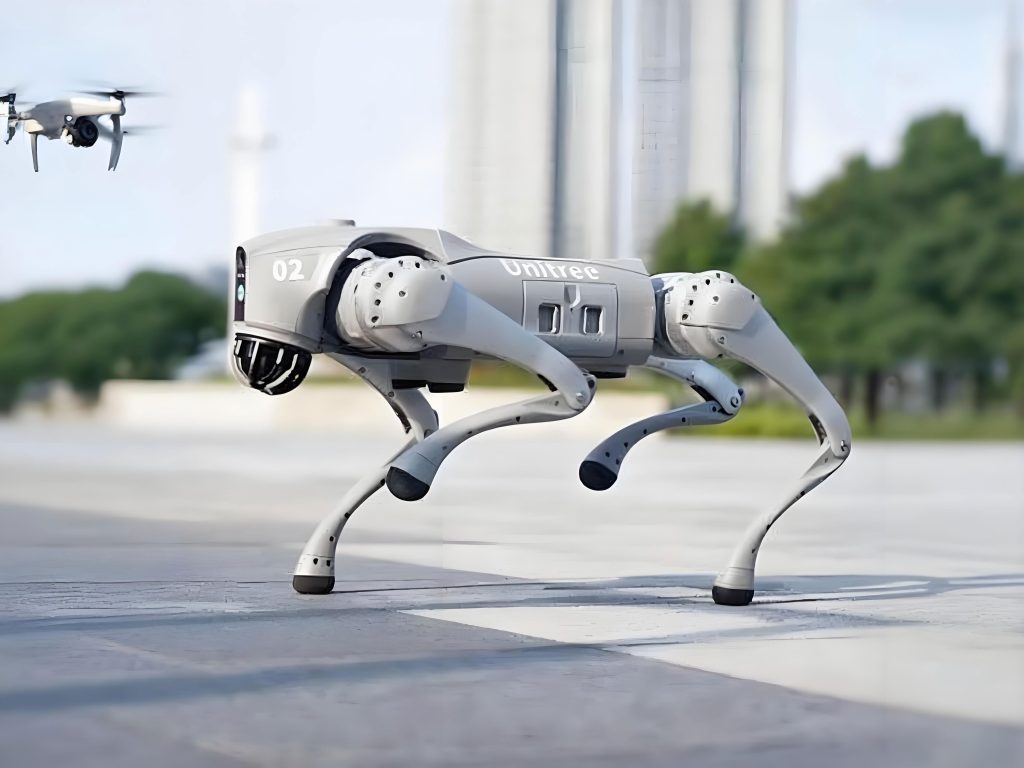
The versatility of bionic robots extends far beyond winter sports. In recent years, quadrupedal bionic robots—often called “robot dogs”—have gained popularity for their agility in rough terrain. These bionic robots are inspired by canine locomotion, offering superior balance and obstacle-crossing capabilities. They have been deployed in security patrols, industrial inspections, and even public entertainment. For instance, during the pandemic, some bionic robots were used to monitor social distancing in parks, demonstrating their utility in public health. The following table compares different types of bionic robots based on their leg configuration and primary applications:
| Leg Configuration | Common Name | Key Advantages | Typical Applications |
|---|---|---|---|
| Hexapod (6 legs) | Skiing/Ice Curling Robot | High stability, load capacity, multi-tasking limbs | Winter sports, rescue operations, research |
| Quadruped (4 legs) | Robot Dog | Agility, energy efficiency, biomimetic gait | Security, inspection, companionship, entertainment |
| Biped (2 legs) | Humanoid Robot | Human-like mobility, tool use in human environments | Service robotics, healthcare, education |
| Octopod (8 legs) | Research Prototype | Redundant stability, complex terrain navigation | Exploration, military, underwater operations |
The control of these bionic robots often involves gait generation algorithms. For a quadruped bionic robot, common gaits include walk, trot, and gallop, each defined by phase relationships between legs. The gait can be modeled using coupled oscillators or central pattern generators (CPGs). For example, the phase \( \phi_i \) of leg \( i \) might follow:
$$ \dot{\phi}_i = \omega + \sum_{j} K_{ij} \sin(\phi_j – \phi_i – \psi_{ij}) $$
where \( \omega \) is the base frequency, \( K_{ij} \) are coupling strengths, and \( \psi_{ij} \) are phase offsets. This equation ensures coordinated movement, essential for stable locomotion. The bionic robot’s ability to switch gaits adaptively based on terrain is a key research area, often leveraging reinforcement learning.
In industrial settings, bionic robots are revolutionizing inspection and maintenance. A quadruped bionic robot can traverse stairs, narrow passages, and uneven floors, carrying sensors to detect anomalies like gas leaks or structural cracks. The economic impact is significant: by automating risky tasks, bionic robots enhance safety and reduce downtime. Moreover, their modular design allows for customization—attaching robotic arms or specialized tools expands their functionality. For instance, a bionic robot equipped with a gripper can manipulate valves or collect samples, blurring the line between mobile platforms and manipulators.
The commercialization of bionic robots is accelerating globally. Numerous startups and tech giants are investing in this domain, driven by advances in actuators, batteries, and AI. Actuators, in particular, are critical for bionic robots; electric, hydraulic, or pneumatic systems must deliver high torque with low weight. The power density \( P_d \) of an actuator, defined as output power per unit mass, is a key metric:
$$ P_d = \frac{\tau \omega}{m_a} $$
where \( \tau \) is torque, \( \omega \) is angular velocity, and \( m_a \) is actuator mass. Improvements in materials and design have boosted \( P_d \), enabling bionic robots to perform dynamic motions like jumping or running. Battery technology also plays a role; energy density \( E_d \) (Wh/kg) determines operational duration. Modern lithium-ion batteries offer \( E_d \approx 250 \) Wh/kg, but researchers are exploring solid-state or fuel cells for longer missions.
Looking ahead, the future of bionic robots is intertwined with societal needs. In healthcare, bionic robots could assist in physical therapy, guiding patients through exercises with precise feedback. In agriculture, they might navigate fields to monitor crop health or apply pesticides selectively. The entertainment industry already uses bionic robots in shows and theme parks, captivating audiences with their lifelike movements. As costs decrease, personal bionic robots might become household companions, helping with chores or providing entertainment. The potential is vast, but challenges remain—such as ensuring safety, ethical use, and public acceptance.
To delve deeper into the technical aspects, let’s consider the perception systems of bionic robots. They typically integrate cameras, LiDAR, IMUs, and force/torque sensors. Sensor fusion algorithms, like Kalman filters, combine data to estimate the bionic robot’s state (position, velocity, orientation). For a bionic robot on snow, estimating slip is crucial; this can be done by comparing wheel/leg odometry with visual odometry. The Kalman filter update equations are:
$$ \hat{x}_{k|k-1} = F_k \hat{x}_{k-1|k-1} + B_k u_k $$
$$ P_{k|k-1} = F_k P_{k-1|k-1} F_k^T + Q_k $$
$$ K_k = P_{k|k-1} H_k^T (H_k P_{k|k-1} H_k^T + R_k)^{-1} $$
$$ \hat{x}_{k|k} = \hat{x}_{k|k-1} + K_k (z_k – H_k \hat{x}_{k|k-1}) $$
$$ P_{k|k} = (I – K_k H_k) P_{k|k-1} $$
where \( \hat{x} \) is the state estimate, \( P \) is error covariance, \( F \) is state transition matrix, \( B \) is control input matrix, \( u \) is control vector, \( Q \) is process noise covariance, \( H \) is observation matrix, \( R \) is measurement noise covariance, \( z \) is measurement vector, and \( K \) is Kalman gain. Implementing such filters in real-time allows the bionic robot to navigate accurately despite sensor noise.
Another exciting area is soft bionic robots, which use compliant materials to mimic biological muscles. These bionic robots offer inherent safety and adaptability, though control is more complex due to nonlinear dynamics. Modeling often involves continuum mechanics, with strain energy functions like the Mooney-Rivlin model for hyperelastic materials:
$$ W = C_{10} (\bar{I}_1 – 3) + C_{01} (\bar{I}_2 – 3) + \frac{1}{D} (J – 1)^2 $$
where \( W \) is strain energy density, \( \bar{I}_1 \) and \( \bar{I}_2 \) are invariants of the deviatoric Cauchy-Green tensor, \( J \) is volume ratio, and \( C_{10}, C_{01}, D \) are material constants. Integrating soft actuators into legged bionic robots could lead to more resilient and energy-efficient designs.
The social impact of bionic robots cannot be overstated. They have the potential to transform labor-intensive industries, but also raise questions about job displacement. Proactive policies, such as reskilling programs, will be essential. Moreover, bionic robots in public spaces must be designed with privacy in mind—for example, cameras should anonymize data. Ethical frameworks for autonomous decision-making, especially in security or medical contexts, are still evolving. As a community, we must guide the development of bionic robots toward beneficial outcomes.
In education, bionic robots serve as excellent tools for teaching STEM concepts. Students can program bionic robots to perform tasks, learning about coding, mechanics, and control theory. Hands-on projects with bionic robots foster creativity and problem-solving skills. Some universities have integrated bionic robot platforms into their curricula, preparing the next generation of engineers. Open-source platforms, like ROS (Robot Operating System), lower barriers to entry, enabling hobbyists and researchers to collaborate.
To summarize the advancements, I have compiled a table of key technological milestones in bionic robotics over the past decade:
| Year | Milestone | Bionic Robot Type | Significance |
|---|---|---|---|
| 2015 | First autonomous skiing demonstration | Hexapod | Proved viability in winter sports |
| 2017 | Commercial quadruped robot released | Quadruped | Made bionic robots accessible for research |
| 2019 | AI-powered gait learning implemented | Quadruped/Hexapod | Enabled adaptive locomotion without manual tuning |
| 2021 | Curling robot with precision throwing | Hexapod | Showcased dexterous manipulation in sports |
| 2022 | Integration of soft actuators | Hybrid (soft-rigid) | Improved safety and energy efficiency |
| 2023 | Swarm coordination of bionic robots | Multiple types | Enabled collaborative tasks in unstructured environments |
The progression highlights how bionic robots are becoming more capable and versatile. Each milestone builds on advances in materials, computing, and algorithms. For instance, the adoption of deep learning has revolutionized perception and control. Convolutional neural networks (CNNs) process visual data to identify terrain types, while recurrent neural networks (RNNs) help in predicting dynamic states. The training process often involves minimizing a loss function \( L \):
$$ L = \frac{1}{N} \sum_{i=1}^{N} (y_i – \hat{y}_i)^2 + \lambda \|\theta\|^2 $$
where \( y_i \) is the ground truth, \( \hat{y}_i \) is the prediction, \( \theta \) represents model parameters, \( \lambda \) is a regularization coefficient, and \( N \) is the number of samples. Such models enable bionic robots to learn from experience, improving performance over time.
In terms of hardware, bionic robots benefit from compact, high-performance computing units like GPUs or TPUs. These processors handle the heavy computation required for real-time AI. Power management is critical; dynamic voltage and frequency scaling (DVFS) can optimize energy use based on workload. The power consumption \( P \) of a computing module might be modeled as:
$$ P = C V^2 f $$
where \( C \) is capacitance, \( V \) is voltage, and \( f \) is frequency. By adjusting \( V \) and \( f \), the bionic robot can extend battery life during low-intensity tasks.
Looking at specific applications, search and rescue is a domain where bionic robots could save lives. In disaster zones, such as collapsed buildings or avalanche sites, bionic robots can navigate debris to locate survivors. Their ability to step over obstacles and carry sensors like thermal cameras makes them invaluable. Researchers are developing bionic robots with amphibious capabilities, allowing them to operate in floods or muddy terrain. The design often involves waterproofing and adaptive buoyancy control.
In agriculture, bionic robots offer a sustainable alternative to heavy machinery. They can tread lightly on soil, reducing compaction, and use computer vision to identify weeds or pests. Precision spraying minimizes chemical usage, benefiting the environment. The economic model for deploying bionic robots on farms includes factors like initial cost, maintenance, and yield improvement. A simple return-on-investment (ROI) calculation might be:
$$ \text{ROI} = \frac{\text{Net Benefits} – \text{Cost}}{\text{Cost}} \times 100\% $$
where Net Benefits include increased crop value and labor savings. As technology matures, ROI is expected to become positive for many farmers.
The entertainment industry is another fertile ground for bionic robots. From robotic pets to animatronic characters in movies, bionic robots captivate audiences. Their ability to express emotions through movement—like wagging a tail or nodding—enhances engagement. Some companies are developing bionic robots for interactive storytelling, where the robot responds to audience actions. This requires natural language processing and gesture recognition, adding layers of complexity.
In healthcare, bionic robots assist with rehabilitation exercises. For patients recovering from strokes or injuries, a bionic robot can guide limbs through prescribed motions, providing resistance or assistance as needed. The control often uses impedance control, where the robot behaves like a spring-damper system:
$$ F = K_p (x_d – x) + K_d (\dot{x}_d – \dot{x}) $$
Here, \( F \) is the force applied by the bionic robot, \( x_d \) and \( \dot{x}_d \) are desired position and velocity, \( x \) and \( \dot{x} \) are actual values, and \( K_p, K_d \) are gain matrices. This allows safe interaction with humans. Additionally, bionic exoskeletons—a form of wearable bionic robot—help individuals with mobility impairments walk again.
The military and defense sectors also explore bionic robots for reconnaissance and logistics. Their stealth and agility make them suitable for covert operations. However, ethical concerns about autonomous weapons necessitate strict governance. Many researchers advocate for international treaties to regulate military bionic robots, ensuring they are used for protective purposes only.
As we peer into the future, the convergence of bionic robots with other technologies like 5G, IoT, and blockchain could unlock new possibilities. 5G enables low-latency remote control, allowing operators to guide bionic robots from afar with high precision. IoT sensors provide environmental data that bionic robots can act upon. Blockchain might secure data exchanges between bionic robots in a swarm, ensuring tamper-proof communication.
In conclusion, the journey of bionic robots from labs to real-world applications is accelerating. Winter sports have served as a dramatic showcase, but the potential spans countless domains. As a researcher, I am excited by the progress and optimistic about the future. Bionic robots are not just machines; they are partners that can enhance human capabilities and address global challenges. With continued innovation and thoughtful integration, bionic robots will undoubtedly become commonplace, enriching our lives in ways we are only beginning to imagine. The repeated emphasis on “bionic robot” throughout this article underscores its centrality in the robotics revolution—a testament to biomimicry’s power in engineering.
To further illustrate the technical depth, consider the optimization of bionic robot gaits using genetic algorithms. These algorithms evolve gait parameters over generations to minimize energy consumption or maximize speed. The fitness function \( f \) for a gait might be:
$$ f = \frac{1}{E} \cdot \frac{S}{T} $$
where \( E \) is energy used, \( S \) is distance traveled, and \( T \) is time taken. Such optimization leads to efficient locomotion patterns tailored to specific terrains. Similarly, bionic robots in swarms use consensus algorithms to coordinate movements. The consensus protocol for position alignment might be:
$$ \dot{p}_i = \sum_{j \in N_i} (p_j – p_i) $$
where \( p_i \) is the position of robot \( i \), and \( N_i \) is its set of neighbors. This ensures the swarm moves cohesively.
In manufacturing, bionic robots collaborate with human workers in shared spaces. Safety standards like ISO/TS 15066 define speed and force limits for collaborative robots. Bionic robots equipped with force-sensitive skins can detect contact and stop immediately, preventing injuries. This human-robot collaboration boosts productivity while maintaining a safe environment.
The materials used in bionic robots also deserve attention. Carbon fiber composites reduce weight without sacrificing strength. Shape memory alloys allow actuators to contract like muscles. Self-healing polymers can repair minor damages, extending the bionic robot’s lifespan. Research into biohybrid bionic robots, which integrate living cells with artificial components, is pushing boundaries further.
Finally, public perception of bionic robots is crucial for adoption. Educational campaigns and transparent demonstrations can alleviate fears. As bionic robots become more relatable—through pet-like designs or helpful behaviors—acceptance grows. The ultimate goal is a symbiotic relationship where bionic robots augment human abilities, creating a brighter future for all. The bionic robot revolution is here, and it promises to reshape our world in profound ways.