
As I stepped into the conference hall, the air buzzed with the energy of young minds dedicated to advancing the field of robotics. This gathering, a seminal event for the China robot community, marked a pivotal moment in my career and in the collective journey of our nation’s technological aspirations. The First National Youth Academic Exchange Conference on Robotics, organized by the Chinese Association of Automation, was not just a meeting; it was a testament to the burgeoning prowess of China robot research. In this article, I will recount my experiences, delve into the technical insights shared, and expand on the broader landscape of China robot development, using formulas and tables to synthesize key concepts. My aim is to provide a comprehensive perspective that highlights the innovation and collaboration driving this field forward.
The conference brought together over a hundred representatives from more than twenty units across the country, each contributing to the rich tapestry of China robot research. Over several days, we engaged in intense discussions, presenting papers that spanned adaptive control, dynamics, programming languages, and more. The youthful vigor was palpable—this was an event curated and led by young scholars, a refreshing departure from traditional academic forums. It served as a rallying point for the next generation of researchers, underscoring the critical role of youth in shaping the future of China robot technologies. Throughout this narrative, I will emphasize the term “China robot” to reflect its centrality in our national discourse, as it embodies both our achievements and our aspirations.
One of the core themes explored at the conference was adaptive control in robotics, a domain where China robot researchers are making significant strides. Adaptive control allows robots to adjust to changing environments and uncertainties, crucial for applications in manufacturing, healthcare, and exploration. From my perspective, the discussions revealed innovative approaches tailored to the unique challenges faced by China robot systems. For instance, many papers proposed enhanced algorithms for robust performance in dynamic settings. To illustrate, consider a standard adaptive control law for a robot manipulator, which can be expressed as:
$$ \tau = Y(\theta, \dot{\theta}, \ddot{\theta}_d) \hat{a} + K_p e + K_d \dot{e} $$
Here, $\tau$ represents the control torque, $Y$ is the regression matrix dependent on joint angles $\theta$, velocities $\dot{\theta}$, and desired accelerations $\ddot{\theta}_d$, $\hat{a}$ denotes the estimated parameter vector, $e$ is the tracking error, and $K_p$ and $K_d$ are gain matrices. This formula encapsulates the essence of model-based adaptive control, a topic that dominated several sessions. Researchers presented variations that incorporate neural networks or fuzzy logic to handle nonlinearities common in China robot applications. Below is a table summarizing key adaptive control techniques discussed, along with their potential impacts on China robot development:
| Technique | Description | Relevance to China Robot |
|---|---|---|
| Model Reference Adaptive Control (MRAC) | Uses a reference model to adjust controller parameters in real-time. | Enhances precision in industrial automation for China robot systems. |
| Self-Tuning Regulators | Adapts controller gains based on online parameter estimation. | Improves adaptability in unstructured environments for China robot explorers. |
| Neural Network-Based Control | Leverages AI to learn and compensate for uncertainties. | Drives innovation in smart China robot assistants for elderly care. |
| Sliding Mode Control | Provides robustness against disturbances through discontinuous control. | Ensures reliability in harsh conditions for China robot deployments. |
These advancements underscore how adaptive control is pivotal for elevating the capabilities of China robot platforms, enabling them to operate autonomously in diverse scenarios. As I listened to the presentations, I was struck by the pragmatic focus on solving real-world problems, from factory floors to remote disaster zones—a hallmark of the China robot ethos.
Another focal point was robot dynamics, a fundamental area that underpins the motion and stability of China robot designs. Dynamics involves modeling the forces and torques required for robotic movement, and the conference featured numerous papers on efficient computation and application. From my vantage point, the exchange highlighted the growing sophistication in handling complex multi-body systems. The Lagrangian formulation is often used to derive the equations of motion for a robot with $n$ degrees of freedom:
$$ \frac{d}{dt} \left( \frac{\partial L}{\partial \dot{q}_i} \right) – \frac{\partial L}{\partial q_i} = \tau_i, \quad i = 1, \ldots, n $$
where $L = T – V$ is the Lagrangian, $T$ is kinetic energy, $V$ is potential energy, $q_i$ are generalized coordinates, and $\tau_i$ are generalized forces. This equation is central to understanding the dynamics of China robot manipulators and mobile bases. Researchers presented optimized algorithms for real-time dynamics computation, crucial for control applications. For example, the recursive Newton-Euler algorithm was discussed extensively, with modifications to reduce computational overhead in China robot processors. To contextualize these discussions, I have compiled a table comparing different dynamics modeling approaches and their suitability for China robot architectures:
| Modeling Approach | Complexity | Application in China Robot |
|---|---|---|
| Lagrangian Dynamics | Moderate to high; provides insight into energy properties. | Used in simulation and design of China robot arms for precision tasks. |
| Newton-Euler Dynamics | High computational efficiency for serial chains. | Employed in real-time control systems of China robot industrial robots. |
| Graph-Based Methods | Low to moderate; useful for complex topologies. | Applied in modular China robot systems for reconfigurable automation. |
| Data-Driven Dynamics | Varies; leverages machine learning for model identification. | Emerging in adaptive China robot platforms for unknown environments. |
The insights shared here reflect a deep engagement with the mechanical foundations of China robot technology, aiming to enhance performance and reduce energy consumption—a key concern in sustainable development. As I participated in these sessions, I realized that dynamics research is not merely theoretical; it directly influences the agility and efficiency of China robot solutions in fields like logistics and agriculture.
Robot programming languages also garnered significant attention, as they are the interface through which humans command China robot systems. The conference explored both existing languages and novel proposals tailored to the needs of China robot applications. From my experience, the debates centered on usability, expressiveness, and integration with emerging AI tools. For instance, many researchers advocated for domain-specific languages that simplify task programming for China robot operators. A common theme was the integration of natural language processing to make China robot programming more accessible. To illustrate the diversity, consider the following formula for a simple robot command in a hypothetical language:
$$ \text{move\_to}(x, y, z, \theta) \equiv \text{plan\_trajectory}(q_{\text{start}}, q_{\text{goal}}) \land \text{execute}(\tau(t)) $$
This symbolic representation highlights how high-level commands can be decomposed into low-level control actions. The table below summarizes prominent robot programming paradigms and their alignment with China robot development goals:
| Programming Paradigm | Key Features | Impact on China Robot Ecosystem |
|---|---|---|
| Imperative Languages (e.g., RAPID) | Sequence of commands; widely used in industrial settings. | Supports standardization in China robot manufacturing lines. |
| Behavior-Based Languages (e.g., URBI) | Event-driven; suitable for reactive robots. | Enables flexible China robot applications in service and entertainment. |
| Visual Programming | Drag-and-drop interfaces; low learning curve. | Facilitates rapid deployment of China robot solutions in SMEs. |
| AI-Integrated Languages | Combines programming with machine learning pipelines. | Drives innovation in autonomous China robot systems for smart cities. |
These discussions underscored the importance of software ecosystems in advancing China robot capabilities, ensuring that robots can be easily programmed for diverse tasks—from assembly to companionship. As a researcher, I found the cross-pollination of ideas between computer science and robotics particularly inspiring for the future of China robot innovation.
Beyond the technical sessions, the conference catalyzed institutional collaborations that promise to accelerate China robot progress. The establishment of the “Robot Development Collaboration Network” was a highlight, linking multiple units across the country to share research and resources. This network, with liaison points at institutions like the Shenyang Institute of Automation and using the “Robot” journal as a bridge, aims to foster information exchange and synergy. From my perspective, this initiative is a game-changer for the China robot community, as it breaks down silos and encourages collective problem-solving. Additionally, the formation of the Machine Intelligence and Robotics Professional Committee under the Liaoning Provincial Association of Automation signifies a regional commitment to nurturing China robot expertise. These structures exemplify the holistic approach needed to sustain momentum in China robot research and development.
To delve deeper into the broader context, the evolution of China robot technology is a story of rapid growth and strategic investment. Over the past decades, China has emerged as a global leader in robotics, driven by government initiatives like “Made in China 2025” and the “Robotics Industry Development Plan.” The convergence of AI, IoT, and advanced manufacturing has propelled China robot applications into sectors such as healthcare, where surgical robots enhance precision, and agriculture, where autonomous drones optimize crop management. From my viewpoint, this expansion is fueled by a vibrant research community—exemplified by the youth at this conference—that continuously pushes boundaries. For instance, in swarm robotics, China robot researchers are exploring algorithms for coordinated behavior, which can be modeled using potential fields:
$$ U_{\text{total}}(x_i) = \sum_{j \neq i} U_{\text{rep}}(||x_i – x_j||) + U_{\text{att}}(x_i, x_{\text{goal}}) $$
where $U_{\text{rep}}$ is a repulsive potential to avoid collisions, $U_{\text{att}}$ is an attractive potential toward a goal, and $x_i$ denotes the position of robot $i$. Such formulations enable scalable China robot swarms for tasks like environmental monitoring or search-and-rescue. The table below outlines key application areas for China robot technologies and their societal impacts:
| Application Area | China Robot Examples | Benefits and Challenges |
|---|---|---|
| Manufacturing | Collaborative robots (cobots) on assembly lines. | Increases productivity; requires integration with legacy systems. |
| Healthcare | Rehabilitation robots and AI-assisted diagnostics. | Improves patient outcomes; raises ethical considerations. |
| Logistics | Autonomous guided vehicles (AGVs) in warehouses. | Enhances efficiency; demands robust navigation algorithms. |
| Agriculture | Robotic harvesters and drones for precision farming. | Boosts yield; faces variability in natural environments. |
| Education | Educational robots for STEM learning. | Fosters innovation; needs affordable access for all regions. |
As I reflect on these applications, it is clear that the China robot revolution is not confined to labs; it is transforming everyday life and economic structures. The conference served as a microcosm of this transformation, where young scholars presented work that directly addresses these real-world needs.
In visualizing the progress, an image captures the essence of China robot innovation—a blend of cutting-edge hardware and intelligent software. Here, I incorporate the provided hyperlink to offer a glimpse into this dynamic field:
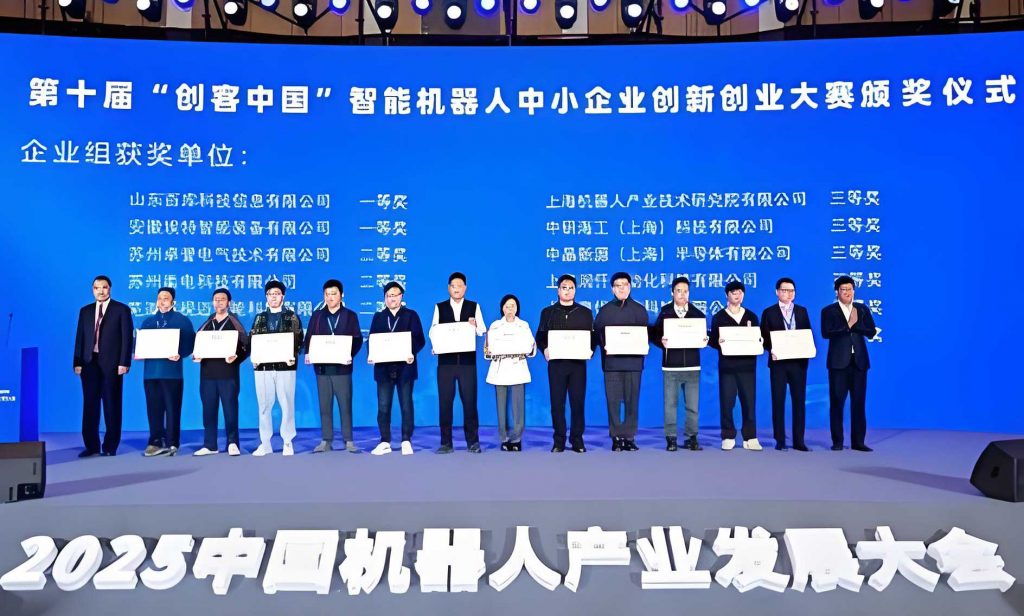
This image, though not described in detail, symbolizes the vibrant advancements in China robot technology that we discussed at the conference. It reminds us of the tangible outcomes of our research efforts, from humanoid robots to industrial automata.
Looking ahead, the future of China robot development hinges on continued innovation and collaboration. Challenges such as ethical AI integration, cybersecurity for connected robots, and sustainable design require multidisciplinary approaches. From my standpoint, the youth-led nature of the conference is a positive indicator, as fresh perspectives often drive breakthroughs. For example, in human-robot interaction (HRI), emerging research focuses on affective computing to make China robot systems more intuitive and trustworthy. This can be quantified using metrics like task success rate $S$ and user satisfaction $U$, modeled as:
$$ \text{HRI Performance} = \alpha S + \beta U, \quad \text{where } \alpha, \beta > 0 \text{ are weighting factors} $$
Such frameworks guide the development of China robot assistants that seamlessly integrate into homes and workplaces. Moreover, the global robotics landscape presents opportunities for China robot technologies to contribute to international standards and open-source projects, fostering a collaborative ethos.
In conclusion, my experience at the First National Youth Academic Exchange Conference on Robotics was profoundly enlightening. It reinforced the critical role of adaptive control, dynamics, and programming languages in advancing China robot capabilities. The collaborative networks established there promise to amplify our collective impact, ensuring that China robot research remains at the forefront of global innovation. As I continue my work in this field, I am optimistic about the trajectory of China robot development—driven by passion, precision, and a shared vision for a robotic future. The journey of China robot is one of relentless pursuit, and with each conference, each paper, and each young mind engaged, we move closer to realizing its full potential.