
As I reflect on the technological landscape of 2025, one development stands out with profound clarity: the relentless and sophisticated ascent of China robot technology. The spectacle of sixteen humanoid machines dancing in perfect synchrony with humans during a televised festival was not merely entertainment; it was a declaration of capability, a showcase of precision engineering and artificial intelligence converging to create entities that blur the line between tool and teammate. This moment symbolizes a broader, systemic shift. I have observed how China robot initiatives are transitioning from ambitious prototypes to functional assets in factories, warehouses, and even homes, driven by a unique combination of state orchestration, manufacturing prowess, and iterative learning. The journey of the China robot is no longer confined to laboratories; it is stepping decisively into the global arena, promising to reshape industries and redefine human-machine collaboration.
The foundational strength of the China robot ecosystem lies in its deeply integrated supply chain and cost-competitive manufacturing. Unlike many Western counterparts who may specialize in either hardware or software, Chinese firms have cultivated vertical integration, controlling a significant portion of the core components essential for humanoid robotics. This control spans from high-precision actuators and harmonic drives to the rare-earth magnets crucial for efficient motors. This domestic mastery translates directly into cost advantages and scaling potential. For instance, while a advanced humanoid robot from a leading U.S. firm can cost over $200,000, comparable China robot models are brought to market at a fraction of that price, sometimes even below $10,000. This disparity is not accidental but engineered through policy and industrial clustering. The government’s “Robot+” Application Action Plan and targeted investments have created fertile grounds for innovation and production, inviting both domestic and foreign capital into what is anticipated to be the world’s largest robotics market.
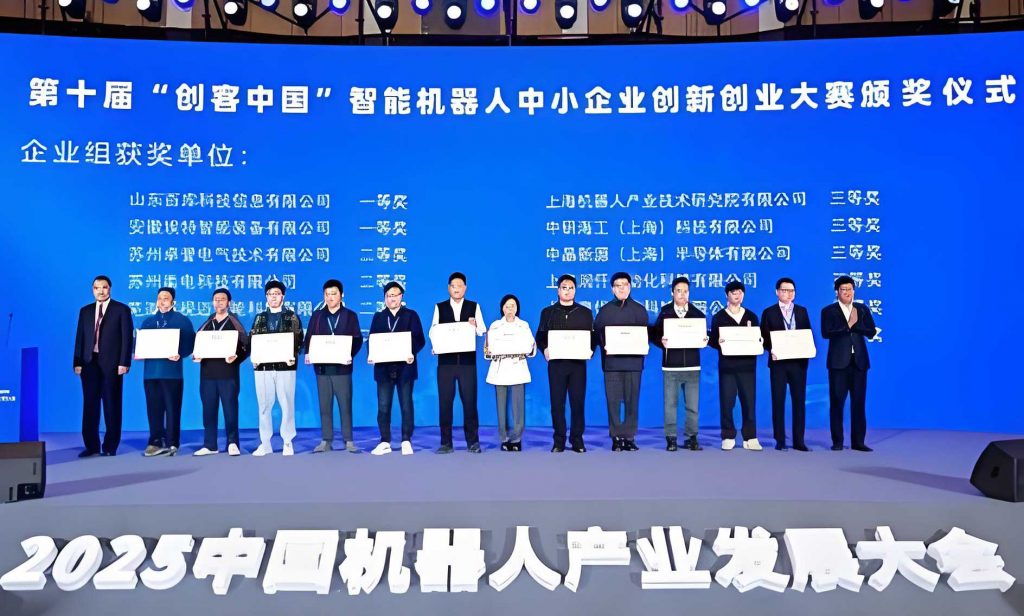
To quantify the mechanical dexterity that enables a China robot to perform complex tasks like dancing or object manipulation, we must consider kinematics. The motion of a robotic limb is governed by its degrees of freedom (DOF). The forward kinematics for a serial manipulator, common in a China robot arm, defines the position and orientation of its end-effector based on joint parameters. For a simple 3-DOF arm, the position $\mathbf{p}$ in 3D space can be modeled as:
$$
\mathbf{p} = \begin{bmatrix}
l_1 \cos(\theta_1) + l_2 \cos(\theta_1+\theta_2) + l_3 \cos(\theta_1+\theta_2+\theta_3) \\
l_1 \sin(\theta_1) + l_2 \sin(\theta_1+\theta_2) + l_3 \sin(\theta_1+\theta_2+\theta_3) \\
0
\end{bmatrix}
$$
where $l_i$ are link lengths and $\theta_i$ are joint angles. Modern China robot designs, however, incorporate over 40 DOF system-wide, requiring far more complex models for whole-body coordination and balance, often solved in real-time using optimized trajectory planning algorithms.
The iterative, task-oriented development philosophy behind many China robot projects is key to their rapid maturation. Rather than aiming for a singular, general-purpose superstar from the outset, the approach involves deploying robots in controlled, real-world scenarios—from dance performances and sports to specific factory tasks. This generates continuous streams of operational data, feeding back into system improvement cycles. The control systems for a China robot often rely on hierarchical architectures. A common formulation for low-level joint control is the Proportional-Integral-Derivative (PID) controller, which computes the control signal $u(t)$:
$$
u(t) = K_p e(t) + K_i \int_{0}^{t} e(\tau) \,d\tau + K_d \frac{de(t)}{dt}
$$
where $e(t)$ is the error between desired and actual joint state, and $K_p$, $K_i$, $K_d$ are tuning gains. For a China robot navigating uneven terrain, a higher-level gait controller modulates these desired states using terrain-agnostic algorithms to maintain stability, a feature vividly demonstrated during dynamic performances.
The hardware landscape of the China robot sector is diverse and rapidly evolving. The following table summarizes key specifications of some prominent humanoid China robot models, illustrating the range of capabilities and price points that define the market’s accessibility.
| Model | Approx. Height (cm) | Key Hardware Features | Degrees of Freedom (DOF) | Approx. Price (USD) | Primary Deployment Focus |
|---|---|---|---|---|---|
| H1 | ~180 | High-torque actuators, full-body force sensors | 40+ | 90,000 | Advanced research, complex task demonstration |
| G1 | 127 | Tendon-driven hands, depth-sensing cameras, long-life battery | Not publicly specified (est. 30+) | 13,600 | Logistics, parcel delivery, light industrial tasks |
| R1 | 121 | Cost-optimized actuators, open software stack | Not publicly specified (est. 20+) | 5,900 | Education, software development, early-stage research |
| Iron (XPENG) | Not specified | Proprietary AI chip (3000 TOPS), 60+ joint modules | 200+ (system-wide) | Not commercialized | Autonomous vehicle technology transfer, navigation |
| GoMate (GAC) | Not specified | Multimodal perception sensors, EV-grade battery | Not specified | Not commercialized | Automotive wire harnessing, human-robot interaction |
Parallel to hardware advances, the “brain” of the China robot is undergoing a revolution fueled by artificial intelligence. Chinese innovation centers are developing foundation models that enable multimodal perception—fusing data from cameras, LiDAR, and tactile sensors—and complex reasoning. The learning process for a China robot often involves imitation learning and reinforcement learning (RL). In RL, the robot, as an agent, learns a policy $\pi(a|s)$ to maximize its expected cumulative reward $R$:
$$
R = \mathbb{E}\left[ \sum_{t=0}^{T} \gamma^t r(s_t, a_t) \right]
$$
where $s_t$ is the state, $a_t$ the action at time $t$, $r$ is the immediate reward, and $\gamma$ is a discount factor. Training such models requires massive datasets. Chinese companies and research institutes are generating these datasets both from real-world deployments and sophisticated simulation environments. The AI systems empower a China robot to understand natural language commands, plan multi-step tasks like “pick up the tool and assemble the component,” and adapt to minor environmental changes autonomously.
When contrasting the China robot trajectory with the Western approach, particularly from the United States, distinct strategic emphases emerge. The U.S. approach has demonstrated profound strength in software, simulation, and foundational AI models. For example, the development of large-scale physics engines and generative AI models for creating synthetic training data represents a significant software-centric advantage. The simulation of dynamics for a robot and its environment can be described by complex differential equations. The Newton-Euler formulation for a rigid body’s motion, crucial for accurate simulation, is given by:
$$
\begin{aligned}
\mathbf{F} &= m\mathbf{a} \\
\boldsymbol{\tau} &= I\boldsymbol{\alpha} + \boldsymbol{\omega} \times (I\boldsymbol{\omega})
\end{aligned}
$$
where $\mathbf{F}$ is force, $m$ is mass, $\mathbf{a}$ is linear acceleration, $\boldsymbol{\tau}$ is torque, $I$ is the inertia tensor, $\boldsymbol{\alpha}$ is angular acceleration, and $\boldsymbol{\omega}$ is angular velocity. U.S. firms have excelled in creating high-fidelity, real-time simulators that solve these equations for vast arrays of objects, accelerating algorithm training without physical wear and tear. However, the China robot strategy complements its hardware iteration with a focused push on applied AI, aiming for “good enough” intelligence that works reliably in specific, valuable contexts like manufacturing and logistics. The integration race is on, and the ultimate leader in the humanoid robot domain may well be determined by who most effectively merges world-class hardware with adaptable, powerful AI.
The economic and societal drivers for the China robot surge are multifaceted. An aging population and rising labor costs create a powerful demand for automation across sectors. The potential applications for a versatile China robot are vast, as outlined in the table below, which maps domains to specific robotic capabilities and value propositions.
| Industry/Sector | Exemplar Tasks for China Robot | Required Capabilities | Current Adoption Stage in China |
|---|---|---|---|
| Manufacturing & EV Assembly | Parts handling, screw driving, wire harnessing, quality inspection | Precise manipulation, force control, visual inspection AI | Pilot testing and early integration in major EV plants |
| Logistics & E-commerce Fulfillment | Parcel sorting, palletizing, last-meter delivery to doorstep | Mobile navigation in complex spaces, grasp planning for varied objects | Active pilot programs with major logistics firms |
| Healthcare & Elder Care | Patient monitoring, fetching items, providing mobility support | Safe human-robot interaction, gentle manipulation, voice interaction | Early R&D and demonstration projects |
| Retail & Hospitality | Customer guidance, inventory checks, concierge services | Natural language processing, person recognition, polite navigation | Demonstrations at high-profile events and select venues |
| Emergency Response | Search and rescue in hazardous environments, initial damage assessment | Robust locomotion in unstructured terrain, sensor fusion for low visibility | Research and prototype development phase |
The scale of ambition is reflected in market projections. Analysts forecast the global humanoid robot market to grow exponentially in the coming decades. The growth trajectory can be modeled using a compound annual growth rate (CAGR) formula:
$$
FV = PV \times (1 + r)^n
$$
where $FV$ is the future market value, $PV$ is the present value, $r$ is the annual growth rate, and $n$ is the number of years. With estimates suggesting a potential market size in the trillions of dollars by 2050, the CAGR for the China robot segment is anticipated to significantly outpace the global average for robotics, fueled by domestic policy and adoption. China’s current density of industrial robots per 10,000 workers has seen a meteoric rise, a trend that is now extending to more advanced, general-purpose humanoid forms.
A critical technical challenge for any humanoid robot, including a China robot, is maintaining dynamic balance while in motion. The Zero Moment Point (ZMP) criterion is a fundamental principle used in gait planning for bipedal robots. The ZMP is the point on the ground where the net moment of the inertial forces and gravity forces has no horizontal component. For stable walking, the ZMP must remain within the support polygon defined by the robot’s foot/feet. The position of the ZMP, $\mathbf{p}_{zmp}$, can be derived from the robot’s dynamics:
$$
\mathbf{p}_{zmp} = \frac{\sum_{i} m_i (\mathbf{r}_i \times (\mathbf{g} – \ddot{\mathbf{r}}_i))_h}{\sum_{i} m_i (g_z – \ddot{z}_i)}
$$
where $m_i$ is the mass of link $i$, $\mathbf{r}_i$ is its position, $\mathbf{g}$ is gravity, $\ddot{\mathbf{r}}_i$ is its acceleration, and $_h$ denotes the horizontal components. The real-time calculation and control of ZMP is a testament to the advanced motion planning embedded in the latest China robot platforms, allowing them to perform dynamic dances and navigate slopes.
Looking forward, the evolution of the China robot will be inextricably linked to progress in embodied AI. The concept of a robot learning a world model—an internal representation of how its actions affect the environment—is paramount. This can be framed as learning a transition probability $P(s_{t+1} | s_t, a_t)$. Optimizing a policy within this model is a cornerstone of making robots more autonomous. The China robot ecosystem’s strength in generating real-world interaction data provides a potentially decisive advantage for training such models, moving beyond purely simulation-based training which can suffer from the “reality gap.”
In conclusion, the ascent of the China robot is a multifaceted phenomenon built on a foundation of strategic policy, manufacturing excellence, and pragmatic, iterative development. From dazzling cultural showcases to gritty industrial pilots, these machines are proving their mettle. The integration of sophisticated hardware with increasingly capable AI is happening at a remarkable pace and scale within China. While global competition in software and simulation remains fierce, the holistic, system-level approach characterizing the China robot development model presents a formidable pathway to commercialization and widespread adoption. The coming years will likely see the China robot transition from a remarkable technological achievement to an indispensable economic actor, reshaping workflows and redefining what is possible in automation on a global stage. The dance has begun, and its next steps will echo far beyond the stage.