
In my perspective, the global industrial landscape is undergoing a profound transformation driven by artificial intelligence, particularly through the emergence of embodied AI robots. As nations like China push forward with strategic initiatives such as the “AI+” action, which aims to integrate AI across all industries, the focus has shifted toward making AI operational at scale and commercially viable. This movement echoes the earlier “Internet+” campaign but with a deeper emphasis on physical-world applications. The core of this evolution lies in embodied AI robots, which combine cognitive intelligence with physical execution to revolutionize manufacturing and beyond. I believe that embodied AI robots are not just incremental improvements but represent a paradigm shift in how we conceive automation and autonomy.
To understand this shift, we must first define key concepts. Embodied AI, or embodied artificial intelligence, refers to intelligent systems that possess a physical form and interact with the environment through sensors and actuators to perceive, decide, and act. These systems learn from interactions, adapting to complex tasks dynamically. In parallel, AI Agents—autonomous entities that perceive environments, make decisions, and take actions to achieve goals—serve as the “brains” for such systems. The synergy between AI Agents and embodied AI is crucial: AI Agents provide high-level cognition, while embodied AI offers a physical interface to the real world. Thus, an embodied AI robot is essentially a robot empowered by an AI Agent, enabling it to operate with greater flexibility and autonomy. This fusion is accelerating, and I see it as the cornerstone of next-generation智能制造.
The development of embodied AI robots hinges on a “brain-body-environment” triad. The brain, often powered by large language models (LLMs) or specialized AI models, handles decision-making and intent understanding. The body, comprising sensors like cameras and lidar, and actuators like robotic arms or wheels, facilitates physical interaction. The environment provides dynamic feedback for learning. This闭环 can be modeled as a reinforcement learning process: $$Q(s,a) = \mathbb{E}\left[ R_{t+1} + \gamma \max_{a’} Q(s’,a’) \mid S_t = s, A_t = a \right]$$ where \(Q(s,a)\) represents the expected cumulative reward for taking action \(a\) in state \(s\), guiding the embodied AI robot to optimize its behavior over time. Such mathematical frameworks underpin the adaptive capabilities of embodied AI robots, allowing them to learn from experience and improve task performance.
In manufacturing, the capabilities of embodied AI robots can be stratified into hierarchical levels, each building on the previous to enable more complex intelligence. The following table summarizes these levels, illustrating how embodied AI robots evolve from individual machines to integrated supply chains.
| Manufacturing Unit | Core Capability Description |
|---|---|
| Machine | A single device with closed-loop abilities in perception, memory, cognition, decision-making, planning, control, and evolution. |
| Production Line | Multiple machines协同工作, enabling holistic perception, reasoning, planning, and control of workflows. |
| Factory | Multiple lines interconnected for resource optimization, production scheduling, and flexible response at the plant level. |
| Supply Chain | Cross-factory collaboration for demand forecasting, resource allocation, and adaptive production across networks. |
This progression highlights how embodied AI robots can scale autonomy, transforming isolated operations into interconnected, self-optimizing systems. For instance, at the machine level, an embodied AI robot like an AI-powered sewing machine can autonomously adjust stitches based on fabric detection, while at the factory level, swarms of embodied AI robots coordinate to reconfigure production lines in real-time.
The physical载体 for embodied AI is predominantly robots, ranging from fixed-base manipulators to humanoid forms. Among these, humanoid robots stand out as ideal platforms for embodied AI robots due to their versatility and human-like interaction potential. They integrate advanced AI “brains” for cognition and “小脑” for motion control, enabling tasks like walking, grasping, and tool use. The ecosystem for developing embodied AI robots involves various enterprises focusing on AI systems and dataset建设, as shown in the table below, which generalizes key players without naming specifics.
| Focus Area | AI System Features | Dataset Strategies |
|---|---|---|
| Advanced Cognition | Integration of multimodal LLMs for task planning and natural language understanding; emphasis on perception-decision-control unity. | Utilization of real-world factory datasets and simulation platforms like Isaac Sim for training; some open-source initiatives. |
| Motion Control | Proprietary algorithms for balance, locomotion, and dexterous manipulation; reinforcement and imitation learning for skill acquisition. | Collection via action capture and deployment in scenarios like smart homes or industrial settings; emphasis on高质量 trajectories. |
| Hardware Adaptation | Design of仿生 limbs and灵巧 hands; focus on轻量化 and durability for diverse environments. | Data from physical tests and digital twins to refine kinematic and dynamic models. |
These efforts are propelling embodied AI robots toward greater autonomy. For example, in apparel manufacturing, embodied AI robots can handle tasks from fabric cutting to sewing, as illustrated by systems that use vision sensors and机械臂 to fold garments autonomously. The integration of AI Agents allows these embodied AI robots to parse client需求 into production commands, enabling zero-intervention modes. I envision that embodied AI robots will become ubiquitous partners in factories, reducing reliance on human labor for repetitive or hazardous tasks.
To achieve high-autonomy smart manufacturing plants, embodied AI robots must be deployed strategically. The vision involves factories where AI manages processes in real-time, digital twins simulate decisions, and embodied AI robots execute adjustments without human intervention. This aligns with reports predicting超自动化 factories by 2040, where embodied AI robots, AGVs, and AMRs form self-optimizing ecosystems. In my view, building such factories requires phased efforts: starting with AI-driven production lines, scaling to autonomous workshops, and eventually creating fully adaptive supply chains. A critical step is deploying embodied AI robots in缝制 systems, where they can oversee operations with minimal supervision, as depicted in the concept of a high-autonomy sewing车间.
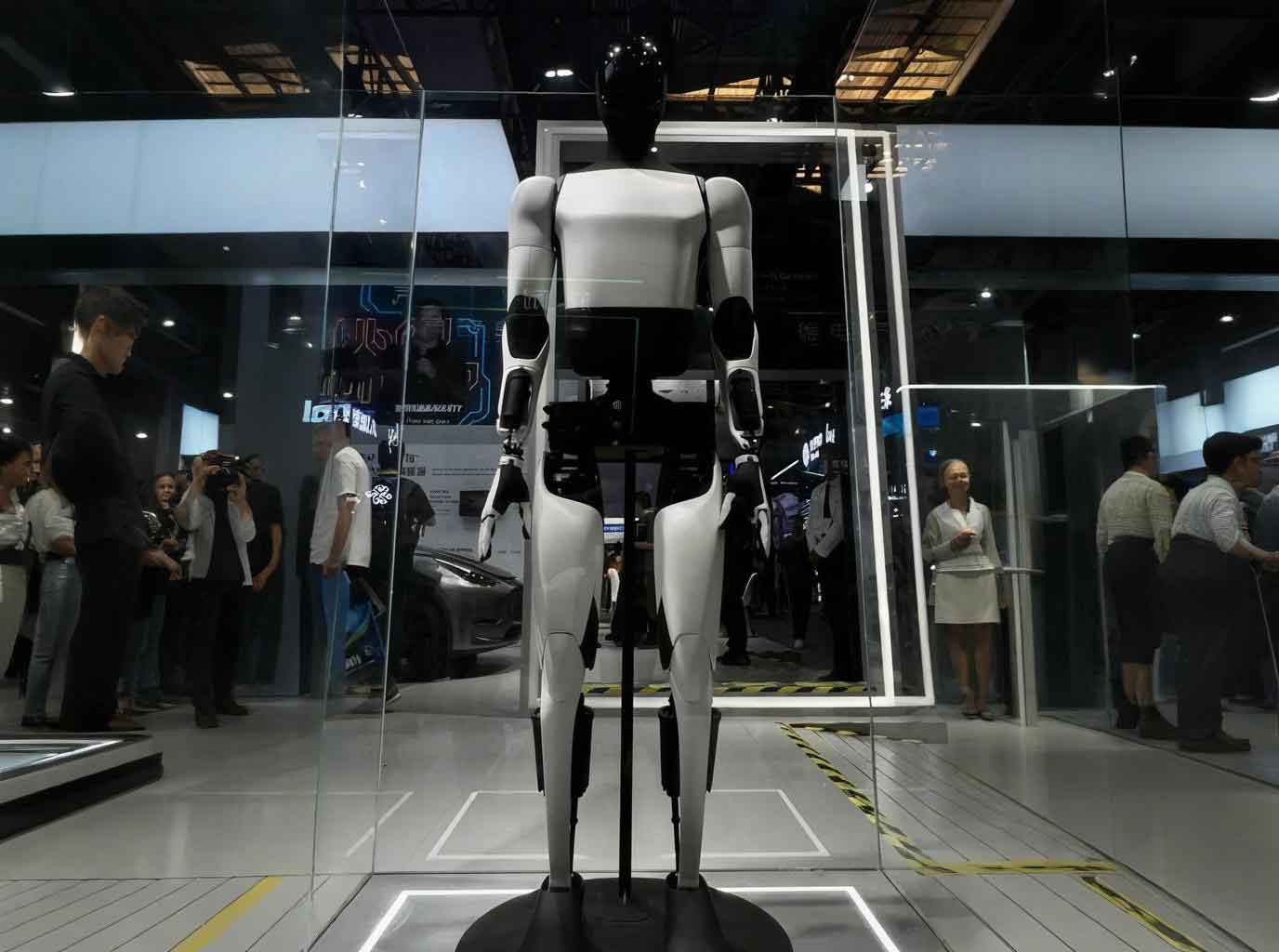
The above image symbolizes the integration of embodied AI robots in industrial settings, showcasing their potential to blend into dynamic environments. In practice, the autonomy of an embodied AI robot can be quantified through metrics like the autonomy index \(A\), defined as: $$A = \frac{T_a}{T_t} \times 100\%$$ where \(T_a\) is the time the embodied AI robot operates without human input, and \(T_t\) is the total task time. As AI models improve, \(A\) approaches 100%, enabling truly high-autonomy systems. Moreover, the economic impact of embodied AI robots is substantial; projections suggest they could generate trillions in value by 2030 through efficiency gains in production, design, and maintenance.
AI Agents play a pivotal role in this ecosystem. Their applications span various scenarios, with embodied AI robots serving as physical executors. The table below outlines primary application areas and their relative emphasis, reflecting how embodied AI robots are deployed.
| Scenario | Application Emphasis | Core Functions and Value |
|---|---|---|
| Production Manufacturing | High (around 44%) | Intelligent scheduling, process optimization, real-time quality monitoring, enabling flexible manufacturing and efficiency boosts. |
| R&D and Design | Moderate (around 32%) | AI-assisted concept generation, automated modeling, design validation, reducing cycle times and trial costs. |
| Operations Maintenance | Significant (around 25%) | Predictive equipment maintenance, fault diagnosis, dynamic optimization of运维 strategies. |
| Supply Chain Management | Notable (around 19%) | Smart demand forecasting, inventory optimization, logistics coordination, enhancing resilience and synergy. |
| Other Scenarios | Minor (around 2%) | Includes energy management, carbon footprint tracking, etc. |
For embodied AI robots, these scenarios translate into tangible tasks. In production, an embodied AI robot might use sensor fusion to inspect products, with decision models based on Bayesian inference: $$P(\text{defect} \mid \text{data}) = \frac{P(\text{data} \mid \text{defect}) P(\text{defect})}{P(\text{data})}$$ allowing real-time quality control. Similarly, in supply chains, embodied AI robots orchestrate logistics through optimization algorithms like linear programming: $$\min \sum c_i x_i \text{ subject to } A x \leq b, x \geq 0$$ where \(x_i\) represents resource allocations by embodied AI robots. This mathematical rigor ensures that embodied AI robots operate efficiently at scale.
Looking ahead, the trajectory for embodied AI robots is set toward deeper integration with AI Agents and broader societal adoption. I anticipate that by 2030, embodied AI robots will achieve普及率 exceeding 90% in smart terminals, becoming growth engines for智能经济. The path to fully智能 societies by 2035 will rely on embodied AI robots performing tasks humans avoid or cannot do, from delicate assembly to emergency response. However, challenges remain, such as ensuring safety, ethics, and seamless human-robot collaboration. Innovations like “large model一体机”—integrated AI systems that simplify deployment—will accelerate this by providing robust infrastructure for embodied AI robots.
In conclusion, embodied AI robots represent a transformative force in manufacturing and beyond. Through the fusion of AI Agents and physical embodiment, they enable high-autonomy factories that self-optimize and adapt. As an observer, I stress the need for continuous upskilling of workers to collaborate with embodied AI robots, alongside investments in digital twins and modular architectures. The future will see embodied AI robots blurring the lines between digital and physical realms, ultimately redefining productivity and human-machine interaction. With each advancement, embodied AI robots move us closer to a world where intelligence is not just computed but embodied in every action.