
As a key participant in the groundbreaking integration of humanoid robots into the realm of dance, I have witnessed firsthand how this fusion is redefining artistic expression. At the recent inaugural World Humanoid Robot Games in August 2025, our team embarked on an ambitious journey to merge cutting-edge technology with deep cultural heritage, showcasing performances that not only captivated global audiences but also earned top honors. This endeavor represents more than a technical feat; it is a profound dialogue between science and art, where humanoid robots become vessels for millennia-old traditions. In this article, I will delve into the technical breakthroughs, creative paradigms, cultural transformations, and future visions that are shaping this new era, all from a first-person perspective. Through detailed analyses, tables, and formulas, I aim to illuminate how humanoid robots are pushing the boundaries of dance aesthetics and enabling innovative forms of cultural preservation.
The core of our work lies in the seamless collaboration between human creativity and robotic precision. We began by exploring how humanoid robots could replicate and enhance traditional dance forms, such as the majestic Qin Terra-cotta Warriors-inspired piece and the dynamic Yingge Dance. These performances demonstrated that humanoid robots are not mere imitators but active contributors to artistic evolution. The humanoid robot, with its programmable motion and unwavering accuracy, allows choreographers to envision movements beyond human physical limits. For instance, in the group dance featuring nine humanoid robots embodying terra-cotta warriors, we achieved millimeter-level synchronization errors during dynamic formations, a feat impossible for human dancers. This was made possible through advanced swarm control algorithms, which I will explain in detail later. The humanoid robot’s ability to perform flips and acrobatics with hydraulic drive systems further expanded our choreographic vocabulary, creating a “反重力” (anti-gravity) effect that defies traditional biomechanics.
To quantify these advancements, let me summarize key technical parameters in Table 1, which highlights the capabilities of humanoid robots in dance performances. This table compares human dancers and humanoid robots across various metrics, emphasizing the unique advantages brought by robotic technology.
| Metric | Human Dancers | Humanoid Robots |
|---|---|---|
| Synchronization Error in Group Formations | Approximately 5-10 cm due to human variability | Less than 1 mm with swarm control algorithms |
| Motion Control Parameters for Complex Routines | Learned intuitively through practice | Over 2000 parameters derived via reinforcement learning |
| Ability to Perform High-Risk Acrobatics | Limited by physical endurance and safety | Enabled by customized hydraulic systems (e.g., front flips) |
| Cultural Expression Through Facial Features | Natural emotional conveyance | Dynamic LED matrices for programmable “living mask” expressions |
| Training Time for Precision Movements | Years of dedicated practice | Minutes to hours via algorithm optimization |
The technological backbone of these performances revolves around sophisticated algorithms and hardware systems. For the swarm dance, we developed a distributed control system that mimics a military hierarchy, with a “general” humanoid robot directing “soldier” units. This approach minimized communication delays and ensured cohesive group movements. The synchronization error, denoted as \( \epsilon \), is governed by the formula for multi-agent coordination: $$ \epsilon = \frac{1}{N} \sum_{i=1}^{N} \| \mathbf{p}_i(t) – \mathbf{p}_{\text{desired},i}(t) \| $$ where \( N \) is the number of humanoid robots (e.g., 9), \( \mathbf{p}_i(t) \) is the actual position of robot \( i \) at time \( t \), and \( \mathbf{p}_{\text{desired},i}(t) \) is the desired position from the choreography. By applying reinforcement learning, we reduced \( \epsilon \) to under 1 mm, enabling flawless formations. The humanoid robot’s motion planning relies on inverse kinematics and dynamics models, expressed as: $$ \tau = M(q)\ddot{q} + C(q, \dot{q})\dot{q} + g(q) $$ where \( \tau \) represents the joint torques, \( M(q) \) is the inertia matrix, \( C(q, \dot{q}) \) accounts for Coriolis and centrifugal forces, \( g(q) \) is the gravitational vector, and \( q \) denotes joint angles. This allows each humanoid robot to execute precise trajectories, such as those required for the Yingge Dance’s 108槌法 (hammer techniques), which we decomposed into 2000+ control parameters.
In terms of hardware, the humanoid robot used for solo performances featured a custom hydraulic drive system that enabled acrobatic maneuvers like front flips. The power output \( P \) for such movements can be modeled as: $$ P = \frac{\Delta E}{\Delta t} = \frac{m g h + \frac{1}{2} I \omega^2}{\Delta t} $$ where \( m \) is the mass of the humanoid robot, \( g \) is gravitational acceleration, \( h \) is the height gained during the flip, \( I \) is the moment of inertia, \( \omega \) is angular velocity, and \( \Delta t \) is the time duration. This system surpasses human capabilities, allowing the humanoid robot to achieve “特技” (stunts) with consistent reliability. Moreover, the integration of LED facial matrices allowed for expressive “活槌脸” (living mask) displays, programmable to reflect cultural archetypes like Li Kui or Guan Sheng from Yingge folklore. The humanoid robot thus becomes a digital canvas for cultural symbols, bridging tradition and innovation.
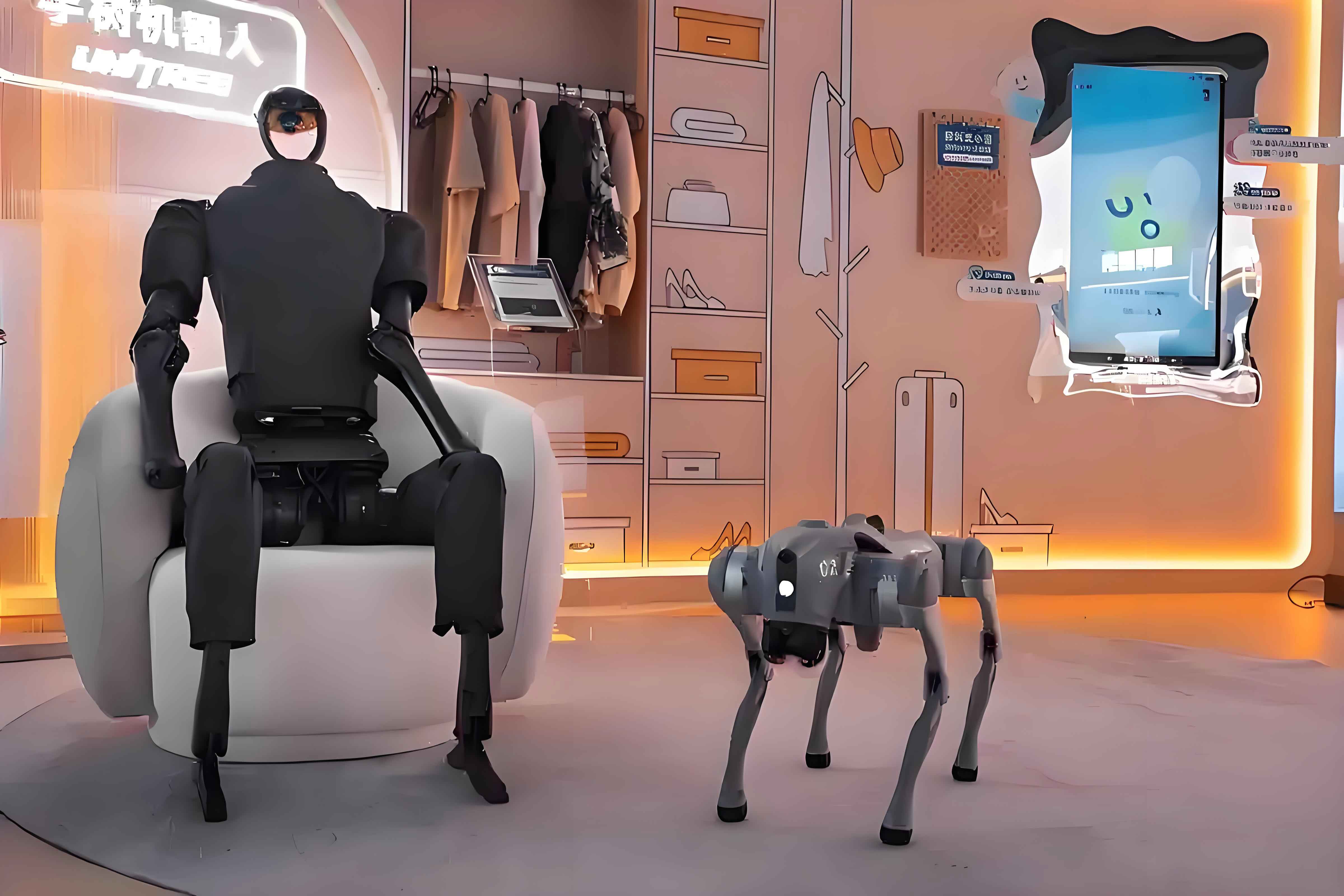
The creative process itself evolved into a bidirectional learning paradigm. As a choreographer, I wore motion capture suits to experience the kinematic constraints of humanoid robots, which in turn simplified my design logic for human movements. Meanwhile, engineers developed a “dance optimization model” that automatically adjusted center-of-mass trajectories based on inputs from seasoned dancers. This model, rooted in control theory, can be represented as: $$ \min_{\mathbf{u}(t)} \int_{0}^{T} \left( \| \mathbf{x}(t) – \mathbf{x}_{\text{ref}}(t) \|^2 + \lambda \| \mathbf{u}(t) \|^2 \right) dt $$ subject to $$ \dot{\mathbf{x}}(t) = f(\mathbf{x}(t), \mathbf{u}(t)) $$ where \( \mathbf{x}(t) \) is the state vector (e.g., position, velocity of the humanoid robot), \( \mathbf{x}_{\text{ref}}(t) \) is the reference trajectory from human dance, \( \mathbf{u}(t) \) is the control input, \( \lambda \) is a regularization parameter, and \( f \) encapsulates the dynamics. This collaboration highlights how humanoid robots and humans co-evolve: humans provide cultural aesthetics and emotional depth, while humanoid robots contribute computational precision and novel motion possibilities. The data闭环 (closed-loop) between us ensures continuous improvement, fostering a new ecosystem for artistic creation.
Cultural preservation through digital means is another cornerstone of our work. We translated intangible cultural heritage, like the Yingge Dance, into quantifiable metrics that humanoid robots can interpret. For example, we defined “impact index” \( I \) and “rhythm density” \( R \) to capture the dance’s “力与美” (power and beauty): $$ I = \frac{1}{T} \int_{0}^{T} |a(t)| dt $$ where \( a(t) \) is the acceleration profile of the humanoid robot’s movements, and $$ R = \frac{N_{\text{beats}}}{\Delta t} $$ where \( N_{\text{beats}} \) is the number of rhythmic accents in time interval \( \Delta t \). Using machine learning, we trained an AI system to generate dance variations based on these indices, creating a scalable cultural algorithm library. This approach is summarized in Table 2, which outlines the digital translation process for cultural elements, emphasizing the role of humanoid robots in safeguarding heritage.
| Cultural Element | Traditional Form | Digital Translation via Humanoid Robot | Quantitative Metrics |
|---|---|---|---|
| Yingge Dance Movements | 108槌法 (hammer techniques) passed down orally | Decomposed into 2000+ motion control parameters for programming | Impact index \( I \), rhythm density \( R \) |
| Qin Terra-cotta Aesthetics | Historical textures and postures from artifacts | 3D-scanned textures replicated in composite materials for robot costumes | Synchronization error \( \epsilon \), thermal conductivity \( k \) |
| Facial Expressions in Dance | Masks and makeup symbolizing characters | LED matrix displays with deformable structures for dynamic role-switching | Pixel resolution, frame rate for emotion rendering |
| Choreographic Styles | Human improvisation and emotional nuance | AI-generated variations based on cultural algorithms | Divergence from reference trajectories, aesthetic score \( S \) |
The humanoid robot’s role extends beyond performance to include educational and therapeutic applications. In dance education, we envision a “人机共训” (human-robot co-training) model where students interact with virtual humanoid robots via VR systems. An AI coach, using sensors and cameras, can analyze a student’s posture in real-time, providing feedback through a model like: $$ \text{Feedback} = \arg\min_{\delta} \| J(\theta + \delta) – J(\theta_{\text{ideal}}) \| $$ where \( J \) represents a cost function for movement quality, \( \theta \) is the student’s joint angles, and \( \delta \) is the suggested correction. This personalized approach could revolutionize training efficiency. Similarly, in professional settings, “virtual dance troupes” composed of AI-driven humanoid robots could blend diverse styles—from Dunhuang flying apsaras to breaking dance—offering unprecedented creative flexibility. The humanoid robot, as a versatile performer, can adapt to any cultural context, making it a global ambassador for dance.
Looking ahead, the roadmap for humanoid robot dance involves advancements at multiple levels. In hardware, next-generation humanoid robots will incorporate biomimetic muscles and tactile feedback systems. The force \( F \) exerted by such muscles can be modeled using Hill’s muscle model: $$ F = F_{\text{max}} \cdot \frac{a \cdot f_l(l) \cdot f_v(v) + F_{\text{passive}}(l)}{F_{\text{max}}} $$ where \( a \) is activation level, \( f_l(l) \) is force-length relationship, \( f_v(v) \) is force-velocity relationship, and \( F_{\text{passive}}(l) \) is passive force. Tactile sensors will enable humanoid robots to perceive pressure and temperature, enhancing interactions in partner dances. In algorithms, we are building a multimodal large model that integrates motion control, affective computing, and aesthetic evaluation. This model can be expressed as: $$ \mathcal{M}(\mathbf{x}, \mathbf{e}, \mathbf{a}) = \alpha \cdot \mathcal{C}_{\text{motion}}(\mathbf{x}) + \beta \cdot \mathcal{C}_{\text{emotion}}(\mathbf{e}) + \gamma \cdot \mathcal{C}_{\text{aesthetic}}(\mathbf{a}) $$ where \( \mathcal{C}_{\text{motion}} \), \( \mathcal{C}_{\text{emotion}} \), and \( \mathcal{C}_{\text{aesthetic}} \) are sub-models for respective domains, weighted by parameters \( \alpha, \beta, \gamma \). Such integration will allow humanoid robots to generate emotionally resonant and visually stunning performances autonomously.
In application, immersive dance theaters leveraging VR/AR technologies will let audiences engage with humanoid robots in real-time. For instance, in an interactive piece, viewer inputs could alter dance narratives through a feedback loop: $$ \mathbf{y}(t+1) = f(\mathbf{y}(t), \mathbf{u}_{\text{audience}}(t)) $$ where \( \mathbf{y}(t) \) is the performance state and \( \mathbf{u}_{\text{audience}}(t) \) is audience input. This transforms passive watching into active participation, expanding dance’s societal impact. Moreover, datasets from humanoid robot performances could become public cultural resources, aiding in rehabilitation or elderly companionship—thus, the humanoid robot evolves into a “super-interface” connecting technology and humanities.
To encapsulate the technical and cultural metrics discussed, Table 3 provides a comprehensive overview of key formulas and their applications in humanoid robot dance. This table serves as a quick reference for understanding the mathematical foundations behind our innovations.
| Concept | Formula | Application in Humanoid Robot Dance |
|---|---|---|
| Synchronization Error | \( \epsilon = \frac{1}{N} \sum_{i=1}^{N} \| \mathbf{p}_i(t) – \mathbf{p}_{\text{desired},i}(t) \| \) | Ensuring precise group formations in swarm dances |
| Robot Dynamics | \( \tau = M(q)\ddot{q} + C(q, \dot{q})\dot{q} + g(q) \) | Controlling joint movements for acrobatic stunts |
| Power for Acrobatics | \( P = \frac{m g h + \frac{1}{2} I \omega^2}{\Delta t} \) | Designing hydraulic systems for flips and jumps |
| Dance Optimization Model | \( \min_{\mathbf{u}(t)} \int_{0}^{T} \left( \| \mathbf{x}(t) – \mathbf{x}_{\text{ref}}(t) \|^2 + \lambda \| \mathbf{u}(t) \|^2 \right) dt \) | Adapting human choreography for robotic execution |
| Cultural Impact Index | \( I = \frac{1}{T} \int_{0}^{T} |a(t)| dt \) | Quantifying the forceful essence of traditional dances |
| Muscle Model for Biomimetics | \( F = F_{\text{max}} \cdot \frac{a \cdot f_l(l) \cdot f_v(v) + F_{\text{passive}}(l)}{F_{\text{max}}} \) | Developing lifelike motion in future humanoid robots |
| Multimodal Fusion | \( \mathcal{M}(\mathbf{x}, \mathbf{e}, \mathbf{a}) = \alpha \cdot \mathcal{C}_{\text{motion}}(\mathbf{x}) + \beta \cdot \mathcal{C}_{\text{emotion}}(\mathbf{e}) + \gamma \cdot \mathcal{C}_{\text{aesthetic}}(\mathbf{a}) \) | Creating emotionally intelligent dance performances |
In conclusion, the integration of humanoid robots into dance is not merely a technological spectacle but a meaningful evolution of cultural expression. From the synchronized marches of robotic terra-cotta warriors to the dynamic槌法 of a solo humanoid robot performer, we are witnessing a renaissance where steel and silk converge. The humanoid robot, as a digital artisan, breathes new life into ancient traditions, ensuring they thrive in the metaverse era. Our experiments have shown that by encoding cultural DNA into algorithms, humanoid robots can become timeless carriers of heritage. As we advance, the humanoid robot will continue to break barriers—whether in education, therapy, or global artistry—inspiring a future where technology and humanity dance in harmony. The journey has just begun, and I am confident that humanoid robots will lead dance into uncharted, exhilarating territories, making every performance a testament to human ingenuity and robotic precision.
Reflecting on this experience, I realize that the true magic lies in the symbiotic relationship between human and machine. The humanoid robot amplifies our creative vision while grounding it in mathematical certainty. As we develop more sophisticated models and hardware, the potential for humanoid robots to transform not only dance but also broader cultural landscapes becomes immense. Each formula, each table of parameters, and each collaborative session brings us closer to a world where art and technology are indistinguishable. The humanoid robot is no longer a tool; it is a partner in the eternal dance of innovation, and I am honored to be part of this revolutionary movement.