
As I walked into the International Conference Center at Zhongguancun Software Park, the air was thick with anticipation. I was attending a specialized session dedicated entirely to humanoid robots, part of a larger series highlighting cutting-edge technological products. This was not just another conference; it felt like a glimpse into the very near future. The event, a high-level forum for launching advanced technologies, was abuzz with experts, innovators, and displays of the most sophisticated humanoid robot prototypes I had ever seen. The primary goal was clear: to accelerate the transformation of scientific and technological achievements into market-ready products, specifically focusing on the burgeoning field of humanoid robotics. The collective energy was directed toward building a robust ecosystem for this transformative technology.
The session opened with addresses from senior government officials responsible for economic, informational, and technological development, as well as leaders from major holding groups and investment companies. Their messages converged on a single point: this region has solidified its position as the primary source and breeding ground for humanoid robot technology innovation nationally. A keynote announcement highlighted the global premiere of a full-size, electrically driven humanoid robot capable of拟人奔跑 (human-like running). This demonstration showcased pioneering applications of state-memory-based predictive control and reinforcement learning through imitation, marking a world-first in the integration of such algorithms for humanoid robot locomotion. The strategic focus, as outlined, is to strengthen the entire industrial chain by concentrating on typical applications of embodied intelligence, technical standards, and core components, thereby constructing a powerful and self-sustaining ecosystem for humanoid robot development.
Following the opening remarks, leading academic and industrial researchers took the stage for thematic speeches. A professor from a top-tier university, who leads a center for intelligent robotics within an artificial intelligence institute, shared insights into national policies and recent research breakthroughs in the humanoid robot domain. The general manager of a newly established humanoid robot innovation center presented a comprehensive overview of their findings and offered strategic recommendations for the future trajectory of humanoid robots. Representatives from this innovation center further elaborated on the latest progress in embodied intelligence, a critical paradigm where intelligence emerges from the interaction between the humanoid robot’s body and its environment. The depth of discussion confirmed that we are at an inflection point for this technology.
A pivotal moment of the event was the official launch ceremony for a “Challenge and Command” project mechanism initiated by the humanoid robot innovation center. This mechanism is designed to connect upstream and downstream component suppliers and application scenario developers. Through a prior application and selection process, thirteen leading enterprises specializing in consumer electronics, robotics, and industrial automation were chosen to participate in this “揭榜挂帅” (unveiling the list and appointing leaders) program. Senior officials presented certificates to representatives of these companies. The initiative aims to discover, track, and cultivate entities that master key core technologies for humanoid robots and possess strong innovation capabilities. By doing so, it seeks to propel the practical application of new technologies and products, gradually exploring and forming an efficient model for the development of the humanoid robot industry, thereby speeding up the innovation of future industries.
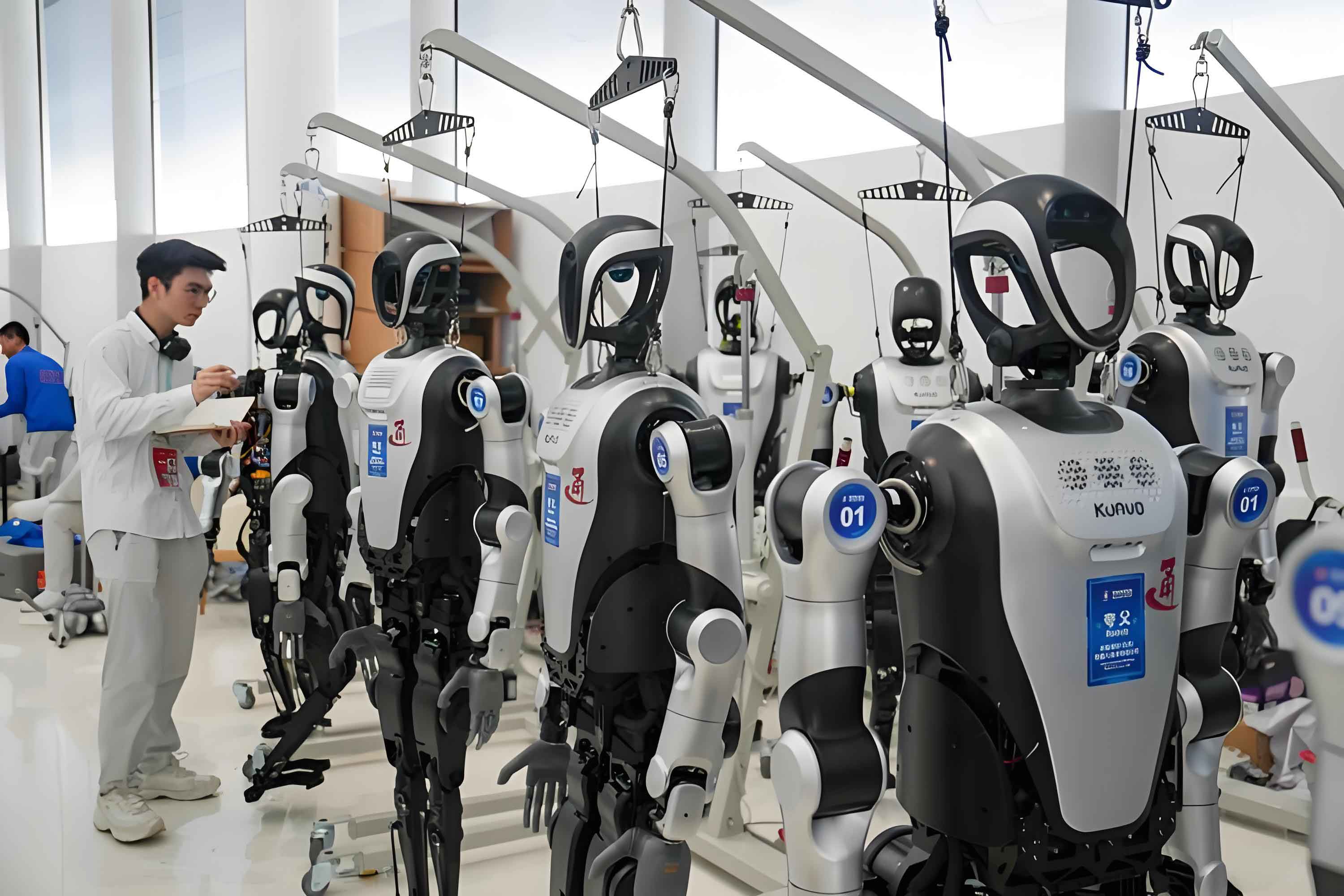
The forum also featured a dedicated segment for promoting a specialized industrial park. A senior representative from the park’s development company delivered a detailed presentation. The park aggregates high-quality resources from across the national robotics research, production, and academic sectors. It focuses intensely on core robotics technologies and products, championing a development model that integrates “key technologies + core products + application scenarios.” The strategy involves attracting premium projects in key technologies, core components, critical applications, and frontier innovation to achieve goals of technological breakthrough, increased production value, and ecosystem optimization. This model appears to be a blueprint for concentrated innovation in humanoid robotics.
The core of the session was a series of compelling roadshow presentations. These featured selected projects from the conference’s “Top 100 New Technologies and Products List,” along with other outstanding initiatives. Six organizations, including the humanoid robot innovation center and several renowned robotics companies, showcased their latest advancements. The demonstrations spanned next-generation humanoid robot platforms, advanced actuators, AI-driven control systems, and novel sensor integration, providing a tangible sense of the rapid progress being made.
Reflecting on the event, the transition from a specialized forum to the broader market seems to be accelerating. Dedicating an entire session to humanoid robots undoubtedly hastens the journey of new technologies and products toward commercialization, putting the process of科技成果转化 (technology achievement transformation) on a fast track. The collective endeavor witnessed here is fundamentally about propelling humanoid robot development forward at an unprecedented pace.
To systematically deconstruct the technological landscape presented, we can analyze the core components of a modern humanoid robot. The functionality of a humanoid robot hinges on the seamless integration of several subsystems. We can represent the overall system performance $P_{robot}$ as a function of its key domains:
$$P_{robot} = f(P_{mech}, P_{act}, P_{sens}, P_{ctrl}, P_{AI})$$
Where:
- $P_{mech}$ represents the performance of the mechanical structure and dynamics.
- $P_{act}$ represents the performance of the actuation system (motors, drives).
- $P_{sens}$ represents the performance of the sensor suite (vision, force, proprioception).
- $P_{ctrl}$ represents the performance of the low-level motion control algorithms.
- $P_{AI}$ represents the performance of the high-level artificial intelligence and embodied intelligence stack.
The conference heavily emphasized advancements in $P_{ctrl}$ and $P_{AI}$, particularly through imitation learning and predictive control.
A significant portion of the discussions revolved around locomotion, a grand challenge for humanoid robots. The dynamics of a bipedal humanoid robot can be modeled using the Lagrangian formulation. The equations of motion are given by:
$$M(q)\ddot{q} + C(q, \dot{q})\dot{q} + G(q) = \tau + J^T F_{ext}$$
Where:
- $q$, $\dot{q}$, $\ddot{q}$ are the vectors of generalized coordinates, velocities, and accelerations, respectively.
- $M(q)$ is the inertia matrix.
- $C(q, \dot{q})$ is the Coriolis and centrifugal force matrix.
- $G(q)$ is the gravitational force vector.
- $\tau$ is the vector of generalized actuator forces/torques.
- $J$ is the Jacobian matrix mapping joint space to contact point space.
- $F_{ext}$ is the vector of external forces (e.g., ground reaction forces).
The showcased running humanoid robot likely employs sophisticated controllers to solve real-time versions of this dynamics problem while maintaining balance, which is a non-trivial feat.
The “state-memory-based predictive control” mentioned can be linked to Model Predictive Control (MPC). A simplified discrete-time MPC formulation for a humanoid robot’s center of mass (CoM) trajectory might be:
$$\min_{u_{k}, x_{k}} \sum_{k=0}^{N-1} ( \| x_k – x_{ref,k} \|^2_Q + \| u_k \|^2_R ) + \| x_N – x_{ref,N} \|^2_{P}$$
Subject to:
$$x_{k+1} = A x_k + B u_k$$
$$u_{min} \leq u_k \leq u_{max}$$
$$C x_k \leq d$$
Here, $x_k$ is the state vector (e.g., CoM position, velocity), $u_k$ is the control input, $x_{ref}$ is the desired reference trajectory, and $Q$, $R$, $P$ are weighting matrices. The “state memory” aspect could involve learning the system matrices $A$ and $B$ or the constraints from prior experience.
Furthermore, reinforcement learning (RL), specifically imitation learning, was highlighted. In inverse reinforcement learning (IRL), a common approach for humanoid robot motion mimicry, the goal is to recover a reward function $R(s, a)$ that explains expert demonstrations. Given a set of expert trajectories $\tau_E = \{(s_0, a_0), (s_1, a_1), …\}$, the maximum entropy IRL objective is to find a reward function such that the policy $\pi(a|s)$ maximizes the expected cumulative reward while matching the expert’s state-action visitation frequencies.
The following table categorizes the key technological focus areas for humanoid robot development as emphasized during the forum, aligning with the ecosystem-building strategy:
| Pillar Category | Description & Key Challenges | Examples from Conference Themes |
|---|---|---|
| Embodied Intelligence ($P_{AI}$) | Integration of perception, reasoning, and action in a physical body. Challenge: Grounding AI in the physical world for adaptive, real-time interaction. | Predictive control with memory, imitation learning for motor skills, multi-modal sensor fusion for scene understanding. |
| Core Actuation & Components ($P_{act}, P_{mech}$) | High-torque density motors, efficient drivers, lightweight yet strong structural materials. Challenge: Achieving human-like strength-to-weight ratio and energy efficiency. | Electrically driven full-size platforms, discussions on harmonic drives, actuator modularization, and new composite materials. |
| Motion Planning & Control ($P_{ctrl}$) | Dynamic balancing, whole-body coordination, compliant interaction. Challenge: Stable locomotion and manipulation in unstructured environments. | Demonstration of bipedal running, whole-body controller (WBC) implementations, force/torque control strategies. |
| Sensing & Perception ($P_{sens}$) | 3D vision, tactile sensing, proprioception. Challenge: Creating a rich, unified world model for decision-making. | Advanced LiDAR and depth camera integration, discussions on artificial skin and tactile sensor arrays. |
| System Integration & Standards | Hardware-software co-design, communication protocols, safety standards. Challenge: Ensuring interoperability and reliability across the supply chain. | “Challenge and Command” mechanism to link suppliers, focus on building technical standards for the industry. |
The roadshow presentations provided concrete examples of progress across these pillars. To summarize the diversity of approaches, the following table lists generic types of projects that align with the presented innovations, avoiding specific company names:
| Project Type | Technical Emphasis | Potential Application Impact |
|---|---|---|
| Next-Gen Platform Development | Integrated design optimizing all pillars ($P_{mech}$ to $P_{AI}$) for general-purpose mobility and manipulation. | Foundation for service, logistics, and domestic humanoid robots. |
| Specialized Actuator & Drive Solutions | Improving $P_{act}$ via novel motor designs (e.g., high-torque direct-drive, proprioceptive actuators). | Enables more powerful, efficient, and responsive humanoid robot movements. |
| AI Software Stack for Embodiment | Advancing $P_{AI}$ through sim-to-real transfer, large behavior models, and intuitive programming interfaces. | Reduces the cost and time for teaching complex tasks to humanoid robots. |
| Advanced Perception Modules | Enhancing $P_{sens}$ with multi-camera SLAM, robust object recognition, and force-torque estimation. | Critical for safe human-robot collaboration and operation in dynamic environments. |
| Application-Specific Solution Packages | Tailoring a humanoid robot’s capabilities for specific verticals (e.g., inspection, elderly care, hazardous environments). | Drives early commercial adoption and validates the technology in real-world settings. |
The economic and developmental trajectory of the humanoid robot sector can be modeled using growth theory concepts. The accumulation of technological capability $K_T$ over time $t$ might follow a law influenced by R&D investment $I(t)$, knowledge spillovers $\alpha$, and the existing knowledge base:
$$\frac{dK_T}{dt} = \beta I(t)^\gamma K_T(t)^\alpha – \delta K_T(t)$$
Here, $\beta$ is an efficiency parameter, $\gamma$ captures returns to scale on investment, and $\delta$ is a knowledge depreciation rate. Events like this forum, which concentrate investment and foster collaboration, effectively increase $\beta$ and $\alpha$, accelerating the growth of $K_T$ for humanoid robots. The “ecosystem” approach directly targets these parameters.
Another critical formula lies in evaluating the stability of a walking or running humanoid robot. The Foot Rotation Indicator (FRI) point is a useful dynamic stability measure. For a planar model, the FRI point $x_{fri}$ along the ground can be computed from the moments and forces acting on the robot:
$$x_{fri} = \frac{\sum_i (m_i (\ddot{z}_i + g) x_i – m_i \ddot{x}_i z_i – I_i \dot{\omega}_i)}{\sum_i m_i (\ddot{z}_i + g)}$$
Where for each link $i$, $m_i$ is mass, $(x_i, z_i)$ are coordinates of its center of mass, $(\ddot{x}_i, \ddot{z}_i)$ are accelerations, $I_i$ is the moment of inertia, $\dot{\omega}_i$ is angular acceleration, and $g$ is gravity. A controller must keep the FRI within the support polygon for static stability, or manage its trajectory for dynamic stability as seen in running.
The path from laboratory breakthrough to market-ready humanoid robot product involves crossing the so-called “Valley of Death” for technology commercialization. This can be conceptualized as an optimization problem where the goal is to maximize the product readiness level (PRL) while minimizing the time $T$ and total cost $C$:
$$\min_{T, C} \left\{ \int_0^T [R_D(t) + R_C(t)] dt \right\} \quad \text{subject to} \quad PRL(T) \geq PRL_{market}$$
$R_D(t)$ is the rate of R&D expenditure, and $R_C(t)$ is the rate of commercialization costs (testing, certification, marketing). Mechanisms like the “Challenge and Command” project are policy interventions designed to lower the effective $R_C(t)$ and provide a clearer path to $PRL_{market}$ for humanoid robot technologies.
In conclusion, attending this specialized forum was a profoundly illuminating experience. The concentration of talent, the clarity of strategic vision, and the tangible technological demonstrations all pointed toward one reality: the era of practical humanoid robots is approaching faster than many anticipate. The systematic focus on embodied intelligence, core components, and ecosystem building is creating a powerful flywheel effect. The mathematical models and control strategies are evolving from theoretical constructs into engineered solutions powering machines that can run, balance, and interact. The collaborative models being pioneered, connecting fundamental research with industrial application through targeted mechanisms, are effectively lowering the barriers to commercialization. Every discussion, every demonstration reinforced the centrality of the humanoid robot as a defining technology of the coming decades. The journey from the specialized session to the global market is indeed accelerating, and it is a journey I am now convinced will reshape numerous aspects of our economy and daily life. The focus remains steadfast on advancing the capabilities, reliability, and accessibility of humanoid robots to unlock their full potential.