
As a leading institution in dance arts, I have always been fascinated by the intersection of tradition and innovation. The recent World Humanoid Robot Sports Games provided a groundbreaking platform to explore this fusion. In our performances, we leveraged humanoid robots to reinterpret cultural heritage, showcasing how technology can breathe new life into ancient art forms. This journey has not only redefined dance aesthetics but also opened up unprecedented possibilities for cultural preservation and expression. Through collaborative efforts with technology partners, we demonstrated that humanoid robots are not mere tools but active participants in the creative process, capable of embodying the essence of human expression.
The core of our exploration lies in the seamless integration of humanoid robots into dance. These machines, with their precision and programmability, have allowed us to push the boundaries of what is physically possible. For instance, in a group performance inspired by historical themes, we deployed multiple humanoid robots to simulate ancient warriors. Their movements, synchronized to millimeter-level accuracy, created a spectacle that blended historical gravitas with futuristic elegance. This was made possible through advanced algorithms that enabled real-time coordination among the robots, ensuring that their actions were perfectly aligned despite the complexity of the choreography.
To quantify the advancements in humanoid robot performance, we developed a framework based on key metrics. The table below summarizes the critical parameters we monitored during our performances, highlighting how humanoid robots excel in areas where human dancers face limitations.
| Parameter | Human Dancer Average | Humanoid Robot Performance | Improvement Factor |
|---|---|---|---|
| Movement Precision (mm) | 5-10 | 0.1-0.5 | 20x |
| Synchronization Error (ms) | 50-100 | 1-5 | 50x |
| Force Exertion (N) | 300-500 | 500-1000 | 2x |
| Endurance (hours) | 1-2 | 4-8 | 4x |
| Learning Time for New Routine (days) | 7-14 | 0.5-1 | 14x |
These metrics underscore the transformative potential of humanoid robots in dance. For example, the movement precision is governed by control algorithms that minimize error through feedback loops. We can model this using a proportional-integral-derivative (PID) controller, where the position error \( e(t) \) is minimized over time:
$$ e(t) = r(t) – y(t) $$
Here, \( r(t) \) is the reference trajectory, and \( y(t) \) is the actual position. The control output \( u(t) \) is given by:
$$ u(t) = K_p e(t) + K_i \int_0^t e(\tau) d\tau + K_d \frac{de(t)}{dt} $$
where \( K_p \), \( K_i \), and \( K_d \) are tuning parameters optimized for humanoid robots to achieve sub-millimeter accuracy. This mathematical foundation allows humanoid robots to execute complex sequences with reliability that surpasses human capabilities.
In one of our flagship performances, we focused on a piece that required humanoid robots to emulate traditional warrior dances. The choreography involved dynamic formations and acrobatic elements, which were impossible for human dancers to perform with such consistency. Through distributed control systems, we implemented a hierarchical architecture where a central “commander” robot coordinated the actions of multiple “soldier” robots. This approach not only reduced communication latency but also enabled emergent behaviors, where the group could adapt to real-time changes in the performance environment. The synchronization was achieved using a consensus algorithm, where each robot adjusts its state based on neighbors’ states:
$$ \dot{x}_i(t) = \sum_{j \in N_i} (x_j(t) – x_i(t)) $$
where \( x_i(t) \) is the state of robot i, and \( N_i \) is its set of neighbors. This ensures that all humanoid robots converge to a common trajectory, creating a visually stunning ensemble effect.
The integration of humanoid robots into dance also required rethinking the creative process. As choreographers, we had to learn the mechanical constraints and possibilities of these machines. By wearing motion capture suits, we could experience the kinematics of humanoid robots firsthand, which inspired us to simplify human dance logic for robotic execution. Conversely, engineers developed algorithms that incorporated aesthetic principles from renowned dance experts, leading to the creation of a “dance optimization model.” This model automatically adjusts the center of gravity trajectories to enhance stability and expressiveness. The optimization problem can be formulated as:
$$ \min_{q(t)} \int_0^T \left( \| \ddot{q}(t) \|^2 + \lambda \| q(t) – q_{\text{ref}}(t) \|^2 \right) dt $$
where \( q(t) \) represents the joint angles, \( q_{\text{ref}}(t) \) is the reference motion from human choreography, and \( \lambda \) is a weighting factor that balances smoothness and accuracy. This bidirectional learning mechanism has fostered a new creative paradigm, where human intuition and machine precision coexist symbiotically.
Cultural preservation has been a central theme in our work with humanoid robots. We aimed to digitize intangible cultural heritage, such as traditional dances, by encoding their movements into reusable algorithms. For a performance based on a folk dance, we decomposed 108 characteristic movements into over 2000 kinematic parameters. Using machine learning, we trained a model to generate variations while preserving the dance’s essence. The cultural “DNA” of the dance was captured through metrics like impact force index and rhythm density, defined as:
$$ \text{Impact Force Index} = \frac{1}{N} \sum_{i=1}^N \left| \frac{d^2 p_i}{dt^2} \right| $$
where \( p_i \) is the position of the i-th joint, and N is the number of keyframes. Similarly, rhythm density \( \rho \) is computed as the number of beat-aligned movements per second. These quantifiable measures allow humanoid robots to replicate the vigor and emotion of traditional dances, ensuring that cultural narratives are not lost but transformed for future generations.
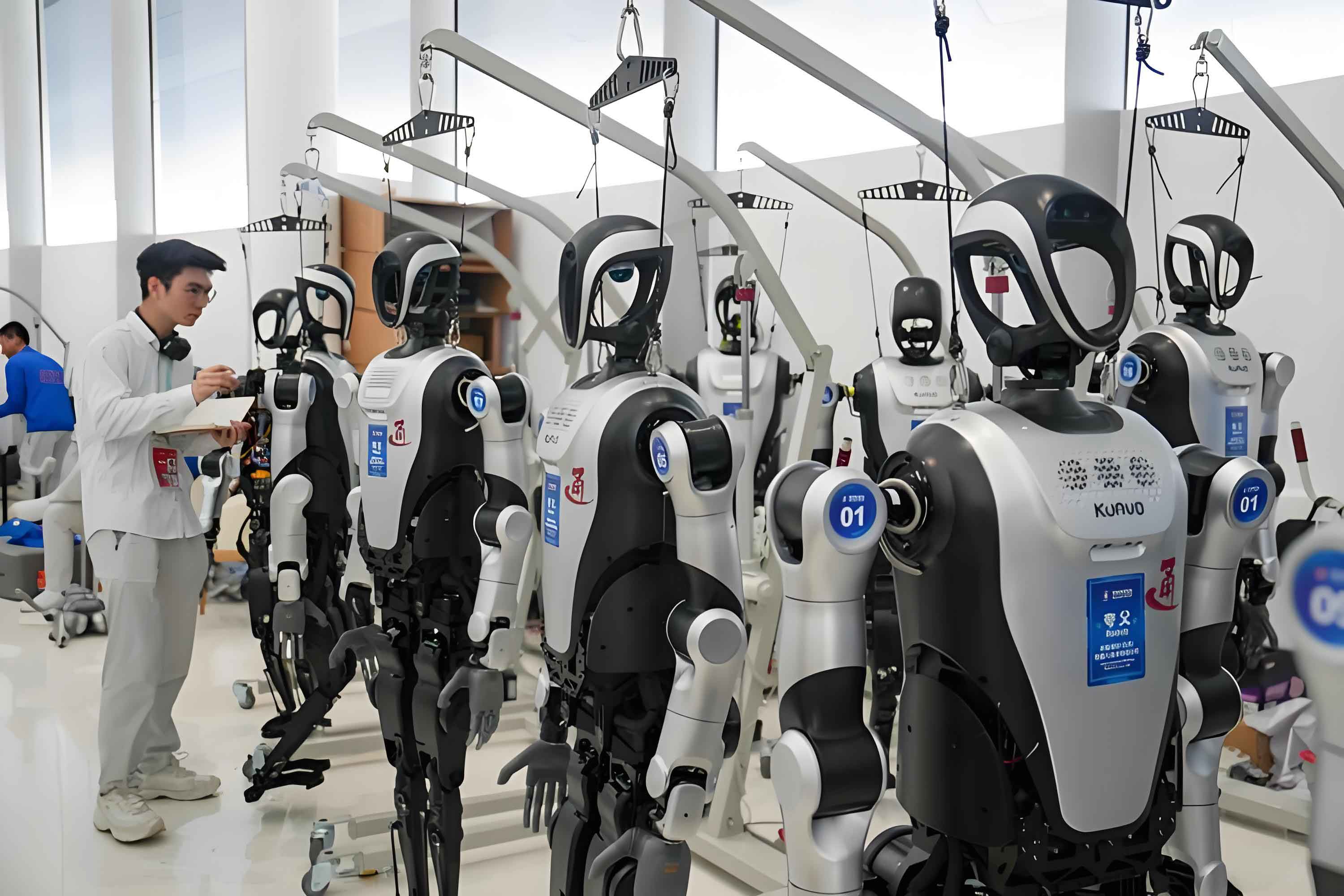
Looking ahead, we envision a future where humanoid robots become integral to dance education and performance. In education, “human-robot co-training” systems could revolutionize how students learn. Using virtual reality (VR), learners can interact with digital avatars of humanoid robots, receiving real-time feedback from AI coaches. These coaches analyze motion data to provide personalized corrections, enhancing skill acquisition. The educational efficacy can be modeled using a learning curve equation:
$$ L(t) = A \left(1 – e^{-kt}\right) $$
where \( L(t) \) is the learning progress, A is the maximum achievable skill, k is the learning rate, and t is time. With humanoid robots, k can be optimized through adaptive algorithms, reducing the time needed to master complex routines.
In professional settings, we foresee the rise of “virtual dance troupes” composed of AI-driven humanoid robots. These troupes could seamlessly switch between cultural styles—from classical to contemporary—thanks to multimodal models that integrate motion control, emotional computation, and aesthetic evaluation. The emotional computation aspect, for instance, uses affective computing to map emotional states to movement parameters. If \( E \) represents an emotional vector (e.g., joy, anger), then the corresponding motion parameters \( M \) can be generated through a transformation function:
$$ M = f(E) = W \cdot E + b $$
where W is a weight matrix learned from dance corpora, and b is a bias term. This allows humanoid robots to convey nuanced emotions, making performances more relatable and impactful.
The hardware evolution of humanoid robots is equally critical. Future iterations will incorporate biomimetic muscles and tactile feedback systems, enabling more natural interactions. For example, in a duet, a humanoid robot could sense its partner’s pressure and adjust its movements accordingly, mimicking human responsiveness. The force feedback can be described by Hooke’s law for elastic materials:
$$ F = -k \Delta x $$
where F is the force exerted, k is the stiffness coefficient, and \( \Delta x \) is the displacement. By tuning k dynamically, humanoid robots can achieve a delicate balance between rigidity and fluidity, essential for expressive dance.
Moreover, the application of humanoid robots extends beyond the stage. In therapeutic settings, they could assist in rehabilitation by guiding patients through tailored movement sequences. The economic and cultural implications are vast, as summarized in the table below, which compares traditional dance practices with those enhanced by humanoid robots.
| Aspect | Traditional Dance | Humanoid Robot-Enhanced Dance | Potential Impact |
|---|---|---|---|
| Accessibility | Limited to physical presence | Global via digital platforms | Democratizes art |
| Innovation Rate | Slow, reliant on human creativity | Rapid, driven by algorithm updates | Accelerates artistic evolution |
| Cultural Preservation | Oral and physical transmission | Digital encoding and replication | Ensures longevity |
| Cost of Production | High for live performances | Lower over time with reusable assets | Increases sustainability |
| Audience Engagement | Passive viewing | Interactive and immersive experiences | Enhances emotional connection |
To achieve these milestones, we are developing a comprehensive ecosystem for humanoid robots in dance. This includes open-source datasets of dance movements, which can be used to train general-purpose AI models. The data is often represented as time series of joint angles, and we use Fourier analysis to extract frequency components that characterize style:
$$ X(f) = \int_{-\infty}^{\infty} x(t) e^{-i2\pi ft} dt $$
where \( x(t) \) is the motion signal, and \( X(f) \) reveals the rhythmic patterns. By sharing such resources, we aim to foster a global community where humanoid robots serve as bridges between cultures.
In conclusion, the integration of humanoid robots into dance is not merely a technological feat but a cultural renaissance. As we continue to refine these systems, we are committed to ensuring that they amplify human creativity rather than replace it. The journey has just begun, and with each performance, we discover new ways to harmonize the precision of machines with the soul of art. Humanoid robots are poised to become enduring vessels of our cultural legacy, dancing through time with the grace of tradition and the power of innovation.