
In an era where technological waves surge forward, the humanoid robot is transitioning from a figment of science fiction imagination to a coveted new star in the industrial reality, poised to drive profound societal and industrial transformation. Our company, a leading provider of smart logistics equipment and solutions, has keenly captured this historic opportunity with a forward-looking strategic vision. We have decisively entered the field of humanoid robotics, fully committing to pioneering the integration and innovation of smart logistics with humanoid robot technology. A far-reaching transformation within the logistics industry is now gathering momentum, and we are at its forefront.
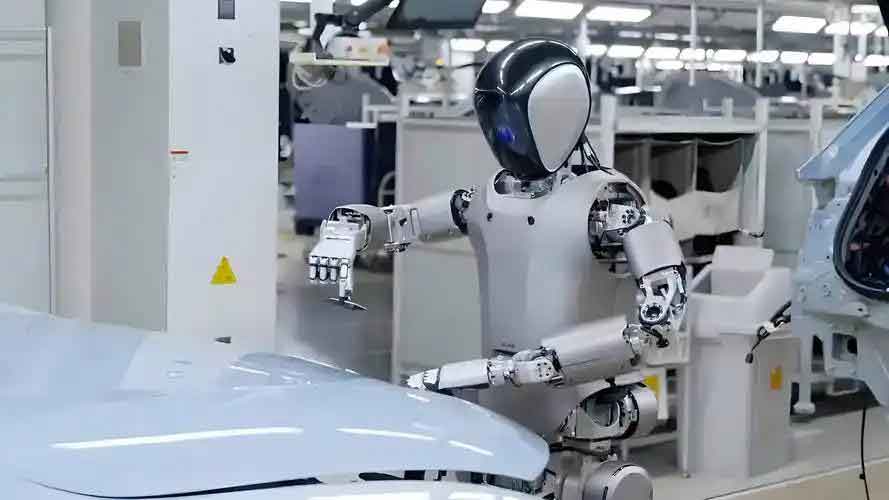
The global market for humanoid robots is experiencing vigorous growth, with projections from relevant institutions suggesting its value could surpass the hundred-billion-dollar mark within the next decade. Against this industry backdrop, we have taken decisive action, initiating a series of visionary strategic deployments in the humanoid robot domain. Every move reflects our corporate resolve and ambition to be a key player in this evolving landscape.
Our strategic approach is multifaceted, focusing on building a comprehensive ecosystem. We have actively established deep collaborative relationships with multiple robotics enterprises. A significant step involved investing in a core component manufacturer, successfully securing a critical link in the upstream supply chain for humanoid robot key parts. Leveraging our own technical expertise accumulated over years in motor technology, we engaged in close collaboration with humanoid robot本体 companies to jointly develop electric motor joint modules. The development of these modules, such as the actuator unit, was not without challenges. Our technical team conducted countless experiments and optimizations, achieving major breakthroughs in motor miniaturization, high-torque output, and precise control. The resulting module not only offers superior performance but also perfectly adapts to the kinematic requirements of humanoid robots, significantly strengthening our influence within the upstream industrial chain.
To solidify our position and accelerate innovation, we have entered into strategic partnerships with several specialized firms. These collaborations focus on different aspects of humanoid robot development for logistics. One partnership centers on the research and development of embodied AI technology, tackling the challenge of environmental perception and adaptation for humanoid robots in logistics settings. Together, we developed an advanced perception algorithm that enables the humanoid robot to more accurately identify cargo and its surroundings, making reasonable operational decisions. Another collaboration prioritizes the practical application and deployment of humanoid robots in smart logistics scenarios. By integrating resources, we have successfully implemented pilot applications of humanoid robots across multiple logistics projects. These partnerships continuously expand our business boundaries, making our布局 in the robotics field more diverse and robust.
Furthermore, we have joined forces with a prominent research institute to establish a dedicated “Humanoid Robot Innovation Center.” A flagship project at this center explores “The Development and Application of Logistics Robot Core Controllers Based on Large Model Cognitive Perception-Control Algorithms.” In this endeavor, the research teams work in tight synergy: we provide actual logistics application scenarios and critical data support, while the institute contributes its strengths in algorithm development and theoretical research. This creates a deep “in-house R&D + cooperative R&D” model that integrates industry, academia, and research. This model injects a continuous stream of power into our technological innovation, accelerating the translation of research achievements into practical productivity. Our leadership has clearly stated that the future of our company will be driven by the dual core forces of smart logistics and humanoid robotics, with comprehensive布局 in the R&D of core components for humanoid robots and intelligent control systems. Through close collaboration with numerous industry partners, we are actively constructing a vast application ecosystem aimed at achieving the global development and implementation of this technology, securing a leading position in the competitive humanoid robot arena.
The industrial application of robotics can be clearly delineated into generations based on technological evolution, each playing an irreplaceable role in specific domains. The characteristics of these generations are summarized below, highlighting where the humanoid robot fits.
| Robot Generation | Core Control & Capability | Primary Applications | Key Limitation |
|---|---|---|---|
| First Generation | PLC-controlled, high precision, high payload | Automotive manufacturing, electronic assembly (repetitive, high-precision tasks) | Lacks environmental perception, inflexible |
| Second Generation | Machine vision program control, basic environment perception | AGVs,物流 robots, sorting, greeting/guidance robots | Limited task complexity and adaptability |
| Next Generation: Humanoid Robot | Embodied AI, advanced motion control (类似小脑) | Complex, multi-layered tasks requiring flexibility (e.g., diverse logistics operations) | Current single-task precision may lag behind 1st Gen |
The humanoid robot, as the most advanced next-generation platform, has embodied intelligence at its core. Currently, development primarily focuses on hardware and motion control, with control principles analogous to the human cerebellum’s regulation of movement, enabling relatively flexible and complex motions. While a humanoid robot’s capability in handling a single, specific task might currently be inferior to a first-generation robot, it holds a significant advantage in managing complex, multi-layered tasks. In logistics scenarios, for instance, by being trained with different datasets, a humanoid robot can perform varied jobs such as unboxing, packing, and transporting, demonstrating remarkable flexibility, scene adaptability, and generalized operational能力. In large e-commerce warehouses, a humanoid robot can navigate aisles flexibly to pick and transport goods based on order requirements, covering a broader operational range and showing stronger adaptability compared to traditional single-task robots.
The logistics industry is widely recognized as the optimal entry point for humanoid robot operations, a conclusion backed by sound industrial logic. Tasks in logistics are relatively simple, involving repetitive work like搬运 and handling, with precision requirements that are not excessively high. This aligns well with the current technical characteristics of humanoid robots. For example, in parcel sorting centers, the work of moving and sorting大量包裹 is labor-intensive and highly repetitive—an environment where humanoid robots could efficiently operate. In contrast, industrial production lines often demand extremely high precision and stability. The current level of visual control and operational accuracy in humanoid robots struggles to meet the needs of such fine operations, like精密 welding in chip manufacturing or the assembly of精密 instruments. The gap between current humanoid robot technology and these high-precision requirements can be conceptually framed. The required precision $P_{req}$ for industrial tasks often exceeds the achievable precision $P_{robot}$ of a current-generation humanoid robot, creating a challenge: $P_{req} > P_{robot}$. However, for many logistics tasks, the required precision $P_{logistics}$ is lower: $P_{robot} \geq P_{logistics}$, making it a viable starting point.
Within the technological architecture of humanoid robots, the relationship between algorithms and hardware is as inseparable as soul and body. Data serves as the crucial link driving their intelligent evolution—the core element that enables the transition from “mechanical execution” to “intelligent decision-making.” The quality and quantity of data directly determine the upper limit of a humanoid robot’s intelligence. Just as humans enhance their abilities through continuous learning and experience accumulation, a humanoid robot requires massive amounts of data for training and optimization to better adapt to various complex work scenarios. The value derived from data training can be modeled. If we consider the performance $Perf$ of a humanoid robot as a function of the volume $V$ and quality $Q$ of its training data, we can express this as: $$Perf = f(V, Q)$$ where $f$ is a monotonically increasing function, indicating that both larger volume and higher quality data lead to improved performance, approaching an asymptotic limit representing the platform’s theoretical capability.
Recently, our strategic collaboration with a leading AI robotics company represents a pioneering initiative within the industry, formally inaugurating the era of data-driven operational scene applications for humanoid robots. As part of this collaboration, our partner is providing full support for us to establish a “Humanoid Robot Data Acquisition Factory” based on logistics operational scenarios. We are leveraging our professional expertise in smart logistics to meticulously construct various application scenes for systematic training and comprehensive data collection from the humanoid robots.
In this data acquisition factory, we have set up multiple logistics作业 scenes for humanoid robots, including actions like搬运, unboxing, sorting, and loading. During these operations, we collect multi-dimensional data encompassing the robot’s visual, tactile, force, motion trajectory, and internal state information. This ensures a rich perception of the physical world. Crucially, the collected operational data is meticulously annotated to guarantee the accuracy and validity of this embodied作业 data. The data collection pipeline can be summarized as follows:
| Stage | Activity | Data Type Collected | Purpose |
|---|---|---|---|
| Scene Setup | Configure物流 tasks (e.g., pick item A from location B) | Scene parameters, task definition | Define the training environment and objective |
| Robot Operation | Humanoid robot executes the task | Video feeds, joint angles/speeds, force/torque readings, tactile sensor data, internal system logs | Capture the full embodied experience |
| Data Annotation | Human experts label sensor data with correct actions/outcomes | Labeled datasets (e.g., image bounding boxes, successful grasp flags) | Create supervised learning targets for AI models |
| Model Training | AI algorithms learn from labeled data | Updated model parameters (weights) | Improve the humanoid robot’s decision-making policy $\pi(a|s)$ |
Concurrently, we are actively developing innovative applications for humanoid robots within the vertical domain of smart logistics. Our path moves from the training grounds of the data acquisition factory, to demonstration scenarios, and finally to actual application at client sites. By leveraging our global network of customers and project resources, we aim to accelerate the commercial delivery of truly data-driven operational applications. In the future, within both the data factory and client作业 sites, the humanoid robot will serve as the core载体 for data collection and application, powerfully推动 the deep, two-way integration of “digitizing the physical world” and “materializing digital capabilities.” We and our partner are also exploring in-depth cooperation on the assetization of collected data, innovating business models based on transactions of embodied large-model data for humanoid robots. This aims to achieve global circulation and maximization of data value. By potentially establishing data交易 platforms, enterprises could trade valuable collected datasets, generating economic returns for data owners while providing precious data resources to others, fostering development across the entire humanoid robot ecosystem.
Despite the vast application prospects for humanoid robots in industrial scenarios, which are viewed as a crucial direction for future industrial development, the leap from simple interactive functions to practical industrial作业 fields still faces numerous significant technical challenges. The key to achieving this lies in training the robots with作业 data-driven methods. This process requires substantial investment in manpower, technology, and capital. It encompasses not only investment in the humanoid robot本体 and the construction of作业 scenes but also in data processing, computing power, and cloud storage. This makes the data acquisition factory a核心 link in advancing humanoid robot technology, characterized by high investment and high technical requirements. We deeply recognize that the commercial application of humanoid robots in logistics scenes will be a complex systems engineering project. It requires synergistic support from many specialized companies and,更重要的是, the deployment of an entire humanoid robot industrial生态链—from core components to the humanoid robot本体, to the application end, encompassing parts, the本体, AI foundation models, data large models, cloud storage, and computing power.
Guided by an open innovation spirit, we are committed to fully integrating resources from all parties to jointly攻克 technical hurdles. Our goal is to rapidly achieve the commercial落地 of humanoid robots in logistics scenes globally, laying the foundation for the next stage of intelligent innovation in the logistics industry and the large-scale application of humanoid robots. Our leadership has expressed that our endeavor is a groundbreaking “0 to 1” innovative practice. Even with enormous investment and formidable difficulties, we will resolutely persevere. The foundational data acquired through our exploration may eventually be shared openly, contributing to the development of the entire industry and even the world, demonstrating a strong sense of corporate responsibility and mission.
Although the path forward is arduous, we are confident about the future. With continuous technological breakthroughs and the gradual expansion of application scenarios, we firmly believe that humanoid robots will profoundly alter the landscape of the logistics industry, guiding it towards a new era of intelligent development and contributing a significant chapter to the advancement of global logistics technology. Looking ahead, we will continue to increase R&D investment, constantly optimize our technology and products, actively explore markets, and march forward hand-in-hand with industry partners to jointly promote the vigorous development of the humanoid robot industry. Our strategic lead has outlined that our布局 in the humanoid robot field is twofold: upstream, relying on our component manufacturing advantages to deeply participate in core parts R&D and downstream, actively collaborating with humanoid robot本体 companies to推动 scene落地. Through deep cooperation with multiple本体 enterprises, we will integrate humanoid robot application solutions into our smart logistics systems, offering clients more intelligent and efficient solutions. This will助力 the logistics industry achieve intelligent升级, moving us closer to the ultimate realization of truly “unmanned logistics” scenarios where humanoid robots play a central role.
The journey of integrating humanoid robots into smart logistics is complex, but the potential rewards are transformative. The synergy between the physical dexterity of the humanoid form factor and the data-centric intelligence of modern AI creates a powerful combination for automating complex, unstructured tasks. The efficiency gains $\Delta E$ in a logistics warehouse from deploying humanoid robots can be conceptualized as a function of the number of tasks $n$ they can perform, the speed $s$ of execution, and the reduction in error rate $\epsilon$ compared to manual or simpler automated processes: $$\Delta E = g(n, s, \frac{1}{\epsilon})$$ where $g$ is an increasing function, highlighting that the versatility (high $n$) and reliability (low $\epsilon$) of humanoid robots are key value drivers alongside speed. As the technology matures and more high-quality embodied data fuels better algorithms, we anticipate the performance curves for humanoid robots to steepen dramatically, unlocking new levels of autonomy and economic value in logistics and beyond. Our commitment is to be a catalyst in this evolution, bridging the gap between visionary technology and practical, scalable industrial application for the benefit of the global supply chain.