
As I observe the rapid evolution of automation, I am continually amazed by the transformative power of the intelligent robot. These machines are no longer simple programmable arms; they are sophisticated systems capable of perception, learning, and adaptation. My experience in industrial automation has shown me that the core of this revolution lies in the seamless integration of mechanics, sensors, and artificial intelligence. Every intelligent robot represents a complex symphony of components working in unison, and understanding this symphony is key to unlocking their full potential. In this discussion, I will delve into the fundamental principles, operational paradigms, and essential stewardship required for these advanced systems, emphasizing why a deep technical and methodological understanding is crucial for the future of manufacturing and beyond.
The fundamental operation of any intelligent robot can be modeled through a series of mathematical frameworks. At the heart of its movement lies kinematics. The position and orientation of the robot’s end-effector in space can be described using homogeneous transformation matrices. For a serial manipulator with n joints, the forward kinematics is given by:
$$ T_{0}^{n} = A_{1} A_{2} A_{3} … A_{n} $$
where $$ A_{i} $$ is the Denavit-Hartenberg matrix for joint i, encapsulating its link length, link twist, joint offset, and joint angle. This equation allows me, as an engineer, to calculate precisely where the robot’s tool will be based on its joint configurations. For the inverse problem—determining the joint angles needed to reach a desired pose—the mathematics becomes more complex, often involving iterative numerical methods or geometric solutions. The dynamics of an intelligent robot, governing its motion under forces, are described by the Lagrangian formulation:
$$ \tau = M(q)\ddot{q} + C(q, \dot{q})\dot{q} + G(q) $$
Here, $$ \tau $$ is the vector of joint torques, $$ M(q) $$ is the mass-inertia matrix, $$ C(q, \dot{q}) $$ represents Coriolis and centrifugal forces, and $$ G(q) $$ is the gravitational force vector. This equation is fundamental for designing control systems that ensure smooth, accurate, and efficient movement for every intelligent robot. To illustrate the complexity and interplay of components in a modern intelligent robot, I have summarized the key subsystems and their functions in the following table.
| Subsystem | Key Components | Primary Function | Performance Metrics |
|---|---|---|---|
| Manipulation & Structure | Actuators (Servo motors), Harmonic drives, Links, End-effectors | Physical interaction with the environment, precise movement. | Payload (kg), Reach (mm), Repeatability (± mm), Degrees of Freedom. |
| Perception | Vision cameras (2D/3D), LiDAR, Force-Torque sensors, Tactile sensors | Environmental sensing, object recognition, force feedback. | Resolution (pixels/mm), Field of View, Sampling Rate (Hz), Accuracy. |
| Control & Processing | Central Processing Unit (CPU), Graphics Processing Unit (GPU), Real-time controller, Motion control cards | Data processing, trajectory planning, real-time control loop execution. | Cycle Time (ms), Bus Bandwidth (Gbps), FLOPS. |
| Artificial Intelligence | Deep learning models (CNNs, RNNs), Reinforcement learning algorithms, Simulation software | Task planning, adaptive behavior, anomaly detection, skill learning. | Inference Time (ms), Model Size (parameters), Training Convergence Rate. |
| Power & Connectivity | High-density batteries, Power management ICs, Ethernet (TSN), 5G/Wi-Fi modules | Providing energy, data communication with central systems and other machines. | Voltage (V), Capacity (kWh), Data Rate (Gbps), Latency (ms). |
From my perspective, the true “intelligence” of an intelligent robot emerges from its perceptual and cognitive layers. Vision systems, often the primary sensor, rely on convolutional neural networks (CNNs) for tasks like object detection. The core operation in a CNN layer can be expressed as:
$$ (I * K)_{(x,y)} = \sum_{i=-a}^{a} \sum_{j=-b}^{b} I(x+i, y+j) \cdot K(i, j) $$
where $$ I $$ is the input image, $$ K $$ is the kernel filter, and $$ * $$ denotes the convolution operation. This allows the intelligent robot to identify workpieces, assess their orientation, and detect defects. Similarly, for path planning in cluttered environments, algorithms like Rapidly-exploring Random Trees (RRT) or probabilistic roadmaps are employed, which optimize for collision-free trajectories. The control law that keeps the intelligent robot stable and accurate is often a variant of Proportional-Integral-Derivative (PID) control, computed in the joint space:
$$ u(t) = K_{p} e(t) + K_{i} \int_{0}^{t} e(\tau) d\tau + K_{d} \frac{de(t)}{dt} $$
Here, $$ u(t) $$ is the control output (e.g., torque), $$ e(t) $$ is the error between desired and actual position, and $$ K_{p} $$, $$ K_{i} $$, $$ K_{d} $$ are tuning gains. Modern intelligent robots often use adaptive or model-predictive control to handle nonlinearities and varying payloads.
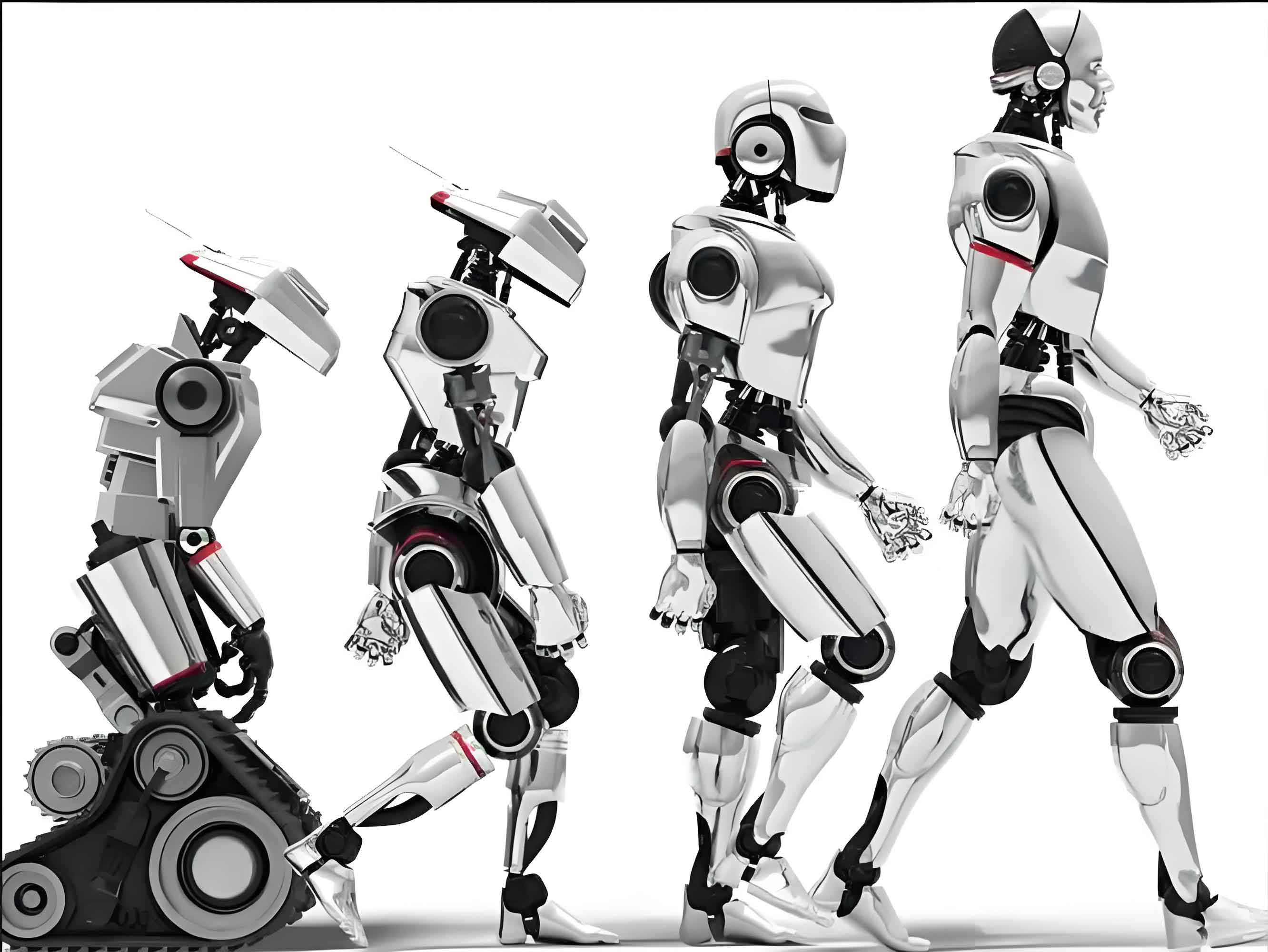
Seeing an intelligent robot in action, such as the one depicted, reinforces the theoretical concepts. In practical applications, like a component handling cell, the intelligent robot must perform a sequence of calibrated actions. Let me describe a typical pick-and-place cycle. First, the vision system locates a part with coordinates (x, y, z) and orientation $$ \theta $$. The inverse kinematics solver then computes the joint angle vector $$ q_{d} = [q_{1}, q_{2}, …, q_{n}]^{T} $$. The trajectory planner generates a smooth time-based path $$ q(t) $$ from the current pose to $$ q_{d} $$, often using a cubic polynomial or an S-curve profile to minimize jerk. The dynamic model is used to pre-calculate the required torques, and the real-time controller executes the PID loop at frequencies often exceeding 1 kHz to follow this trajectory precisely. This entire pipeline must be robust and fault-tolerant, which is why systematic inspection and maintenance are non-negotiable for any deployment of an intelligent robot.
Just like any high-precision electromechanical system, the reliability and longevity of an intelligent robot depend critically on a disciplined regimen of inspection and maintenance. From my own practice, I categorize these activities into daily checks, weekly or monthly preventive maintenance, and annual overhauls. Neglecting these can lead to drift in accuracy, catastrophic failure, or unscheduled downtime. The following table outlines a comprehensive maintenance schedule I typically recommend for an industrial intelligent robot system.
| Frequency | Scope | Key Actions | Metrics & Tools | Expected Outcome |
|---|---|---|---|---|
| Daily / Pre-shift | Operational Readiness | Visual inspection for loose cables, leaks; Verify emergency stops; Check for abnormal sounds/vibrations; Clean protective lenses on cameras. | Checklist, Stethoscope, Lint-free cloth. | Ensure safe startup, prevent minor issues from escalating. |
| Weekly | Performance Calibration | Verify repeatability at key positions; Check TCP (Tool Center Point) calibration; Inspect mechanical brakes function; Monitor controller temperatures. | Dial indicator, Calibration sphere, Thermometer. | Maintain positioning accuracy within specified tolerances (e.g., ±0.1 mm). |
| Monthly | Mechanical & Electrical | Inspect gearbox and actuator seals for wear; Tighten mechanical fasteners to specified torque; Check electrical connections for corrosion; Backup system parameters and AI models. | Torque wrench, Multimeter, Backup software. | Prevent mechanical wear, ensure electrical integrity, safeguard data. |
| Quarterly | Systematic Diagnostics | Run full diagnostic software suite; Test force-torque sensor calibration; Lubricate joints as per manufacturer specs; Validate network latency and data integrity. | Manufacturer’s diagnostic tools, Force gauge, Network analyzer. | Comprehensive system health assessment, update maintenance baseline. |
| Annually | Major Overhaul | Replace wear parts (e.g., bearings, seals); Deep clean internal components; Update firmware and security patches; Perform load cycle test and dynamic accuracy verification. | Bearing puller, Cleanroom supplies, Official firmware. | Extend service life by 5-10 years, restore like-new performance specifications. |
The maintenance of the “brain” of the intelligent robot—its AI models—is equally important. Model performance can degrade over time due to concept drift, where the statistical properties of the input data change. This necessitates periodic retraining or fine-tuning. The retraining process often aims to minimize a loss function $$ L(\theta) $$ over a new dataset $$ D_{new} $$, while preventing catastrophic forgetting of previous knowledge. A common technique is elastic weight consolidation, which adds a regularization term:
$$ L'(\theta) = L_{D_{new}}(\theta) + \sum_{i} \frac{\lambda}{2} F_{i} (\theta_{i} – \theta_{i}^{*})^2 $$
Here, $$ \theta^{*} $$ are the parameters of the old, trained model, $$ F_{i} $$ is the Fisher information matrix diagonal element for parameter $$ i $$, and $$ \lambda $$ is a hyperparameter controlling the strength of consolidation. This ensures the intelligent robot continues to perform reliably as its working environment evolves.
When considering the lifecycle of an intelligent robot, its total cost of ownership (TCO) is a critical metric for any operation I am involved in. The TCO can be broken down into capital expenditure (CapEx) and operational expenditure (OpEx). A significant portion of OpEx is driven by maintenance and energy consumption. The energy consumption of an intelligent robot during a task cycle can be approximated by integrating the power over time:
$$ E_{cycle} = \int_{t_{0}}^{t_{f}} P(t) dt = \int_{t_{0}}^{t_{f}} ( \tau(t)^{T} \dot{q}(t) + P_{static}) dt $$
where $$ P_{static} $$ represents the constant power draw from controllers, sensors, and computing units. Optimizing trajectories for energy efficiency directly impacts long-term operational costs. Furthermore, the mean time between failures (MTBF) and mean time to repair (MTTR) are key reliability metrics. System availability $$ A $$ is then given by:
$$ A = \frac{MTBF}{MTBF + MTTR} $$
A robust maintenance program directly improves MTBF and reduces MTTR, thereby maximizing the availability of the intelligent robot for production. I have found that predictive maintenance, using data from vibration sensors and motor current signatures, can forecast failures before they occur. The health indicator $$ H(t) $$ can be modeled as a function of sensor readings $$ s_{1}, s_{2}, …, s_{m} $$:
$$ H(t) = f(s_{1}(t), s_{2}(t), …, s_{m}(t); \beta) $$
where $$ \beta $$ are learned parameters. When $$ H(t) $$ crosses a threshold, maintenance is scheduled proactively, preventing unexpected stoppages. This data-driven approach is becoming the standard for managing fleets of intelligent robots.
The application spectrum for the modern intelligent robot is vast and growing. In discrete manufacturing, such as the assembly of consumer electronics, an intelligent robot can perform delicate insertions with force feedback, achieving sub-millimeter precision. In process industries, mobile intelligent robots equipped with sensors patrol facilities, performing tasks like thermal inspection of equipment or gas leak detection. The navigation of such a mobile intelligent robot often relies on simultaneous localization and mapping (SLAM). The core SLAM problem can be framed as maximizing the posterior probability of the robot’s path $$ x_{1:t} $$ and the map $$ m $$ given observations $$ z_{1:t} $$ and control inputs $$ u_{1:t} $$:
$$ P(x_{1:t}, m | z_{1:t}, u_{1:t}) $$
Solving this in real-time allows the intelligent robot to build a map and locate itself within it autonomously. Another frontier is human-robot collaboration (HRC), where an intelligent robot shares workspace with humans. Here, safety standards dictate strict limits on force and speed. The permissible speed $$ v_{max} $$ based on the distance $$ d $$ to a human can be derived from standards like ISO/TS 15066, often following a power model:
$$ v_{max}(d) = k \cdot d^{n} $$
where $$ k $$ and $$ n $$ are constants determined by risk assessment. This ensures that the intelligent robot can stop safely before causing harm upon contact.
Looking ahead, the evolution of the intelligent robot is tightly coupled with advancements in AI, materials science, and edge computing. The next generation will feature more embodied intelligence, where reasoning is intimately linked with physical interaction. Morphological computation—using the body’s mechanics to simplify control—will lead to more efficient designs. The learning process for a new skill may involve deep reinforcement learning (DRL), where the intelligent robot learns a policy $$ \pi(a|s) $$ that maximizes the expected cumulative reward $$ R $$:
$$ J(\theta) = \mathbb{E}_{\tau \sim \pi_{\theta}} [R(\tau)] = \mathbb{E}_{\tau \sim \pi_{\theta}} [\sum_{t=0}^{T} \gamma^{t} r(s_{t}, a_{t})] $$
Here, $$ \tau $$ is a trajectory, $$ \gamma $$ is a discount factor, and $$ \theta $$ are the policy parameters. Training often occurs in high-fidelity digital twins before deployment on the physical intelligent robot, drastically reducing learning time and risk. Furthermore, the rise of modular designs, as hinted at in recent industry developments, allows for flexible configuration. One can envision a future where an intelligent robot is assembled from standardized joint modules, perception pods, and gripper interfaces, dramatically reducing deployment time and cost for custom applications.
In conclusion, my journey through the world of automation has solidified a fundamental belief: the intelligent robot is the cornerstone of the next industrial revolution. It is a multidisciplinary marvel, demanding expertise in mechanics, control theory, computer science, and data analytics. Its successful deployment is not just about procurement but about sustained stewardship—through rigorous mathematical modeling, systematic maintenance, and continuous learning. As these systems become more capable and pervasive, our understanding and methodologies must evolve in tandem. The formula for success lies in respecting the complexity of the intelligent robot while diligently working to make its operation more reliable, efficient, and synergistic with human endeavors. The future will be built, inspected, and maintained by these intelligent partners, and our preparedness will define the pace of progress.