
We stand at the precipice of a new era in personal technology, where intelligent devices cease to be mere tools and evolve into dynamic companions. The convergence of advanced materials science, artificial intelligence, and precision engineering is making this possible. In this exploration, I will delve into the intricate design philosophy and engineering marvel behind a new class of ultra-lightweight AI robotic companions, examining the principles that allow a sophisticated machine to achieve a weight of merely one kilogram while possessing fluid, natural motion and adaptive intelligence. The journey of the modern robot dog is one of minimizing mass and maximizing capability, a testament to the power of integrated design.
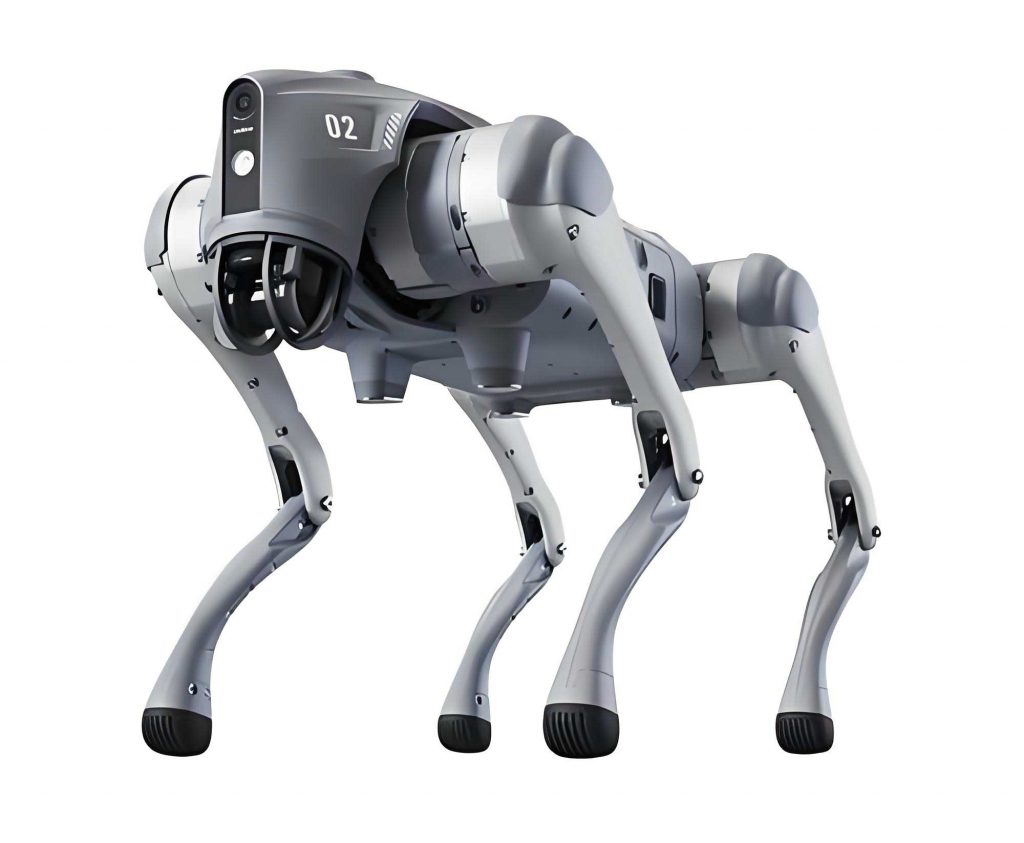
The core design challenge for a personal robot dog is fundamentally paradoxical: how to embody robust functionality and computational power within a form factor that is approachable, portable, and energetically efficient. The solution lies in a holistic, system-level approach where every component serves multiple purposes. The primary objective function for the design can be framed as a multi-variable optimization problem:
$$
\text{Maximize } \Psi = \frac{\alpha \cdot C_{\text{computational}} + \beta \cdot C_{\text{mobility}} + \gamma \cdot C_{\text{interaction}}}{\delta \cdot M + \epsilon \cdot P + \zeta \cdot C}
$$
Where:
- $\Psi$ represents the overall performance index.
- $C_{\text{computational}}$, $C_{\text{mobility}}$, $C_{\text{interaction}}$ are capabilities in AI processing, kinematic mobility, and human-robot interaction.
- $M$ is total mass, $P$ is power consumption, and $C$ is unit cost.
- $\alpha, \beta, \gamma, \delta, \epsilon, \zeta$ are weighting coefficients reflecting design priorities.
The pursuit of an ultra-light robot dog focuses intensely on minimizing $M$ while maximizing the numerator, a feat achieved through revolutionary actuator design and material selection.
Chapter 1: The Biomechanical Core – Actuation and Structural Integrity
The soul of any legged robot dog is its actuation system. Traditional designs often involve bulky motors, complex external wiring harnesses, and segregated control units, leading to increased weight, points of failure, and unnatural, jerky movement. The breakthrough lies in a deeply integrated approach. The mentioned Neurocore technology paradigm signifies a shift towards decentralized intelligence and high-degree-of-freedom (DoF) integration at the joint level.
Consider a standard leg assembly for a quadruped. A high-performance robot dog requires a minimum of 3 DoF per leg (hip abduction/adduction, hip flexion/extension, knee flexion/extension) for stable and agile movement. For a quadruped, this implies 12 independent actuators. The innovation is embedding the control circuitry, sensors, and communication bus directly within a compact actuator module that provides three rotational degrees of freedom. This eliminates all external wiring between joints, drastically reducing weight and improving reliability. The torque $\tau$ required at a joint can be modeled using a simplified dynamics equation:
$$
\tau = I \ddot{\theta} + b \dot{\theta} + m g l \cos(\theta) + \tau_{\text{external}}
$$
Where $I$ is the moment of inertia, $\theta$ is the joint angle, $b$ is the damping coefficient, $m$ is the mass of the limb segment, $g$ is gravity, $l$ is the distance to the center of mass, and $\tau_{\text{external}}$ accounts for ground reaction forces. The integrated actuator must be precisely tuned to deliver this torque profile efficiently. The use of aerospace-grade aluminum alloys for the primary chassis and limbs is critical. These materials offer an exceptional strength-to-weight ratio, characterized by the following key properties compared to standard materials:
| Material | Density (ρ) kg/m³ | Yield Strength (σ_y) MPa | Specific Strength (σ_y/ρ) kN·m/kg | Typical Use Case |
|---|---|---|---|---|
| Mild Steel (A36) | 7850 | 250 | ~31.8 | Heavy structural frames |
| 6061-T6 Aluminum | 2700 | 276 | ~102.2 | Aerospace, high-end robotics |
| Carbon Fiber Composite | 1600 | 600+ (direction-dependent) | ~375+ | Premium sporting goods, aerospace |
| Polycarbonate (PC) | 1200 | 65 | ~54.2 | Protective casings, lenses |
For our robot dog, aluminum provides the optimal balance of machinability, cost, durability, and weight savings, enabling the elegant, functional bionic form. The skeletal structure is designed using topological optimization algorithms that mimic bone growth, removing material where stress is low to create organic, lightweight, yet incredibly strong geometries. This results in a robot dog that is not only light enough to carry but also robust enough for dynamic interaction.
Chapter 2: The Neural Fabric – AI, Perception, and Adaptive Behavior
Mass reduction is futile without a powerful brain to command the form. The intelligence of this robot dog is what transforms it from a remote-controlled toy into a true companion. The “AI” operates on multiple interconnected layers:
1. Proprioceptive Layer: This involves the robot dog’s sense of self-movement and body position. Integrated sensors in each actuator (encoders, current sensors, temperature sensors) provide real-time feedback. The state of the robot dog can be represented as a vector $\mathbf{s}_t$ at time $t$:
$$
\mathbf{s}_t = [\theta_1, \dot{\theta}_1, \tau_1, …, \theta_{12}, \dot{\theta}_{12}, \tau_{12}, \mathbf{a}_t, \mathbf{\omega}_t]^T
$$
where $\mathbf{a}_t$ and $\mathbf{\omega}_t$ are linear acceleration and angular velocity from an inertial measurement unit (IMU). This data feeds into stability control algorithms like the Whole-Body Control (WBC) framework, which solves a quadratic program (QP) at kilohertz rates to compute optimal joint torques:
$$
\begin{aligned}
\min_{\ddot{\mathbf{q}}, \boldsymbol{\tau}, \mathbf{f}} & \quad \|\ddot{\mathbf{q}} – \ddot{\mathbf{q}}_{\text{des}}\|^2 + \|\boldsymbol{\tau}\|^2 \\
\text{subject to} & \quad \mathbf{M}(\mathbf{q})\ddot{\mathbf{q}} + \mathbf{C}(\mathbf{q}, \dot{\mathbf{q}}) = \mathbf{S}^T\boldsymbol{\tau} + \mathbf{J}_c(\mathbf{q})^T\mathbf{f} \\
& \quad \mathbf{J}_c(\mathbf{q})\ddot{\mathbf{q}} + \dot{\mathbf{J}}_c(\mathbf{q}, \dot{\mathbf{q}})\dot{\mathbf{q}} = \mathbf{0} \\
& \quad \boldsymbol{\tau}_{\text{min}} \leq \boldsymbol{\tau} \leq \boldsymbol{\tau}_{\text{max}}, \quad \mathbf{f} \in \mathcal{C}
\end{aligned}
$$
Here, $\mathbf{q}$ are generalized coordinates, $\mathbf{M}$ is the mass matrix, $\mathbf{C}$ contains Coriolis and gravity terms, $\mathbf{S}$ is a selection matrix, $\boldsymbol{\tau}$ are actuator torques, $\mathbf{J}_c$ is the contact Jacobian, and $\mathbf{f}$ are contact forces constrained within a friction cone $\mathcal{C}$.
2. Exteroceptive Layer: This is the robot dog’s perception of the world, typically via cameras, depth sensors, and microphones. Computer vision models (Convolutional Neural Networks or CNNs) enable object recognition, person following, and scene understanding. For a robot dog designed for personal use, recognizing its owner, responding to voice commands, and navigating a living room cluttered with obstacles are paramount. The processing happens both on-edge (on the robot dog’s own processor for low-latency reactive tasks) and potentially via cloud synergy for complex reasoning.
3. Behavioral Layer: This is the high-level AI that synthesizes perception and proprioception to generate lifelike behaviors. Reinforcement Learning (RL) is increasingly used to train agile locomotion policies in simulation before transferring them to the physical robot dog. The policy $\pi_\phi(\mathbf{a}_t | \mathbf{o}_t)$, parameterized by $\phi$, maps observations $\mathbf{o}_t$ to actions $\mathbf{a}_t$ (desired joint positions or torques) to maximize a reward $r_t$. The “Open Platform + Entertainment” development model is crucial here. By providing Software Development Kits (SDKs) and Application Programming Interfaces (APIs), developers can create new skills, tricks, and interactive applications, exponentially expanding the utility and personality of the robot dog.
| AI Module | Primary Function | Key Technologies | Impact on User Experience |
|---|---|---|---|
| Locomotion Control | Stable walking, running, pose transitions | WBC, Model Predictive Control (MPC), RL | Creates fluid, natural, and trustworthy movement for the robot dog. |
| Vision Perception | Object/person recognition, navigation | CNNs, Visual SLAM | Allows the robot dog to interact contextually with people and its environment. |
| Human-Robot Interaction (HRI) | Voice commands, emotional expression, learning routines | Natural Language Processing (NLP), Behavior Trees | Fosters an emotional bond, making the robot dog feel like a responsive companion. |
| Developer API | Skill creation, data access, customization | REST/gRPC APIs, Python/C++ SDKs | Transforms the robot dog from a closed product into a platform for innovation. |
Chapter 3: The Symbiosis of Form and Experience – A Comparative Framework
The principles demonstrated by the ultra-light robot dog are not isolated; they reflect a broader industrial design philosophy evident in other cutting-edge consumer tech, such as the portable projector mentioned. Both products exemplify the quest for “maximum experience in a minimal footprint.” We can analyze this through a comparative lens:
| Design Axis | Ultra-Light AI Robot Dog | Portable Projector | Unifying Principle |
|---|---|---|---|
| Core Innovation | Integrated 3-DoF actuators (Neurocore), Topology-optimized Al frame | Miniaturized DLP optics, Efficient thermal management | System Integration: Distributing function and intelligence to reduce mass/complexity. |
| User Interaction | Natural motion, voice/gesture control, open API for developers | Single-handed operation, auto-focus, obstacle avoidance | Intuitive Autonomy: The device handles complexities (balance, focus) so the user enjoys the result. |
| Form Language | Bionic elegance, expressive yet functional | Precise cylindrical geometry, clean lines | Purposeful Minimalism: Form is derived directly from core function and user ergonomics. |
| Experience Enhancement | Companionship, entertainment, educational platform | Large-screen entertainment anywhere, power bank functionality | Contextual Versatility: The product adapts to and enhances various user scenarios (home, outdoor, development). |
| Sustainability & Packaging | (Implied) Durable, repairable design for long lifecycle | EPP foam packaging repurposed as a stable stand | Extended Value Cycle: Design considers the entire product lifecycle, from materials to end-of-use utility. |
The mathematical parallel lies in optimization for different primary constraints. For the robot dog, the key is dynamic performance under a severe mass budget $M_{\text{max}} \approx 1 \text{ kg}$. For the projector, it is luminous flux $\Phi$ (brightness) and resolution under a strict volumetric constraint $V_{\text{max}}$ and thermal budget $Q_{\text{dissipated}}$. Both solve their version of the engineering optimization problem.
Chapter 4: The Development Ecosystem and Future Trajectory
The true potential of a modern robot dog is unlocked not just by its out-of-the-box features, but by its capacity for growth. The “open platform” aspect is a strategic multiplier. It invites researchers, hobbyists, and commercial developers to build upon the hardware, creating applications from advanced research in robotic navigation to simple entertainment games. This creates a virtuous cycle: more developers lead to more use-cases, which increases the robot dog’s value and sales, funding further hardware refinement.
Future iterations will likely see further mass reduction through advanced composites, increased battery energy density, and even more powerful edge AI chips. The actuator technology may evolve to include variable impedance control, allowing the robot dog to modulate the stiffness of its joints—making it both precise for tasks and safe for physical interaction. The locomotion policy for such a robot dog could evolve to handle a continuum of terrains, described by a terrain parameter $\xi$, making its gait policy $\pi_\phi(\mathbf{a}_t | \mathbf{o}_t, \xi)$.
In conclusion, the engineering of an ultra-light AI robotic companion represents a masterclass in integrated design. It is a harmonious solution to the multidimensional optimization problem of weight, strength, intelligence, and cost. Every aspect, from the aerospace aluminum bones and the neural-core actuators to the cloud-connected AI and developer-friendly APIs, is meticulously crafted to deliver a singular experience: that of a lively, capable, and personal tech companion. The evolution of the robot dog is a clear indicator that the future of personal robotics is not about building heavier, stronger machines, but about creating smarter, lighter, and more adaptable partners that seamlessly integrate into the fabric of our daily lives. The journey from a mechanical novelty to a true companion is paved with equations of motion, weights of materials, and lines of code, all converging to breathe life into a new form of digital being.