
My extensive involvement in the field of power transmission has consistently brought me face-to-face with the critical role of precision gearing in heavy machinery. One component that stands out for its sophistication and performance is the rotary vector reducer. This discussion stems from a focused project aimed at developing a high-performance rotary vector reducer for a specific application: the travel motor of hydraulic excavators. The drive to undertake this development was clear. While rotary vector reducer units were widely adopted domestically for their exceptional qualities, the market was entirely dependent on imported products. This reliance presented challenges in terms of cost, supply chain stability, and technical autonomy. Therefore, leveraging available technical expertise to localize the production of a reliable rotary vector reducer was not just an engineering challenge but a strategic necessity for the industry’s growth.
The core mission was to create a rotary vector reducer that could serve as a direct, reliable replacement for imported units. The target application demanded a device capable of converting the hydraulic motor’s high-speed, low-torque rotation into the low-speed, high-torque output required to drive an excavator’s tracks. The defined performance benchmarks were stringent, as summarized below:
| Parameter | Specification |
|---|---|
| Operating Temperature | -10°C to +45°C |
| Maximum Output Torque | 34,300 N·m |
| Maximum Output Speed | 60 rpm |
| Reduction Ratio | 44.87 |
| Braking Torque | 398 N·m |
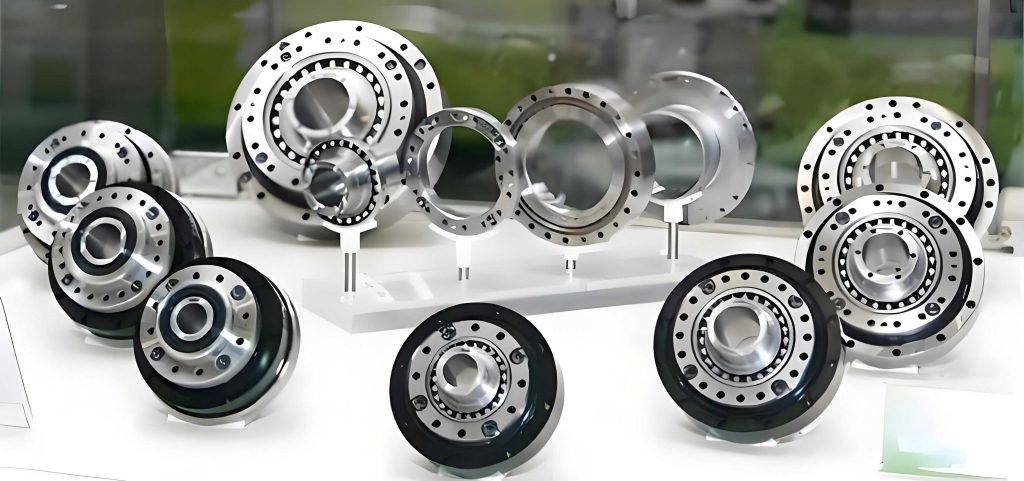
The operational principle of the rotary vector reducer is elegantly efficient, relying on a two-stage planetary system. The first stage is a conventional involute planetary gear train, which provides an initial speed reduction. The second, and most distinctive stage, is a cycloidal pin-wheel planetary mechanism. The output from the first stage drives crankshafts, which have eccentric sections. These eccentrics engage with cycloidal discs via bearings. The lobed, hypocycloidal shape of these discs meshes with a ring of stationary pin gears housed in the output shell (sprocket hub). As the crankshafts rotate, they cause the cycloidal discs to undergo a compound planetary motion—both rotating on their own axis and revolving around the central axis. This motion, through an anti-rotation mechanism (often the crankshafts themselves or a parallel pin arrangement), is transferred as pure, slow-rotation, high-torque output to the hub. The total reduction ratio i_total of this rotary vector reducer is the product of the ratios of its two stages. If Z_sun, Z_planet, and Z_ring represent the tooth counts of the first-stage sun, planet, and ring gears respectively, and Z_pin and Z_lobe represent the number of stationary pins and lobes on the cycloidal disc, the ratio can be expressed as:
$$
i_{total} = \left(1 + \frac{Z_{ring}}{Z_{sun}}\right) \times \left(\frac{Z_{pin}}{Z_{pin} – Z_{lobe}}\right)
$$
For our target ratio of 44.87, specific tooth counts were engineered into the design. The architecture of the rotary vector reducer confers several outstanding characteristics crucial for heavy-duty applications. Its compact, integrated design allows it to be housed directly within the motor assembly, minimizing axial space. The two-stage design distributes load, with the low-speed cycloidal stage offering superior shock absorption and smoother operation. The multi-tooth engagement of the cycloidal disc (often 50% or more of the pins are engaged simultaneously) provides exceptionally high torsional stiffness, impact resistance, and overload capacity. Furthermore, the design inherently allows for high rotational accuracy and minimal backlash when manufactured with precision.
The development journey highlighted several key technological challenges where success was paramount. The core of a rotary vector reducer‘s performance lies in the precision and stability of its key components: the cycloidal discs, the crankshafts, and the sprocket hub. Sensitivity analysis on transmission error revealed that certain error combinations had a disproportionately large effect on overall precision and smoothness. The guiding principle that emerged was the need to control not just absolute tolerances, but the *relative distribution* of errors among components to achieve optimal meshing.
Cycloidal Disc Design and Manufacture: These are thin, disc-like components featuring bearing holes for the crankshaft eccentric journals, process holes, and the precise hypocycloidal tooth form. Post carburizing and quenching, they possess a deep, hard case but are prone to distortion. A critical requirement is that the two discs used in a pair must be assembled with a specific angular offset (usually 180° divided by the number of lobes). Our manufacturing strategy focused on relative accuracy. First, the three bearing holes were machined with high precision. These holes then served as the master datum for machining the cycloidal tooth profile in a dedicated fixture on a CNC form grinder, ensuring the tooth form was perfectly positioned relative to the bearing centers. The discs were manufactured and ground in pairs, marked accordingly, and kept together throughout assembly. Tooth profile modification, essential for optimizing lubrication and stress distribution, was achieved using a combination of negative equidistant and negative offset methods. The primary accuracy metrics controlled were the adjacent pitch error and the cumulative pitch error of the cycloidal teeth.
Crankshaft Design and Manufacture: This is a complex shaft integrating eccentric throws, bearing journals, and an involute spline. The challenges were multifaceted: controlling heat treatment distortion of the spline, maintaining a consistent eccentricity value and phase angle (typically 180° ± 1′) between throws on the same shaft, and ensuring a strict angular relationship (≤ 1′) between the spline’s keyway and the orientation of the adjacent eccentric section. The “relative error distribution” principle dictated that the eccentricity errors on the three throws of a shaft should be biased in the *same direction*. We employed a dedicated imported crankshaft grinder. After spline grinding, the shaft was mounted between centers. A special fixture, using a precision ball probe engaged in the spline’s root for angular positioning and in-process measurement, allowed for the simultaneous finishing grinding of both eccentric throws and the bearing journals in a single setup. This ensured exceptional consistency in phase and the required geometric relationships.
Sprocket Hub Design and Manufacture: This large, thin-walled casting is the final output member and houses the ring of stationary pin gears. Machining the semi-circular pin bores to high standards of diameter, roundness, position, and surface finish was difficult due to potential tool vibration. The innovative solution was to first cast and machine the bores as *full circles* with stock allowance, achieving high geometric accuracy in a stable machining condition. These full bores were then precisely split into the required semi-circles using wire electrical discharge machining (EDM). The main bearing bores at each end were finish-bored in a single setup to guarantee coaxiality. A pivotal surface treatment was applied to the pin bores: an ion-plated solid lubricant coating of Molybdenum Disulfide (MoS2) and Antimony Trioxide (Sb2O3), 15-20 µm thick. While MoS2 provides excellent inherent lubrication with a low friction coefficient and high load capacity, Sb2O3 was incorporated as an antioxidant and a synergist to significantly enhance the coating’s wear resistance and durability in service, a critical factor for the longevity of the rotary vector reducer.
Crankshaft Dimensional Stability: To prevent performance degradation from dimensional change over the reducer’s life, a comprehensive heat treatment regimen was developed. This included tailored pre-heat treatment, quenching, and deep cryogenic processing. The goal was to minimize retained austenite to ≤1%, thereby locking in the achieved dimensions, maximizing hardness, and enhancing fatigue strength for sustained precision and reliability.
The ultimate validation of our developed rotary vector reducer came through rigorous assembly, testing, and field trials. The assembly and test philosophy was designed for a clear comparative analysis. We conducted no-load type tests on four configurations:
1. The fully developed domestic rotary vector reducer.
2. An imported benchmark rotary vector reducer.
3. A hybrid unit with the domestic RV mechanism and imported peripheral parts.
4. A hybrid unit with the imported RV mechanism and domestic peripheral parts.
Testing was performed on a dedicated hydraulic test bench, simulating real-world operational speeds. The primary objectives were to verify lubrication performance, seal integrity, bearing temperature rise, and noise levels. Temperature-over-time curves served as a key performance indicator. The results were highly encouraging, as the data from the critical tests show:
| Test Configuration | Key Observation | Performance Outcome |
|---|---|---|
| Fully Domestic Reducer | Temperature rise profile over time | Matched design specifications; smooth operation, low noise. |
| Imported Benchmark Reducer | Temperature rise profile over time | Baseline performance for comparison. |
| Domestic RV Core + Imported Parts | Temperature curve nearly identical to benchmark | Confirmed core mechanism’s performance parity. |
| Imported RV Core + Domestic Parts | Temperature curve nearly identical to benchmark | Validated compatibility and quality of domestic periphery parts. |
The analysis of the temperature-time curves revealed a fundamental finding: under identical test conditions, the thermal performance of our developed rotary vector reducer was virtually indistinguishable from that of the imported benchmark unit. The curves exhibited nearly identical slopes and stabilization temperatures, indicating equivalent efficiency and heat generation characteristics. All configurations operated smoothly, with normal noise levels and reliable sealing. Following successful bench testing, prototype units were installed on hydraulic excavators for field evaluation. The units have performed reliably under actual working conditions, meeting all operational demands without any observed anomalies, thus validating the design, manufacturing, and assembly processes.
In retrospect, the successful development of this rotary vector reducer hinged on several pivotal insights. First, moving beyond simple tolerance control to managing the synergistic distribution of errors among interacting components was crucial for achieving high transmission accuracy. Second, innovative process solutions—such as machining full bores before splitting for the sprocket hub, using the bearing holes as a master datum for grinding cycloidal teeth, and implementing specialized fixturing for crankshaft grinding—were essential to realizing the designed part geometries. Third, the application of advanced surface engineering, like the MoS2-Sb2O3 solid lubricant coating, addressed critical wear challenges in the pin-cycloid interface. Finally, a rigorous and comparative testing protocol, culminating in real-world field trials, provided the definitive proof of performance and reliability. This project demonstrated that with focused engineering on critical technologies, it is entirely feasible to produce a high-performance, reliable rotary vector reducer capable of meeting the rigorous demands of modern heavy machinery, thereby contributing to greater technological independence and supply chain resilience in the industry.