
As a researcher immersed in the field of robotics, I have witnessed the evolution of end-effectors from simple, task-specific tools to complex, biomimetic systems that aspire to replicate the unparalleled dexterity of the human hand. The pursuit of a truly dexterous robotic hand represents one of the most fascinating and enduring challenges in robotics. For over half a century, this pursuit has been driven by a fundamental insight: our human-made world—its tools, interfaces, and objects—is designed for the human hand. Therefore, to create robots that can seamlessly integrate into and manipulate this world, endowing them with a dexterous robotic hand is not merely an option but a necessity.
The journey began with simple two-fingered grippers, reliable workhorses of industrial automation designed for repetitive pick-and-place tasks. Their simplicity, however, was their limitation. As robotic applications expanded beyond structured factory floors into logistics, healthcare, agriculture, and domestic settings, the objects encountered became more varied, fragile, and unstructured. This necessitated the development of multi-fingered grippers, often with three or four fingers and adaptive or underactuated mechanisms that could conform to object shapes, significantly improving grasp stability and success rates on diverse items. Yet, these hands were fundamentally designed for grasping, not for the intricate, in-hand manipulation that defines true dexterity.
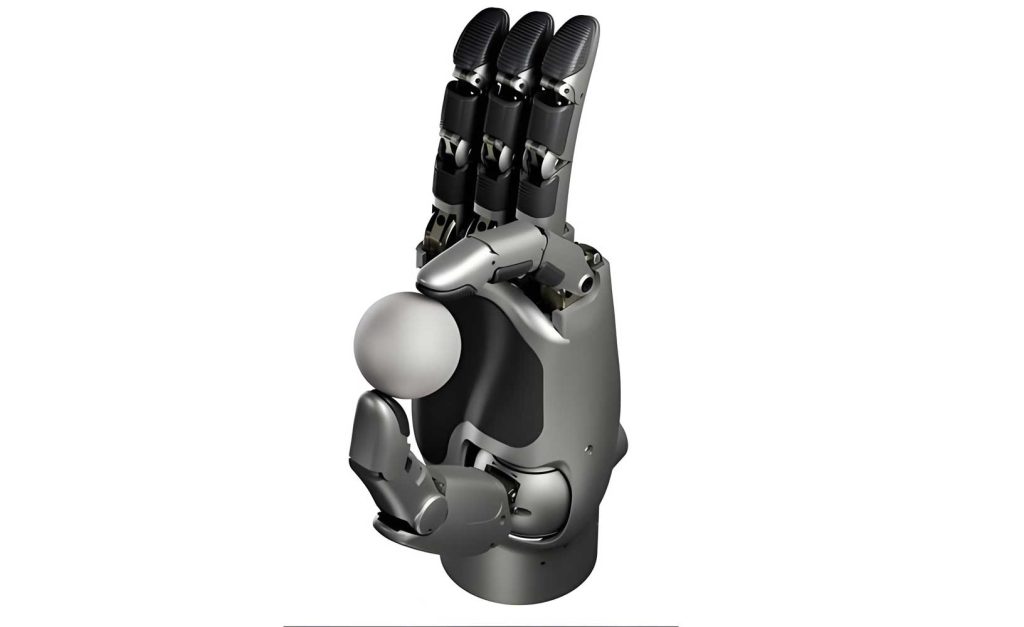
The true leap forward came with the ambition to create a multi-fingered dexterous robotic hand. The goal shifted from merely holding an object to actively manipulating it: re-orienting a screwdriver, twirling a pen, opening a bottle cap, or performing precise assembly. Early pioneers like the Okada hand, the Stanford/JPL hand, and the Utah/MIT hand established the architectural paradigm: multiple fingers (typically 3-5), each with multiple independently or semi-independently controlled joints, often driven by remote actuators via tendon systems. These foundational works highlighted both the immense potential and the daunting complexity of building a dexterous robotic hand.
The Inherent Complexity of a Dexterous Robotic Hand
The complexity of a modern dexterous robotic hand is multi-faceted, stemming from the intricate interplay of biomimetic design, actuation, sensing, materials, and control. Achieving human-like performance requires advances across all these domains simultaneously.
1. Biomimetic Structures and Mechanisms
The design of a dexterous robotic hand often starts with anatomical inspiration. However, replicating the elegance and functionality of the human hand’s skeletal and ligamentous system is profoundly difficult. Traditional approaches have relied on rigid pin joints and linkages, which offer precise control but lack compliance and adaptability. Tendon-driven systems, inspired by biological musculature, provide a lightweight and flexible alternative, allowing actuators to be placed in the forearm or palm. The force closure and motion of a tendon-driven finger can be modeled. For a finger with n joints, the relationship between tendon tensions $ \mathbf{T} = [T_1, T_2, …, T_m]^T $ and the resultant joint torques $ \mathbf{\tau} = [\tau_1, \tau_2, …, \tau_n]^T $ is given by:
$$ \mathbf{\tau} = \mathbf{R} \mathbf{T} $$
where $ \mathbf{R} $ is the moment arm matrix. This coupling introduces control challenges. More recent approaches explore soft and hybrid rigid-soft structures to achieve natural compliance and safe interaction. The ultimate frontier is deep biomimicry, attempting to replicate not just the form but the internal architecture of human joints and ligaments, though this often comes at the cost of increased mechanical complexity. The table below summarizes the primary design philosophies for a dexterous robotic hand.
| Design Philosophy | Key Advantages | Primary Challenges |
|---|---|---|
| Rigid Linkage & Gear-Driven | High precision, stiffness, and payload capacity; Direct drive potential. | Bulky, complex internal mechanisms; Poor shock absorption; Low compliance. |
| Tendon-Driven (Antagonistic) | Lightweight, compact finger design; Good force-to-weight ratio; Natural compliance. | Tendon friction/stretch; Complex routing; Low bandwidth; Potential for slack. |
| Soft / Continuum Robotics | Inherent safety and compliance; Excellent adaptability to object shapes. | Low stiffness and force output; Difficult kinematic/ dynamic modeling; Precision control. |
| Hybrid Rigid-Soft | Balances precision and adaptability; Can incorporate variable impedance. | Complex design integration; Challenging to model cross-domain dynamics. |
| Underactuated / Adaptive | Reduced number of actuators; Simplified control; Self-adaptive grasping. | Limited dexterity for manipulation; Grasping posture is morphology-dependent. |
| Bio-inspired Joint Mechanisms | High-fidelity replication of human motion and compliance. | Extremely complex fabrication and assembly; Difficult to instrument and maintain. |
2. Actuation and Transmission Systems
The choice of actuator is central to the performance of a dexterous robotic hand. Electric motors remain the most common due to their high precision, controllability, and integration ease. However, their weight and size often necessitate placement in the forearm, leading to complex tendon transmission systems. The fundamental trade-off between actuator density and performance is a key constraint. Pneumatic and hydraulic actuators offer higher power density and natural compliance, making them suitable for robust grasping. Pneumatic Artificial Muscles (PAMs), like McKibben muscles, provide a compact, high-force biomimetic actuator but suffer from nonlinear dynamics and limited bandwidth, modeled by a force relationship such as:
$$ F = P \cdot [a(1 – \epsilon)^2 – b] $$
where $ F $ is contraction force, $ P $ is pressure, $ \epsilon $ is strain, and $a$, $b$ are geometry-dependent constants. Emerging smart material actuators (SMA, DEA, ICPF) promise direct, silent actuation but are still limited by strain, speed, and efficiency. Transmission systems must efficiently convey motion and force from actuators to joints. While tendons dominate, novel methods like twisted string actuators (TSA) offer high reduction ratios in a compact form, where the contraction $ \Delta L $ is related to the number of twists $ N $ and the string radius $ r $:
$$ \Delta L = L_0 – \sqrt{L_0^2 – (2\pi N r)^2} $$
3. Sensing and Perception
A dexterous robotic hand is blind without sophisticated sensing. Sensing can be categorized as proprioceptive (internal state) and exteroceptive(external interaction). Proprioception includes joint position, velocity, and tendon tension. Exteroception is far more challenging and critical for dexterity, encompassing tactile sensing (normal force, shear force, vibration), thermal sensing, and even slip detection. The holy grail is a conformable, high-density “electronic skin” that can match the spatial and temporal resolution of human glabrous skin. Current technologies include resistive, capacitive, piezoresistive, and optical sensors embedded in soft substrates. The integration of multi-modal sensor arrays into the curved, compliant surfaces of a dexterous robotic hand while maintaining robustness and providing a tractable signal remains a major research hurdle.
4. Modeling, Planning, and Control
The control stack for a dexterous robotic hand is arguably its most complex layer. It begins with an accurate dynamic model. For a hand with $ n $ degrees of freedom, the equations of motion are:
$$ \mathbf{M}(\mathbf{q})\ddot{\mathbf{q}} + \mathbf{C}(\mathbf{q}, \dot{\mathbf{q}})\dot{\mathbf{q}} + \mathbf{g}(\mathbf{q}) = \boldsymbol{\tau}_{motor} – \boldsymbol{\tau}_{ext} $$
where $ \mathbf{q} $ is the joint angle vector, $ \mathbf{M} $ is the inertia matrix, $ \mathbf{C} $ captures Coriolis and centrifugal forces, $ \mathbf{g} $ is gravity, and $ \boldsymbol{\tau}_{ext} $ are external torques. For tendon-driven hands, this model must be coupled with tendon dynamics. Grasp planning involves finding a set of contact points $ \mathbf{c}_i $ and associated contact forces $ \mathbf{f}_i $ that yield a stable, force-closure grasp, often evaluated by the capacity to resist external wrenches within the friction cone constraints.
However, modeling for in-hand manipulation is exceedingly complex due to rolling and sliding contacts, changing dynamics, and underactuation. This has led to a significant shift towards data-driven and learning-based methods. Reinforcement Learning (RL) and Imitation Learning are now widely used to train control policies for complex manipulation skills directly, often in simulation with subsequent sim-to-real transfer. While powerful, these methods require vast amounts of data and their generalizability to novel objects and tasks is still an open question.
The Application Complexity and the Paradigm of Simplification
The drive for complexity in the design of a dexterous robotic hand is fundamentally motivated by the desire to simplify its use in complex real-world applications. This relationship is dialectical: we build complex systems to make complex tasks simple.
Levels of Functional Aspiration
The application demands on a dexterous robotic hand can be viewed at three ascending levels of complexity:
- Partial Function Replication: This level focuses on replicating specific motions or providing assistive force, as seen in rehabilitation exoskeletons or prosthetic hands for basic grasping. The dexterous robotic hand here is a specialized tool for a subset of human hand functions.
- Dexterous Operation Replication: This is the core challenge—enabling the dexterous robotic hand to perform the vast array of skilled manipulations a human hand can: using tools, assembling components, handling flexible materials. This level is the target for service robots, advanced manufacturing cobots, and logistics automation.
- Human Ability Enhancement: The ultimate frontier, where the dexterous robotic hand surpasses human capabilities in strength, precision, endurance, or by incorporating additional functionalities (e.g., built-in tools, magnetic grippers, extended degrees of freedom).
Simplifying Complex Applications
In traditional industrial automation, a complex assembly task is broken down into a sequence of simple operations, each performed by a dedicated, single-purpose tool or station on a fixed production line. This requires extensive system design, programming, and integration. A truly capable dexterous robotic hand颠覆s this paradigm. Imagine a single robotic workstation equipped with a dexterous robotic hand that can, within one fixture, pick up a screwdriver, grasp a screw, align it, drive it, put the tool down, and then manipulate the assembled part—all based on high-level task instructions.
The complexity of process planning, tool changing, and coordinated motion across multiple stations is absorbed by the planning and control intelligence of the dexterous robotic hand system. The user’s role shifts from low-level robotic programming to high-level task specification. This makes automation feasible for high-mix, low-volume production, which is increasingly the norm. The same principle applies in other domains: a logistics robot with a dexterous robotic hand can handle thousands of different item types without retooling, and a domestic assistant can operate standard household appliances. The sophisticated, “complex” hand becomes the universal tool that dramatically simplifies system integration, task programming, and operational flexibility.
Future Trends and Persistent Challenges
Despite remarkable progress, the vision of a dexterous robotic hand that matches the human hand in generality and robustness remains elusive. Future research must tackle several interconnected challenges.
| Research Frontier | Key Challenges | Potential Directions |
|---|---|---|
| Deep Biomimicry & Novel Mechanisms | Moving beyond superficial imitation to replicate the functional biomechanics of ligaments, joint congruence, and passive compliance. | Integrative design of multi-material joints; Leveraging compliant mechanisms and topological optimization; Bio-hybrid systems. |
| High-Density Flexible Perception | Creating durable, stretchable sensor skins with high spatiotemporal resolution for texture, shape, and force. | Nanomaterial-based sensors (e.g., carbon nanotubes, graphene); Neuromorphic tactile sensing chips; Distributed, event-driven sensing architectures. |
| Manipulation Planning & Control | Generating robust and generalizable plans for dexterous, in-hand manipulation with rolling contacts. | Combining physics-based models with deep learning; Learning compositional “manipulation primitives”; Improving sim-to-real transfer fidelity. |
| Cost-Effective Robustness | Bridging the gap between high-performance research prototypes and affordable, reliable commercial products. | Modular, manufacturable designs; Alternative materials and fabrication (e.g., 3D printing); Simplified yet effective underactuated designs for target domains. |
In conclusion, the development of the dexterous robotic hand is a journey of embracing complexity to achieve simplicity. We design intricate biomimetic structures, integrate novel actuators and dense sensor arrays, and develop advanced learning algorithms not as ends in themselves, but as means to an end. That end is to create a tool so capable and adaptable that it disappears into the task—a tool that allows a robot to interact with our world as naturally as we do, thereby simplifying the most complex applications in industry, healthcare, and daily life. The path forward requires continued interdisciplinary convergence, but the promise of a truly universal dexterous robotic hand continues to drive the field toward new heights of innovation.