
The landscape of robotics is undergoing a profound transformation, driven by two seemingly divergent yet equally revolutionary paths. On one front, we witness the emergence of highly specialized, mobile robotic systems designed to solve grand-scale engineering challenges, fundamentally altering paradigms in sectors like aerospace manufacturing. On the other, the evolution of the humanoid robot continues, now focusing on unprecedented adaptability and real-world utility through innovative form-factor morphing. This article delves into these two critical frontiers, exploring the underlying principles, technological breakthroughs, and the future they are collectively shaping. My analysis will synthesize engineering concepts, present comparative frameworks, and project the trajectory of intelligent robotic systems.
The first major breakthrough centers on a mobile hybrid robotic system engineered for in-situ machining of large, complex components. The core challenge in manufacturing structures for spacecraft, satellite panels, or large marine vessels lies in their sheer size and the stringent precision requirements. Traditional methods often involve moving the massive part to a fixed, gigantic multi-axis machine tool—a logistically daunting and potentially accuracy-compromising process. The novel solution inverts this paradigm: instead of moving the part to the machine, a mobile robot brings a high-precision machining unit to the part.
This system is architecturally a “hybrid” or “混联” robot, masterfully combining the strengths of serial and parallel kinematics. Its design can be broken down into three synergistic layers, governed by a unified “type-performance-precision” interactive design theory for parallel mechanisms.
| System Layer | Primary Function | Key Innovation | Mathematical/Control Challenge |
|---|---|---|---|
| 1. Omnidirectional Mobile Platform | Macro-positioning over large workspaces (e.g., a factory floor or inside a rocket fuel tank). | High-payload mobility with stability for precision tasks. | Path planning and vibration damping during transit. State estimation given by: $$\dot{\mathbf{x}}_p = f_p(\mathbf{x}_p, \mathbf{u}_p) + \mathbf{w}_p$$ where $\mathbf{x}_p$ is the platform pose and $\mathbf{w}_p$ is process noise. |
| 2. High-Stiffness Positioning Parallel Mechanism | Medium-range, high-stiffness orientation and positioning of the end-effector. | A lightweight, coupled 5-degree-of-freedom (DoF) fully parallel mechanism. | Solving the inverse kinematics for a 5-DoF parallel manipulator. The joint variables $\mathbf{q}$ are found from the desired tool pose $\mathbf{T}$: $$\mathbf{q} = \mathcal{K}^{-1}(\mathbf{T})$$ |
| 3. High-Precision Five-Axis Machining Module (Serial Kinematics) | Micro-scale, ultra-precision milling (“sculpting”). | Integration of a precision spindle and cutting tools onto the hybrid mobile base. | Tool path generation and compensation for residual errors from Layers 1 & 2. The tool tip position $\mathbf{p}_t$ is: $$\mathbf{p}_t = \mathbf{T}_p \cdot \mathbf{T}_m \cdot \mathbf{T}_s(\theta)$$ where $\mathbf{T}$ denotes transformation matrices. |
The true genius lies in the “hand-eye-brain” collaborative in-situ processing model. The “brain” is the central planning and adaptive control system. The “eye” comprises a cross-scale measurement system, likely using laser trackers and optical scanners, which builds a real-time digital twin of the workpiece. This model is described by a point cloud $\mathcal{P} = \{\mathbf{p}_1, \mathbf{p}_2, …, \mathbf{p}_n\}$. The “hand” is the hybrid robot itself. The system’s control law must dynamically reconcile the static accuracy of the machining module with the dynamic errors introduced by the mobile platform’s positioning, a problem of co-regulating multiple coordinate frames. The overall error budget $\mathbf{E}_{total}$ can be modeled as a sum:
$$\mathbf{E}_{total} = \mathbf{E}_{kinematic} + \mathbf{E}_{dynamic}(\ddot{\mathbf{q}}, \dot{\mathbf{q}}) + \mathbf{E}_{thermal} + \mathbf{E}_{cutting}$$
where $\mathbf{E}_{kinematic}$ arises from geometric calibration errors in the parallel mechanism, solvable through parameter identification, and $\mathbf{E}_{dynamic}$ is a function of joint accelerations and velocities.
This convergence enables a “large-scale positioning + local five-axis fine sculpting” strategy. The economic and technical impact is transformative, allowing for the on-site creation and repair of monolithic structures that were previously impossible or prohibitively expensive to machine, thereby ushering in a new era of agile, distributed manufacturing for megastructures.
Parallel to this, the field of the humanoid robot is pivoting from pure bipedal locomotion towards functional versatility in human-centric environments. The latest evolution is the introduction of a dual-form humanoid robot, a concept that dramatically enhances operational range and task adaptability. The primary limitation of a traditional bipedal humanoid robot is energy efficiency and speed over long, flat distances—a wheeled base is far superior for traversal. The dual-form design intelligently switches between these two modalities.
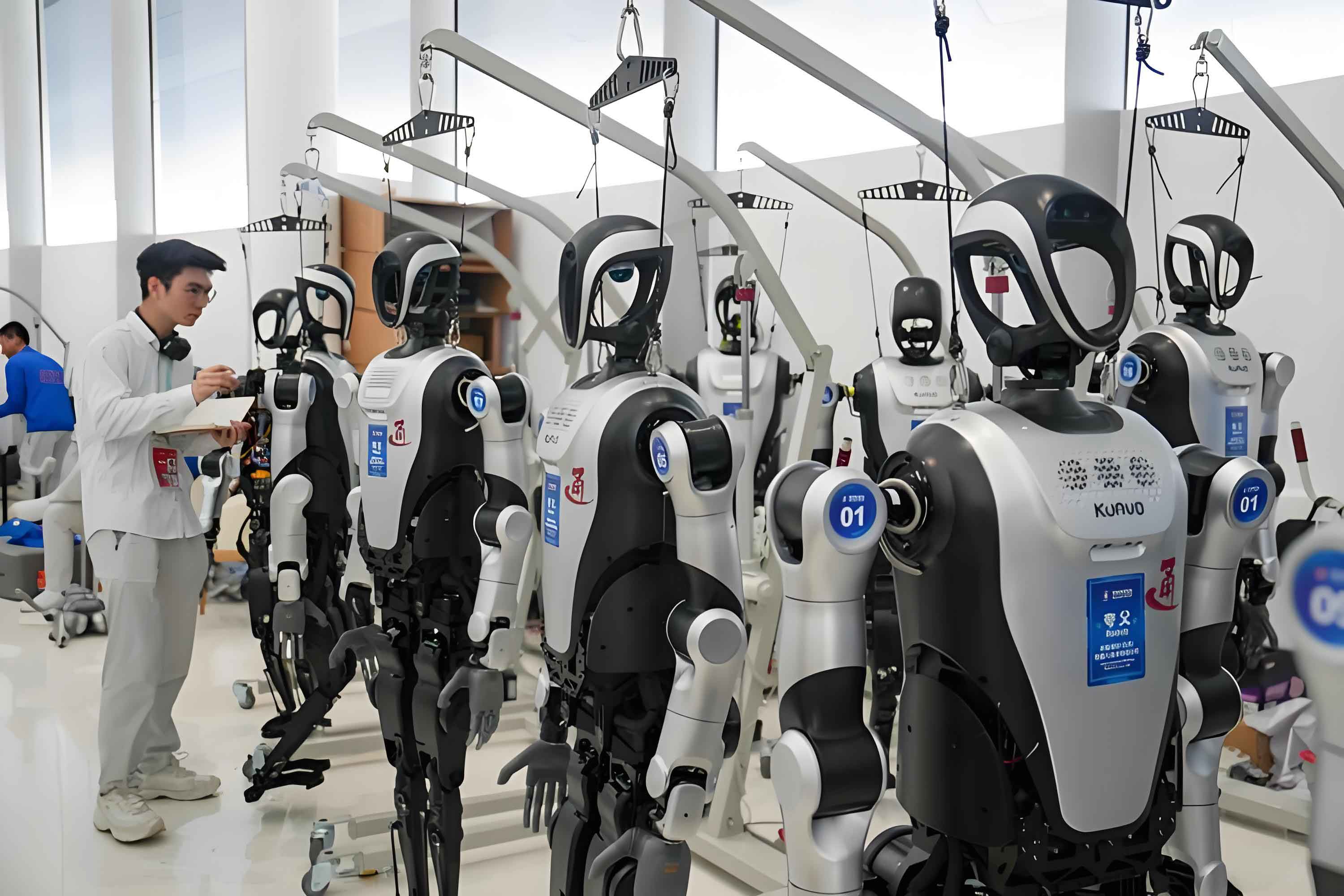
This humanoid robot operates in two distinct modes, each with optimized kinematics and dynamics:
| Operational Mode | Morphology | Primary Use Case | Governing Kinematics | Advantage |
|---|---|---|---|---|
| Bipedal/Humanoid Mode | Standard anthropomorphic form with legs. | Navigation over uneven terrain, climbing stairs, performing upper-body tasks in confined spaces designed for humans. | Modeled as a floating-base multi-body system. The equation of motion is: $$\mathbf{M}(\mathbf{q})\ddot{\mathbf{q}} + \mathbf{C}(\mathbf{q}, \dot{\mathbf{q}}) = \mathbf{S}^T \boldsymbol{\tau} + \mathbf{J}_c^T \mathbf{F}_c$$ where $\mathbf{M}$ is the inertia matrix, $\mathbf{C}$ contains Coriolis/gravity terms, and $\mathbf{J}_c$ is the contact Jacobian. | Unmatched adaptability to human infrastructure. |
| “Cavalry” / Wheeled Mode | Upper humanoid torso mounted on a separable wheeled底盘 (chassis). | Rapid, efficient coverage of large (>10,000 m²), flat areas (office floors, shopping malls, airports). | Modeled as a wheeled mobile manipulator. The base velocity $\dot{\mathbf{x}}_b = [\dot{x}, \dot{y}, \dot{\theta}]^T$ is related to wheel velocities $\boldsymbol{\omega}_w$ via: $$\dot{\mathbf{x}}_b = \mathbf{R}(\theta) \mathbf{J} \boldsymbol{\omega}_w$$ | High endurance, speed, and stability for patrol, delivery, or guidance tasks. |
The seamless transition between these modes is a software and mechanical marvel. It requires a unified state estimation framework that fuses data from LiDAR, cameras, and inertial measurement units (IMUs) to understand the robot’s context and decide on mode switching. The decision logic can be framed as a cost minimization problem:
$$ \text{Mode}^{*} = \arg\min_{m \in \{Biped, Wheeled\}} \left( \alpha \cdot C_{time}(m, \mathcal{E}) + \beta \cdot C_{energy}(m, \mathcal{E}) + \gamma \cdot C_{task}(m, \mathcal{T}) \right) $$
where $\mathcal{E}$ represents the perceived environment (stairs, carpet, open space) and $\mathcal{T}$ is the current task.
At the heart of its utility is the embodied AI system, which provides robust human-robot interaction (HRI). This system integrates several modules: Automatic Speech Recognition (ASR) with acoustic source localization, a Natural Language Understanding (NLU) module for intent extraction, a dialogue manager supporting multi-turn conversations and interruption handling, and a Text-to-Speech (TTS) engine. The NLU module often uses a probabilistic model to find the most likely intent $I^*$ given an utterance $U$: $$I^* = \arg\max_{I \in \mathcal{I}} P(I | U) = \arg\max_{I \in \mathcal{I}} P(U | I) P(I)$$. This, combined with a large knowledge graph $\mathcal{KG} = (V, E)$ of entities and relations, allows the humanoid robot to act as an informative guide or concierge.
Furthermore, autonomous functions like 3D SLAM (Simultaneous Localization and Mapping), path planning, and elevator interaction via “elevator control integration” enable it to operate as a fully autonomous agent in multi-story buildings. The SLAM problem is often solved by optimizing a pose graph: $$\boldsymbol{\Theta}^* = \arg\min_{\boldsymbol{\Theta}} \sum_{\langle i,j \rangle} \lVert \mathbf{e}_{ij}(\boldsymbol{\theta}_i, \boldsymbol{\theta}_j, \mathbf{z}_{ij}) \rVert^2_{\boldsymbol{\Sigma}_{ij}}$$ where $\boldsymbol{\Theta} = \{\boldsymbol{\theta}_1, …\}$ are robot poses and $\mathbf{e}_{ij}$ is an error term between measured $\mathbf{z}_{ij}$ and predicted relative pose.
Let us now synthesize and contrast these two revolutionary strands of development. While one is a task-specific “super-tool” and the other a general-purpose “human proxy,” they share profound underlying technological synergies.
| Comparative Dimension | Mobile Hybrid Machining Robot | Dual-Form Humanoid Robot | Common Technological Core |
|---|---|---|---|
| Primary Design Driver | Extreme Precision and Stiffness for Material Removal | Adaptive Mobility and Natural Interaction in Human Spaces | Task-Optimized Kinematic Architecture |
| Core Innovation | Hybrid (Serial-Parallel) Kinematics & Mobile In-Situ Operation | Morphological Reconfiguration (Biped/Wheeled) | Dynamic Reconfiguration of Degrees-of-Freedom and Workspace |
| Key Sensory Input | Cross-scale Metrology (Laser, Vision) for Localization & Part Mapping | Multi-modal Perception (LiDAR, Vision, Audio) for Navigation & HRI | Sensor Fusion for Real-Time World Modeling |
| Central Control Challenge | Cooperative Static/Dynamic Error Compensation Across Subsystems | Unified Locomotion & Manipulation Planning Across Morphologies | Hierarchical, Real-Time Control of Complex Multi-Body Systems |
| Mathematical Foundation | Parallel Mechanism Kinematics/Dynamics, Error Modeling | Floating-Base Dynamics, SLAM, NLP | Rigid-Body Dynamics, Optimization Theory, State Estimation | Target “Environment” | Structured but Gigantic (Factory, Hangar, Construction Site) | Semi-Structured Human Environments (Office, Mall, Hospital) | Non-ideal, Real-World Spaces Requiring Autonomous Adaptation |
The convergence point for these technologies is the overarching principle of embodied intelligence—where sensing, computation, and action are tightly integrated within a physical body to solve problems in the real world. The machining robot embodies intelligence for precision fabrication, while the humanoid robot embodies intelligence for social and logistical service. Both represent a move away from robots as static, cage-bound automata and towards them as mobile, perceptive, and dexterous partners.
Looking forward, we can extrapolate several trends. The mobile precision robot paradigm will likely shrink in scale, leading to agile robotic systems for in-situ maintenance and construction in fields like wind energy, shipbuilding, and large-scale 3D printing. The algorithms for dynamic compensation and “hand-eye-brain” coordination will become more sophisticated, potentially leveraging real-time finite element analysis to predict and correct for workpiece deflection during machining.
For the humanoid robot, the future lies in greater specialization and ecosystem integration. We will see variations optimized for logistics (warehouse humanoid robots), healthcare (elderly assistance humanoid robots), and public service (security and guidance humanoid robots). The dual-form factor may evolve into multi-form, with perhaps climbing or even aquatic capabilities for disaster response scenarios. The embodied AI will evolve from task-oriented dialogue to include affective computing, enabling the robot to perceive and appropriately respond to human emotional states, a key step for true social integration. Furthermore, swarms of collaborative humanoid robots, communicating and coordinating to perform complex tasks, will emerge from research labs into practical applications.
In conclusion, the robotics field is not on a single path but is advancing on multiple, interconnected fronts. The development of macro-scale mobile machining robots solves fundamental industrial challenges by rethinking the relationship between the tool and the workpiece. Concurrently, the refinement of the adaptable humanoid robot aims to seamlessly embed intelligent robotic agents into the fabric of daily human life. Both trajectories are propelled by advances in core theories of mechanics, control, perception, and artificial intelligence. They demonstrate that the next decade in robotics will be defined not just by making robots stronger or faster, but by making them profoundly more adaptable, context-aware, and capable of performing complex, high-value tasks in the unstructured and demanding theater of the real world.