
As a researcher deeply immersed in the study of intelligent systems and their industrial applications, I observe a pivotal shift on the horizon. The manufacturing sector, long the backbone of economic power, is undergoing a fundamental transformation. Traditional automation, while revolutionary in its own right, has reached its limits in managing the complexity, dynamism, and demand for customization that defines modern markets. The next great leap forward is driven not by passive machines, but by intelligent entities that can perceive, learn, and act within the physical world. This is the era of the embodied AI robot—a system that integrates a physical or virtual body with a cognitive core capable of interactive learning and autonomous decision-making. The emergence of this technology promises not merely to optimize existing workflows but to fundamentally rewrite the rules of manufacturing, from the factory floor to the global supply chain.
At its core, an embodied AI robot represents a convergence of two critical components: a body for interaction and a mind for cognition. The body, or the embodiment, provides the means to sense and act upon the environment. This is realized through advanced hardware such as multi-modal sensors (force, tactile, inertial, vision) and sophisticated robotic forms, most notably humanoid robots designed for general-purpose tasks. The mind is powered by the breakthroughs in artificial intelligence, particularly large foundation models. While Large Language Models (LLMs) provide a foundation for reasoning and instruction-following, the true cognitive engine for embodiment is the Multimodal Large Model (LMM). These models can process and correlate visual, linguistic, and sensory data, enabling the embodied AI robot to understand contextual scenes, generate task plans, and answer queries about its physical surroundings. The final, crucial link is control. Training a robot to perform dexterous tasks is achieved through two primary methods: simulation in high-fidelity virtual environments (e.g., Omniverse, iGibson) for scalable reinforcement learning, and dynamic motion capture from human demonstrations for teaching complex, nuanced skills.
| Component | Core Technologies | Function in the Embodied AI Robot |
|---|---|---|
| Embodiment (Body) | Smart Sensors (Vision, Force, Tactile), Humanoid Robotics (Actuators, Manipulators), Mobility Systems. | Provides perception and physical interaction with the world. It is the source of multi-modal sensory data and the actuator for tasks. |
| Cognition (Mind) | Multimodal Large Models (LMMs), Vision-Language Models (VLMs), Reinforcement Learning Algorithms. | Processes sensory data, understands context, generates task plans, makes decisions, and learns from interaction. |
| Training & Control | Virtual Simulation Platforms, Dynamic Motion Capture, Teleoperation Suites. | Enables the scalable learning of skills (simulation) and the transfer of complex human expertise (motion capture) to the robot. |
The profound impact of the embodied AI robot on manufacturing can be understood through several interconnected theoretical lenses. First, it acts as a transformative agent within the production function. Traditionally, output $Y$ is modeled as a function of capital $K$, labor $L$, and technology $A$, often in a Cobb-Douglas form: $Y = A \cdot K^\alpha \cdot L^\beta$. The embodied AI robot redefines these inputs. It constitutes a new form of capital that is inherently intelligent and adaptable. More critically, it is both the primary “miner” and a generative source of the new key production factor: data ($D$). Through continuous interaction, it extracts high-value, task-specific data and uses it to generate new operational knowledge, effectively overcoming the “data bottleneck.” Simultaneously, it alters the labor factor $L$, not merely displacing it but redefining its composition from manual, repetitive tasks to supervisory, creative, and maintenance roles focused on the AI systems themselves.
Second, the embodied AI robot revolutionizes human-machine relations. It transcends the paradigm of a “tool” to become an interactive “collaborator.” This shift enables interactive management, where humans provide high-level goals and oversight, while the embodied AI robot handles execution, real-time optimization, and even suggests process improvements based on its learned experience. This leads to a co-production model where the unique strengths of human intuition and robotic precision, endurance, and computational power are synergistically combined.
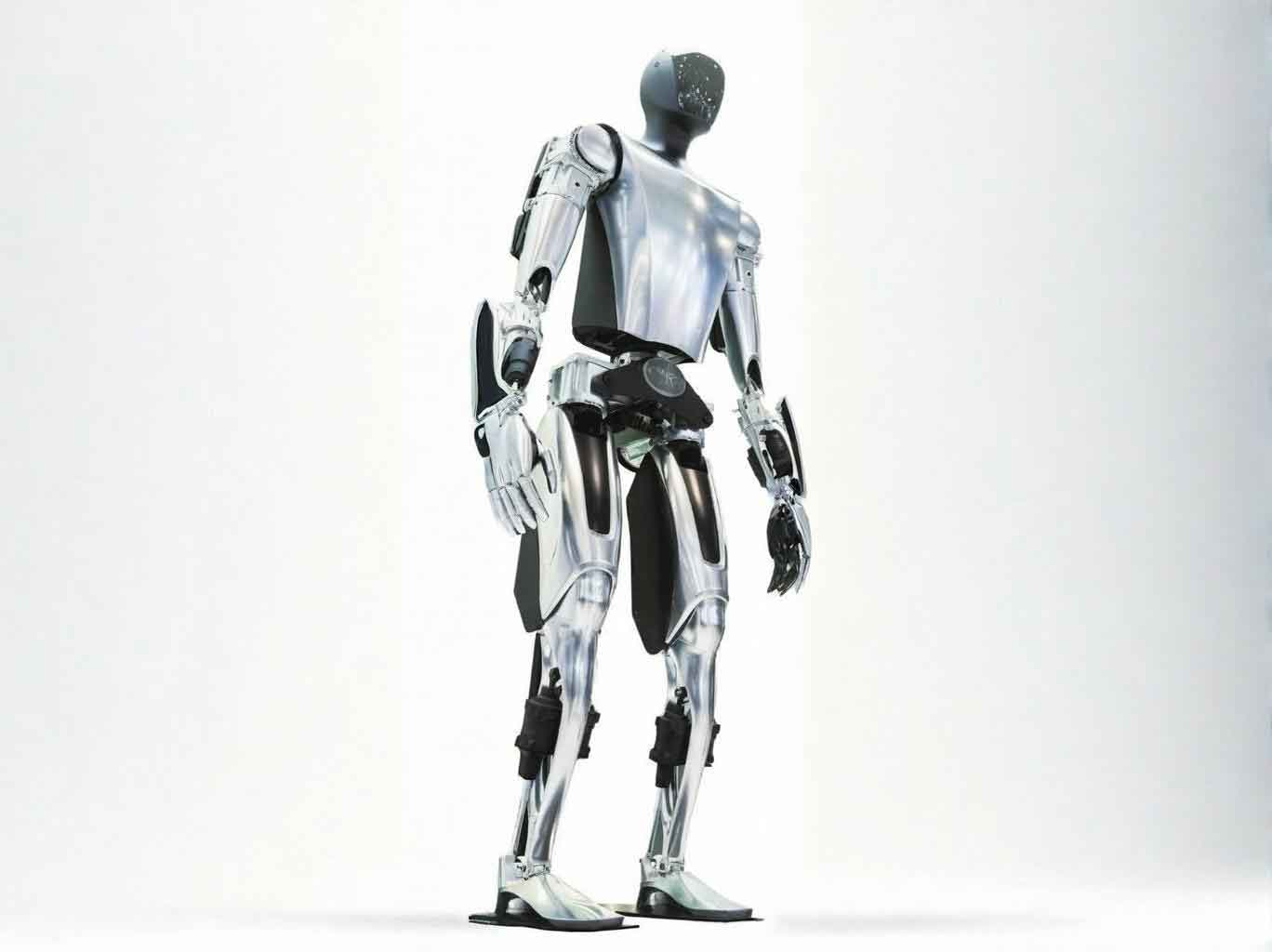
The practical manifestation of this theory is a comprehensive reshaping of the manufacturing workflow. The integration of the embodied AI robot creates a seamless, intelligent, and self-optimizing production ecosystem. Imagine a production line where each station is manned or assisted by an embodied AI robot. These agents do not execute pre-programmed routines blindly. They visually inspect incoming parts, adapting their grip and assembly sequence to minor variations. They monitor their own tool wear and predict maintenance needs. They communicate with upstream and downstream stations, dynamically balancing the line in response to a bottleneck or a priority order change. In logistics, an embodied AI robot navigates a warehouse, not along fixed paths, but by dynamically understanding its environment, identifying optimal pick routes, and safely collaborating with human workers. This results in a leap in productivity, quality, and flexibility.
The most significant transformation may be the shift towards a true, comprehensive flexible manufacturing paradigm. Traditional flexible manufacturing systems (FMS) are limited to a pre-defined set of variants. An embodied AI robot-driven system enables generative manufacturing. Here, the embodied AI robot serves as the physical bridge between digital design and physical instantiation. A customer’s personalized requirements can be processed by a generative design AI, and the resulting unique blueprint can be directly executed by the re-tooled and re-instructed embodied AI robot on the floor. This enables mass customization at scale, blurring the line between prototyping and mass production and moving towards a model of demand-driven, on-the-fly fabrication.
| Manufacturing Stage | Traditional/Pre-Embodied AI | Transformed by the Embodied AI Robot |
|---|---|---|
| Design & Planning | CAD software, human-centric planning. Fixed process routes. | Generative design co-piloted by AI. Dynamic, AI-optimized production planning. Digital twins validated by robot interaction. |
| Assembly & Production | Robotic arms with fixed programming. Limited adaptability. | Dexterous, sensor-rich embodied AI robots handling complex, variable assemblies. Real-time adaptation to part variances. |
| Quality Inspection | Machine vision systems for specific defects. Sampled testing. | Comprehensive, multi-sensor (visual, tactile) 100% inspection by embodied AI robots. Defect root-cause analysis and feedback to production. |
| Logistics & Maintenance | AGVs on fixed routes. Scheduled, preventive maintenance. | Autonomous mobile embodied AI robots for dynamic material handling. Predictive maintenance performed or assisted by robots. |
The ripple effects of this workflow transformation extend far beyond the factory walls, fundamentally altering the industrial landscape. The embodied AI robot is a key enabler of deep servitization and the fusion of manufacturing and services. As these robots manage production, they also generate continuous streams of performance data, enabling new “product-as-a-service” models. For example, a manufacturer can sell “guaranteed uptime” for industrial equipment, with embodied AI robots (on-site or remote) performing the predictive and corrective maintenance. This fusion challenges traditional metrics like manufacturing’s share of GDP, suggesting new indicators such as “embodied AI intensity” are needed.
Economically, the widespread adoption of embodied AI robot technology addresses a chronic modern challenge: Baumol’s Cost Disease. This phenomenon describes how sectors with slow productivity growth (like many services) see rising relative costs, pulling resources away from high-productivity sectors like manufacturing and slowing overall economic growth. The embodied AI robot is a general-purpose technology that dramatically boosts productivity in both manufacturing and services (e.g., in logistics, healthcare, retail). By narrowing the productivity growth gap, it mitigates the structural shift and associated economic drag, helping to stabilize the economic role of manufacturing.
We can model this effect. Let $g_m$ and $g_s$ be the total factor productivity (TFP) growth rates in manufacturing and services, respectively. Baumol’s disease occurs when $g_m > g_s$, leading to a rising relative price of services and a shift in employment. The embodied AI robot elevates $g_s$ significantly. The growth differential narrows:
$$
\Delta g = g_m – g_s \rightarrow 0
$$
This results in more balanced relative price changes and a stabilization of sectoral shares in the economy.
On a global scale, the embodied AI robot is a dual-force for supply chain resilience and regionalization. Its ability to enable flexible, small-batch production reduces the dependency on long, cost-optimized global supply chains for every component. It makes re-shoring or near-shoring more economically viable by allowing local factories to be highly adaptive and efficient. At the same time, the intelligent connectivity of these systems allows for smarter, more resilient global networks. An embodied AI robot-equipped factory in one region can dynamically adjust its production in real-time based on demand signals, disruption alerts, or logistics data from another continent, contributing to a globally integrated yet regionally robust industrial ecosystem.
However, the path to this future is fraught with significant challenges. Technically, we face the “hardware bottleneck.” Creating a cost-effective, reliable, and dexterous embodied AI robot body requires breakthroughs in materials, actuators (like high-torque density motors), and sensor fusion. The cognitive software stack is equally daunting, requiring LMMs that are not just conversational but are grounded in physical reality and capable of long-horizon, sequential task planning. The data challenge is unique: training requires massive amounts of interaction data from the physical world, which is expensive and slow to acquire. While simulation helps, the “sim-to-real” gap—transferring skills learned virtually to the messy physical world—remains a central research problem.
| Challenge Category | Specific Issues | Potential Impact |
|---|---|---|
| Technological | Dexterous manipulation, affordable hardware, sim-to-real transfer, real-time multi-modal reasoning. | Slows deployment, limits capabilities to simple tasks, increases cost. |
| Economic & Operational | High initial CAPEX, unclear ROI for complex tasks, integration with legacy systems, workforce transition. | Limits adoption to large firms, creates implementation hurdles, causes social friction. |
| Ethical & Societal | Job displacement in certain roles, data privacy and security, safety and liability for autonomous actions, algorithmic bias. | Erodes public acceptance, creates legal and regulatory uncertainty, risks reinforcing inequalities. |
Economically, the high capital expenditure for advanced embodied AI robot systems poses a barrier, especially for SMEs. The business case must evolve beyond labor substitution to value creation through flexibility, quality, and new services. Ethically and socially, the displacement of routine manual and even some cognitive jobs is inevitable, necessitating major initiatives in workforce reskilling and social safety nets. Questions of safety, liability (who is responsible when an autonomous embodied AI robot makes an error?), and data privacy in highly sensor-laden environments must be addressed through robust governance frameworks.
To accelerate the development and positive integration of the embodied AI robot, a multi-faceted strategy is essential. The guiding principle should be application-pull rather than pure technology-push. Nations with mature and diverse manufacturing bases must leverage this as a competitive advantage. Policies should incentivize pilot projects in high-value, complex manufacturing sectors (e.g., aerospace, semiconductors, biopharma) where the unique capabilities of an embodied AI robot can solve tangible bottlenecks. The rich, high-stakes data generated from these real-world applications will, in turn, fuel the iterative improvement of the AI models and robotic hardware, creating a virtuous cycle of innovation.
Technologically, we must foster cross-disciplinary collaboration. The embodied AI robot sits at the nexus of materials science, mechanical engineering, computer science, and cognitive neuroscience. Investment should focus on creating shared, open-platform infrastructure for development, such as universal robotic simulation environments and benchmark task suites. Furthermore, the ecosystem strategy should encourage a collaborative division of labor: large “anchor” enterprises can drive the development of foundational, general-purpose embodied AI robot platforms and core AI models, while smaller, agile firms innovate on specific vertical applications, tooling, and integration services.
Finally, proactive and adaptive governance is critical. This involves creating standards for interoperability, safety, and data exchange to prevent market fragmentation. Concurrently, ethical guidelines and regulations must be developed to ensure human oversight (the “human-in-the-loop” principle), algorithmic transparency, and clear accountability structures. Most importantly, societal adaptation must be supported through comprehensive education reform and lifelong learning programs, preparing the workforce not to compete with the embodied AI robot, but to architect, train, maintain, and collaborate with it.
In conclusion, the embodied AI robot is far more than an incremental upgrade to industrial automation. It represents a paradigm shift towards a manufacturing ecosystem that is intelligent, adaptive, and deeply integrated with human intention. By reshaping the production function, reinventing human-machine collaboration, and enabling unprecedented flexibility, it holds the key to addressing pressing economic challenges like productivity stagnation and supply chain fragility. The journey ahead is complex, requiring synchronized advances in technology, business models, and social policy. However, by strategically fostering application-driven innovation, cross-disciplinary collaboration, and responsible governance, we can steer the development of the embodied AI robot towards a future where it amplifies human potential and builds a more resilient, innovative, and sustainable industrial base for the global economy.