
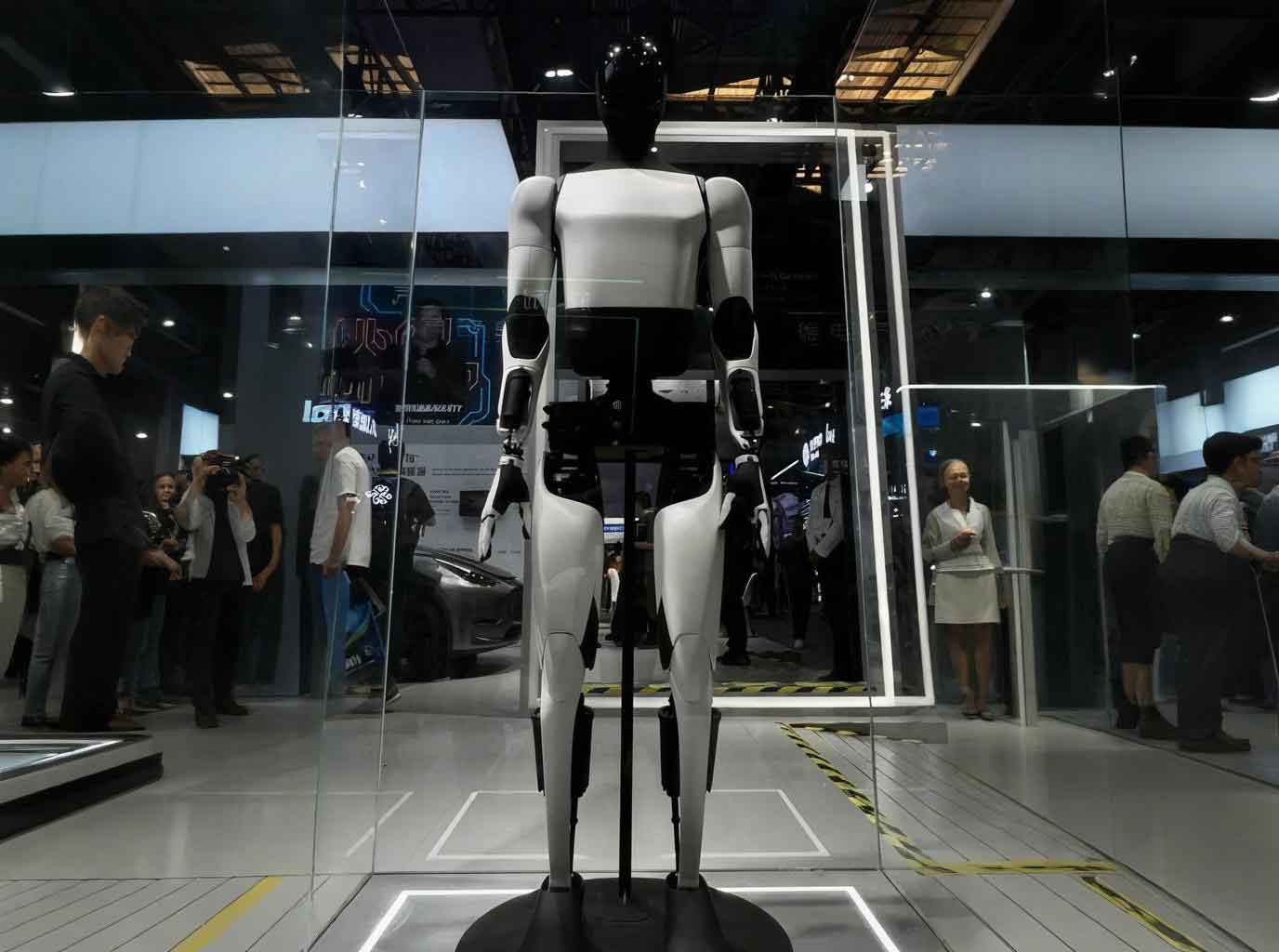
The global manufacturing landscape is undergoing a profound transformation, with smart manufacturing emerging as the strategic core for achieving high-quality industrial development. While traditional automation and digital tools have laid a crucial foundation, a significant gap persists between the potential of intelligent technologies and their tangible, value-driven application on the factory floor. The advent of embodied AI robot systems presents a historic opportunity to bridge this gap. Unlike disembodied AI that operates solely within digital realms, an embodied AI robot possesses a physical form—a robotic agent—that can perceive, reason, act, and learn through direct interaction with the physical environment. This paradigm shift is not merely a technological upgrade; it represents a fundamental rethinking of manufacturing organization, system architecture, and core capabilities. This article systematically explores the innovative framework and application patterns through which embodied AI robot technology drives the next evolution of smart manufacturing.
The Symbiotic Relationship: Embodied AI and Smart Manufacturing
The integration of embodied AI robot systems into manufacturing creates a symbiotic relationship that manifests across organizational, systemic, and technological layers.
At the organizational level, the embodied AI robot acts as a versatile, intelligent organizational unit. It dynamically integrates functions across the hierarchy of smart manufacturing, from individual intelligent units (e.g., a single manipulator) to complex systems (e.g., an assembly cell) and systems-of-systems (e.g., a full production line). This enables agile responses to varying production demands for planning, scheduling, execution, and quality control.
At the systemic level, the embodied AI robot provides an optimal realization of the Human-Cyber-Physical System (HCPS) that underpins smart manufacturing. The “embodiment” provides the physical actuator within the production space, while the “AI” core constitutes a powerful upgrade to the cyber system. This synergy enhances information processing, enables knowledge generation, and optimizes control over physical processes, leading to unprecedented levels of autonomy and self-configuration.
At the technological level, the core competency stack of an embodied AI robot perfectly aligns with the target functions of a smart manufacturing system, as detailed in Table 1.
| Embodied AI Robot Core Module | Key Technological Capabilities | Smart Manufacturing Target Function | Manufacturing Impact |
|---|---|---|---|
| Perception | Multimodal sensing (vision, force/torque, tactile); SLAM; Scene understanding. | Self-Perception | Real-time mapping of physical shop floor to digital twin; monitoring of workpiece state, equipment health. |
| Decision | Task decomposition & planning; Reasoning with LLMs/VLMs; Dynamic scheduling. | Self-Decision | Generating optimal process plans, execution sequences, and scheduling responses to disruptions. |
| Action | Precise motor control; Imitation/Reinforcement Learning for manipulation; Trajectory optimization. | Self-Execution | Physically carrying out complex assembly, handling, and processing tasks with high precision. |
| Learning & Adaptation | Reinforcement Learning from feedback; Sim-to-real transfer; Continuous optimization. | Self-Learning & Self-Adaptation | System improves from experience, adapts to new product variants, and optimizes its own performance parameters. |
This alignment can be modeled as a closed-loop process where the embodied AI robot continuously refines its operation. The perception module $P$ observes the state $s_t$ of the environment. The decision module $D$, often powered by a policy $\pi_\theta$ parameterized by $\theta$, processes this to choose an action $a_t$.
$$a_t = \pi_\theta(P(s_t))$$
The action is executed, leading to a new state $s_{t+1}$ and a reward $r_t$ (e.g., task completion success, energy efficiency). The learning module $L$ uses this experience tuple $(s_t, a_t, r_t, s_{t+1})$ to update the policy parameters $\theta$, enhancing future performance.
$$\theta \leftarrow L(\theta; s_t, a_t, r_t, s_{t+1})$$
This loop empowers the embodied AI robot to achieve the self-* properties central to advanced smart manufacturing.
The Three-Dimensional Innovation Framework
The transformative impact of the embodied AI robot on smart manufacturing can be conceptualized through a three-dimensional innovation framework: Production Space, Production Capacity, and Production Process.
1. Production Space: Creating a Cyber-Physical Continuum
The embodied AI robot acts as a bidirectional bridge between the physical and digital worlds. Its sensors create a high-fidelity, real-time map of the physical workshop, feeding data into a dynamic Digital Twin. This enables a true cyber-physical continuum where:
- Virtual-Real Mapping: Every entity (robot, workpiece, AGV) has a synchronized digital counterpart. Changes in one are reflected in the other.
- Cloud-Edge-End Collaborative Computing: The embodied AI robot leverages edge computing for low-latency, real-time control ($\text{Action}$) while offloading heavy perception ($P$) and learning ($L$) tasks to the cloud. This creates a shared computational fabric. Data from all embodied AI robot instances aggregate in the cloud, forming a massive, continuously growing knowledge base $K$ that benefits all systems.
$$K_{t+1} = K_t \cup \bigcup_{i=1}^{N} D_i^{(t)}$$
where $D_i^{(t)}$ is the data generated by the i-th embodied AI robot at time $t$, and $N$ is the total number of robots.
2. Production Capacity: A Triad of Core Restructuring
The embodied AI robot drives a fundamental restructuring of manufacturing capacity across three interconnected pillars, as summarized in Table 2.
| Pillar | Traditional State | Embodied AI Robot-Driven State | Key Enablers |
|---|---|---|---|
| Data Element | Siloed, static data; manual collection. | End-to-end, real-time data flow; autonomous generation via robot interaction. | Robot sensors; unified data models; IoT integration. |
| Intelligent Paradigm | Rule-based automation; limited adaptability. | Generalizable perception, reasoning, and action; continuous learning from physical feedback. | Multimodal Foundation Models (PaLM-E, RT-X); World Models; Reinforcement Learning. |
| Production Mode | Fixed automation; rigid human-machine boundaries. | Flexible autonomy; safe & intuitive human-robot collaboration (HRC); multi-robot coordination. | Natural language interfaces; impedance control; centralized multi-agent scheduling. |
The intelligent paradigm shift is particularly critical. It moves from specialized, brittle automation to a more general form of intelligence. For instance, a grasping policy for an embodied AI robot trained via deep reinforcement learning can be formulated as maximizing the expected cumulative reward $J(\theta)$:
$$J(\theta) = \mathbb{E}_{\tau \sim \pi_\theta} \left[ \sum_{t=0}^{T} \gamma^t r(s_t, a_t) \right]$$
where $\tau = (s_0, a_0, …, s_T)$ is a trajectory, and $\gamma$ is a discount factor. This allows the embodied AI robot to learn robust, adaptive strategies directly from interaction.
3. Production Process: End-to-End Intelligence Infusion
The embodied AI robot infuses intelligence across the entire product lifecycle. In R&D, it enables human-in-the-loop design and high-fidelity virtual prototyping. In production, it brings flexibility to assembly, welding, and finishing. In operations and maintenance, it enables autonomous inspection and predictive repair. This creates a fully integrated, intelligent manufacturing process flow.
Application Modes in Key Manufacturing Segments
1. Smart Production Lines
Here, the embodied AI robot transitions the line from static automation to dynamic, cognitive automation.
- Autonomous Decision & Optimization: The embodied AI robot can reschedule its own tasks in real-time based on line state, part availability, and priority changes, moving beyond fixed programming.
- Deep Human-Robot Collaboration (HRC): With advanced natural language and gesture understanding, an embodied AI robot can achieve intent alignment with human workers. It can respond to complex verbal instructions like, “Pause that and help me with this jammed fixture on Cell B.”
- Customized Production: The flexibility of the embodied AI robot makes small-batch, high-mix production economically viable. It can quickly be reprogrammed via demonstration or instruction to handle new product variants.
2. Smart Logistics and Warehousing
Embodied AI robot systems are revolutionizing material handling.
- Intelligent Storage & Retrieval: Robotic shuttles and humanoid robots like Digit can navigate dense, dynamic storage racks, optimizing space and retrieval times based on real-time demand signals.
- Smart Picking & Sorting: AMRs equipped with advanced vision and manipulators can identify, pick, and sort items of varying shapes and sizes directly from bins or conveyors, enabling highly efficient, goods-to-robot order fulfillment.
- Autonomous Transport: AGVs and AMRs evolve into intelligent carriers that can dynamically replan paths, safely navigate crowded floors alongside humans, and manage intra-facility transportation seamlessly.
3. Quality Inspection and Predictive Maintenance
The embodied AI robot brings mobility, dexterity, and intelligence to these critical support functions.
- Data-Driven Intelligent Inspection: A mobile embodied AI robot with high-resolution 3D vision (e.g., based on technologies like Mech-Eye) can perform precise, consistent inspections at multiple stations. Defect data feeds back to optimize upstream processes. The inspection accuracy can be modeled as a function of the robot’s perceptual model $f_{perc}$ and its positioning accuracy $\delta_p$: $\text{Accuracy} = f_{perc}( \text{sensor res.}, \delta_p )$.
- Proactive Maintenance: The embodied AI robot can perform routine checks (e.g., reading gauges, listening for abnormal sounds) and complex interventions (e.g., operating circuit breakers with a robotic arm). It fuses sensor data to predict equipment failure probability $P_{fail}$ using models that consider historical data $H$ and current condition $C$: $P_{fail}(t) = g(H, C(t))$.
Industry-Specific Pathways and Future Outlook
The implementation of embodied AI robot technology follows an evolutionary path that varies by industry, as outlined in Table 3.
| Industry / Capability Focus | Short-Term Path (1-2 yrs) | Mid-Term Path (3-5 yrs) | Long-Term Vision (5+ yrs) |
|---|---|---|---|
| Automotive Manufacturing Focus: Final Assembly Flexibility |
Optimize sub-assembly tasks; improve QC automation using fixed robotic stations with advanced vision. | Mobile embodied AI robot platforms handle dynamic tasks (wire harnessing, interior fitting); multi-modal data fusion for adaptive line balancing. | Fully autonomous, flexible assembly lines capable of mixed-model production with minimal reconfiguration downtime. |
| Electronics Manufacturing Focus: Precision Micro-Assembly |
High-speed, high-accuracy visual inspection robots; automated board handling and loading/unloading. | Flexible embodied AI robot cells for small-batch SMT line changeovers and delicate component placement. | “Lights-out” micro-factories with embodied AI robot systems performing the entire assembly of complex devices like smartphones. |
The core breakthrough of the embodied AI robot lies in its “intelligence increment” and generalization ability. Unlike hard-coded machines, it can learn and adapt. The future will see it overcoming data scarcity through advanced simulation and world models, and breaking morphological constraints to tackle non-standardized, high-complexity tasks economically.
To accelerate this future, a holistic ecosystem approach is essential. This includes fostering R&D across the full stack—from creating high-quality robotic datasets and advancing key algorithms (e.g., 3D-VLA, diffusion policies) to building multi-scenario testing platforms. Policy should encourage “industry-academia-research-application” collaboration to build a robust innovation chain. Furthermore, establishing open validation platforms across sectors like aerospace and shipbuilding will prove the technology’s adaptability. Ultimately, promoting global collaboration and standards will integrate embodied AI robot solutions into worldwide smart manufacturing infrastructure, solidifying its role as the foundational engine for the next industrial revolution.