
The landscape of robotics is undergoing a seismic shift, moving decisively from programmed automation to embodied, intelligent agency. As an observer deeply embedded within this field, I witness the convergence of advanced mechanics, artificial intelligence, and cognitive science birthing a new generation of machines. The most captivating embodiment of this convergence is the humanoid robot. These platforms are no longer mere assemblies of actuators and sensors; they are becoming integrated systems where a physical “body” is animated by an artificial “mind,” enabling interaction with human-centric environments in profoundly natural ways. The recent advancements, exemplified by breakthroughs in autonomous locomotion and multi-agent collaboration, signal that we are crossing the threshold from controlled laboratory demonstrations to systems capable of operation in the unstructured, complex world we inhabit.
The fundamental challenge for any humanoid robot is mastering bipedal locomotion. This is a deceptively complex task that humans perform subconsciously. For a machine, it requires the real-time integration of perception, state estimation, motion planning, and dynamic control. The latest generation of robots has moved beyond pre-computed, rigid gait patterns. The breakthrough lies in “Perceptive Walking,” a paradigm where locomotion is dynamically generated based on continuous environmental feedback. This is achieved through a hierarchical control architecture often conceptualized as an embodied “Brain” and “Cerebellum.”
The “Brain” (high-level planner) is responsible for semantic understanding and path planning. It processes high-dimensional sensor data—primarily from cameras and LiDAR—to create a model of the terrain. The “Cerebellum” (low-level controller) handles the dynamic balance and joint-level trajectory execution. It translates the planned path into stable, efficient leg and torso movements, compensating for disturbances in real-time. The synergy between these systems can be modeled. The high-level planner generates a desired footstep sequence \( F_d = \{p_1, p_2, …, p_n\} \), where each \( p_i \) is a 3D position and orientation. The low-level controller then solves for the optimal joint trajectories \( \mathbf{q}(t) \) that minimize a cost function \( C \):
$$
C = \int_{0}^{T} ( w_{track} \| \mathbf{f}_{foot}(t) – p(t) \|^2 + w_{effort} \| \dot{\mathbf{q}}(t) \|^2 + w_{balance} \| \mathbf{CoP}(t) – \mathbf{CoM}(t) \|^2 ) dt
$$
where \( \mathbf{f}_{foot}(t) \) is the actual foot position, \( p(t) \) is the interpolated desired position from \( F_d \), \( \dot{\mathbf{q}}(t) \) is the joint velocity vector (representing effort), and \( \mathbf{CoP}(t) \) and \( \mathbf{CoM}(t) \) are the Center of Pressure and Center of Mass, respectively. The weights \( w \) balance tracking accuracy, energy consumption, and stability. This formulation allows the humanoid robot to adjust its gait mid-stride upon detecting an obstacle or a change in surface property.
| Feature | Static Walking (Traditional) | Dynamic Walking (Previous Gen) | Perceptive Walking (Current Breakthrough) |
|---|---|---|---|
| Core Principle | Zero Moment Point (ZMP) control on known, flat surfaces. | Model Predictive Control (MPC) for dynamic balance on varied, known terrain. | Real-time vision-based terrain reconstruction fused with whole-body dynamics control. |
| Environmental Awareness | Minimal; assumes perfect world model. | Limited; uses contact and force sensing for reaction. | High; active 3D perception drives motion generation. |
| Adaptability | Very Low | Medium | Very High |
| Key Enabler | Precise joint control | High-frequency state estimation | Multi-modal sensor fusion & embodied AI models |
| Example Terrain | Factory floor | Gentle slopes, minor debris | Staircases, rubble, sand, snow |
The practical manifestation of this is the ability to navigate complex staircases—a critical benchmark. Success is defined by three rules: no collision with stair edges (no磕碰), precise foot placement on the step plane (不踩棱), and no missed steps (不踏空). Achieving this requires sub-centimeter accuracy in both perception and control over a sequence of actions. The robot must estimate the height \( h \), depth \( d \), and sometimes the material of each step, updating its belief state \( B_t \) with each new observation \( z_t \): \( B_t = P(s_t | z_{1:t}, u_{1:t}) \), where \( s_t \) is the true state of the staircase and \( u_t \) are the control actions. The motion is then planned as a constrained optimization, ensuring the swing foot’s trajectory clears the stair nosing. Mastering continuous multi-step ascent/descent in outdoor environments marks a pivotal moment, proving the robustness of the underlying algorithms against real-world noise and variability.
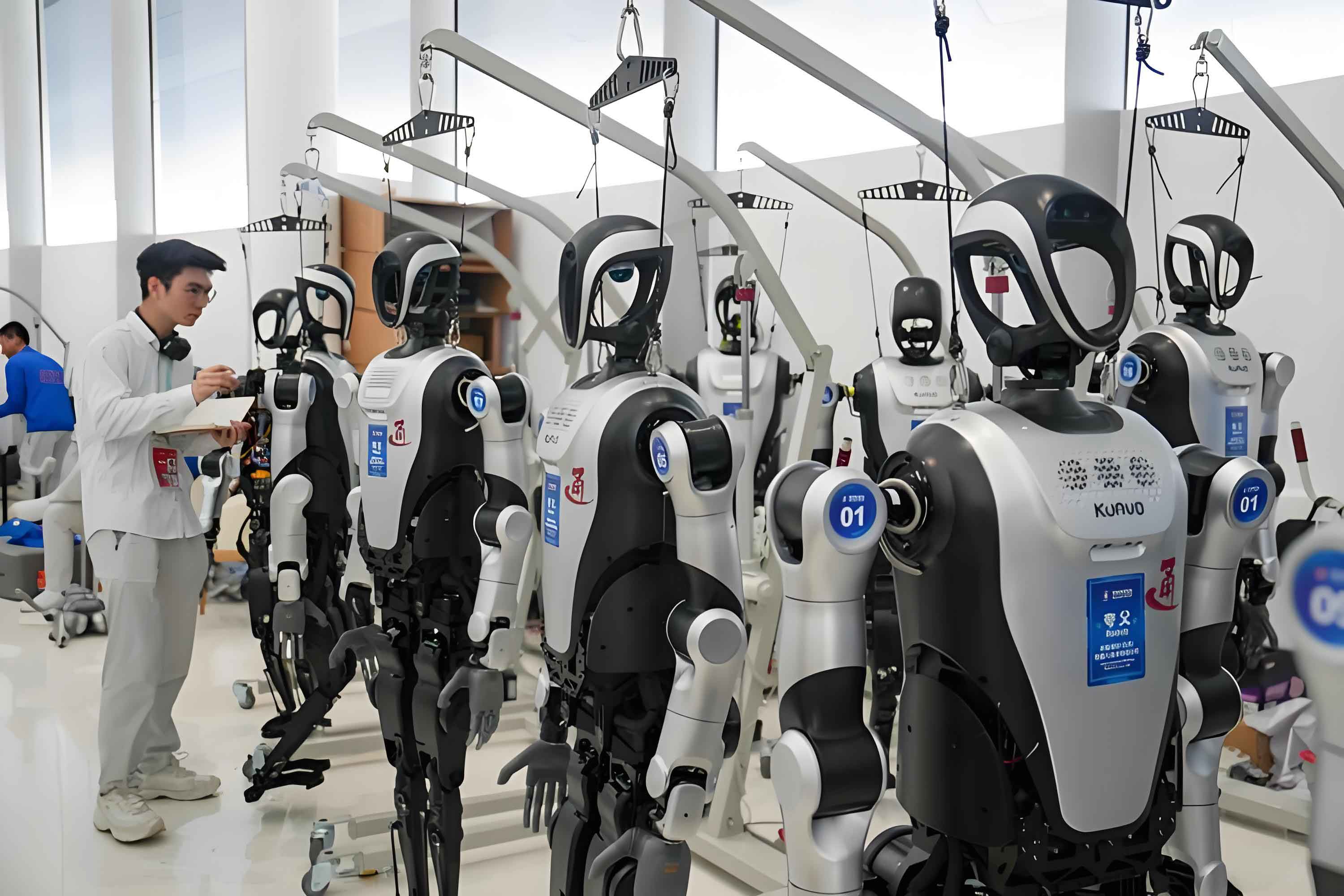
Beyond structured obstacles, general terrain adaptation is paramount. The leap from walking at 6 km/h on flat ground to running at 12 km/h on deformable surfaces like sand or snow represents a quantum improvement in dynamic control and mechanical design. Running introduces a flight phase where both feet are off the ground, drastically reducing the margin for error. The controller must manage higher impact forces and more aggressive shifts in momentum. The dynamics on compliant terrain are modeled by modifying the foot-ground interaction. Instead of a rigid contact model, we use a spring-damper system to represent surfaces like snow or sand: \( F_{ground} = -k \delta x – b \dot{x} \), where \( \delta x \) is the penetration depth. The controller’s cost function \( C \) now must also include terms to minimize sinkage and slippage, requiring rapid adaptation of leg stiffness and foot angle. This capability transforms the humanoid robot from an indoor platform to a viable agent for outdoor search, rescue, and exploration missions in unpredictable environments.
While single-robot autonomy is foundational, the future of productivity lies in collaboration. The next frontier is humanoid robot “Swarm” or “Group Intelligence.” Here, the challenge scales from controlling a single complex body to orchestrating multiple such bodies towards a common goal, such as assembling a car or managing a warehouse. This requires a novel software architecture that transcends individual robot brains. A proposed architecture involves a “BrainNet,” a networked intelligence comprising heterogeneous nodes.
| Component | Analogy | Core Technology | Primary Function |
|---|---|---|---|
| Super Brain (Cloud/Edge) | Strategic Commander | Multi-modal Embodied Reasoning LLM | High-dimensional task decomposition, macro-planning, resource allocation for the entire fleet. |
| Intelligent Cerebellum (On-robot/Edge) | Tactical Coordinator | Transformer-based Fusion Models | Multi-robot perception fusion, synchronized skill execution, real-time collision avoidance, distributed learning. |
| Agent Node (Individual Robot) | Skilled Operator | Onboard Motion & Skill Controllers | Executing assigned skills (pick, place, fasten), maintaining local stability, reporting sensory feedback. |
| IoH (Internet of Humanoids) | Nervous System | High-bandwidth, low-latency communication protocol | Enabling state sharing, command distribution, and collective world model updates among all robots. |
The “Super Brain” tackles the problem of complex task planning. Given a high-level command like “Assemble the vehicle door subsystem,” it must reason through the sequence, prerequisites, and parallelization opportunities. This is where large reasoning models, potentially based on architectures like DeepSeek-R1, come into play. They allow the system to parse natural language instructions, understand implicit constraints (e.g., “the hinge must be fastened before mounting the panel”), and generate a task graph \( G(T, E) \), where tasks \( T_i \) are nodes and dependencies \( E_{ij} \) are edges. The model then schedules these tasks across available robot agents \( R_k \), minimizing total makespan \( T_{total} \): \( \min \max_{k} (\sum_{i \in \Psi(R_k)} t_i) \), where \( \Psi(R_k) \) is the set of tasks assigned to robot \( k \) and \( t_i \) is the duration of task \( i \).
The “Intelligent Cerebellum” handles the messy reality of execution. Multiple humanoid robot units sharing a workspace must have a unified perception of dynamic objects (like parts being moved) and each other. This is achieved through cross-domain fused perception. Each robot broadcasts its localized sensor data (e.g., “I see a bolt at pose \( P_b \) in my camera frame”). A central or distributed fusion module aggregates these observations to create a consistent, global 3D scene \( \mathcal{S}_{global} \). Multi-robot collaborative control then uses this shared scene to compute collision-free trajectories for all agents simultaneously. This can be formulated as a multi-agent path finding (MAPF) problem in continuous space, often solved in real-time using decentralized or prioritized planning algorithms to ensure safe and efficient coordination.
The hardware underpinning these advances cannot be overstated. A humanoid robot destined for real-world application must possess high structural stability, actuator robustness, and energy efficiency for long operational cycles. Advances in high-torque density actuators (like customized harmonic drives or proprietary motor designs), lightweight composite materials, and high-energy-density battery packs are critical. The mechanical design must minimize the inertia of moving limbs to enable fast, efficient motions, which is often quantified by the dynamic manipulation index. The integration of these hardware capabilities with the sophisticated algorithms described creates a platform that is not just a research prototype but a viable industrial tool.
In conclusion, the trajectory for humanoid robot technology is clear. We are moving from isolated marvels of engineering to interconnected systems of embodied intelligence. The dual breakthroughs of sophisticated, perception-driven autonomy for individual robots and the nascent frameworks for multi-robot group intelligence are complementary. One enables a single agent to operate in our world; the other enables teams of such agents to reshape our productive world. The formulas and architectures discussed here—from the cost functions of dynamic walking to the task graphs of the Super Brain—are the blueprints for this future. The convergence of embodied AI, advanced robotics, and networked communication is poised to unlock applications from disaster response and planetary exploration to fully flexible, reconfigurable manufacturing, finally bringing the long-envisioned era of general-purpose humanoid robot assistants into tangible reality.