
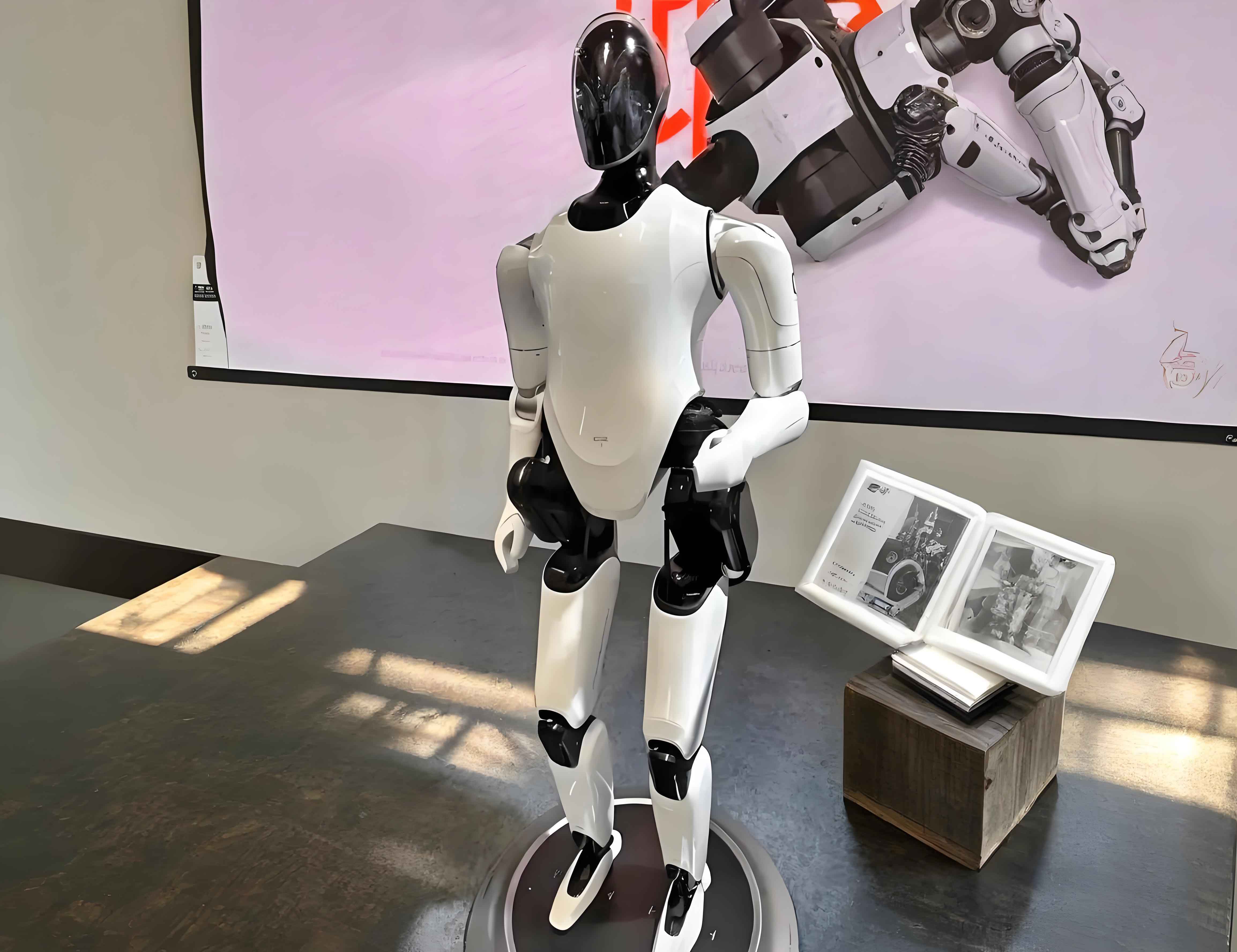
The field of robotics stands at a pivotal juncture, particularly for systems deployed beyond the controlled confines of factories and laboratories. My research and observations in the sector point to a critical convergence: the path to viable, scalable **embodied AI robot** solutions for extreme and unstructured environments is being carved by advances in embodied intelligence. This paradigm shift moves beyond pre-programmed automation towards creating machines that can perceive, reason, and act adaptively within the physical world. The industrialization of such **embodied AI robot** platforms, however, is not merely a technological challenge; it is a complex systemic endeavor involving foundational bottlenecks, novel AI integration, and ecosystem realignment.
The primary hurdle for widespread adoption stems from a fundamental mismatch between generalized robotic platforms and highly fragmented, unpredictable application scenarios. The requirements for a robot inspecting legacy industrial infrastructure are vastly different from those for a machine navigating post-disaster rubble or a chemical spill. This leads to a crippling dilemma: over-engineering for generality results in prohibitively expensive and complex machines, while excessive customization for specific tasks destroys economies of scale and slows innovation. The table below summarizes the core challenges across key dimensions:
| Challenge Dimension | Manufacturing/Industrial Inspection | Emergency Response & Disaster Relief | Common Root Cause |
|---|---|---|---|
| Environmental Adaptation | Complex, cluttered legacy layouts; unstable surfaces; need for long-duration operation near sensitive equipment. | Highly dynamic, destructively unstructured terrain (collapses, floods); rapidly changing conditions (fire, gas). | Limitations of single-mode locomotion (wheeled, tracked, legged). Gap between simulated/testing and real-world physics. |
| Perception & Decision-Making | Need for high-precision, repeatable detection of anomalies (cracks, corrosion, leaks) amidst visual noise. | Requirement for real-time semantic understanding of latent dangers (structural instability, victim location) with partial, degraded sensor data. | Traditional SLAM and pre-defined computer vision algorithms fail in adversarial, feature-scarce, or perpetually novel environments. |
| System Integration & Cost | High cost of custom deployment (e.g., overhead rail systems); integration with existing operational technology (OT) and safety protocols. | Extreme requirements for robustness, resistance to EMI, heat, water; difficulty in justifying CapEx for low-probability, high-consequence events. | Lack of standardized, modular hardware/software interfaces. Supply chain struggles with low-volume, high-reliability components. |
| Evaluation & Validation | Difficulty in creating comprehensive digital twins that accurately reflect wear, tear, and edge-case failures of aging plants. | Impossibility of fully replicating the “unreproducible” chaos of real disasters for testing. The “first deployment” is often the ultimate test. | Absence of unified benchmarks and certification standards for performance in extreme, unstructured settings. |
These challenges create a negative feedback loop. The high cost and niche applicability limit market size, which in turn discourages large-scale investment in component standardization and dedicated AI model training, perpetuating the cycle of fragmentation. Breaking this cycle requires a new technological foundation, which is precisely where embodied intelligence becomes the critical enabler.
Embodied intelligence for robots is not a single technology but a layered architecture that tightly couples perception, cognition, and action in a physical body interacting with an environment. For the **embodied AI robot**, this means moving from scripted responses to learned, adaptive behaviors. The key technological pathways emerging from current research can be framed around several core equations and principles.
First, the problem of generalization across tasks and environments can be conceptualized as maximizing the transferability of learned policies. A core objective is to develop a policy $ \pi $ that generalizes across a distribution of tasks $ \mathcal{T} $ and environments $ \mathcal{E} $. The optimal policy aims to maximize the expected return $ R $:
$$
\pi^* = \arg\max_{\pi} \mathbb{E}_{\tau \sim \mathcal{T}, e \sim \mathcal{E}} \left[ R(\xi) \right]
$$
where $ \xi $ denotes a trajectory of states, actions, and observations in environment $ e $ for task $ \tau $. The challenge is that $ \mathcal{E} $ for extreme scenarios is exceptionally broad and contains high-dimensional, hard-to-model disturbances.
To address this, the industry is moving beyond traditional modular pipelines (Sense -> Plan -> Act) towards Perception-Action Integration. Here, raw sensor inputs are mapped directly to low-level control commands through learned models, enabling reflexive adaptation to unforeseen terrain changes. This can be seen as learning a dynamics-aware policy:
$$
\mathbf{a}_t = \pi_\theta(\mathbf{o}_t, \mathbf{h}_{t-1}, \mathbf{g})
$$
where $ \mathbf{a}_t $ is the action, $ \mathbf{o}_t $ is the current high-dimensional observation (e.g., depth cloud, IMU data), $ \mathbf{h}_{t-1} $ is the hidden state of a recurrent network capturing temporal dynamics, and $ \mathbf{g} $ is a task goal. This end-to-end approach, such as Vision-based Omni-awareness (VOA) models, allows an **embodied AI robot** to navigate complex stairs, rubble, or curbs without needing a precise geometric map.
Second, the architecture for cognitive reasoning is evolving. The computational constraints of onboard processing in harsh environments necessitate a hybrid “front-end small model + back-end large model” strategy. The small, efficient model on the robot handles real-time, time-critical perception and control loops. It can be tasked with calculating a stability metric in real-time, such as a simplified version of the Zero Moment Point (ZMP) for legged platforms:
$$
\text{ZMP}_{x} = \frac{\sum_{i} m_i (\ddot{z}_i + g) x_i – \sum_{i} m_i \ddot{x}_i z_i}{\sum_{i} m_i (\ddot{z}_i + g)}
$$
where $ m_i $, $ (x_i, z_i) $, and $ (\ddot{x}_i, \ddot{z}_i) $ are the mass, coordinates, and accelerations of link $ i $. Concurrently, a more powerful model on a remote edge server or cloud, potentially a large foundation model fine-tuned on robotics data, handles higher-level mission planning, anomaly interpretation, and long-term strategy. This model can reason about semantic scenes, update mission parameters based on new goals from human supervisors, and manage multi-robot coordination.
Third, the embodiment itself—the “body”—is a source of intelligence. Robust locomotion in chaos is a form of “cerebellar” or sub-cognitive intelligence. Advancements in actuator design (series elastic actuators, hydraulic hybrids), materials (heat-resistant, EMI-shielding composites), and fault-tolerant mechanical design are non-negotiable prerequisites. The overall system reliability $ R_{sys}(t) $ for an **embodied AI robot** in the field is a product of the reliability of its interdependent subsystems:
$$
R_{sys}(t) = R_{mech}(t) \times R_{power}(t) \times R_{compute}(t) \times R_{comms}(t) \times R_{software}(t)
$$
Failure in any one—a motor overheating, a seal failing, a processor locking—can render the most advanced AI brain useless. Thus, industrialization demands a co-optimization of the physical and the digital.
Technological breakthroughs, however, remain inert without a conducive ecosystem for integration, validation, and deployment. The industry’s future hinges on constructing a virtuous cycle connecting technology, industry, and application. This ecosystem can be visualized as a five-element closed-loop system.
This model illustrates the necessary feedback loops between core components: standardized hardware platforms, shared AI models and data, rigorous testing environments, clear economic value drivers, and a skilled workforce.
Key actionable pillars for building this ecosystem include:
1. Standardization and Modularity: The community must drive toward open (or at least industry-consensus) standards for hardware and software interfaces. A modular **embodied AI robot** architecture would separate the mobility platform (“chassis”), the sensor suite (“perception head”), and the tooling/manipulation end-effector. This allows for specialization and cost reduction in each module while maintaining interoperability. Standard communication protocols (like DDS or ROS 2 with real-time extensions) and data formats for sensor fusion are equally critical.
2. Development of Domain-Specific Foundation Models and Shared Datasets: General-purpose vision or language models lack the specific priors needed for robotics in extreme settings. The field requires large-scale, curated datasets of robot interaction data in varied challenging conditions—not just images, but multi-modal streams of proprioception, force/torque, lidar, and correlated outcomes. Pre-training or fine-tuning foundation models on this data will drastically accelerate the development of robust “robot brains.”
3. Creation of Advanced Physical Testbeds and Digital Twins: To bridge the “test vs. reality” gap, investment in high-fidelity, destructive testing facilities—shared “Robot Proving Grounds”—is essential. These facilities should replicate chaotic urban collapse, industrial accident scenarios, and extreme weather. Coupled with this, high-fidelity, physics-based simulation environments (digital twins) that can accurately model sensor noise, actuator dynamics, and complex material interactions are needed for safe, scalable training and “what-if” analysis. The relationship between simulation and reality can be framed as minimizing a domain gap $ \mathcal{D} $:
$$
\min_{\phi} \mathcal{D}(P_{real}(\mathbf{o}, \mathbf{a}) \, || \, P_{sim}(\mathbf{o}, \mathbf{a}; \phi))
$$
where $ \phi $ parameterizes the simulator, and $ P $ denotes the joint distribution of observations and actions.
4. Evolution of Business Models: The high upfront cost of advanced **embodied AI robot** systems is a major adoption barrier. Business models must evolve from pure capital expenditure (CapEx) sales toward Robot-as-a-Service (RaaS) or mission-based leasing. This aligns vendor incentives with long-term reliability and performance, fosters continuous software updates, and makes the technology accessible for more users, particularly in public safety.
5. Cross-Disciplinary Workforce Development: Building and operating these systems requires a new breed of engineer—individuals who understand mechatronics, AI/ML, control theory, and domain-specific operational knowledge (e.g., firefighting protocols, industrial safety standards). Academic programs and industry certifications must adapt to cultivate this hybrid expertise.
In conclusion, the era of the truly useful **embodied AI robot** for the world’s most demanding jobs is within sight, but its arrival is conditional. It depends not on a single algorithm or actuator, but on our collective ability to orchestrate a complex symphony of technological innovation, industrial standardization, and ecosystem collaboration. The core thesis is clear: embodied intelligence is the key that unlocks robustness and generalization, but it is the framework of a supportive, synergistic industrial ecosystem that will turn that key and propel these extraordinary machines from research labs and niche prototypes into indispensable, scalable partners for human endeavor in hazardous environments. The journey is towards creating machines that are not just tools, but resilient, intelligent agents capable of standing where humans cannot, ensuring safety, preserving assets, and saving lives.