
The technological landscape is undergoing a seismic shift, moving beyond abstract algorithms confined to data centers into the dynamic, physical world. This shift is embodied in the rapid ascent of Embodied Artificial Intelligence (EAI), a field where intelligence is not merely computed but enacted through a physical form. As an entity deeply embedded in the infrastructure of connectivity and computation, I view the rise of the embodied AI robot not just as another technological trend, but as the dawn of a new symbiotic era between digital intelligence and physical action. The recent explicit inclusion of “embodied intelligence” in national strategic documents marks a pivotal moment, transitioning it from a research curiosity to a cornerstone of future industrial policy.
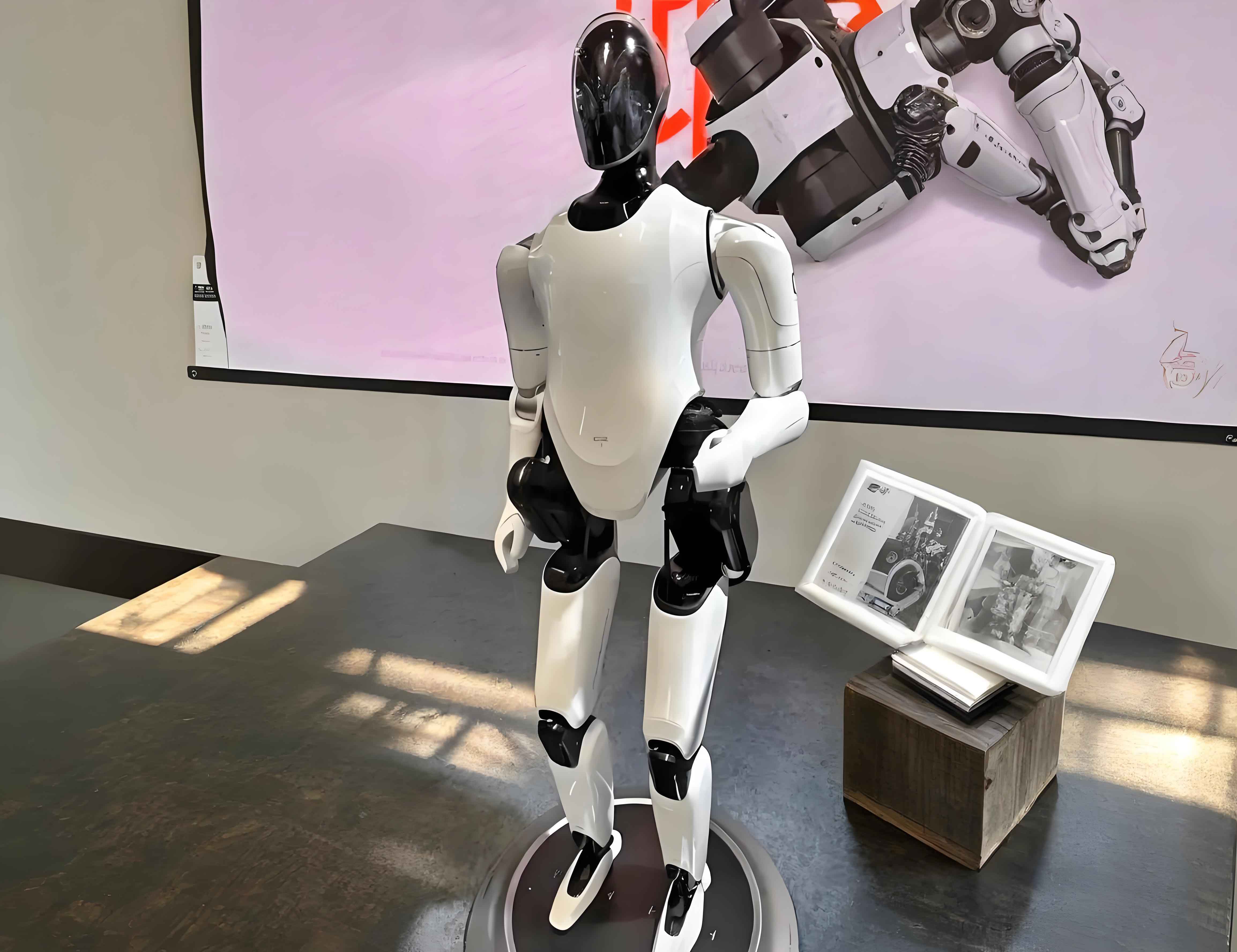
The core thesis of EAI is that intelligence emerges from the interaction between an agent, its body, and its environment. An embodied AI robot is the ultimate manifestation of this principle. Its intelligence is fundamentally grounded; it learns and reasons not from static datasets alone, but from the consequences of its physical actions. This paradigm is powered by the convergence of two powerful forces: large AI models and advanced robotics. Large models, especially multimodal ones, provide the “brain”—offering commonsense knowledge, language understanding, and complex task planning. The robotic body provides the “means”—the actuators and sensors to perceive and manipulate the real world. The synergy can be expressed as a foundational equation for a functional embodied AI robot:
$$ \text{Embodied Intelligence}(E) = \mathcal{M}_{LM}(\text{Perception}, \text{Task}) + \mathcal{R}_{Body}(\text{Action}, \text{Feedback}) $$
Where $\mathcal{M}_{LM}$ is the large model’s planning and reasoning function, and $\mathcal{R}_{Body}$ is the robot’s control and dynamics function. The feedback loop is critical for continuous learning.
Market Catalysts and Exponential Growth Trajectory
The momentum behind EAI is fueled by a powerful dual-engine: relentless technological breakthroughs and escalating, tangible market demand. The proliferation of large foundation models has been the primary accelerant. These models act as cognitive engines for embodied AI robot systems, enabling:
- Cross-modal Fusion: Seamlessly integrating visual, auditory, tactile, and linguistic data to form a cohesive understanding of a scene. $$ \text{World Model} = f_{\theta}(V, A, L, T) $$ where $V$=Visual, $A$=Auditory, $L$=Language, $T$=Tactile inputs, and $f_{\theta}$ is the fusion model.
- Generalizable Task Planning: Decomposing high-level instructions (“tidy the living room”) into sequences of actionable steps, adaptable to unseen environments.
- Real-time Learning and Adaptation: Using interaction data to refine policies on-the-fly, a process often framed as embodied reinforcement learning: $$ \pi^* = \arg\max_{\pi} \mathbb{E}_{\pi} \left[ \sum_{t} \gamma^t R(s_t, a_t) \right] $$ where $\pi$ is the robot’s policy, $R$ is the reward from the environment, and $\gamma$ is a discount factor.
This technological push meets a significant market pull. The potential applications span from domestic assistance and industrial logistics to healthcare and advanced exploration. Conservative projections already indicate a massive and growing market, as summarized below:
| Region/Scope | 2023 Market Size (Est.) | 2027 Projection (Est.) | CAGR Implication |
|---|---|---|---|
| China (Embodied AI Total) | ~$590 Billion USD | ~$892 Billion USD | ~10.8% |
| Global (Service & Industrial Robots) | ~$55 Billion USD | >$110 Billion USD | >15% |
Deconstructing the Embodied AI Robot: Core Elements
To understand the opportunities, one must understand the architectural stack of an embodied AI robot. It is built upon four interdependent pillars:
- The Physical Body (Embodiment): The morphology – humanoid, quadruped, mobile manipulator, etc. – defines the action space. Kinematics and dynamics are fundamental: $$ \tau = M(q)\ddot{q} + C(q, \dot{q})\dot{q} + g(q) $$ where $\tau$ is torque, $q$ is joint position, $M$ is inertia, $C$ captures Coriolis forces, and $g$ is gravity.
- The Intelligent Agent (AI Brain): This is the algorithm stack, increasingly centered on a large foundation model fine-tuned for embodiment. It handles perception, mapping, planning, and control.
- The Data Lifeline: The fuel for learning. This includes simulated data (from engines like Isaac Sim), real-world interaction logs, and curated human demonstrations.
- The Learning & Evolution Framework: The methodologies for continuous improvement, such as simulation-to-real transfer (Sim2Real), meta-learning, and lifelong learning.
The Competitive Landscape: A Global Race for Dominance
The strategic importance of EAI has triggered a global race, with technology giants, automotive leaders, and ambitious startups all vying for position. Their approaches vary, focusing on different layers of the stack, from developing the foundational AI models to building the most advanced physical platforms. The following table captures the diversified strategies across the ecosystem.
| Strategic Focus Area | Leading Entities | Key Initiatives & Products |
|---|---|---|
| Foundation Model Development | OpenAI, Google (DeepMind), Meta, Anthropic | Developing multimodal LLMs (GPT-4, Gemini, Llama) with increasingly strong reasoning and planning capabilities applicable to physical tasks. |
| Integrated AI & Robotics Platforms | Tesla, Google, Physical Intelligence | Tesla’s Optimus (leveraging FSD stack), Google’s RT-X project, PI’s π0 model for general robot tasks. |
| Full-Stack Humanoid Robot Development | Tesla, Boston Dynamics, Figure, Agility Robotics, Chinese firms (Fourier, GR-2 ecosystem) | Creating general-purpose humanoid platforms targeting logistics, manufacturing, and domestic service. |
| Vertical Application & Component Solutions | NVIDIA (Isaac), Intrinsic, legacy robot arms companies | Providing development platforms (NVIDIA Isaac Sim), AI software for specific tasks (bin picking, assembly), and critical hardware components. |
This vibrant competition is rapidly accelerating the maturity of the entire field. Every breakthrough in dexterous manipulation for one embodied AI robot raises the bar for all, and every new, more capable foundation model becomes a potential cognitive upgrade for existing platforms.
Core Challenges on the Path to General Embodied Intelligence
Despite the excitement, the path to a truly robust and general-purpose embodied AI robot is fraught with significant hurdles. These challenges represent both obstacles and areas of immense opportunity for focused investment and innovation.
Technical Hurdles: Beyond Task-Specific Intelligence
The current paradigm often involves “bolting” a large language model onto a robot controller. While effective for structured tasks, this can lack true understanding and physical common sense. Key technical gaps include:
- World Model Learning: Developing internal models that predict physical outcomes without exhaustive trial-and-error. The robot needs to understand that a glass is fragile, or that a floor might be slippery.
- Unsupervised Skill Acquisition: Moving beyond pre-defined tasks to allow robots to discover useful skills through autonomous exploration, a more efficient learning objective: $$ \max I(S; Z) $$ where $I$ is mutual information between skills $S$ and a learned representation of states $Z$.
- Long-horizon Planning with Uncertainty: Planning over extended time frames in stochastic environments remains computationally hard.
The Data Dilemma: Scarcity, Cost, and Privacy
Data is the lifeblood of modern AI, and for embodied AI robot systems, the requirements are particularly stringent.
| Data Challenge | Description | Consequence |
|---|---|---|
| Real-World Interaction Scarcity | Physical data collection is slow, expensive, and risks damaging the robot or environment. | Limits the diversity and scale of training data, leading to brittle models that fail in novel situations. |
| Multi-modal Annotation Complexity | Labeling video with corresponding actions, force-torque data, and linguistic descriptions is highly labor-intensive. | Creates a major bottleneck for supervised learning approaches and increases development costs. |
| Safety & Privacy Imperatives | Robots operating in homes, hospitals, or factories will collect vast amounts of sensitive visual and operational data. | Demands robust on-device processing, federated learning frameworks, and strict compliance with data sovereignty regulations like GDPR. The risk equation is critical: $$ \text{Risk}_{\text{privacy}} = \text{Likelihood}_{\text{breach}} \times \text{Impact}_{\text{sensitive data}} $$ |
The Strategic Imperative for Network Operators
This is where the unique value proposition of advanced network operators becomes not just relevant, but critical. We are not mere spectators in this revolution; we are enablers poised at the confluence of all necessary vectors: ubiquitous connectivity, distributed compute, trusted enterprise relationships, and massive vertical market access. The embodied AI robot of the future will not be an island of intelligence; it will be a node in a vast, intelligent network.
1. Founding the “Nervous System”: Connectivity and Compute Infrastructure
Operators must evolve their networks from pipelines of bits into intelligent, deterministic platforms for physical AI.
- Ultra-Reliable, Low-Latency Communication (URLLC): 5G-Advanced and 6G are prerequisites. A embodied AI robot performing remote surgery or collaborative manufacturing requires guaranteed latency bounds. The end-to-end latency budget must satisfy: $$ T_{total} = T_{sense} + T_{tx} + T_{network} + T_{compute} + T_{tx} + T_{actuate} < T_{max} $$ where $T_{max}$ could be as low as 1-10ms for critical loops.
- Orchestrated Edge-to-Cloud Compute: The “brain” of the robot will be distributed. Heavy model inference or complex learning can occur in the cloud, while time-critical perception and control run on an on-device or ultra-local edge server. Operators can provide this seamless fabric.
- AI-Native Network Management: Using AI to dynamically allocate network slices, predict congestion, and ensure QoS for robot traffic, treating it as a premier service class.
2. Catalyzing the Ecosystem: From Enabler to Integrator
Beyond infrastructure, operators have a pivotal role as ecosystem catalysts and vertical solution integrators.
| Strategic Role | Concrete Actions | Example Outcome |
|---|---|---|
| Platform Provider | Offer “Robot-as-a-Service” platforms combining connectivity, edge compute, device management, and foundational AI APIs. | A startup can deploy its embodied AI robot globally without building its own management backend. |
| Vertical Solution Integrator | Partner with robot makers, AI firms, and end-users (factories, hospitals) to build turnkey solutions for specific problems. | Deploying a fleet of cleaning and inventory robots in smart airports, with guaranteed network performance and centralized oversight. |
| Trust & Security Anchor | Leverage existing enterprise trust to provide secure data tunnels, federated learning orchestration, and hardware-backed identity for robots. | Ensuring a factory robot’s operational data never leaves the country and is protected from tampering. |
| Simulation & Testing Hub | Operate large-scale, high-fidelity digital twin simulation environments on cloud/edge infrastructure for training and validating robot algorithms. | Allowing a developer to train a robot for 10,000 hours in a simulated warehouse before any physical deployment. |
3. Forging the Future: Proactive Initiatives and Standardization
Leading operators are already moving beyond theory. Initiatives like establishing dedicated Embodied AI Innovation Centers signal a deep commitment. These centers focus on core challenges like multi-robot collaboration over networks, efficient model compression for edge deployment, and creating benchmark datasets. Furthermore, active participation in standards bodies (3GPP, IEEE, ISO) is crucial to define the communication protocols, safety certifications, and data formats that will allow embodied AI robot systems from different vendors to interoperate seamlessly and safely.
The journey of embodied intelligence is just beginning. The vision of a helpful, ubiquitous embodied AI robot is compelling, but its realization hinges on a robust, intelligent, and trustworthy cyber-physical infrastructure. This is the quintessential opportunity for modern network operators. By building the nervous system, powering the brain, and fostering the ecosystem, we transition from connectivity providers to foundational architects of the physical AI age. The challenge is immense, but the imperative is clear: to connect intelligence to action, and in doing so, shape a future where technology understands and assists in the world we physically inhabit.