
The global manufacturing landscape is undergoing a profound transformation, driven by the imperative for greater flexibility, efficiency, and autonomy. While data-driven digital manufacturing has laid a critical foundation, the next evolutionary leap lies in infusing physical systems with advanced cognitive capabilities. This is where embodied intelligence, the fusion of artificial intelligence with a physical form to enable perception, reasoning, and action in the real world, emerges as a pivotal force. An embodied AI robot is not merely a programmed machine but an intelligent agent that learns from and adapts to its environment through continuous sensorimotor interaction. This article explores the integration of embodied intelligence into smart manufacturing, detailing its technical architecture, transformative applications, persistent challenges, and future trajectory, with a consistent focus on the role of the embodied AI robot.
The Evolutionary Trajectory of Manufacturing Intelligence
The journey toward today’s intelligent systems can be mapped across three distinct phases, each marked by a fundamental shift in operational paradigm and technological enablement.
| Evolutionary Phase | Core Paradigm | Key Enabling Technologies | Inherent Limitations |
|---|---|---|---|
| Rule-Based Automated Manufacturing | Pre-programmed, repetitive tasks executed with high precision. | Programmable Logic Controllers (PLCs), Computer Numerical Control (CNC) machines, Supervisory Control and Data Acquisition (SCADA) systems. | Inflexible to change, lacks adaptability and cognitive ability, low utilization of operational data. |
| Data-Driven Digital Smart Manufacturing | System optimization and visibility through pervasive data collection and analysis. | Industrial Internet of Things (IIoT), Cloud Computing, Big Data Analytics, Digital Twins, AI for predictive analytics. | Reliance on predefined models, limited autonomous decision-making and physical-world agility in unstructured scenarios. |
| Embodied Intelligence-Enabled Smart Manufacturing | Autonomous, adaptive, and collaborative task execution through situated intelligence. | Embodied AI, Multimodal Perception, Large Foundation Models, Advanced Robotic Control (Force, Motion Planning). | Emerging challenges in data fusion, environmental complexity, safety, and system integration. |
The transition from the second to the third phase represents a qualitative leap from observing and optimizing to understanding and acting. While digital manufacturing creates a virtual “shadow” of the process, embodied intelligence puts an “agent” into the physical loop. This agent—an embodied AI robot—closes the gap between digital insight and physical action, enabling systems to handle variability, learn from experience, and collaborate naturally.
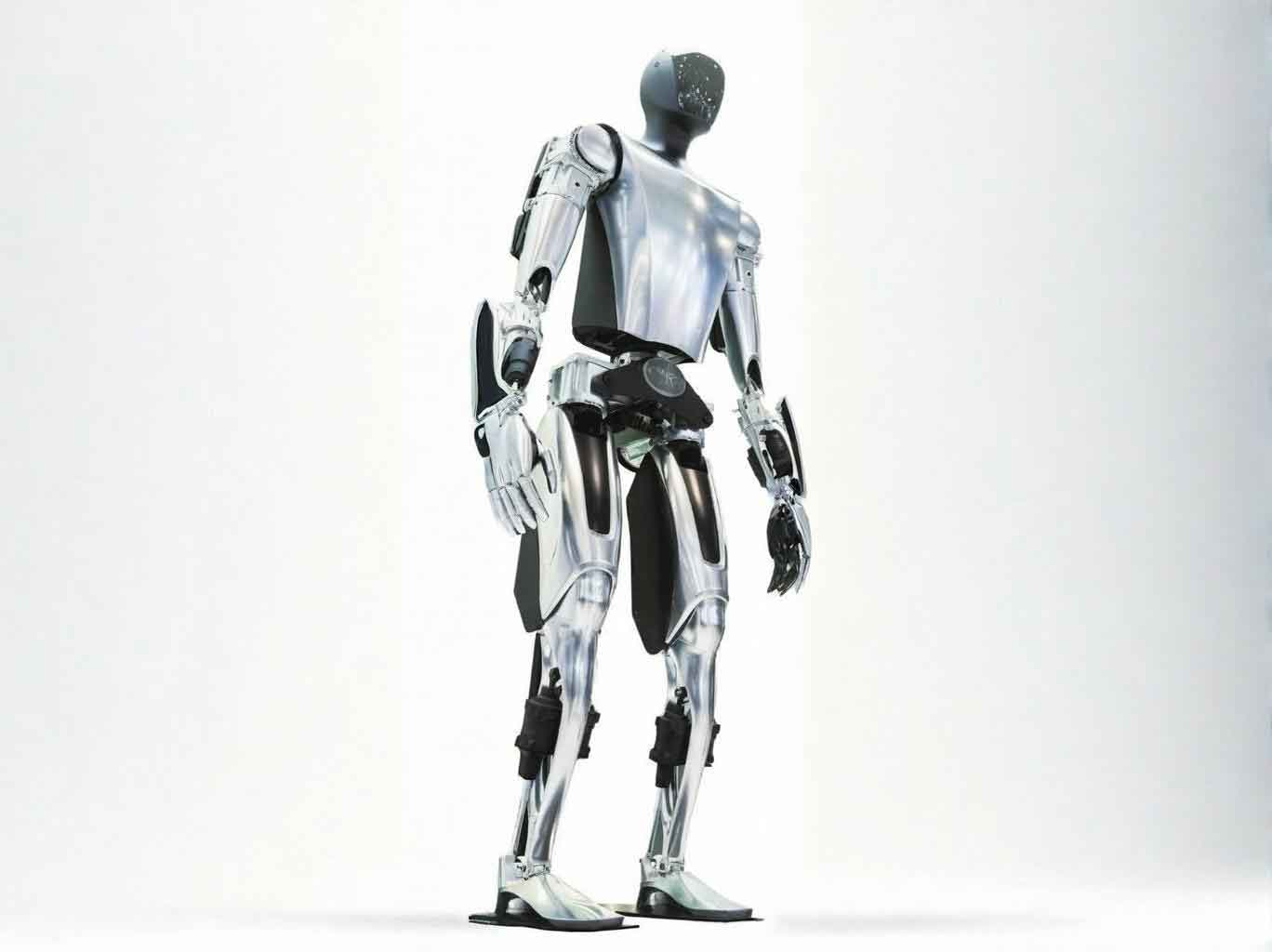
The Technical Architecture of Embodied Intelligence-Driven Manufacturing
The Core Interaction Model: A Closed Perception-Action Loop
At the heart of this paradigm is a continuous “Perception-Decision-Action-Feedback” loop centered on the embodied AI robot. This model formalizes the interaction between human operators, the embodied agent, other machines, and the environment. The human provides high-level task directives and oversight. The embodied AI robot perceives the environment through multimodal sensors, processes this information to understand context and state, makes informed decisions on how to act, and executes physical actions via its actuators. Crucially, the environment provides constant sensory feedback, and machines report their status, allowing the embodied AI robot to adapt its actions in real-time, creating a dynamic, self-optimizing system. This loop transforms the robot from a blind executor into a situational-aware collaborator.
Critical Technical Pillars for the Embodied AI Robot
Several advanced technologies converge to enable the sophisticated capabilities expected of an embodied AI robot in a manufacturing setting.
1. Multimodal Manufacturing Data Fusion and Perception
An embodied AI robot must construct a coherent understanding of its surroundings from heterogeneous data streams. This involves fusing visual (2D/3D cameras), tactile (force/torque, tactile skin), auditory (acoustic monitoring), and proprioceptive (joint position, velocity) data. The technical challenge lies in the alignment, synchronization, and joint representation of these modalities.
The fusion process can be modeled at different levels. Let $M_v$, $M_t$, $M_a$ represent the feature spaces for visual, tactile, and auditory modalities, respectively. The goal is to learn a unified representation $Z$ that preserves the complementary information from each. A common approach involves deep neural networks to project each modality into a shared semantic space:
$$ z_v = f_\theta(x_v), \quad z_t = g_\phi(x_t), \quad z_a = h_\psi(x_a) $$
where $f_\theta, g_\phi, h_\psi$ are modality-specific encoders. The fused representation for decision-making can be a concatenation or a more sophisticated attention-weighted combination:
$$ Z = \alpha_v z_v + \alpha_t z_t + \alpha_a z_a, \quad \sum \alpha_i = 1 $$
The weights $\alpha_i$ can be dynamically computed based on contextual relevance, allowing the embodied AI robot to focus on the most informative sensory signals for a given task—vision for object recognition, force for insertion, and sound for anomaly detection.
2. Embodied Manufacturing Empowered by Large Foundation Models
Large Language Models (LLMs) and Vision-Language Models (VLMs) provide the cognitive substrate for high-level reasoning and instruction understanding. An embodied AI robot can leverage these models to interpret natural language commands from human workers (“assemble the gearbox on the red pallet”), generate task plans, and understand complex operational manuals. The integration framework typically follows a layered architecture:
- Perception & Grounding: Raw sensor data is processed and semantically grounded. A VLM might caption a scene: “A metallic gear is 30cm left of the robotic arm on a cluttered workbench.”
- Cognition & Planning: An LLM, provided with this grounded scene description and the command, decomposes the task into a sequence of actionable steps, referencing a manufacturing knowledge graph for constraints and best practices.
- Action Generation: The step-by-step plan is translated into low-level motor commands or parameterized skill invocations (e.g.,
execute_skill(pick, object=gear, grasp_type=precision)).
This enables one-shot teaching and generalization, where a single demonstration or description can adapt the embodied AI robot’s behavior to similar but unseen parts or configurations.
3. Force Control for Compliant and Precise Interaction
Precision assembly, deburring, and polishing require delicate physical interaction. Pure position control is insufficient; an embodied AI robot must control the forces it exerts. Impedance and admittance control are key techniques that model the robot’s end-effector as a mass-spring-damper system, allowing it to behave compliantly. The fundamental impedance control law in the Cartesian space is given by:
$$ F = M_d (\ddot{x}_d – \ddot{x}) + B_d (\dot{x}_d – \dot{x}) + K_d (x_d – x) $$
where $F$ is the commanded force, $x_d, \dot{x}_d, \ddot{x}_d$ are the desired pose, velocity, and acceleration, $x, \dot{x}, \ddot{x}$ are the actual ones, and $M_d, B_d, K_d$ are the desired inertia, damping, and stiffness matrices. By tuning $K_d$ to low values, the embodied AI robot becomes “soft” and can safely handle contact uncertainties. Advanced implementations use adaptive or learning-based methods to optimize these parameters in real-time for different materials and tasks, a core capability for a dexterous embodied AI robot.
4. Robot Motion Planning Algorithms
Navigating dynamic shop floors and manipulating objects in clutter requires robust motion planning. The problem is to find a collision-free path $\tau(t)$ from start $q_{start}$ to goal $q_{goal}$ in configuration space $C$, while respecting dynamics $\dot{q} = f(q, u)$. Sampling-based algorithms like RRT* (Rapidly-exploring Random Tree Star) are widely used for their efficiency in high-dimensional spaces:
- Randomly sample a configuration $q_{rand}$ in $C$.
- Find the nearest node $q_{near}$ in the existing tree $T$.
- Extend from $q_{near}$ towards $q_{rand}$ by a step size $\delta$ to get $q_{new}$.
- If the path between $q_{near}$ and $q_{new}$ is collision-free, add $q_{new}$ to $T$.
- Rewire the tree to optimize the path cost (e.g., shortest distance, minimal energy).
For an embodied AI robot operating among humans and other machines, the planner must also incorporate real-time sensor updates for dynamic obstacle avoidance and possibly social navigation rules.
The Integrated Technical Framework
These pillars are integrated into a cohesive, layered framework that structures an embodied intelligence-driven smart factory. The following table summarizes this architecture:
| Layer | Components | Core Function |
|---|---|---|
| Physical Layer | Collaborative Robots (Cobots), AGVs, 3D Printers, Force/Tactile/Vision Sensors, Edge Computing Devices. | Provides the actuation, sensing, and local computation hardware for the embodied AI robot. |
| Data Layer | IIoT Data Hub, Time-Series Databases, Manufacturing Execution System (MES) data streams. | Aggregates, stores, and preprocesses multimodal data from the physical layer for upstream consumption. |
| Algorithm Layer | Multimodal Fusion Models, Foundation Models (LLMs/VLMs), Motion/Path Planners, Reinforcement Learning Algorithms. | Hosts the core intelligence software for perception, cognition, and planning. |
| Perception Layer | Scene Understanding, Object Recognition & Pose Estimation, Anomaly Detection from sensor fusion. | Translates raw data into a structured, semantic representation of the environment for the embodied AI robot. |
| Decision Layer | Task Planning, Resource Scheduling, Cooperative Strategy Formulation, Human Instruction Interpretation. | Generates high-level goals and sequences of actions based on perception, factory state, and human input. |
| Execution Layer | Low-Level Robot Controllers (Force/Position), AGV Navigators, Gripper Actuators, Human-Robot Interface (HRI). | Executes the planned actions with precision and safety, enabling the physical work of the embodied AI robot. |
| Feedback Layer | Real-Time Performance Monitoring, Digital Twin Synchronization, Learning from Demonstration (LfD) data capture. | Closes the loop, providing data for online adaptation and offline learning to improve future performance of the embodied AI robot. |
The Transformative Impact: How Embodied Intelligence Empowers Manufacturing
The integration of the embodied AI robot drives tangible advancements across the manufacturing value chain.
| Domain | Traditional Approach | Embodied Intelligence Enhancement |
|---|---|---|
| Production & Assembly | Dedicated, rigid automation lines for high-volume production. Poor suitability for high-mix, low-volume. | Flexible, cognitive assembly cells where an embodied AI robot can handle part variability, perform delicate insertions using force feedback, and be rapidly re-tasked via natural language. |
| Warehousing & Logistics | AGVs following fixed paths or beacons; manual picking for complex items. | Mobile manipulators (embodied AI robots) that navigate dynamically, visually identify and precisely grasp diverse items from bins (bin picking), and collaborate to move heavy loads. |
| Inspection & Maintenance | Periodic manual inspections; scheduled maintenance leading to downtime or unexpected failures. | Embodied AI robots equipped with high-resolution cameras and IR sensors perform autonomous, continuous patrols. They can identify visual defects, thermal anomalies, and even execute simple maintenance tasks like cleaning or tightening. |
| Human-Robot Collaboration | Strict physical separation (caging) or simple, pre-defined cooperative tasks. | Natural, fluid collaboration. The embodied AI robot understands human gestures and verbal cues, predicts intent, and adjusts its actions for safe and efficient co-execution of tasks, such as holding a part while a human fastens it. |
Persistent Challenges and Application Difficulties
Despite its promise, the widespread deployment of the embodied AI robot faces significant hurdles.
1. Scarcity of Multimodal Manufacturing Data. High-quality, annotated datasets that synchronize vision, force, sound, and action in industrial contexts are rare. This scarcity limits the training and validation of robust multimodal perception models, constraining the real-world performance of the embodied AI robot. Creating such datasets is expensive and time-consuming.
2. Complexity and Unpredictability of Real Manufacturing Environments. Workshops present extreme conditions: poor lighting, dust, reflective surfaces, electromagnetic noise, and dynamic clutter. This “reality gap” severely challenges the perception and robustness of algorithms typically trained in clean simulations, leading to failures when the embodied AI robot is deployed on the actual shop floor.
3. Safety Risks from AI Hallucinations and Unpredictable Behaviors. Foundation models can “hallucinate” plausible but incorrect instructions or plans. In a physical system, an erroneous command generated by the cognitive layer of an embodied AI robot could lead to collisions, damage to products, or safety hazards. Ensuring verifiable, predictable, and safe decision-making is paramount.
4. The Hardware-Software Co-Design Bottleneck. The high-level intelligence of an embodied AI robot is often hampered by the physical limitations of its hardware: actuator bandwidth, sensor latency, communication delays, and mechanical precision. Achieving the necessary synergy between agile algorithms and responsive, reliable hardware remains a key engineering challenge.
5. Lack of Standards, Ethics, and Regulatory Frameworks. There are no universal standards for safety, interoperability, or performance benchmarking for embodied AI robots. Critical questions about liability in case of accidents, data privacy, and ethical human-robot interaction guidelines are largely unresolved, creating uncertainty for adopters.
Future Trajectories and Strategic Recommendations
The future of manufacturing will be increasingly shaped by the pervasive presence of the embodied AI robot. Trends point toward deeper human-robot symbiosis, the emergence of swarm intelligence in distributed manufacturing, and the rise of fully autonomous “lights-out” factories for certain processes. To accelerate this future responsibly, a multi-pronged strategy is essential:
1. Prioritize Foundational Research and Breakthroughs. Direct resources toward overcoming core technical bottlenecks: multimodal simulation-to-reality transfer, causal reasoning in physical tasks, and safe reinforcement learning for the embodied AI robot. Publicly funded research into robust, explainable, and energy-efficient embodied AI algorithms is crucial.
2. Foster Collaborative Ecosystems and Accelerate Piloting. Encourage open innovation platforms where hardware vendors, AI software firms, system integrators, and end-user manufacturers collaborate. Support the creation of shared testbeds and pilot lines to de-risk deployment and demonstrate the tangible ROI of the embodied AI robot across different industries.
3. Establish Safety-Centric Standards and Regulations. Industry consortia and regulatory bodies must urgently develop standards for the safe operation, interoperability, and performance validation of embodied AI robots. These should include rigorous testing protocols for AI decision-making modules in safety-critical loops.
4. Broaden the Horizon of Application Scenarios. Move beyond current pilot applications in assembly and logistics. Actively explore and invest in deploying the embodied AI robot in challenging sectors like construction, shipbuilding, and in-situ repair, where environments are highly unstructured and tasks are complex.
In conclusion, embodied intelligence represents not merely an incremental improvement but a fundamental re-architecting of smart manufacturing. By embedding cognitive capabilities into physical forms, the embodied AI robot transitions from a tool to an intelligent collaborator. While the path forward is strewn with technical and integrative challenges, a concerted effort focused on research, collaboration, standardization, and bold application will unlock a new era of autonomous, adaptive, and human-centric manufacturing.