
The field of artificial intelligence is undergoing a profound paradigm shift. For decades, the dominant trajectory has been one of refining “disembodied computation”—building increasingly powerful digital brains that operate on abstract symbols and datasets. However, a new frontier is emerging, one where intelligence is not merely computed but is enacted through physical interaction with the world. This is the paradigm of embodied intelligence, and its most tangible manifestation is the embodied AI robot. As a researcher observing this transition, I argue that this shift represents more than a technical evolution; it is a fundamental rethinking of how intelligent systems learn, understand, and act, promising to reshape our technological and economic landscape.
The journey from classical, logic-based AI to modern deep learning has yielded astonishing capabilities in pattern recognition and data synthesis. Yet, these systems remain fundamentally disconnected from the physical reality they seek to model. They suffer from the “symbol grounding problem,” where internal representations lack intrinsic meaning tied to sensory-motor experience, and an “epistemological gap,” where knowledge is static and divorced from the causal, messy dynamics of the real world. The core limitation is a decoupling of knowledge from action. An embodied AI robot, in contrast, is designed to overcome this very schism. Its intelligence is not pre-programmed but emerges from the continuous, closed-loop cycle of perceiving the environment, making decisions based on those perceptions, and executing physical actions that alter the environment, thereby generating new perceptual data. This “perception-decision-action” loop is the cornerstone of the embodied paradigm.
It is crucial to clarify the concept. Embodied AI robot is a specific instance of the broader paradigm of embodied intelligence. The paradigm emphasizes that cognition is shaped by the physical body and its interactions. The robot is the physical instantiation, the “body” to the AI “brain.” This body need not be humanoid. While humanoid forms offer potential for general-purpose operation in human-centric environments, the essence of an embodied AI robot lies in its closed-loop, interactive capabilities. It could be a wheeled logistics bot, a robotic arm in a factory, or an aerial drone. The key is the tight integration of a cognitive core with a physical platform that allows for situated, goal-directed behavior. We can conceptualize the evolution of these systems in three tiers: from Algorithm-Enabled systems (smart software on conventional hardware), to Morphology-Optimized systems (hardware co-designed with software to exploit physical intelligence), and ultimately toward Co-Evolving systems where brain and body adapt synergistically.
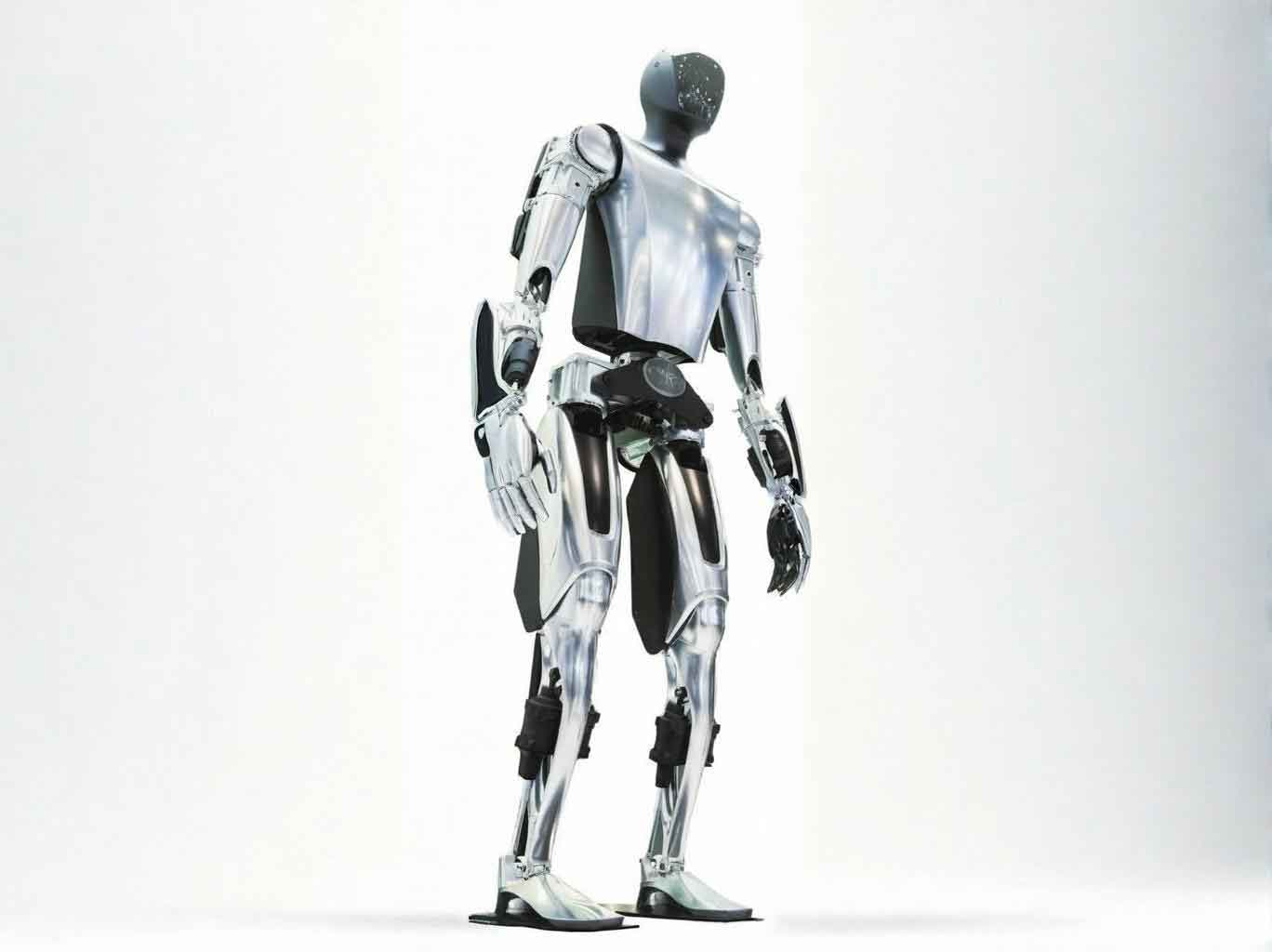
The technical architecture of an advanced embodied AI robot can be deconstructed into four functionally integrated layers, forming a coherent stack that enables autonomous operation and learning.
| Functional Layer | Core Components & Technologies | Primary Function |
|---|---|---|
| Perception | LiDAR, RGB-D Cameras, IMUs, Force/Torque Sensors, Tactile Sensors, Sensor Fusion Algorithms, SLAM | To create a real-time, multi-modal digital representation of the robot’s internal state and external environment. It transforms physical signals into structured data. |
| Decision & Cognition | Multimodal Foundation Models, Task Planners, Motion Planners (Path, Trajectory), Controllers (PID, MPC), AI Accelerator Chips | To process perceptual data, understand context, generate high-level task plans, and compute low-level, safe, and efficient control commands. |
| Execution | Servo Motors, Precision Gearboxes, Harmonic Drives, Compliant Actuators, Soft Robotic Components, Mechanical Linkages | To physically enact the control commands with precision, applying forces and motions to interact with and manipulate the world. |
| Learning & Adaptation | Reinforcement Learning, Imitation Learning, Simulation Engines, Digital Twins, Data Logging Systems | To enable the system to improve its performance over time through experience, both from real-world interactions and simulated training. |
Mathematically, we can model a single cycle of this loop. Let the robot’s state at time \( t \) be \( s_t \), its raw sensor observations be \( o_t \), and its chosen action be \( a_t \). The perception layer generates an estimated state \( \hat{s}_t = f_\theta(o_t) \), where \( f_\theta \) is a learned perception model. The decision layer then computes an action policy: \( a_t = \pi_\phi(\hat{s}_t, g) \), where \( \pi_\phi \) is the policy model and \( g \) is a goal. The execution layer applies \( a_t \), transitioning the world to a new state \( s_{t+1} \) according to the environment dynamics \( P(s_{t+1} | s_t, a_t) \). The learning layer seeks to optimize the parameters \( \theta \) and \( \phi \) to maximize the expected cumulative reward \( R = \mathbb{E}[\sum_{t} \gamma^t r(s_t, a_t)] \), where \( \gamma \) is a discount factor. This formalizes the continuous learning process of an embodied AI robot.
The industrial ecosystem required to bring such sophisticated systems to life is complex and layered. It extends from fundamental research to specific, value-generating applications, creating a multi-segment value chain.
| Industry Segment | Key Players & Activities | Value Proposition & Economic Role |
|---|---|---|
| Upstream: Core Technology | Semiconductor firms (AI chips), Sensor manufacturers, Actuator/Component suppliers, AI model developers, OS/platform creators. | Provides the essential hardware and software “building blocks.” High-margin, R&D-intensive. Defines the performance ceiling for the entire industry. |
| Midstream: System Integration & Platformization | Robot OEMs (industrial, service, humanoid), System integrators, Platform companies offering developer kits and APIs. | Integrates upstream components into functional products or platforms. Acts as the crucial bridge between technology and application. Competes on engineering excellence and ecosystem building. |
| Downstream: Scenario Application | Manufacturing firms, Logistics companies, Healthcare providers, Agriculture businesses, Retail and service industries. | The ultimate source of demand and value realization. Drives ROI through efficiency gains, new capabilities, and labor augmentation in specific verticals. |
The economic implications of widespread embodied AI robot adoption are transformative. At the microeconomic level, they reshape the production function. Traditionally, automation followed a static, programmed script. An embodied AI robot introduces dynamic, data-driven optimization into the physical production process. The production function \( Y = F(K, L, M, A) \) (Output = f(Capital, Labor, Materials, Technology)) evolves. Technology \( A \) is no longer just a static efficiency multiplier but becomes an adaptive, learning variable \( A(t, D) \), where its effectiveness improves over time \( t \) based on operational data \( D \). This leads to endogenous growth within the firm’s operations. Organizationally, this shifts the role of human workers from direct operators to supervisors, trainers, and exception handlers, fostering a “human-robot symbiosis” model where creativity and strategic oversight are human domains, and precision, endurance, and repetition are managed by the embodied AI robot.
Macro-economically, this technology can resolve the classic tension between scale and scope. A fleet of versatile embodied AI robot units can be quickly reconfigured via software, enabling mass customization—the efficient production of small, personalized batches. This flexibility optimizes supply chains and reduces inventory costs. Furthermore, new business models emerge, such as Robot-as-a-Service (RaaS), which lowers adoption barriers and creates continuous data feedback loops. The value in the ecosystem increasingly accrues to the providers of the core “intelligence” (AI models, data platforms, and services) rather than just the physical hardware.
However, the path to this future is fraught with systemic challenges. Three major bottlenecks stand out. First, technological sovereignty and supply chain fragility persist. Critical components like high-performance precision reducers, dynamic force-torque sensors, and ultra-efficient AI inference chips often rely on concentrated global suppliers. Second, the “simulation-to-reality” gap and scenario落地难 remain significant. While simulation is a powerful training tool, the complexity and noise of the real physical world often expose brittleness in models trained solely in virtual environments. Collecting vast, high-quality real-world interaction data is expensive and slow. Third, the ecosystem is still fragmented, with gaps between AI researchers, roboticists, and domain-specific end-users, leading to misaligned innovation and a shortage of cross-disciplinary talent.
To navigate these challenges, a tripartite strategic pathway is essential. The foundation must be consolidating core competencies. This requires mission-oriented R&D programs focused on critical bottlenecks like specialized actuators and embodied AI chips, coupled with support for open-source software frameworks and shared multimodal datasets to lower development barriers. The engine for iteration must be scenario-driven deployment. Creating lighthouse projects in priority sectors (e.g., advanced manufacturing, agile logistics) provides real-world testing grounds. Investing in high-fidelity simulation-to-reality pipelines and standardized physical testbeds can accelerate the learning cycle for every embodied AI robot. Finally, the enabling environment requires fostering collaborative ecosystems. This involves promoting industry clusters, developing cross-disciplinary educational programs that blend AI, robotics, and domain engineering, and proactively establishing clear safety, liability, and ethical governance frameworks to ensure responsible innovation.
In conclusion, the transition to embodied intelligence, materialized through the embodied AI robot, marks a pivotal chapter in the evolution of AI. It moves us from systems that “think” about the world to systems that “experience” and “act” within it. This paradigm promises to unlock new levels of autonomy and flexibility in our physical economy, from factories to homes. The technical architecture is maturing, the industrial value chain is taking shape, and the potential economic impact is profound. Yet, realizing this potential depends on our ability to tackle foundational technological challenges, bridge the gap between digital models and physical reality, and cultivate an open, collaborative, and responsibly governed innovation ecosystem. The journey of the embodied AI robot from lab prototype to ubiquitous partner in human endeavor is not merely a technical quest but a multifaceted socioeconomic undertaking that will define the next era of intelligent systems.