
As we stand at the forefront of global technological innovation, I observe with immense enthusiasm the transformative role that the humanoid robot industry is playing in driving industrial upgrading. From my perspective within this dynamic sector, the integration of humanoid robots is not merely an incremental change but a fundamental shift, redefining productivity, service paradigms, and economic structures. The journey of developing and deploying humanoid robots is a testament to our collective commitment to technological excellence and sustainable growth.
The core of our endeavor lies in mastering the intricate technologies that breathe life into a humanoid robot. The architecture of a modern humanoid robot is a symphony of advanced systems. We focus intensely on actuation, sensing, and cognition. The dynamics of a humanoid robot can be partially described by the Lagrangian formulation for a multi-body system:
$$
\mathcal{L} = T – V
$$
where $T$ represents the total kinetic energy and $V$ the potential energy of the system. The equations of motion are then derived from:
$$
\frac{d}{dt} \left( \frac{\partial \mathcal{L}}{\partial \dot{\mathbf{q}}} \right) – \frac{\partial \mathcal{L}}{\partial \mathbf{q}} = \boldsymbol{\tau}
$$
Here, $\mathbf{q}$ is the vector of generalized coordinates (joint angles) and $\boldsymbol{\tau}$ is the vector of generalized forces (torques). This formalism is crucial for simulating and controlling the complex movements of a humanoid robot.
In perception, a humanoid robot relies on sensor fusion. Let $ \mathbf{z}_t $ be the sensor measurement vector at time $t$. The state estimation problem, often solved via a Kalman filter or its nonlinear variants, aims to compute the posterior belief over the state $ \mathbf{x}_t $:
$$
P(\mathbf{x}_t | \mathbf{z}_{1:t}) \propto P(\mathbf{z}_t | \mathbf{x}_t) \int P(\mathbf{x}_t | \mathbf{x}_{t-1}) P(\mathbf{x}_{t-1} | \mathbf{z}_{1:t-1}) d\mathbf{x}_{t-1}
$$
This allows a humanoid robot to maintain a stable understanding of its environment. Furthermore, the control loop for balance often utilizes algorithms like Zero Moment Point (ZMP) control. The ZMP must remain within the support polygon defined by the feet of the humanoid robot for stable walking, a condition we constantly optimize.
| System | Core Components | Function & Mathematical Representation | Current Research Focus |
|---|---|---|---|
| Actuation & Drive | Electric actuators, Hydraulic systems, Harmonic drives | Joint torque $\tau = J^T \mathbf{F}$; Actuator model: $V = IR + K_b \dot{\theta}$ | High torque-density motors, proprioceptive actuators |
| Sensing & Perception | IMUs, Cameras, LiDAR, Force/Torque sensors | Sensor fusion: $\hat{\mathbf{x}} = \arg \min_{\mathbf{x}} \sum_i \rho( \| \mathbf{z}_i – h_i(\mathbf{x}) \|^2 )$ | Multimodal fusion, event-based vision |
| Cognition & AI | On-board CPUs/GPUs, Neural Network accelerators | Policy learning: $\pi^* = \arg \max_\pi \mathbb{E}_{\tau \sim \pi}[\sum_t \gamma^t R(s_t, a_t)]$ | Foundation models for robotics, few-shot learning |
| Power & Energy | Lithium-ion batteries, Power management systems | Energy consumption: $E = \int_{0}^{T} \sum_i |\tau_i(t) \dot{q}_i(t)| dt$ | High-energy-density cells, dynamic power gating |
Our practical work extends far beyond the lab. We actively explore and deploy humanoid robots across diverse sectors. The versatility of a humanoid robot stems from its anthropomorphic form, which allows it to operate in environments built for humans. In educational settings, humanoid robots serve as engaging tutors and tools for teaching STEM concepts. They can demonstrate physical principles and make programming tangible. The impact is quantifiable; studies in our pilot programs show a marked increase in student engagement metrics when a humanoid robot is involved in the learning process.
In the service industry, the deployment of humanoid robots is revolutionizing customer interaction. From front-desk concierge services in hotels to providing information in shopping malls, these robots handle repetitive queries, allowing human staff to focus on complex tasks. We model the efficiency gain using queueing theory. For instance, if a humanoid robot can handle a service rate of $\mu_r$ customers per hour, complementing human staff with rate $\mu_h$, the total system throughput increases, reducing average wait time $W_q$ in an M/M/c queue model:
$$
W_q = \frac{C(c, \rho)}{\mu c (1 – \rho)}, \quad \rho = \frac{\lambda}{\mu c}
$$
where $\lambda$ is the arrival rate, $c$ is the total number of servers (humans + robots), and $\mu$ is the average service rate. Introducing humanoid robots effectively increases $c$ and optimizes $\mu$.
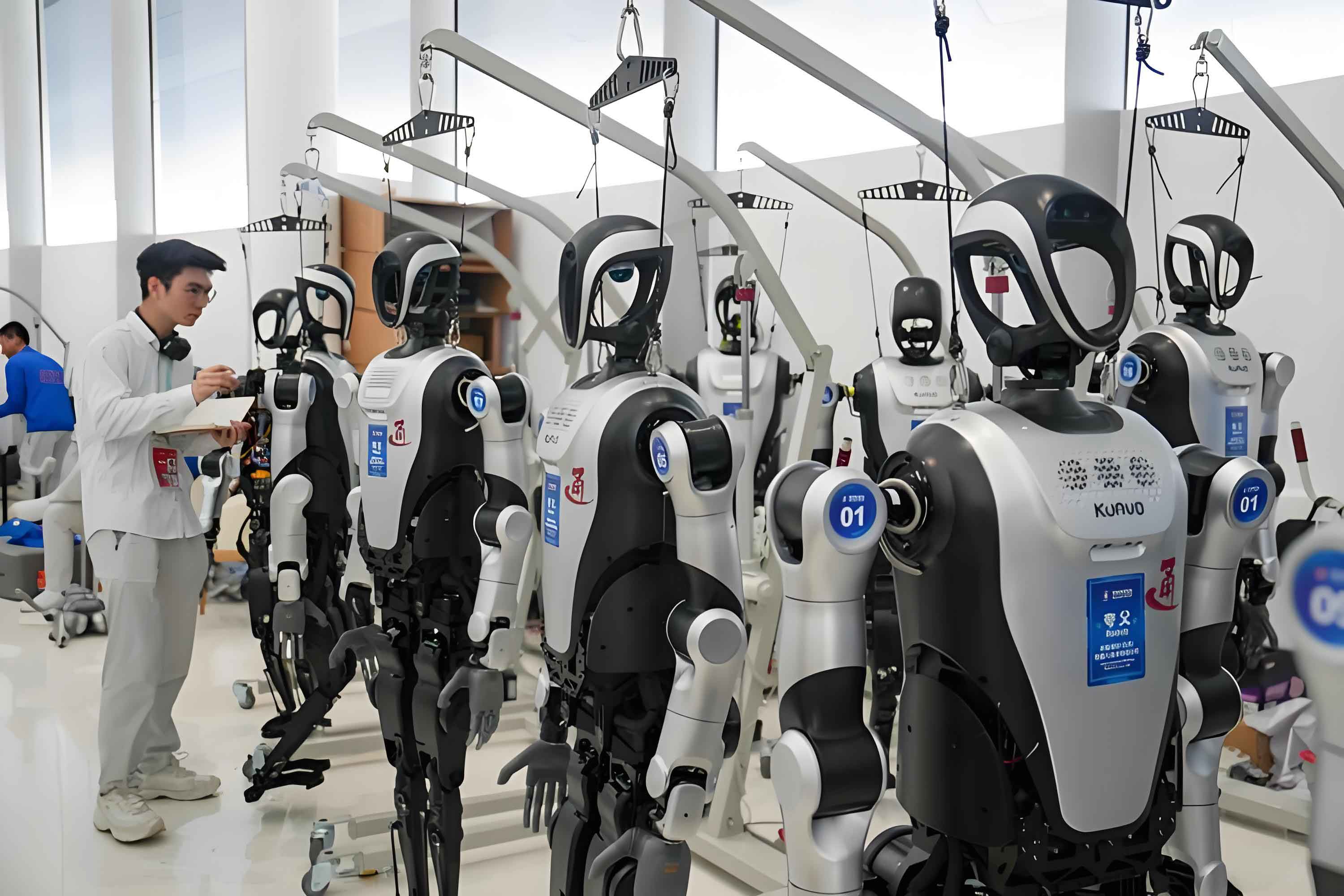
The manufacturing and quality assurance process for humanoid robots itself is a pinnacle of precision engineering. As depicted, rigorous inspection protocols ensure every unit meets stringent performance and safety standards before deployment. This commitment to quality is fundamental to building trust in humanoid robot technology.
| Industry Sector | Primary Tasks for Humanoid Robot | Key Performance Indicators (KPIs) | Typical System Configuration |
|---|---|---|---|
| Education & Research | Interactive teaching, Programming platform, Research testbed | Student engagement score, Learning outcome improvement, Research publication rate | 1-2 robots per lab/class, Cloud-based curriculum |
| Retail & Hospitality | Customer greeting, Information kiosk, Basic guidance | Customer satisfaction index, Query resolution rate, Operational cost reduction | Stationary or mobile platform, Integrated CMS, Multilingual NLP |
| Healthcare (Assistive) | Patient monitoring, Logistics support, Rehabilitation aid | Patient compliance, Task completion time, Error rate in material handling | Safety-certified models, Soft robotics elements, Strict privacy controls |
| Logistics & Manufacturing | Assembly assistance, Parts fetching, Quality inspection | Cycle time, Defect rate, Overall Equipment Effectiveness (OEE) | Mobile manipulators, Integrated vision systems, ROS 2 middleware |
| Entertainment & Public Events | Performance, Crowd interaction, Brand ambassador | Audience size, Social media impressions, Sponsorship value | High-DOF models, Advanced animation software, Robust locomotion |
The path from innovation to industry is paved with strategic collaboration. We actively partner with global research institutions and corporations to accelerate the industrialization of humanoid robot technology. This ecosystem approach is vital. The technology readiness level (TRL) of a humanoid robot component often follows an S-curve, described by the logistic function:
$$
\text{TRL}(t) = \frac{L}{1 + e^{-k(t – t_0)}}
$$
where $L$ is the maximum TRL (9), $k$ is the growth rate, and $t_0$ is the inflection point. Collaborative R&D significantly increases $k$, shortening the development cycle. Our joint ventures focus not only on hardware but also on creating shared software platforms and standards, which reduce integration costs and spur wider adoption of the humanoid robot.
The economic implications are profound and multifaceted. First, the humanoid robot sector acts as a powerful catalyst for upstream technological innovation. The development of a single humanoid robot necessitates advances in materials science (for lighter, stronger limbs), chip design (for efficient on-board processing), and algorithm theory (for real-time planning). This creates a positive feedback loop. The R&D expenditure in this field has a high multiplier effect. We can model the knowledge spillover using a simplified endogenous growth model. Let $A$ represent the stock of knowledge (technology). Its growth might be expressed as:
$$
\dot{A} = \delta H_A^\lambda A^\phi
$$
where $H_A$ is human capital engaged in R&D for humanoid robots, $\delta > 0$, $\lambda \leq 1$, and $\phi$ captures the returns to past knowledge. A high $\phi$ suggests that innovation in humanoid robot technology builds powerfully on existing knowledge, creating a virtuous cycle.
Second, the humanoid robot is a key enabler for industrial transformation, particularly in manufacturing. Traditional assembly lines are giving way to flexible, collaborative cells where humanoid robots work alongside humans. This transition boosts productivity. Consider a production function for a smart factory:
$$
Y = F(K, L_h, L_r, A) = A \cdot [\alpha K^\rho + \beta L_h^\rho + (1-\alpha-\beta) L_r^\rho]^{1/\rho}
$$
where $Y$ is output, $K$ is capital, $L_h$ is human labor, $L_r$ is labor provided by humanoid robots, and $A$ is total factor productivity enhanced by AI. The elasticity of substitution is given by $\sigma = 1/(1-\rho)$. For $\rho < 1$ ($\sigma > 1$), human and robotic labor are substitutes, but in many complex tasks, they are complements ($\rho > 1$, $\sigma < 1$). The humanoid robot introduces a new factor $L_r$, optimizing the overall production mix and elevating $A$ through data-driven insights.
| Impact Dimension | Direct Effects | Indirect & Induced Effects | Quantitative Metric (Example Formula) |
|---|---|---|---|
| Productivity Gain | Higher output per hour in automated tasks | Upskilling of workforce, Optimization of supply chains | % Change in Labor Productivity = $\frac{Y/L’ – Y/L}{Y/L} \times 100$ |
| Job Market Evolution | Displacement of routine manual jobs | Creation of high-skill jobs (robot maintenance, programming, supervision) | Net Job Creation = $\Delta J_{create} – \Delta J_{displace}$ |
| Capital Investment | Investment in robot hardware & software | Investment in complementary infrastructure (5G, edge computing) | Cumulative Investment $I_{total} = \sum_{t=0}^{T} I_0 (1+g)^t$ |
| Innovation Spillover | Patents filed in robotics | Advancements in adjacent fields (computer vision, haptics, battery tech) | Spillover Index $S = \sum_{j \neq i} \frac{Cites_{i \to j}}{Patents_i}$ |
| Service Sector Expansion | New robotic service offerings | Increased demand for personalized services, Entertainment content | Market Size $M_t = M_0 e^{rt}$, where $r$ is growth rate driven by adoption |
Third, the humanoid robot is seeding entirely new economic ecosystems. As the technology matures, we see burgeoning growth in related services: specialized maintenance and repair, customized AI behavior development, leasing models for humanoid robots, and data analytics services powered by the operational data from these robots. The value created in these ancillary sectors can be substantial. The total addressable market (TAM) for humanoid robot-centric services can be modeled as a function of the installed base:
$$
\text{TAM}_{services}(t) = N(t) \times [\gamma_c C(t) + \gamma_s S(t)]
$$
where $N(t)$ is the number of deployed humanoid robots, $C(t)$ is the average annual hardware-related service cost (e.g., maintenance), $S(t)$ is the average annual software/service subscription fee, and $\gamma_c, \gamma_s$ are scaling factors. As $N(t)$ grows exponentially in the coming years, so too will the service economy around the humanoid robot.
From my vantage point, the convergence of technologies that make advanced humanoid robots possible—like deep reinforcement learning for motor skills—follows a rapid trajectory. The learning process for a humanoid robot to master a task like walking can be framed as a Markov Decision Process (MDP) solved via policy gradient methods:
$$
\nabla_\theta J(\theta) = \mathbb{E}_{\tau \sim \pi_\theta} \left[ \sum_{t=0}^{T} \nabla_\theta \log \pi_\theta(a_t | s_t) \hat{A}(s_t, a_t) \right]
$$
where $\hat{A}$ is an estimator of the advantage function. The computational cost of training these policies is falling, enabling more sophisticated behaviors for the humanoid robot.
Looking ahead, our collective mission is clear. We must deepen international cooperation to establish safety and interoperability standards for the humanoid robot. We need to invest in foundational education to cultivate the next generation of engineers and ethicists who will steer this technology. Furthermore, continuous innovation in energy storage and efficient actuation is paramount to unlock the full potential of mobile humanoid robots operating for extended periods. The roadmap involves solving grand challenges like robust whole-body manipulation in unstructured environments, which requires advances in both hardware and AI.
In conclusion, the ascendance of the humanoid robot represents a pivotal chapter in our industrial evolution. Through relentless focus on core technology, pragmatic application across sectors, and synergistic ecosystem building, the humanoid robot is proving to be far more than a machine—it is a versatile platform for innovation, a partner in economic transformation, and a beacon of future possibilities. Every breakthrough in sensors, every new algorithm for balance, and every successful deployment of a humanoid robot in a new setting reinforces this trajectory. We are not just building robots; we are architecting a more capable, efficient, and innovative future with the humanoid robot at its core. The journey is complex and demanding, but the potential rewards for productivity, societal well-being, and global technological leadership are immense. As we continue to refine, deploy, and imagine new roles for the humanoid robot, we solidify its status as an indispensable engine for progressive change.