
I have been closely observing the rapid evolution of artificial intelligence and robotics, and it is my firm belief that embodied AI robots represent a transformative leap forward. As an integration of advanced AI with physical robotic systems, embodied AI robots emphasize learning and adaptation through interaction with the environment. This concept, which traces back to early computational theories, has gained tremendous momentum in recent years due to breakthroughs in large-scale models. In this analysis, I will delve into the technological advancements, market dynamics, challenges, and future prospects of embodied AI robots, utilizing tables and formulas to summarize key points.
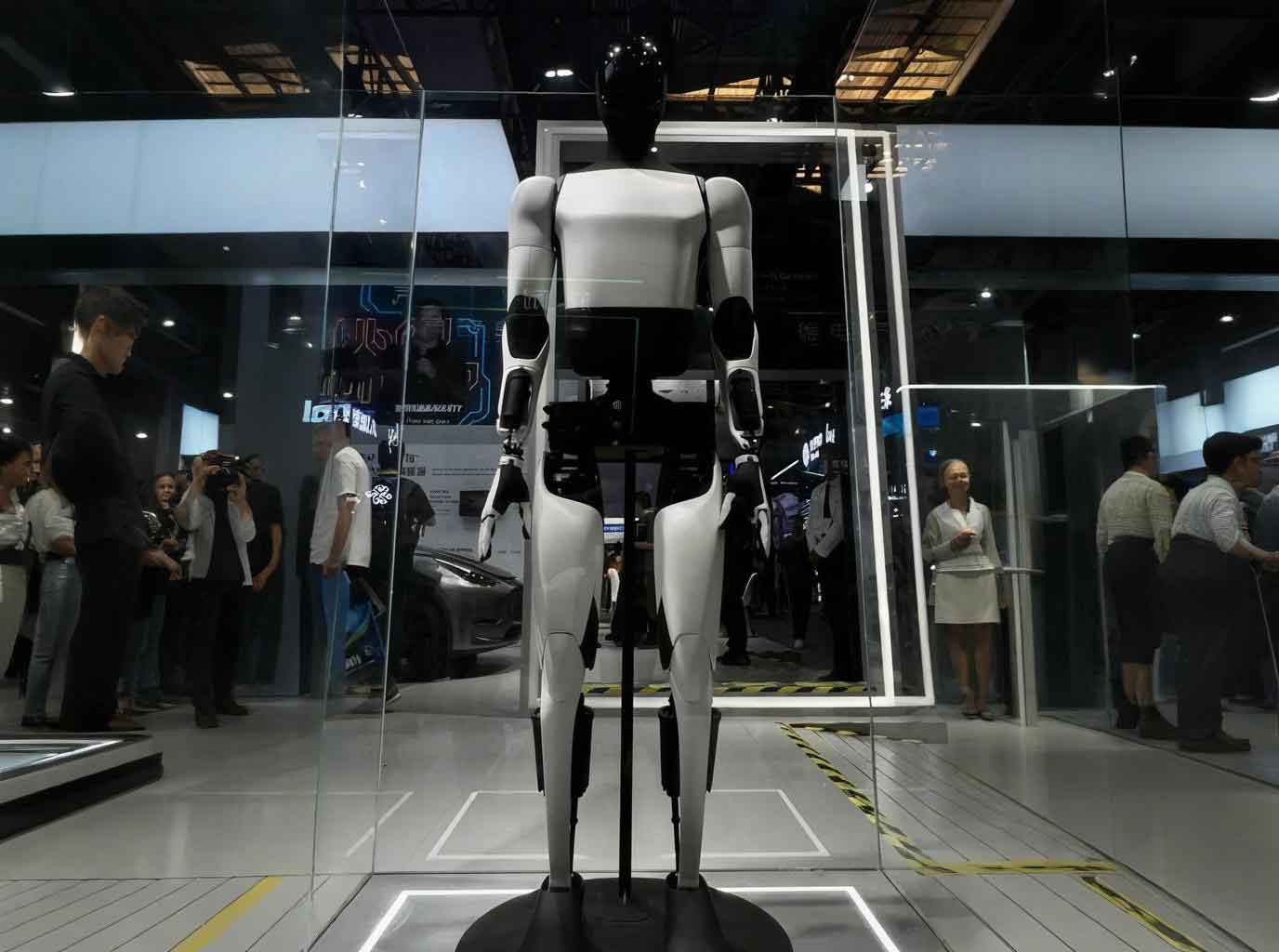
From my perspective, the core of embodied AI robots lies in their ability to perceive, decide, and act autonomously. The recent progress in multimodal large models has significantly enhanced the “brain” of these robots, enabling complex reasoning and planning. For instance, the decision-making process in an embodied AI robot can be modeled using a reinforcement learning framework, where the goal is to maximize cumulative rewards. The value function \( V(s) \) for a state \( s \) is defined as:
$$V(s) = \max_a \left( R(s,a) + \gamma \sum_{s’} P(s’|s,a) V(s’) \right)$$
Here, \( R(s,a) \) denotes the immediate reward for taking action \( a \) in state \( s \), \( \gamma \) is the discount factor, and \( P(s’|s,a) \) is the transition probability to state \( s’ \). This formula underpins the learning algorithms that allow embodied AI robots to improve their strategies over time.
I have noted that technological innovations in embodied AI robots can be categorized into three key components: the brain (cognition), the cerebellum (motion control), and the limbs (dexterity). The following table summarizes recent breakthroughs in these areas:
| Component | Advancement | Key Technologies | Example |
|---|---|---|---|
| Brain | Enhanced decision-making via multimodal large models | Transformer architectures, attention mechanisms | Models like π0 enabling task planning in home environments |
| Cerebellum | Improved motion control and generalization | Reinforcement learning, adaptive algorithms | Generalized standing algorithms for varied terrains |
| Limbs | Increased dexterity through bionic design | Multimodal sensing, actuator technologies | Robots with multiple degrees of freedom performing delicate tasks |
In my view, the training of large models for embodied AI robots involves optimizing complex loss functions. For a model with parameters \( \theta \), the loss \( L(\theta) \) over a dataset \( \{(x_i, y_i)\}_{i=1}^N \) can be expressed as:
$$L(\theta) = -\sum_{i=1}^{N} \log P(y_i | x_i; \theta) + \lambda \|\theta\|^2$$
where \( \lambda \) is a regularization parameter to prevent overfitting. This approach enables embodied AI robots to learn from vast amounts of data, improving their generalization across tasks.
I observe that embodied AI robots are finding applications across diverse sectors. The table below outlines some initial successes in various fields:
| Application Domain | Use Cases | Impact of Embodied AI Robots |
|---|---|---|
| Industrial Manufacturing | Assembly, quality inspection, logistics | Increased precision and efficiency in production lines |
| Home Service | Cleaning, cooking, elderly care | Reduction in manual labor and enhanced convenience |
| Commercial Retail | Inventory management, customer assistance | Improved operational efficiency and customer experience |
| Autonomous Driving | Navigation, obstacle avoidance, fleet management | Enhanced safety and reduced traffic congestion |
From my analysis, the perception module of an embodied AI robot can be described mathematically. Let \( s_t \) represent the state of the environment at time \( t \), and \( o_t \) be the observation obtained through sensors. The perception function \( f \) maps states to observations:
$$o_t = f(s_t) + \epsilon_t$$
where \( \epsilon_t \) is sensor noise. This model highlights the importance of accurate sensing for embodied AI robots to interact effectively.
I have tracked the growing industry scale of embodied AI robots, which is becoming a significant economic driver. The following table presents key metrics based on market data:
| Metric | 2020 Baseline | 2024 Status | 2030 Projection | Remarks |
|---|---|---|---|---|
| Global Number of Enterprises | ~14.7k (estimated) | ~45.17k | Expected to grow exponentially | Reflecting rapid entry of new players |
| Market Size (Humanoid Robots) | Nascent stage | $1.017 billion | $15.1 billion | CAGR of approximately 45% |
| Investment and Financing | Moderate activity | Surge in deals, e.g., $6.75B in 2024 | Continued high influx | Indicating strong investor confidence |
In my assessment, the motion control of embodied AI robots can be formulated using dynamics equations. For a robot with joint angles \( q \), the equation of motion is:
$$M(q)\ddot{q} + C(q, \dot{q})\dot{q} + G(q) = \tau$$
where \( M(q) \) is the inertia matrix, \( C(q, \dot{q}) \) represents Coriolis and centrifugal forces, \( G(q) \) is the gravitational vector, and \( \tau \) is the torque input. Advanced algorithms optimize \( \tau \) to achieve stable and agile movements for embodied AI robots.
I recognize that embodied AI robots face several challenges that hinder their widespread adoption. The table below categorizes these challenges:
| Challenge Category | Specific Issues | Impact on Embodied AI Robots |
|---|---|---|
| Technological | Algorithmic generalization, data scarcity, hardware limitations | Restricts adaptability and increases development costs |
| Industrial Ecology | Fragmented supply chain, lack of standards, poor collaboration | Slows down scaling and innovation |
| Safety and Governance | Unpredictable decisions, ethical dilemmas, data privacy risks | Raises public concern and regulatory hurdles |
From my perspective, the planning problem for embodied AI robots can be framed as a Markov Decision Process (MDP). The optimal policy \( \pi^*(s) \) maximizes the expected cumulative reward:
$$\pi^*(s) = \arg\max_\pi \mathbb{E}\left[ \sum_{t=0}^{\infty} \gamma^t R(s_t, a_t) \mid \pi \right]$$
Solving this requires efficient algorithms, which are still evolving for complex environments.
I anticipate that embodied AI robots will evolve from specialized tools into universal intelligent carriers. This transition can be modeled as an expansion in capability space. Let \( C \) represent the set of tasks an embodied AI robot can perform. Initially, \( C \) is limited, but over time, with learning, it approaches a universal set \( U \):
$$\lim_{t \to \infty} C(t) = U \quad \text{where} \quad U \text{ encompasses diverse complex tasks}$$
This vision underscores the potential of embodied AI robots to become versatile assistants.
I have observed that the application of embodied AI robots is expanding into new industries. The following table projects future penetration across sectors:
| Industry | Potential Applications of Embodied AI Robots | Expected Benefits |
|---|---|---|
| Healthcare | Surgical assistance, patient monitoring, rehabilitation | Improved accuracy and personalized care |
| Education | Interactive tutoring, skill training, special needs support | Enhanced learning outcomes and engagement |
| Agriculture | Precision farming, automated harvesting, livestock management | Increased yield and resource efficiency |
| Construction | Site inspection, heavy lifting, autonomous bricklaying | Reduced labor risks and faster project completion |
In my view, the collaboration between multiple embodied AI robots can be optimized using game theory. For \( n \) robots, the utility function \( U_i \) for robot \( i \) in a collaborative task is:
$$U_i(a_1, a_2, …, a_n) = R_i(a_i) + \sum_{j \neq i} \alpha_{ij} C(a_i, a_j)$$
where \( a_i \) is the action of robot \( i \), \( R_i \) is its individual reward, \( C \) represents collaboration benefits, and \( \alpha_{ij} \) are coupling coefficients. This formula facilitates efficient multi-robot systems.
I believe that the industrial ecosystem for embodied AI robots is shifting from dispersed layouts to clustered development. This can be quantified using a clustering index \( \kappa \), defined as:
$$\kappa = \frac{\text{Number of collaborative partnerships}}{\text{Total number of firms}}$$
As \( \kappa \) increases, it indicates better integration and resource sharing among hardware makers, software developers, and system integrators focused on embodied AI robots.
From my analysis, data processing for embodied AI robots involves handling multimodal streams. Let \( D = \{ (v_i, l_i, a_i) \} \) be a dataset of visual, linguistic, and action data. The learning objective is to minimize a multimodal loss:
$$L_{\text{multi}} = \sum_i \left( \| \hat{v}_i – v_i \|^2 + \| \hat{l}_i – l_i \|^2 + \| \hat{a}_i – a_i \|^2 \right)$$
where \( \hat{v}_i, \hat{l}_i, \hat{a}_i \) are predicted outputs. This enables embodied AI robots to understand and respond to diverse inputs.
I have noted that safety assurance for embodied AI robots requires formal verification. The probability of a failure event \( F \) can be bounded using reliability theory:
$$P(F) \leq \sum_{k=1}^{m} P(F | E_k) P(E_k)$$
where \( E_k \) are environmental conditions. Reducing \( P(F) \) is crucial for deploying embodied AI robots in sensitive areas.
In my assessment, the economic impact of embodied AI robots can be modeled using growth equations. Let \( Y(t) \) represent economic output influenced by embodied AI robot adoption:
$$\frac{dY}{dt} = \alpha Y + \beta R(t)$$
where \( \alpha \) is the baseline growth rate, \( \beta \) is the contribution coefficient, and \( R(t) \) is the penetration level of embodied AI robots. This suggests that embodied AI robots can act as catalysts for development.
I anticipate that future research on embodied AI robots will focus on meta-learning algorithms. The meta-loss for quick adaptation to new tasks is:
$$L_{\text{meta}}(\phi) = \sum_{\tau \sim p(\tau)} L_{\tau}( \theta_\tau ) \quad \text{with} \quad \theta_\tau = u(\phi, D_\tau)$$
where \( \phi \) are meta-parameters, \( \tau \) denotes tasks, and \( u \) is an update rule. This will allow embodied AI robots to learn efficiently from limited experience.
From my perspective, the standardization of interfaces for embodied AI robots is essential. A compatibility score \( S \) between two systems can be defined as:
$$S = \frac{\text{Number of successful interactions}}{\text{Total interaction attempts}}$$
Higher \( S \) values, achieved through common protocols, will accelerate the integration of embodied AI robots into existing infrastructures.
I believe that the ethical framework for embodied AI robots must incorporate accountability metrics. Let \( A \) be an accountability measure for an action outcome \( O \):
$$A(O) = \sum_{i} w_i \cdot I_i(O)$$
where \( w_i \) are weights for stakeholders (e.g., developers, users), and \( I_i \) are influence indicators. This helps in assigning responsibility for actions of embodied AI robots.
In my view, the energy efficiency of embodied AI robots is a critical factor. The power consumption \( P \) during operation can be modeled as:
$$P = P_{\text{comp}} + P_{\text{sense}} + P_{\text{act}}$$
where \( P_{\text{comp}} \), \( P_{\text{sense}} \), and \( P_{\text{act}} \) are power for computation, sensing, and actuation, respectively. Optimizing each component is vital for sustainable deployment of embodied AI robots.
I have observed that human-robot interaction for embodied AI robots can be enhanced through natural language processing. The probability of correct interpretation of a command \( c \) given context \( x \) is:
$$P(\text{correct} | c, x) = \sigma( \mathbf{W} \cdot \text{embed}(c) + \mathbf{b} )$$
where \( \sigma \) is a sigmoid function, \( \mathbf{W} \) and \( \mathbf{b} \) are parameters, and embed is an embedding function. This improves the usability of embodied AI robots.
From my analysis, the scalability of training data for embodied AI robots follows a log-linear relationship. The performance \( Perf \) as a function of data size \( N \) is:
$$Perf(N) = a \cdot \log(N) + b$$
where \( a \) and \( b \) are constants. This underscores the need for large, diverse datasets to advance embodied AI robots.
I anticipate that regulatory policies for embodied AI robots will evolve based on risk assessments. A risk score \( R \) can be computed as:
$$R = \sum_{j} \text{severity}(j) \times \text{likelihood}(j)$$
for potential hazards \( j \). Policies can then be tailored to mitigate risks associated with embodied AI robots.
In my assessment, the innovation cycle for embodied AI robots is accelerating. The time \( T \) from research to commercialization can be expressed as:
$$T = \frac{K}{\text{Collaboration Intensity} \times \text{Funding Level}}$$
where \( K \) is a constant. Increased collaboration and investment shorten \( T \), benefiting the development of embodied AI robots.
I believe that embodied AI robots will play a pivotal role in addressing global challenges such as labor shortages and aging populations. Their adaptability and learning capabilities make them ideal for dynamic environments. As I reflect on the progress so far, it is clear that embodied AI robots are not just technological artifacts but catalysts for societal transformation. The journey from concept to ubiquitous helper is underway, and I am confident that continued innovation will unlock unprecedented potentials for embodied AI robots across all facets of life.