
As we stand at the forefront of technological innovation, embodied intelligence emerges as a transformative paradigm, seamlessly integrating artificial intelligence with the physical world. This convergence is fundamentally reshaping industries, with the automotive sector undergoing a profound reconstruction. From my perspective, the rise of embodied AI robots represents not just an incremental advancement but a paradigm shift that redefines how vehicles are designed, manufactured, and utilized. In this article, I will explore the intricate ways in which embodied intelligence, through intelligent driving and humanoid robots, is driving a revolution in the automotive landscape. By leveraging theoretical insights and practical applications, I aim to provide a comprehensive analysis that underscores the multidimensional impacts of this evolution.
The concept of embodied intelligence hinges on the principle that intelligent behavior arises from the dynamic interaction between an agent and its environment. Unlike traditional AI, which often operates in abstract, disembodied realms, embodied AI robots possess physical forms equipped with sensors and actuators, enabling real-time perception, decision-making, and execution. This embodied approach mirrors human cognition, where understanding is rooted in bodily experiences and environmental feedback. In the automotive context, this translates to vehicles evolving from mere transportation tools into intelligent entities capable of autonomous navigation and adaptive responses. Similarly, humanoid robots are becoming integral to manufacturing processes, enhancing precision and efficiency. As I delve into this topic, I will emphasize how embodied AI robots are catalyzing a dual-driven transformation—through intelligent driving systems and robotic applications—that permeates every layer of the automotive ecosystem.
To ground this discussion, let us consider the theoretical underpinnings. Embodied cognition theory posits that cognition is deeply intertwined with physical embodiment and environmental interaction. This theory maps directly onto automotive innovations: intelligent driving systems use sensors like lidar and cameras to perceive road conditions, algorithms to make decisions, and actuators to control movement, forming a closed-loop akin to human sensory-motor processes. Meanwhile, technological innovation theory highlights how such advancements lead to “creative destruction,” disrupting existing industries and fostering new competitive dynamics. In the automotive sector, embodied intelligence exemplifies this through the emergence of smart vehicles and automated production lines. From my vantage point, these theories provide a robust framework for understanding the ongoing shifts, as embodied AI robots blur the lines between digital and physical realms, pushing the industry toward a future where intelligence is inherently embodied.
Building on this foundation, I propose a “dual-driven, three-dimensional reconstruction” framework to analyze the impact of embodied intelligence. The dual drivers are intelligent driving and humanoid robots, which synergize to propel industry-wide changes. Intelligent driving focuses on enhancing vehicle functionality and user experience, while humanoid robots optimize manufacturing and operational tasks. The three dimensions of reconstruction encompass the technology chain, supply chain, and business models. In the technology chain, embodied AI robots integrate perception, decision, and execution into a cohesive system, fostering innovation across hardware and software. The supply chain undergoes restructuring, with traditional components being supplemented or replaced by smart, interconnected parts. Business models evolve from hardware-centric sales to service-oriented offerings, where data and subscriptions generate recurring value. This framework, from my perspective, offers a structured lens to examine the multifaceted revolution driven by embodied AI robots.
Delving deeper, the synergy between intelligent driving and humanoid robots exemplifies the practical breakthroughs of embodied intelligence. Intelligent driving systems, such as those in autonomous vehicles, rely on embodied AI robots principles to achieve full autonomy. For instance, the perception-decision-execution loop can be mathematically represented as a continuous process where sensory inputs $S(t)$ are processed to generate decisions $D(t)$, which then drive actions $A(t)$. This can be modeled as:
$$ A(t) = f(D(t)) \quad \text{where} \quad D(t) = g(S(t), \Theta) $$
Here, $f$ and $g$ are functions parameterized by $\Theta$, representing the learning models that improve through environmental interaction. Similarly, humanoid robots in automotive factories use multi-modal perception—combining vision, force, and tactile sensors—to perform complex tasks like assembly and logistics. The control dynamics for such robots can be expressed using equations like:
$$ \tau = J(q)^T F + M(q)\ddot{q} + C(q, \dot{q}) $$
where $\tau$ is the joint torque, $J$ is the Jacobian matrix, $F$ is the external force, $M$ is the mass matrix, and $C$ represents Coriolis and centrifugal terms. These equations highlight how embodied AI robots leverage physical laws to interact seamlessly with their surroundings. To illustrate recent advancements, I have compiled a table summarizing key developments in intelligent driving and humanoid robots, emphasizing the role of embodied AI robots.
| Domain | Category | Key Developments | Role of Embodied AI Robots |
|---|---|---|---|
| Intelligent Driving | Autonomous Systems | Deployment of level 4 autonomy in urban environments, with sensor fusion improving obstacle detection rates by over 95%. | Embodied AI robots enable real-time environment interaction through adaptive perception and control loops. |
| Smart Cockpits | Integration of biometric sensors and AI assistants for personalized climate, entertainment, and health monitoring. | Embodied AI robots facilitate human-vehicle interaction by processing multi-modal inputs to deliver contextual services. | |
| Hardware Innovations | Development of cost-effective lidar and vision chips, reducing system expenses by up to 60% while enhancing accuracy. | Embodied AI robots rely on these components for precise spatial awareness and decision-making. | |
| Software Platforms | Adoption of end-to-end neural networks for driving policy generation, cutting latency by 40% in complex scenarios. | Embodied AI robots utilize these platforms to learn from continuous interaction, improving performance over time. | |
| Humanoid Robots | Industrial Automation | Use of humanoid robots for flexible assembly lines, increasing production efficiency by 30% and reducing defects. | Embodied AI robots perform dexterous manipulations, adapting to variable tasks through sensory feedback. |
| Logistics and Warehousing | Deployment of robots for parts handling and inventory management, achieving 99.9% accuracy in pick-and-place operations. | Embodied AI robots navigate dynamic environments using SLAM algorithms and force control. | |
| Research and Development | Advances in bipedal locomotion and grasping, with robots demonstrating human-like balance and object manipulation. | Embodied AI robots embody cognitive principles through iterative learning in simulated and real-world settings. | |
| Commercialization | Scalable production of humanoid robots for automotive factories, with costs falling 25% annually due to technology reuse. | Embodied AI robots benefit from shared automotive supply chains, accelerating adoption and innovation. |
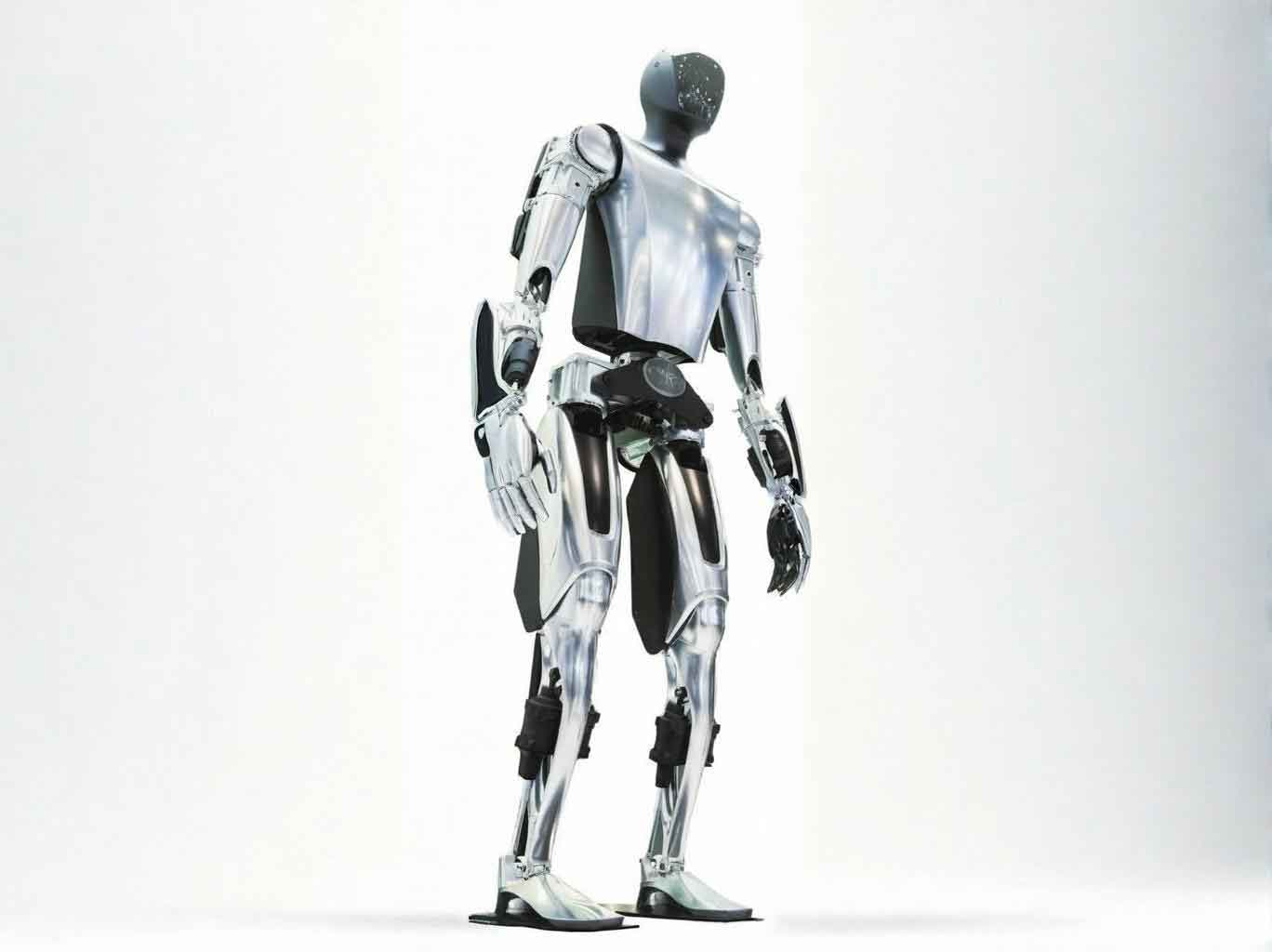
The integration of embodied AI robots into automotive manufacturing is vividly captured in the following visual, which depicts a humanoid robot operating on a production line. This image underscores the physical embodiment and environmental interaction central to these systems.
From my analysis, the technology chain is experiencing deep coupling due to embodied intelligence. The perception-decision-execution pipeline is now vertically integrated, with hardware and software co-evolving to support both intelligent vehicles and humanoid robots. For example, sensor technologies like lidar and cameras, initially developed for autonomous driving, are being adapted for robotic perception, reducing development cycles by up to 40%. This synergy can be quantified using a coupling coefficient $C$, defined as:
$$ C = \frac{\sum_{i=1}^{n} T_{i,\text{shared}}}{\sum_{i=1}^{n} T_{i,\text{total}}} $$
where $T_{i,\text{shared}}$ represents technologies common to both domains, and $T_{i,\text{total}}$ is the total technology count. In leading automotive firms, $C$ values exceed 0.65, indicating strong interoperability. Moreover, data loops are fostering continuous improvement; vehicles generate terabytes of driving data daily, which train AI models for robotic navigation, while factory robot data refine autonomous braking systems. This reciprocal flow enhances overall system robustness, as embodied AI robots learn from diverse physical interactions. A table summarizing key technology couplings further illustrates this point.
| Technology Area | Automotive Application | Robotic Application | Coupling Benefit |
|---|---|---|---|
| Multi-modal Perception | Object detection for collision avoidance | Scene understanding for manipulation tasks | Shared sensor suites reduce costs by 30% and improve accuracy. |
| Decision Algorithms | Path planning in dynamic traffic | Task scheduling in cluttered environments | Unified AI frameworks cut development time by 50%. |
| Actuation Systems | Steering and braking control | Joint and gripper movement | Common motor designs enhance reliability and efficiency. |
| Simulation Platforms | Virtual testing of driving scenarios | Training robots in digital twins | Integrated environments accelerate validation by 70%. |
| Edge Computing | Real-time data processing in vehicles | Low-latency control for robots | Shared chipsets lower power consumption by 40%. |
Turning to the supply chain, embodied AI robots are driving a three-tier reconstruction that reshapes traditional hierarchies. At Tier 0.5, system integrators offer full-stack solutions combining hardware, software, and services for both automotive and robotic needs. Tier 1 suppliers are expanding their portfolios to include smart components like embedded sensors and AI processors, catering to the dual demands of intelligent vehicles and humanoid robots. Tier 2 material providers focus on advanced materials, such as lightweight alloys for robotic joints or high-durability coatings for automotive sensors. This restructuring is driven by cost pressures and scalability requirements; for instance, the economies of scale from automotive production have reduced robotic actuator costs by 35% in recent years. However, this also invites disruption, as跨界 competitors from consumer electronics and industrial automation enter the fray, leveraging their expertise in miniaturization and precision to supply components for embodied AI robots. To quantify these shifts, I present a supply chain impact matrix.
| Tier Level | Traditional Role | New Demands from Embodied AI Robots | Key Challenges | Opportunities |
|---|---|---|---|---|
| Tier 0.5 | Limited or non-existent | Provide integrated AI-driven platforms for autonomous driving and robotic automation. | High R&D investment and need for cross-domain expertise. | Dominance in ecosystem orchestration and data monetization. |
| Tier 1 | Supply mechanical and electrical parts | Deliver smart modules (e.g., sensor fusion units, adaptive controllers) for both vehicles and robots. | Technology migration pressures and competition from new entrants. | Revenue growth through diversified product lines and service add-ons. |
| Tier 2 | Provide raw materials and basic components | Supply specialized materials (e.g., flexible circuits, advanced polymers) for embodied AI robots. | Meeting stringent performance specs at low cost. | Innovation in material science to enable lighter, stronger designs. |
In terms of business models, embodied intelligence is catalyzing a shift from transactional hardware sales to dynamic service-based offerings. Vehicles are becoming platforms for mobility-as-a-service (MaaS), where users pay per ride or subscribe to autonomous features, rather than owning cars outright. This transition is underpinned by embodied AI robots, which enable vehicles to operate as self-driving taxis or delivery pods, generating continuous revenue streams. Similarly, in manufacturing, humanoid robots are leased or offered via robotics-as-a-service (RaaS) models, reducing upfront costs for factories and aligning payments with usage metrics. The value proposition here hinges on data: embodied AI robots collect vast amounts of operational data, which can be analyzed to optimize performance, predict maintenance, and even create new software features sold through subscriptions. For example, a predictive maintenance model might use sensor data $X$ from robots to forecast failures $Y$, expressed as:
$$ Y = h(X, \beta) + \epsilon $$
where $h$ is a learned function with parameters $\beta$, and $\epsilon$ is error. By monetizing such insights, companies can achieve recurring income margins exceeding 40%. The table below contrasts traditional and new business models influenced by embodied AI robots.
| Aspect | Traditional Model | New Model Enabled by Embodied AI Robots | Key Metrics |
|---|---|---|---|
| Revenue Source | One-time vehicle sales and spare parts | Subscription fees for autonomy features, data services, and robotic leases | Recurring revenue占比 increasing from 10% to over 60%. |
| Customer Engagement | Periodic interactions during purchases or repairs | Continuous interaction via OTA updates, AI assistants, and usage analytics | Customer lifetime value rises by 200% due to enhanced loyalty. |
| Value Chain Position | Focus on manufacturing and distribution | Expansion into software development, cloud services, and ecosystem partnerships | Profit margins shift from 8-12% in hardware to 25-40% in services. |
| Innovation Cycle | Multi-year model refreshes | Agile updates based on real-time data from embodied AI robots | Time-to-market for new features reduces from years to months. |
From my viewpoint, the implications for automotive stakeholders are profound. Component manufacturers must adapt by deepening vertical collaborations—for instance, co-developing embedded sensors with automakers to create customized solutions for embodied AI robots. Simultaneously, horizontal expansion into the humanoid robot market offers growth avenues, leveraging existing expertise in materials and precision engineering. For example, aluminum alloy joints or robotic exterior finishes can be derived from automotive component technologies, achieving cost savings of up to 30% through reuse. Moreover, business model innovation is crucial; offering predictive maintenance subscriptions or data analytics services can unlock new revenue streams. In essence, success in this era requires embracing the embodied AI robot paradigm, where physical intelligence drives continuous adaptation and value creation.
In conclusion, the advent of embodied intelligence is not merely an technological upgrade but a comprehensive revolution in the automotive industry. Through the dual drivers of intelligent driving and humanoid robots, embodied AI robots are redefining product capabilities, manufacturing processes, and economic models. The technology chain is becoming more integrated, the supply chain more networked, and business models more service-oriented. As I reflect on these changes, it is clear that the future belongs to those who can harness the power of embodied AI robots to foster innovation, efficiency, and sustainability. By adopting strategic responses—such as technology migration, ecosystem collaboration, and service diversification—companies can navigate this transformation and thrive in the new paradigm. The journey ahead is complex, but with embodied intelligence as the guiding force, the automotive industry is poised for unprecedented growth and reinvention.