
As I observe the rapid evolution of technology, one field that consistently captures my imagination and professional interest is the development of humanoid robots. These machines, designed to mimic human form and function, represent a pinnacle of interdisciplinary engineering. In this article, I will delve into the current dynamics, technological foundations, and future trajectories of humanoid robot development, drawing from recent industry movements and research advancements. My aim is to provide a comprehensive overview that highlights the multifaceted nature of this domain, emphasizing key aspects such as embodied intelligence, motion control, and ecosystem building. Throughout, I will use tables and formulas to summarize critical points, ensuring a detailed exploration that spans over 8000 tokens. The keyword ‘humanoid robot’ will be frequently reiterated to underscore its centrality in this discourse.
The concept of a humanoid robot is not merely about creating a mechanical replica of a human; it is about enabling seamless human-robot collaboration across diverse settings, from industrial floors to domestic environments. As I reflect on recent initiatives, I note that various regions are actively formulating strategies to foster the growth of this industry. For instance, a provincial industrial authority has drafted an action plan aimed at accelerating the aggregation and high-quality development of humanoid robot industries. This plan outlines a vision to establish a robust innovation system and industrial ecology by 2027, with aspirations to become a significant hub for humanoid robot production by 2030. Such efforts underscore the global race to harness the potential of humanoid robots, driven by their promise to revolutionize sectors like manufacturing, healthcare, and education.
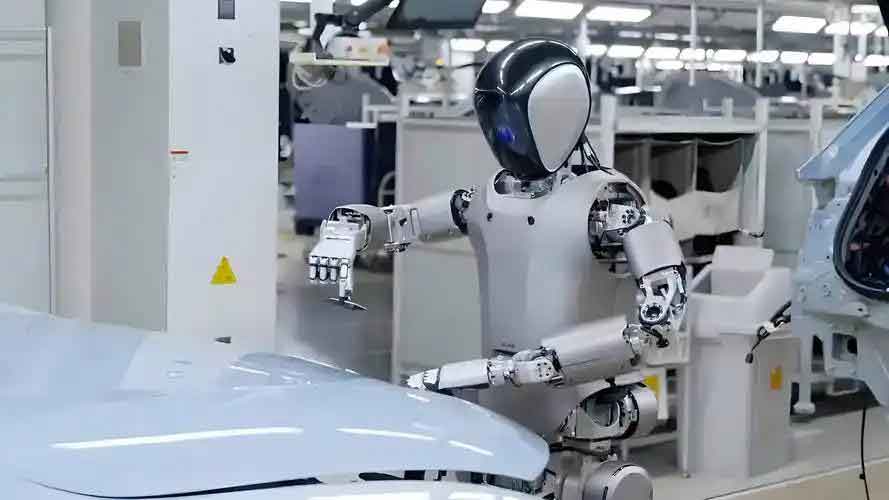
From my perspective, the technological backbone of a humanoid robot is built upon several core components: the brain (embodied AI), the cerebellum (motion control), the limbs (actuation and structure), and sensory systems. Each of these elements requires deep integration of disciplines such as mechanics, artificial intelligence, control theory, materials science, and computer science. Let me start by examining the computational aspects. The ‘brain’ of a humanoid robot relies on advanced algorithms for perception, decision-making, and learning. A fundamental formula in reinforcement learning, often used for training humanoid robots, is the Q-learning update rule:
$$ Q(s, a) \leftarrow Q(s, a) + \alpha \left[ r + \gamma \max_{a’} Q(s’, a’) – Q(s, a) \right] $$
Here, \( Q(s, a) \) represents the expected cumulative reward for taking action \( a \) in state \( s \), with \( \alpha \) as the learning rate, \( r \) as the immediate reward, and \( \gamma \) as the discount factor. This approach enables a humanoid robot to optimize its behaviors through trial and error, essential for adaptive interactions. Moreover, embodied intelligence emphasizes the coupling of perception and action, which can be modeled using Bayesian inference:
$$ P(h \mid e) = \frac{P(e \mid h) P(h)}{P(e)} $$
where \( h \) denotes hypotheses about the environment, and \( e \) represents sensory evidence. This allows a humanoid robot to maintain updated beliefs about its surroundings, facilitating robust operation in dynamic settings.
Moving to the ‘cerebellum’ or motion control system, kinematics and dynamics are paramount. The forward kinematics of a humanoid robot’s arm can be expressed using the Denavit-Hartenberg parameters. For a serial chain of \( n \) joints, the transformation matrix from the base to the end-effector is:
$$ T_n^0 = \prod_{i=1}^{n} A_i $$
where \( A_i \) is the homogeneous transformation matrix for joint \( i \). For dynamic control, the equations of motion are derived from the Lagrangian formulation:
$$ \tau = M(q) \ddot{q} + C(q, \dot{q}) \dot{q} + g(q) $$
In this equation, \( \tau \) is the vector of joint torques, \( M(q) \) is the inertia matrix, \( C(q, \dot{q}) \) represents Coriolis and centrifugal forces, and \( g(q) \) accounts for gravitational effects. These formulas are critical for ensuring stable and efficient movement of a humanoid robot, especially when navigating complex terrains or manipulating objects.
To provide a structured overview of the developmental goals for humanoid robot industries, I have compiled the following table based on analyzed action plans. It summarizes key milestones and focus areas:
| Timeframe | Primary Objectives | Key Metrics |
|---|---|---|
| By 2027 | Establish initial innovation system and industrial ecology for humanoid robots; achieve preliminary industrialization capability. | Number of integrated platforms, patent filings, startup formations. |
| By 2030 | Accelerate industrialization of humanoid robots; enrich application scenarios; deeply integrate products into real economy; become influential development hub. | Market share, deployment in sectors (e.g., healthcare, logistics), economic impact. |
This table illustrates a phased approach to nurturing the humanoid robot ecosystem. In my view, achieving these targets requires addressing both strengths and weaknesses in the supply chain. For example, while progress has been made in AI algorithms and system integration, gaps persist in components like high-precision reducers, long-endurance batteries, lightweight skeletal structures, myoelectric sensors, and specialized software. I believe that focusing on these短板 is essential for advancing the overall performance of humanoid robots.
Let me elaborate on the technical challenges. High-performance reducers are crucial for precise joint movements in a humanoid robot. The torque transmission efficiency can be modeled as:
$$ \eta = \frac{T_{out}}{T_{in}} \times 100\% $$
where \( \eta \) is efficiency, \( T_{out} \) is output torque, and \( T_{in} \) is input torque. Improving \( \eta \) to over 90% is a key R&D target. Similarly, for battery systems, energy density \( E \) (in Wh/kg) dictates operational duration:
$$ E = \frac{C \times V}{m} $$
with \( C \) as capacity in Ah, \( V \) as voltage, and \( m \) as mass. Innovations in solid-state or lithium-sulfur chemistries could boost \( E \), enabling longer missions for humanoid robots.
In terms of software, the development of middleware and simulation environments accelerates testing. A common metric is the reality gap \( \Delta \), defined as the difference between simulated and real-world performance:
$$ \Delta = \| P_{sim} – P_{real} \| $$
Reducing \( \Delta \) through domain randomization and transfer learning is vital for deploying humanoid robots reliably.
The action plans I’ve studied emphasize four focal areas: optimizing whole-machine design, strengthening advantages (brain, cerebellum, limbs, testing),补齐短板 (as above), and co-building ecosystems. To break this down, I present another table detailing the main tasks aligned with these priorities:
| Task Category | Specific Actions | Expected Outcomes |
|---|---|---|
| 攻克关键技术 (Overcome Key Technologies) | Advance embodied intelligence; deploy innovation platforms; enhance system integration capabilities. | Breakthroughs in adaptive learning; establishment of R&D centers; improved deployment speed. |
| 培育重点产品 (Cultivate Key Products) | Develop整机 products; solidify key components (e.g., actuators, sensors); promote software innovation. | Commercial humanoid robot models; localized supply chain; open-source tools. |
| 推广应用场景 (Promote Application Scenarios) | Deepen scenario mining (e.g., elderly care, education); innovate business models; accelerate成果转化. | Pilot projects in 10+ sectors; new service offerings; increased adoption rates. |
| 推进集群建设 (Advance Cluster Development) | Nurture enterprises; attract investments and talent; foster industrial agglomeration. | Growth of SMEs; influx of capital; formation of specialized parks. |
| 强化支撑能力 (Strengthen Support Capabilities) | Enhance financial backing (e.g., venture funds); accelerate talent cultivation through academia-industry ties. | Increased R&D funding; skilled workforce pipeline. |
From my experience, the success of a humanoid robot initiative hinges on collaborative ecosystems. Recently, a leading academic institution unveiled new entities dedicated to AI, data science, and humanoid robotics. These institutes aim to leverage multidisciplinary expertise to drive breakthroughs in areas like material sensing, structural actuation, motion control, and embodied intelligence. Such efforts are poised to accelerate the产业化 of humanoid robots, particularly in service, medical, and educational domains. I see this as a testament to the growing recognition of humanoid robots as a catalyst for regional innovation and industrial upgrading.
Delving deeper into the research frontiers, the intersection of AI and robotics is fertile ground. For instance, proprioceptive sensing in a humanoid robot can be enhanced using strain gauges, where the change in resistance \( \Delta R \) relates to strain \( \epsilon \) via the gauge factor \( GF \):
$$ \frac{\Delta R}{R} = GF \cdot \epsilon $$
This enables precise feedback for balance and manipulation. Meanwhile, in computer vision, object detection for humanoid robots often employs convolutional neural networks (CNNs). The loss function for training might combine localization and classification errors:
$$ L = \lambda_{coord} \sum_{i=0}^{S^2} \sum_{j=0}^{B} \mathbb{1}_{ij}^{obj} \left[ (x_i – \hat{x}_i)^2 + (y_i – \hat{y}_i)^2 \right] + \lambda_{noobj} \sum_{i=0}^{S^2} \sum_{j=0}^{B} \mathbb{1}_{ij}^{noobj} (C_i – \hat{C}_i)^2 + \sum_{i=0}^{S^2} \mathbb{1}_{i}^{obj} \sum_{c \in classes} (p_i(c) – \hat{p}_i(c))^2 $$
Such technical nuances underscore the complexity behind enabling a humanoid robot to perceive and interact with its environment intelligently.
Regarding market dynamics, I anticipate that the humanoid robot sector will experience exponential growth. To quantify this, consider a simple adoption model based on the Bass diffusion framework:
$$ \frac{dN(t)}{dt} = p \cdot (M – N(t)) + q \cdot \frac{N(t)}{M} \cdot (M – N(t)) $$
Here, \( N(t) \) is the cumulative number of adopters at time \( t \), \( M \) is the market potential, \( p \) is the coefficient of innovation, and \( q \) is the coefficient of imitation. For humanoid robots, early industrial applications may drive \( p \), while societal acceptance could boost \( q \). I project that by 2035, humanoid robots could penetrate 15-20% of applicable sectors, from logistics to personal assistance.
Another critical aspect is ethical and safety considerations. As humanoid robots become more autonomous, ensuring alignment with human values is paramount. Formal methods can be applied to verify robot behaviors. For example, linear temporal logic (LTL) formulas can specify safety properties:
$$ \Box \neg ( \text{collision} ) $$
meaning “always not collision,” which must hold for a humanoid robot operating in shared spaces. Integrating such constraints into control algorithms is an ongoing research challenge.
In terms of education and talent development, the rise of humanoid robotics necessitates new curricular frameworks. A proposed syllabus might include modules on mechatronics, machine learning, and human-robot interaction. The following table outlines a sample course structure for training future engineers in humanoid robot technologies:
| Course Module | Core Topics | Hands-On Projects |
|---|---|---|
| Robotics Fundamentals | Kinematics, dynamics, control theory, sensor fusion. | Building a simple humanoid robot arm with PID control. |
| Artificial Intelligence for Robotics | Reinforcement learning, computer vision, natural language processing. | Implementing SLAM (Simultaneous Localization and Mapping) on a humanoid robot platform. |
| Humanoid-Specific Design | Bipedal locomotion, manipulation, power management. | Gait optimization using simulation software. |
| Ethics and Society | AI ethics, safety standards, regulatory frameworks. | Case studies on humanoid robot deployments in healthcare. |
Such programs, often promoted by academic-industry partnerships, are vital for sustaining innovation in the humanoid robot field.
Reflecting on the broader implications, I believe that humanoid robots will redefine productivity and social interactions. In manufacturing, they can undertake repetitive or hazardous tasks, enhancing efficiency. The overall equipment effectiveness (OEE) metric may improve as humanoid robots reduce downtime:
$$ OEE = Availability \times Performance \times Quality $$
With a humanoid robot’s ability to work 24/7, Availability approaches 100%, while AI-driven adjustments boost Quality. In healthcare, humanoid robots could assist in rehabilitation, with motion therapy tailored using adaptive control laws. For instance, impedance control adjusts the robot’s dynamics to provide compliant assistance:
$$ F = K_p (x_d – x) + K_d (\dot{x}_d – \dot{x}) $$
where \( F \) is the interaction force, \( x_d \) and \( x \) are desired and actual positions, and \( K_p \), \( K_d \) are gain matrices. This enables safe physical human-robot collaboration, a key feature for humanoid robots in medical settings.
To summarize the technological roadmap, I envision humanoid robot evolution proceeding through generations: from teleoperated machines to fully autonomous entities. The table below categorizes these stages:
| Generation | Capabilities | Enabling Technologies |
|---|---|---|
| First-Gen Humanoid Robot | Basic locomotion, simple object manipulation, remote control. | Servo motors, basic sensors, wired communication. |
| Second-Gen Humanoid Robot | Enhanced autonomy, environment perception, limited learning. | Depth cameras, IMUs, classical AI algorithms. |
| Third-Gen Humanoid Robot | Full embodied intelligence, adaptive behavior, human-like dexterity. | Neuromorphic computing, advanced actuators, cloud robotics. |
Current efforts, as per the action plans, aim to transition from second to third generation, with a focus on具身智能 (embodied intelligence) as a linchpin. I am particularly excited about advances in tactile sensing for humanoid robots, which can be modeled using pressure distribution matrices \( P \in \mathbb{R}^{m \times n} \), enabling fine-grained manipulation.
In conclusion, the journey toward advanced humanoid robots is a collective endeavor involving policymakers, researchers, entrepreneurs, and end-users. From my vantage point, the convergence of robust planning, targeted R&D, and ecosystem collaboration will propel this field forward. The humanoid robot is not just a technological marvel; it is a transformative force that will reshape industries and daily life. As we navigate challenges like component miniaturization, energy efficiency, and ethical integration, I remain optimistic about the potential of humanoid robots to augment human capabilities and drive sustainable progress. The ongoing initiatives, though localized in reports, reflect a global momentum that I am keen to participate in and witness unfold.
To further illustrate the interdisciplinary nature, consider the synergy between materials science and robotics. Lightweight composites for humanoid robot skeletons can be characterized by specific stiffness \( E/\rho \), where \( E \) is Young’s modulus and \( \rho \) is density. Maximizing this ratio allows for agile movements. Similarly, in AI, the training of humanoid robot policies often involves policy gradient methods:
$$ \nabla_{\theta} J(\theta) = \mathbb{E}_{\tau \sim \pi_{\theta}} \left[ \sum_{t=0}^{T} \nabla_{\theta} \log \pi_{\theta}(a_t \mid s_t) A(s_t, a_t) \right] $$
where \( J(\theta) \) is the expected return, \( \pi_{\theta} \) is the policy, and \( A \) is the advantage function. These technical depths highlight the rich tapestry of innovations fueling humanoid robot development.
Ultimately, as I pen these thoughts, I am reminded that the essence of a humanoid robot lies in its ability to bridge the digital and physical worlds. Whether through assisting in disaster response or providing companionship, the humanoid robot stands as a testament to human ingenuity. I look forward to contributing to this vibrant field and observing how each breakthrough brings us closer to a future where humanoid robots are integral partners in our societal fabric.