
As I observe the rapid evolution of artificial intelligence, I am increasingly convinced that we are on the cusp of a transformative era dominated by embodied intelligence. The concept of “embodied intelligence” refers to intelligent systems that interact with the physical world through a body, such as humanoid robots. This paradigm shift is not merely a technological curiosity; it represents a fundamental pathway toward achieving General Artificial Intelligence (GAI). In recent years, the global race to develop and deploy humanoid robots has intensified, with numerous regions unveiling ambitious blueprints to harness this technology for economic growth and societal advancement. From my perspective, the convergence of policy support, technological breakthroughs, and expanding application scenarios is propelling humanoid robots from laboratory prototypes to integral components of our daily lives and industrial ecosystems.
The momentum behind humanoid robot development is palpable. Governments and industries worldwide are recognizing the potential of these machines to revolutionize sectors ranging from manufacturing to healthcare. I see embodied intelligence as a new engine for economic development, a fresh track for future industries, and a high ground in global technological competition. The core idea is to create robots that can perceive, reason, and act autonomously in complex environments, much like humans. This involves integrating advanced “brain” models for cognition, “cerebellum” models for motor skills, and robust “body” hardware. The journey toward ubiquitous humanoid robots is fraught with challenges, but the concerted efforts across research, policy, and investment are accelerating progress at an unprecedented pace.
One of the most significant developments I have witnessed is the strategic push from major economic hubs. A pivotal “construction blueprint” has been unveiled, outlining a three-year plan to foster innovation and industrial cultivation in embodied intelligence. This plan aims to break through over a hundred key technologies, deploy tens of thousands of embodied robots, and nurture a trillion-yuan industrial cluster. The focus is on multimodal fusion perception, large-scale “brain” models, skill libraries for “cerebellum” models, robot motion control, core components, and intelligent chips. By the end of 2027, the goal is to produce no fewer than ten internationally leading software and hardware products. This ambitious roadmap underscores the commitment to making humanoid robots a cornerstone of the next industrial revolution.
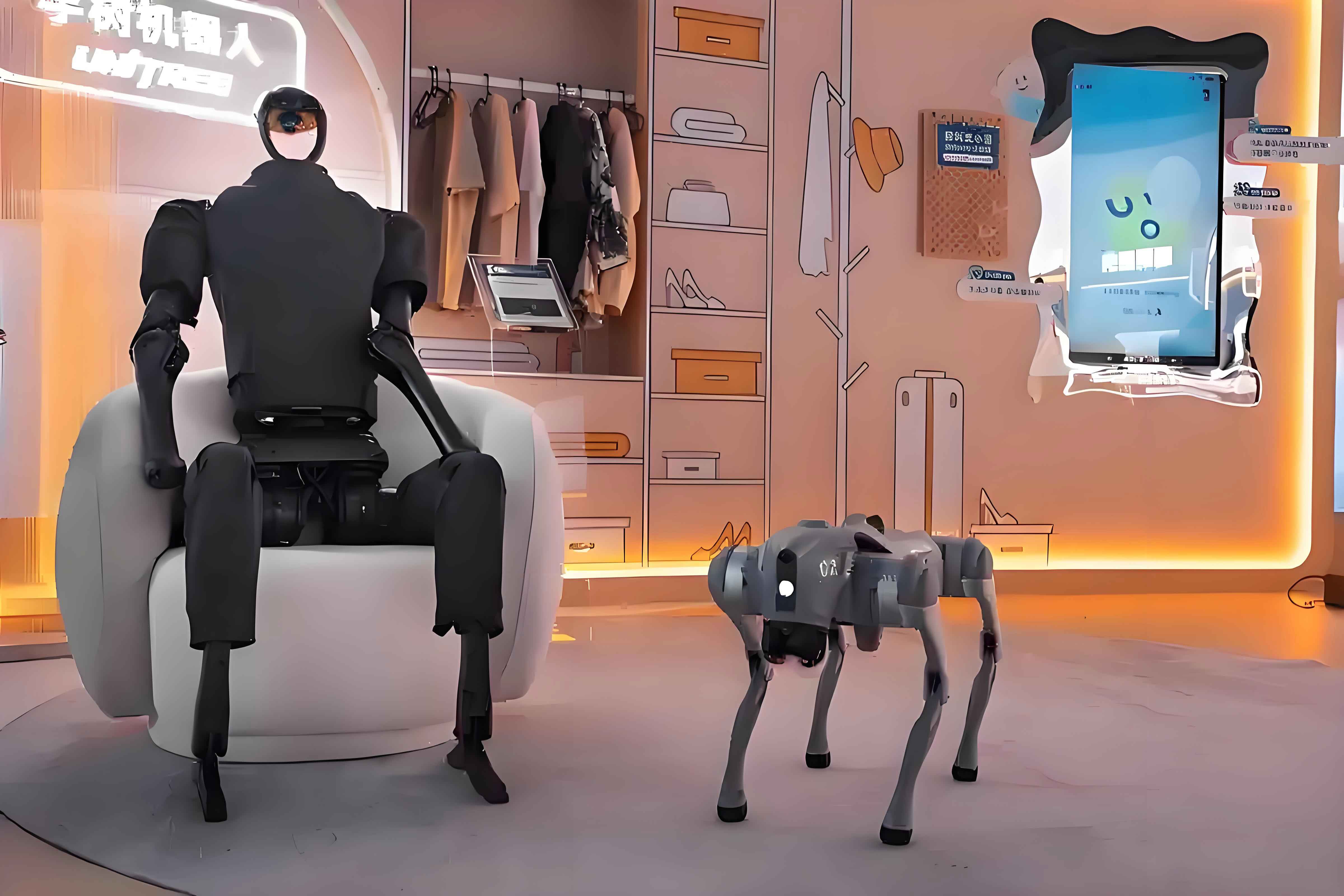
To understand the technological foundations, let me delve into some key aspects of humanoid robot design. The perception system of a humanoid robot often relies on multimodal sensors, such as cameras, LiDAR, and tactile sensors, which feed data into fusion algorithms. A simplified model for multimodal perception can be represented as:
$$ P(x) = \int_{S} f_{\text{visual}}(x) \cdot g_{\text{tactile}}(x) \, dS $$
where \( P(x) \) is the integrated perception output, \( f_{\text{visual}} \) and \( g_{\text{tactile}} \) are functions processing visual and tactile inputs, and \( S \) denotes the sensor space. This fusion enables robust environment understanding, crucial for tasks like navigation and manipulation.
Motion control for humanoid robots involves complex dynamics. The equation of motion for a bipedal robot can be expressed using the Lagrangian formulation:
$$ \frac{d}{dt} \left( \frac{\partial L}{\partial \dot{q}} \right) – \frac{\partial L}{\partial q} = \tau $$
where \( L = T – V \) is the Lagrangian (kinetic energy \( T \) minus potential energy \( V \)), \( q \) represents generalized coordinates (joint angles), and \( \tau \) denotes joint torques. Achieving stable walking and manipulation requires solving these equations in real-time, often leveraging model predictive control (MPC) algorithms approximated as:
$$ \min_{u} \sum_{k=0}^{N-1} \left( \| x_k – x_{\text{ref}} \|^2_Q + \| u_k \|^2_R \right) $$
subject to \( x_{k+1} = f(x_k, u_k) \), where \( x \) is the state, \( u \) is the control input, \( Q \) and \( R \) are weighting matrices, and \( f \) models the robot dynamics. These mathematical frameworks are essential for developing the “cerebellum” skill libraries that govern fluid movements in humanoid robots.
The “brain” of a humanoid robot is typically powered by large language models (LLMs) or vision-language models (VLMs) adapted for physical interaction. The learning process can be framed as maximizing the expected reward in embodied tasks:
$$ J(\theta) = \mathbb{E}_{\tau \sim p_{\theta}(\tau)} \left[ \sum_{t=0}^{T} \gamma^t r(s_t, a_t) \right] $$
where \( \theta \) represents model parameters, \( \tau \) is a trajectory of states \( s_t \) and actions \( a_t \), \( r \) is the reward function, and \( \gamma \) is a discount factor. Training these models requires vast datasets of human-robot interactions, which are being compiled through simulation platforms and real-world data collection. I believe that advancements in these AI models will significantly enhance the reasoning and decision-making capabilities of humanoid robots, enabling them to handle unstructured environments.
Across different regions, I have noted a competitive landscape emerging. Various provinces and municipalities have introduced policies to support the development of humanoid robots and embodied intelligence. Below is a table summarizing some key initiatives:
| Region | Policy/Plan Name | Key Targets (by 2027) | Focus Areas |
|---|---|---|---|
| Beijing | Three-Year Action Plan for Embodied Intelligence | Break 100+ key techs; deploy 10k robots; foster trillion-level cluster | Multimodal perception, brain models, cerebellum skills, motion control |
| Zhejiang | Humanoid Robot Industry Innovation Development Implementation Plan | Accelerate industrial innovation; layout future industries | Humanoid robot manufacturing, AI integration, application scenarios |
| Guangdong | Modern Industrial System 2025 Action Plan | Develop humanoid robots; break through core components; cultivate 3-5 unicorns | Machine brain, limbs, body; innovation centers; scenario innovation |
| Shanghai | Various AI and robotics initiatives | Promote embodied intelligence as core direction | Research platforms, enterprise cultivation, international cooperation |
| Shandong | Local robotics development policies | Support humanoid robot projects and industrial chains | Manufacturing upgrades, service robotics, component supply |
This table illustrates the widespread recognition of humanoid robots as a strategic priority. I observe that these policies often emphasize technological breakthroughs, ecosystem building, and scenario-driven applications. For instance, the push to establish innovation platforms—such as simulated world models, multimodal data collection facilities, robot pilot verification bases, and open testing environments—is critical for accelerating iteration cycles. These platforms allow researchers and companies to test algorithms safely and efficiently, reducing the time from concept to deployment. In my analysis, such infrastructure investments are vital for maintaining a competitive edge in the global humanoid robot race.
When considering application scenarios, I see a phased approach being adopted. Initially, humanoid robots are being deployed in controlled environments like research labs and educational institutions to build developer communities. Subsequently, they are expanding into industrial and commercial settings, such as automotive assembly lines and retail stores, where they can perform repetitive or precision tasks. Looking ahead, personalized applications in home services and elderly care are on the horizon. The following table categorizes potential scenarios for humanoid robot adoption:
| Scenario Category | Specific Applications | Current Maturity | Challenges |
|---|---|---|---|
| Research & Education | AI training, robotics courses, experimental platforms | High | Cost, accessibility for institutions |
| Industrial Manufacturing | Assembly, welding, quality inspection, logistics | Medium | Integration with existing systems, safety protocols |
| Commercial Services | Customer assistance, inventory management, cleaning | Medium | Human-robot interaction, public acceptance |
| Healthcare & Elderly Care | Patient monitoring, rehabilitation exercises, companionship | Low to Medium | Regulatory approval, reliability, affordability |
| Household & Personal Use | Domestic chores, tutoring, entertainment | Low | High cost, limited functionality, privacy concerns |
From my perspective, the industrial and commercial sectors will likely be the first to see widespread adoption of humanoid robots, driven by efficiency gains and labor shortages. However, the long-term vision involves humanoid robots becoming commonplace in homes, particularly as aging populations increase demand for assistive technologies. I have noticed that some companies are already exploring consumer-facing humanoid robots, with products priced from tens of thousands to hundreds of thousands of dollars. Despite the high costs, there is significant market interest, as evidenced by sold-out pre-orders and even rental services emerging for humanoid robots. This indicates a growing public fascination and willingness to engage with this technology.
Technological hurdles remain, though. In my assessment, key bottlenecks include core components like motors, reducers, and specialized chips, as well as foundational materials such as biomimetic and lightweight composites. The cost structure of a humanoid robot can be broken down using a simplified formula:
$$ C_{\text{robot}} = \sum_{i=1}^{n} (C_{\text{component}_i} + C_{\text{assembly}_i}) + C_{\text{software}} + C_{\text{R&D}} $$
where \( C_{\text{component}} \) includes expenses for actuators, sensors, and processors; \( C_{\text{assembly}} \) covers manufacturing labor; \( C_{\text{software}} \) encompasses AI model development; and \( C_{\text{R&D}} \) reflects research investments. Currently, \( C_{\text{component}} \) and \( C_{\text{R&D}} \) dominate, keeping prices high. To address this, I see efforts to subsidize innovation—for example, through government funds offering up to billions for single projects—aimed at lowering barriers and fostering mass production.
Data availability is another critical issue. Training robust models for humanoid robots requires diverse, high-quality datasets of physical interactions. The cost of collecting real-world data can be prohibitive, leading to increased reliance on simulation. A common approach uses reinforcement learning in simulated environments, where the policy update can be described as:
$$ \theta_{k+1} = \theta_k + \alpha \nabla_{\theta} J(\theta) \approx \theta_k + \alpha \sum_{t} \nabla_{\theta} \log \pi_{\theta}(a_t | s_t) A(s_t, a_t) $$
with \( \alpha \) as the learning rate, \( \pi_{\theta} \) the policy, and \( A \) the advantage function. Simulations allow for rapid, cost-effective data generation, but the “sim-to-real” gap—discrepancies between virtual and physical worlds—must be bridged. I believe that advancements in digital twins and high-fidelity simulators will be crucial for scaling up humanoid robot capabilities.
Looking at the innovation ecosystem, I am encouraged by the proliferation of startups and potential unicorns dedicated to humanoid robots. These companies are driving rapid iteration, often leveraging open-source tools and collaborative research. The development cycle for a humanoid robot can be modeled as an iterative process:
$$ \text{Design} \rightarrow \text{Simulate} \rightarrow \text{Prototype} \rightarrow \text{Test} \rightarrow \text{Refine} $$
with feedback loops accelerated by shared platforms. For instance, the establishment of embodied intelligence “factories”—integrated facilities for body design, control system development, and intelligence integration—enables concurrent engineering and faster time-to-market. I expect such infrastructures to become hubs for collaboration between academia, industry, and government, ultimately fueling a virtuous cycle of innovation.
International cooperation also plays a role. Standards are being developed to ensure interoperability and safety; for example, recent international standards for elderly care robots provide guidelines for design and testing. This fosters global market growth and helps align technological advancements with societal needs. In my view, harmonized standards will reduce fragmentation and accelerate the adoption of humanoid robots across borders.
As we move forward, I anticipate several milestones. By 2027, I predict that humanoid robots will be commonly seen in factories and warehouses, performing tasks alongside humans. By 2030, advancements in AI and cost reduction could make humanoid robots viable for household chores and elderly assistance. The penetration rate might follow a logistic growth curve:
$$ N(t) = \frac{K}{1 + e^{-r(t – t_0)}} $$
where \( N(t) \) is the number of deployed humanoid robots, \( K \) is the carrying capacity (market saturation), \( r \) is the growth rate, and \( t_0 \) is the inflection point. With current investments, \( r \) is increasing, potentially leading to steep adoption curves in the next decade.
In conclusion, I am optimistic about the future of humanoid robots. The convergence of policy support, technological innovation, and expanding applications is creating a fertile ground for embodied intelligence to flourish. While challenges like cost, component reliability, and ethical considerations remain, the collective efforts across sectors are addressing these hurdles. I believe that humanoid robots will transition from niche tools to ubiquitous assistants, reshaping industries and enhancing quality of life. The journey has just begun, and I look forward to witnessing—and perhaps even interacting with—the humanoid robots that will soon become an integral part of our world.