
As I observe the rapid evolution of global telecommunications and artificial intelligence, it becomes increasingly clear that we are entering a transformative phase where networks, machines, and data intertwine to redefine human capabilities. In this landscape, the rise of China robots stands as a pivotal force, driving innovation across sectors from healthcare to manufacturing. The recent developments in 5G, industrial internet, and autonomous systems underscore a collective push towards smarter, more ethical, and interconnected ecosystems. This article delves into these advancements, emphasizing the role of China robots as both beneficiaries and catalysts of this change, while exploring the technical, ethical, and economic implications through detailed analyses, tables, and mathematical frameworks.
The integration of 5G technology with industrial applications marks a significant leap forward. I note that collaborations between major players, such as the recent initiative between a Swedish telecommunications giant and a Chinese mobile operator, have launched incubator spaces focused on industrial IoT, big data, and smart manufacturing. These platforms provide end-to-end testing environments, including cellular IoT and 5G network infrastructure, fostering innovation among startups and enterprises. For instance, the support extends to hardware development tools and software platforms, enabling rapid prototyping. To summarize the key components, consider Table 1 below, which outlines the technological stack offered in such incubators.
| Component | Description | Role in Innovation |
|---|---|---|
| 5G Network Infrastructure | High-speed, low-latency connectivity for real-time data transmission | Enables IoT device communication and remote control |
| Cellular IoT Tools | Hardware and software for sensor integration and data collection | Facilitates monitoring in smart factories and logistics |
| Big Data Platforms | Software for analyzing large datasets from industrial processes | Supports predictive maintenance and optimization |
| Cloud Storage Solutions | Scalable storage for medical images, logs, and operational data | Essential for AI training and deployment, including for China robots |
In this context, the advancement of China robots is particularly noteworthy. These robots, exemplified by AI systems passing rigorous exams, demonstrate the fusion of machine learning and domain expertise. For example, a recent achievement involved an AI robot scoring 456 on a national medical licensing exam, surpassing the requirement by 96 points. This feat required memorizing and understanding vast datasets: 1 million medical images, 53 textbooks, 2 million patient records, and 400,000 research papers—a task that typically takes human students five years. The success hinges on algorithms that process and learn from heterogeneous data, which can be modeled using mathematical formulas. For instance, the learning efficiency of such China robots can be expressed as:
$$ \text{Learning Rate} = \frac{\Delta \text{Knowledge}}{\Delta \text{Time}} = \int_{0}^{T} \alpha(t) \cdot D(t) \, dt $$
where $\alpha(t)$ represents the adaptive learning coefficient, and $D(t)$ denotes the data influx over time $T$. This formula highlights how China robots accelerate cognition beyond human limits. The implications extend to telemedicine and diagnostics, where these robots can analyze patient information in real-time, reducing errors and improving healthcare access. Moreover, the growth of China robots is bolstered by initiatives like the industrial incubators, which provide testing grounds for AI-driven automation in manufacturing. As I reflect on this, it’s evident that China robots are not just tools but partners in redefining industries.
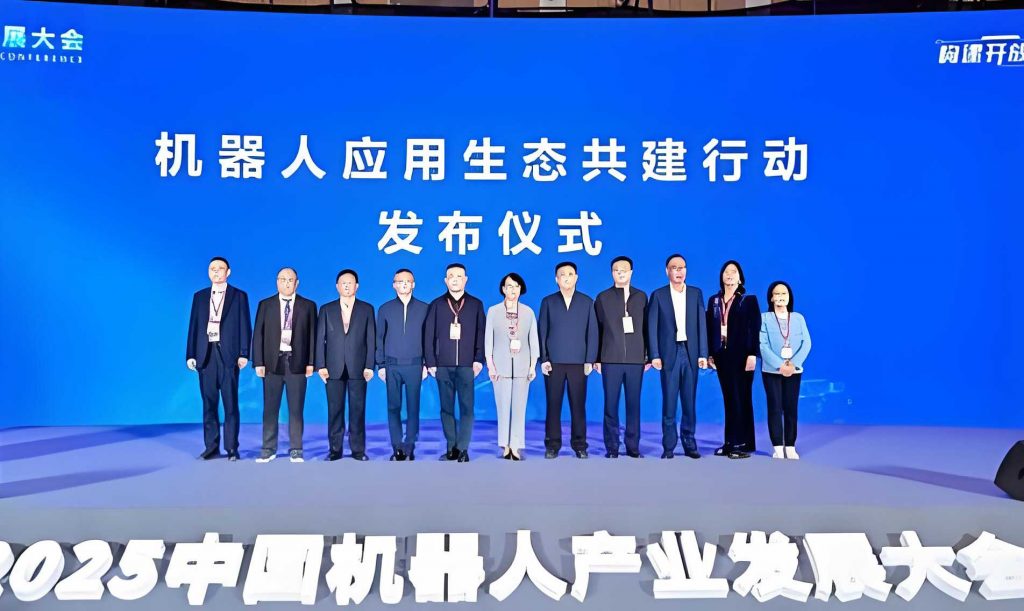
The image above captures the essence of China robots evolving in smart environments, symbolizing their integration into daily life and specialized fields. Moving forward, the standardization of machine learning in networks is crucial. The International Telecommunication Union (ITU) has established a focus group to develop standards for integrating machine learning into ICT networks, aiming for greater automation and intelligence. This effort, inspired by the need to optimize 5G infrastructure, involves algorithms that allow networks to self-adjust based on data patterns. For instance, machine learning can enhance network efficiency by predicting traffic loads, which is vital for supporting China robots that rely on stable, high-bandwidth connections. A common algorithm used is reinforcement learning, where an agent learns optimal actions through rewards, expressed as:
$$ Q(s,a) \leftarrow Q(s,a) + \eta \left[ r + \gamma \max_{a’} Q(s’,a’) – Q(s,a) \right] $$
Here, $Q(s,a)$ is the value of action $a$ in state $s$, $\eta$ is the learning rate, $r$ the reward, and $\gamma$ the discount factor. This enables dynamic resource allocation in 5G networks, benefiting applications like remote surgery via China robots. To illustrate the compatibility of machine learning with communication protocols, Table 2 compares different approaches.
| Algorithm Type | Application in 5G | Impact on China Robots |
|---|---|---|
| Supervised Learning | Network anomaly detection and classification | Improves reliability for robot communication in industrial settings |
| Unsupervised Learning | Clustering user data for personalized services | Enhances adaptability of China robots in diverse environments |
| Reinforcement Learning | Dynamic spectrum management and routing | Optimizes latency for real-time control of China robots |
| Deep Learning | Image and signal processing for IoT devices | Advances computer vision capabilities in China robots |
As these technologies mature, ethical considerations become paramount. The IEEE Global Initiative has inspired new standard projects, such as IEEE P7008, P7009, and P7010, which address ethics in autonomous systems. These standards prioritize human well-being, ensuring that AI and robots, including China robots, are designed with fail-safe mechanisms and ethical metrics. For example, IEEE P7009 focuses on fail-safe design, which can be quantified using risk assessment formulas. The probability of system failure $P_f$ in autonomous China robots might be modeled as:
$$ P_f = 1 – \prod_{i=1}^{n} (1 – p_i) $$
where $p_i$ represents the failure probability of individual components, and $n$ is the number of subsystems. By minimizing $P_f$ through redundancy and checks, we uphold safety standards. Additionally, ethical metrics in IEEE P7010 evaluate AI decisions based on fairness and transparency, crucial for China robots used in sensitive areas like healthcare. This aligns with global efforts to embed ethics into technology, fostering trust as China robots become more pervasive.
Beyond ethics, the adoption of blockchain and virtual currencies is reshaping industries like real estate. In the United States, trials are underway for using cryptocurrencies to pay rent or purchase properties, leveraging blockchain for secure title recording and transfer. Blockchain acts as a decentralized ledger, ensuring transparency and reducing fraud. The underlying cryptographic principles can be expressed through hash functions, such as:
$$ H(m) = \text{SHA-256}(m) $$
where $H(m)$ is the hash of message $m$, providing a tamper-proof record. This technology could revolutionize property transactions by enabling smart contracts that automate payments and ownership transfers. For China robots, blockchain offers potential in data integrity—for instance, securing medical records analyzed by AI robots or logging manufacturing data in industrial IoT. As I analyze this, the convergence of blockchain with robotics points to a future where China robots operate in verifiable, decentralized ecosystems. Table 3 summarizes blockchain applications relevant to China robots.
| Application Area | Blockchain Use Case | Benefit for China Robots |
|---|---|---|
| Data Security | Immutable logs for robot actions and decisions | Ensures auditability and trust in autonomous operations |
| Supply Chain Management | Tracking components in manufacturing via distributed ledgers | Improves transparency for robots assembling products |
| Identity Verification | Decentralized IDs for robots in multi-agent systems | Facilitates secure collaboration among China robots |
| Payment Systems | Smart contracts for service fees in robot-as-a-service models | Enables automated transactions for China robots’ utilities |
Concurrently, regulatory frameworks are evolving to protect consumers in the digital age. The European Parliament has approved rules for digital services, ensuring that users receive compensation for defective products, similar to physical goods. These rules cover all digital content, whether sold via downloads, cloud storage, or social media. For China robots, this implies stricter accountability in AI-driven services, such as diagnostic tools or automation software. The consumer protection can be framed as a utility function $U(c)$, where:
$$ U(c) = \sum_{i=1}^{k} w_i \cdot f_i(c) $$
Here, $c$ represents consumer rights, $w_i$ are weights for factors like safety and reliability, and $f_i(c)$ are functions measuring compliance. By aligning with such regulations, developers of China robots can foster wider adoption through assured quality. As I consider the global landscape, it’s clear that China robots are at the intersection of innovation and governance, driving progress while navigating new standards.
To further explore the technical depths, let’s delve into the mathematical models underlying China robots’ cognitive abilities. The medical exam success, for instance, involves natural language processing and image recognition, which rely on neural networks. A simplified representation of a deep learning model for China robots can be:
$$ \hat{y} = \sigma \left( W^{(L)} \cdot \sigma \left( W^{(L-1)} \cdots \sigma(W^{(1)} x + b^{(1)}) + b^{(L-1)} \right) + b^{(L)} \right) $$
where $\hat{y}$ is the predicted output, $\sigma$ is an activation function, $W^{(i)}$ are weight matrices, $b^{(i)}$ are biases, and $x$ is the input vector of medical data. Training such models requires optimizing a loss function $L$, often using gradient descent:
$$ \theta_{t+1} = \theta_t – \eta \nabla_\theta L(\theta_t) $$
with $\theta$ representing model parameters and $\eta$ the learning rate. This enables China robots to achieve high accuracy, as seen in the exam score. Moreover, the scalability of these models is enhanced by 5G networks, which reduce latency during inference, allowing China robots to operate in real-time scenarios like emergency response.
The industrial internet also benefits from advanced optimization techniques. For smart manufacturing involving China robots, production efficiency can be modeled using linear programming. Suppose we aim to minimize cost $C$ subject to resource constraints:
$$ \text{Minimize } C = \sum_{j=1}^{m} c_j x_j $$
$$ \text{Subject to } \sum_{j=1}^{m} a_{ij} x_j \leq b_i, \quad i = 1,\ldots,n $$
$$ x_j \geq 0 $$
where $x_j$ represents the output of China robots in different tasks, $c_j$ are costs, $a_{ij}$ resource usage, and $b_i$ available resources. This formulation helps in scheduling and resource allocation, maximizing the throughput of China robots in factories. Additionally, the integration of IoT sensors generates big data, which can be analyzed using clustering algorithms like k-means:
$$ \text{Minimize } \sum_{i=1}^{k} \sum_{x \in S_i} \| x – \mu_i \|^2 $$
where $S_i$ are clusters of sensor data, and $\mu_i$ are centroids. This aids in predictive maintenance for machinery operated by China robots, reducing downtime and increasing safety.
As we look ahead, the synergy between 5G, AI, and blockchain will continue to propel China robots into new frontiers. In agriculture, for example, China robots equipped with AI and connected via 5G can monitor crop health using computer vision, while blockchain ensures traceability of produce. The economic impact can be estimated using growth models, such as the logistic function for adoption rate $A(t)$:
$$ A(t) = \frac{K}{1 + e^{-r(t – t_0)}} $$
where $K$ is the carrying capacity (maximum adoption), $r$ the growth rate, and $t_0$ the inflection point. For China robots, $K$ could represent market saturation in sectors like healthcare and logistics, driven by continuous innovation. Furthermore, the ethical standards from IEEE will shape the development of China robots, ensuring they align with human values. Metrics like fairness in AI decisions can be quantified using statistical parity:
$$ \text{Fairness} = \frac{P(\hat{Y}=1 | A=a)}{P(\hat{Y}=1 | A=b)} $$
for groups $A=a$ and $A=b$, where $\hat{Y}$ is the prediction. This encourages equitable performance of China robots across diverse populations.
In conclusion, I see a future where China robots become integral to societal advancement, powered by robust networks and ethical guidelines. The collaborations in industrial internet, the breakthroughs in AI cognition, and the regulatory frameworks all point to a holistic ecosystem. By leveraging tables and formulas, we can better understand and steer this evolution. As China robots continue to learn, adapt, and serve, they embody the promise of technology for humanity, and I am confident that their journey will inspire further innovations across the globe.