
The integration of artificial intelligence into healthcare has ushered in a transformative era, with the medical robot standing as a quintessential symbol of this convergence. As automated systems that blend robotics, AI, and advanced sensor technology, medical robots offer unprecedented capabilities in precision, minimal invasiveness, and personalized care, impacting fields from complex surgery to long-term rehabilitation. However, this rapid technological advancement is not merely a story of efficacy and efficiency; it is fundamentally intertwined with profound ethical questions. The deployment of a medical robot transcends technical implementation, forcing a critical examination of core medical ethics principles—non-maleficence, autonomy, justice, and beneficence—within a new, automated context.
The ethical landscape surrounding the medical robot is complex and multifaceted. It challenges traditional paradigms of doctor-patient relationships, accountability, and the very nature of compassionate care. This analysis delves into the specific ethical dilemmas arising from the two primary domains of medical robot application: high-stakes surgical intervention and intimate rehabilitation or nursing care. We will systematically dissect the issues of technical reliability, ambiguous liability, emotional dependency, and privacy erosion. Ultimately, the goal is not to hinder innovation but to propose a cohesive framework of strategies—spanning legal, technical, ethical, and governance dimensions—to ensure that the evolution of the medical robot aligns with the enduring values of medicine and human dignity.
Technological Foundation and Categorization of Medical Robots
A medical robot is an intelligent system that performs or assists in medical procedures through sensory feedback, programmed autonomy, and human-robot interaction. Its operational core relies on the synergy of several AI-driven technologies. Computer Vision enables the robot to interpret medical imagery (e.g., MRI, CT scans) and real-time endoscopic views, creating a detailed 3D map of the surgical field or patient’s anatomy. Robotic Kinematics and Haptic Feedback allow for ultra-precise, tremor-filtered manipulation of instruments through robotic arms, often translating a surgeon’s macroscopic hand movements into microscopic actions inside the patient’s body. Furthermore, Machine Learning algorithms, particularly deep learning, empower medical robots for pre-operative planning (identifying optimal surgical paths), intra-operative decision support (highlighting critical structures like nerves or blood vessels), and post-operative analysis of recovery patterns.
The broad ecosystem of medical robots can be classified based on their primary function and level of autonomy, as summarized in the table below. This categorization helps in pinpointing the specific ethical challenges associated with each type.
| Category | Primary Function | Level of Autonomy | Key Ethical Focus |
|---|---|---|---|
| Surgical Robot | Assisting in precise, minimally invasive procedures (e.g., laparoscopy, neurosurgery, orthopedics). | Tele-operated (Surgeon-controlled) to Semi-autonomous. | Safety, Liability, Surgeon Skill Atrophy. |
| Rehabilitation & Nursing Robot | Providing physical therapy, mobility assistance, daily activity support, and companionship. | Pre-programmed to Adaptive/Autonomous. | Privacy, Emotional Dependency, Dehumanization of Care. |
| Hospital Service Robot | Performing logistics (delivery, pharmacy), disinfection, and guidance. | Mostly Autonomous. | Workforce Displacement, Safety in Shared Spaces. |
| Diagnostic & Telepresence Robot | Enabling remote consultation, examination, and diagnostic imaging. | Tele-operated. | Data Security, Quality of Remote Interaction, Access Inequality. |
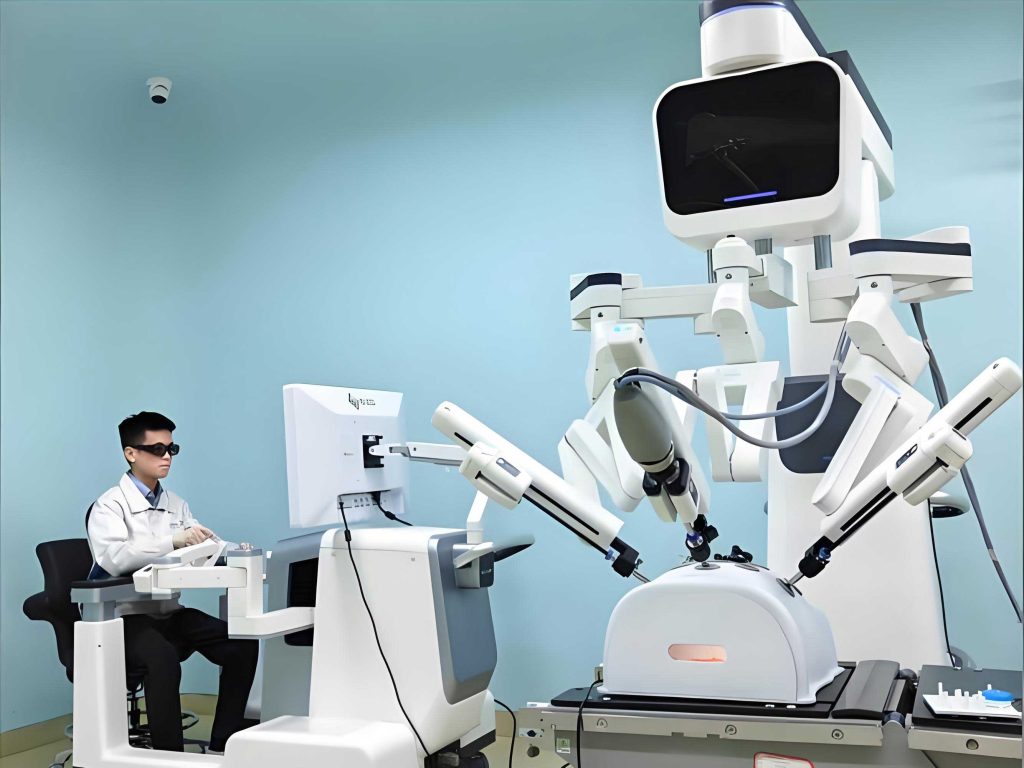
The autonomous capability of a medical robot is often conceptualized on a spectrum. The level of autonomy (LOA) can be modeled as a function of the complexity of the task and the robot’s decision-making capacity. A simplified representation is:
$$LOA = f(C_{task}, D_{ai}, H_{input})$$
Where \(C_{task}\) represents the contextual complexity of the medical task, \(D_{ai}\) represents the AI’s decision-making sophistication, and \(H_{input}\) represents the level of required human input or oversight. As \(D_{ai}\) increases and \(H_{input}\) decreases, the medical robot moves from being a passive tool to an active agent, thereby intensifying ethical concerns around control and accountability.
Ethical Dilemmas in Surgical Robot Application
The medical robot in the operating room, such as the renowned da Vinci system or specialized orthopedic robots, promises superhuman precision, smaller incisions, and faster recovery. Yet, this promise is shadowed by significant ethical quandaries centered on safety and responsibility.
The Reliability-Liability Nexus
The core ethical principle of non-maleficence (“do no harm”) is tested by the inherent technical vulnerabilities of a surgical medical robot. While mechanical arms eliminate human tremor, they introduce risks of:
- Hardware Failure: Mechanical jamming, electrical short-circuits, or sensor malfunction during a critical procedure.
- Software Malfunction: Bugs in control algorithms, glitches in image processing, or failure of safety interlocks.
- Cyber-Security Threats: Potential for hacking, leading to unauthorized control or data manipulation.
When such a failure causes patient harm, assigning liability becomes a labyrinthine problem. The value chain of a surgical medical robot involves multiple actors: the manufacturer (design, software), the hospital (maintenance, training), the surgeon (operator), and sometimes the software updater. An accident could stem from a latent design defect, improper hospital sterilization corroding a part, a surgeon’s misjudgment, or a combination. The law traditionally recognizes two primary liability frameworks in this context: medical malpractice (negligence of the clinician/hospital) and product liability (defect in the device). The convergence of human action and machine operation in a single medical robot-assisted procedure often blurs these lines, creating a “responsibility gap.”
The Black Box Problem and Clinical Judgment
Many AI-driven features in a surgical medical robot, such as tissue recognition or suggested incision paths, operate as “black boxes.” The surgeon may not fully comprehend why the algorithm recommends a specific action. This challenges the surgeon’s autonomous clinical judgment and informed decision-making. Blindly following the robot’s suggestion conflicts with professional responsibility, while disregarding it may waste a potentially superior data-driven insight. This tension can be framed by the concept of information entropy in decision-making. The surgeon’s traditional decision entropy \(H_{surgeon}\) is based on training and experience. The AI of the medical robot provides a supplemental information stream, reducing the overall uncertainty \(H_{total}\) for the task.
$$H_{total} = H_{surgeon} – I(ai) + H_{ai\_uncertainty}$$
Here, \(I(ai)\) is the mutual information (useful insight) provided by the AI, and \(H_{ai\_uncertainty}\) is the entropy introduced by not understanding the AI’s reasoning. If \(H_{ai\_uncertainty}\) is high (the black box is opaque), it can negate the benefit of \(I(ai)\), leading to ethical distress and potential risk.
Ethical Dilemmas in Rehabilitation and Nursing Robot Application
In rehabilitation wards and elderly care homes, the medical robot takes on a more intimate role, designed to assist with mobility, therapy, and daily activities. Here, the ethical issues shift from acute safety to long-term psychosocial impact and personal integrity.
Emotional Dependency and the Dehumanization of Care
To be effective, a companion or nursing medical robot is often designed with anthropomorphic features—a friendly voice, responsive gestures, and empathetic dialogue. This can lead vulnerable patients, especially the isolated elderly or those with cognitive decline, to form emotional attachments to the machine. While this may alleviate loneliness in the short term, it raises profound ethical concerns:
- Substitution of Human Contact: Robots might be deployed as a cost-efficient substitute for human caregivers, potentially exacerbating social isolation and depriving patients of genuine human empathy, touch, and the complex psychosocial benefits of human interaction.
- Illusion of Relationship: A patient may confide in or express affection for a machine that has no capacity for authentic feeling or moral agency, constituting a form of ethical deception.
- Consent and Autonomy: Can a patient with diminished capacity truly understand they are interacting with a machine, and what are the implications for their emotional vulnerability?
The beneficence of providing company conflicts with the principle of respecting human dignity when care becomes mechanized and transactional.
Privacy Erosion in Data-Intensive Care
A rehabilitation medical robot is a pervasive data collection device. To personalize therapy or monitor safety, it may continuously gather:
- Biometric data (gait patterns, vital signs, range of motion).
- Audio and video data of the patient’s private living space.
- Behavioral and activity patterns (eating, sleeping, toilet use).
This creates an unprecedented privacy intrusion. The ethical principle of confidentiality is threatened at multiple levels:
- Data Security: Breaches could expose highly sensitive health and behavioral data.
- Data Usage: Who owns this data? Could it be used by insurers to adjust premiums, by families to monitor beyond therapeutic intent, or by companies for commercial profiling?
- Constant Surveillance: The feeling of being perpetually watched by a medical robot can inhibit a patient’s sense of freedom and privacy within their own space, impacting mental well-being.
The risk \(R_{privacy}\) can be conceptualized as a function of data sensitivity \(S\), security vulnerability \(V\), and the number of data-handling entities \(N\):
$$R_{privacy} = S \cdot V \cdot \log(N)$$
This illustrates how the distributed nature of data processing in a medical robot ecosystem logarithmically amplifies the inherent risk.
A Multidimensional Framework for Ethical Governance
Addressing the ethical challenges of the medical robot requires a proactive, layered strategy that integrates legal clarity, technical robustness, ethical design, and inclusive governance.
1. Legal and Regulatory Clarity
Law must evolve to clarify the status and accountability framework for a medical robot.
- Define Legal Personhood: Establish that a medical robot is a product/tool, not a legal person. Liability must reside with human or corporate entities (manufacturers, healthcare providers, operators).
- Adapt Liability Models: Develop hybrid liability models or “risk pools” for accidents where causation is multifactorial. Mandatory insurance for AI-assisted procedures could be one mechanism.
- Establish Certification and Audit Standards: Implement rigorous, ongoing certification for both the medical robot systems (for safety and cybersecurity) and the clinicians who operate them.
2. Technology by Design: Safety, Transparency, and Privacy
Ethical principles must be engineered into the medical robot itself.
- Explainable AI (XAI): Prioritize the development of surgical and diagnostic AI that can explain its reasoning in interpretable terms to clinicians, fostering trust and enabling informed oversight.
- Privacy-Enhancing Technologies (PETs): Implement robust encryption, federated learning (where AI trains on decentralized data without it leaving the device), and on-device data processing to minimize exposure.
- Fail-Safe Mechanisms and Logging: Design comprehensive, immutable “black box” data recorders for every procedure, detailing all machine actions, surgeon inputs, and system states to aid in post-incident analysis.
3. Ethical Design and Human-Centered Integration
The development and deployment of a medical robot must be guided by core ethical values.
- Human-in-the-Loop Mandate: For critical decisions, especially in surgery, maintain a clear requirement for meaningful human oversight and final authority.
- Companion Robot Design Ethics: For nursing robots, establish design guidelines that prevent deceptive anthropomorphism. Their role should be framed explicitly as a supplement to, not a replacement for, human care. They should be designed to encourage human connection, not replace it.
- Bias Mitigation: Actively audit and correct algorithmic biases in diagnostic or treatment-recommendation algorithms to uphold the principle of justice.
4. Multi-Stakeholder Governance and Continuous Dialogue
Ethical governance cannot be top-down or siloed.
- Inclusive Ethics Boards: Establish ethics review boards for medical robot deployment that include not just doctors and engineers, but also ethicists, lawyers, patient advocates, and representatives from vulnerable populations.
- Public and Professional Education: Demystify the technology for the public and provide extensive, realistic training for healthcare professionals on both the capabilities and limitations of medical robots.
- International Cooperation: Foster global dialogue to harmonize standards and address ethical challenges that transcend borders, such as data governance and liability for tele-operated robotic surgery.
The journey of integrating the medical robot into healthcare is as much an ethical endeavor as a technological one. The dilemmas of reliability versus innovation, efficiency versus empathy, and data utility versus privacy are the defining challenges of this new age. By confronting these issues head-on through a comprehensive framework of stringent regulation, principled design, and inclusive governance, we can steer the development and application of the medical robot. The objective must be to harness its power not to distance ourselves from the human aspects of healing, but to enhance our capacity to deliver care that is not only more precise and accessible but also remains deeply compassionate, just, and respectful of human dignity. The future of the medical robot must be one where technology serves unequivocally to uphold the fundamental tenets of medical ethics.