
The quest to create machines capable of traversing complex, unstructured environments has long driven robotics research. Among various mobility paradigms, the bionic robot, particularly the multi-legged bionic robot, stands out for its superior adaptability inspired by biological locomotion. This article provides a comprehensive overview of the development, structural principles, and future trajectories of bionic multi-legged robots.
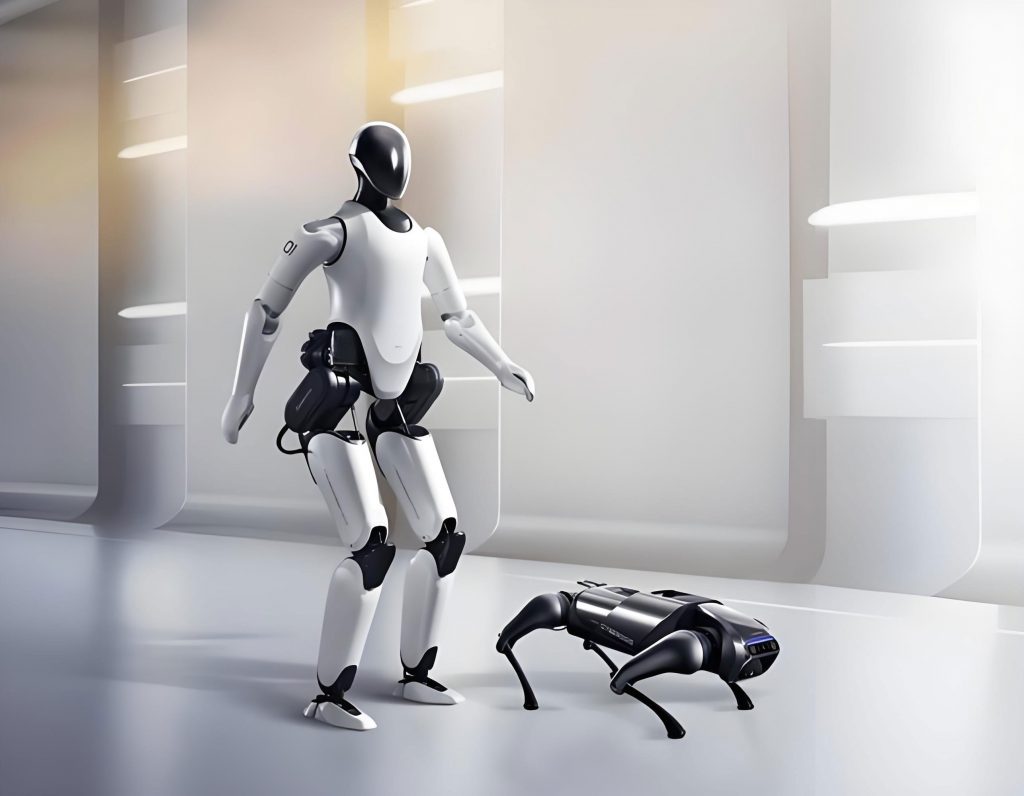
Mobile robots are primarily categorized by their locomotion mechanisms: track-based, wheeled, tracked, and legged. Each type presents distinct advantages and limitations in terms of speed, terrain adaptability, stability, and energy efficiency. The following table summarizes their key characteristics:
| Locomotion Type | Advantages | Disadvantages | Primary Use Cases |
|---|---|---|---|
| Track-based | High speed on defined paths, operational flexibility. | Constrained to rails/tracks. | Entertainment, factory automation. |
| Wheeled | Simple structure and control, efficient on flat surfaces. | Poor performance on soft, steep, or rugged terrain. | Indoor logistics, structured outdoor environments. |
| Tracked | Good climbing and obstacle-crossing ability due to large contact area. | High vibration, high energy consumption, complex mechanical wear. | Military, construction, heavy-duty exploration. |
| Multi-legged (Bionic) | Excellent stability and adaptability to rough terrain, high fault tolerance, omni-directional movement. | Complex mechanical design and control, typically slower speed. | Search & Rescue, planetary exploration, forestry, agriculture. |
The bionic robot, specifically the multi-legged variety, operates on the principle of discrete footholds. Each leg, often featuring multiple joints (degrees of freedom), swings and makes contact with the ground in a coordinated sequence known as a gait. By adjusting parameters like joint angles, stride length, and body height, these robots achieve stable locomotion. The core advantages include a low center of gravity, resistance to tipping over, and the ability to maintain stability even if one or more legs fail. Traditional designs using rigid linkages offer high stiffness and payload capacity but can be mechanically complex. Conversely, emerging soft-bodied bionic robots, inspired by invertebrates, excel in conforming to environments and executing crawling or peristaltic motions, though they generally exhibit lower force output.
Bionics: The Foundational Discipline
Bionics, or biologically inspired engineering, is an interdisciplinary field that merges biology with engineering domains like electronics, mechanics, and computer science. It aims to analyze, mimic, and reconstruct the structures, materials, functions, and control strategies of biological systems to solve technological challenges. The field is broadly divided into five sub-domains, each contributing uniquely to the development of advanced bionic robots.
| Sub-domain of Bionics | Core Principle | Examples in Robotics |
|---|---|---|
| Structural Bionics | Replicating the mechanical architecture and form of organisms. | Fish-like swimming robots, snake-like robots for confined spaces, insect-inspired hexapods. |
| Material Bionics | Utilizing smart or composite materials that mimic biological tissues. | Artificial muscles (e.g., SMA, EAP), synthetic skin with sensing capabilities, self-healing materials. |
| Functional Bionics | Implementing specific biological functions or behaviors. | Machine vision for navigation, expressive faces for human-robot interaction, efficient locomotion gaits. |
| Swarm Bionics | Emulating the collective, decentralized intelligence of animal groups. | Coordinated drone swarms, multi-robot systems for exploration or logistics. |
| Control & Neural Bionics | Imitating the information processing and control of biological nervous systems. | Artificial Neural Networks (ANN) for learning, Central Pattern Generators (CPG) for rhythmic motion, fuzzy logic for decision-making. |
The design of a multi-legged bionic robot often integrates principles from several of these sub-domains. For instance, its structure is biomimetic, its joints may use compliant materials, its gait is a functional mimicry, and its control system might employ neural bionic algorithms.
Development and Current Status of Multi-legged Bionic Robots
Early Concepts and Mechanical Precursors
The conceptual origin of automata and bionic machines dates back centuries. Historical records from ancient China mention ingenious mechanical devices. In Europe, designs for humanoid and quadrupedal automata emerged during the Renaissance and later centuries, though these were typically powered by clockwork or external forces, lacking autonomy. A pivotal moment arrived in the late 19th century with Eadweard Muybridge’s photographic studies of animal locomotion, which provided the first detailed visual data on gait sequences—information crucial for engineering legged motion. However, the true dawn of the intelligent, self-contained bionic robot began in the 1960s with the convergence of computing, control theory, and bionics.
Pioneering Developments in the United States and Japan
The late 1960s saw the creation of the “Walking Truck” by R. Mosher in the USA. This quadruped was a pioneering hydraulic-powered bionic robot. Its operator-controlled legs, equipped with position sensors, demonstrated the feasibility of coordinated legged locomotion over obstacles, highlighting both the power and control challenges of hydraulic actuation.
In Japan, sustained research at the Fukuda Laboratory of Tokyo Institute of Technology produced the notable TITAN series of walking robots. The TITAN-VIII, with its open-loop leg linkage mechanism, showcased remarkable flexibility and terrain adaptability within a compact form factor.
A landmark in multi-legged robot history was the 1983 “ODEX-I” from Odetics Inc. This hexapod featured a circular body with six independently actuated legs, granting it omnidirectional capability. Its hierarchical control architecture became a model for complex robot control:
1. High-Level Control: Made strategic decisions about path and gait.
2. Mid-Level Control: Processed sensor data (tactile, proprioceptive) and coordinated leg movements.
3. Low-Level Control: Executed direct servo commands for each joint motor.
The late 1980s and early 2000s witnessed a trend towards more autonomous and specialized bionic robots. MIT’s “Genghis” (1989) was a lightweight, sensor-rich hexapod designed for planetary exploration concepts. It incorporated infrared sensors and a behavioral-based control system. NASA’s “Spiderbot” and the Northeastern University’s “BUR-001” lobster-inspired robot further demonstrated the potential for small, agile bionic robots in reconnaissance and hazardous environment operations.
The 21st century has been defined by advanced platforms from companies like Boston Dynamics. “BigDog,” funded by DARPA, demonstrated extraordinary stability, load-carrying capacity (>150 kg), and the ability to traverse extreme terrain. Its successors, like “Spot,” exhibit advanced autonomy, dynamic balance, and the ability to perform complex tasks like door opening. The “Atlas” humanoid, while bipedal, represents the pinnacle of dynamic legged mobility and full-body coordination, employing computer vision and advanced real-time control.
Representative Multi-legged Bionic Robots
| Robot Name (Country) | Type | Key Features | Actuation & Control Highlights |
|---|---|---|---|
| Walking Truck (USA) | Quadruped | Early hydraulic actuation, operator-in-the-loop control. | Demonstrated basic coordinated leg control for rough terrain. |
| TITAN-VIII (Japan) | Quadruped | Compact, open-loop linkage for flexibility. | Showcased mechanical design for adaptability. |
| ODEX-I (USA) | Hexapod | Circular body, omnidirectional movement. | Pioneering three-layer hierarchical control architecture. |
| Genghis (USA) | Hexapod | Lightweight, sensor-rich (IR, compass). | Behavior-based subsumption architecture for autonomy. |
| BUR-001 (USA) | Octoped | Lobster-inspired, amphibious design. | Biomimetic morphology for shallow-water mine countermeasures. |
| BigDog / Spot (USA) | Quadruped | Exceptional dynamic stability, high payload, agile. | Advanced hydraulic/electric actuation, model-predictive & reactive control. |
| JTUWM-III / MDTWR (China) | Quadruped/Hexapod | Early mammalian joint imitation; later micro-robot with SMA actuation. | Transition from DC servo to smart material (SMA) actuation. |
| HITCRII-I (China) | Hexapod | Compound four-bar linkage leg mechanism. | Good stiffness and agility with servo motors. |
Advances in China
Research on multi-legged bionic robots in China, though starting later, has progressed significantly. Early work in the 1990s produced the “JTUWM-III,” a quadruped mimicking mammalian leg joints with three degrees of freedom per leg. A major step in miniaturization and novel actuation was the “MDTWR,” a micro-hexapod utilizing Shape Memory Alloy (SMA) wires as artificial muscles, offering silent operation and a simple structure.
Subsequent research has explored various avenues. A six-legged robot inspired by the Camponotus japonicus ant employed pneumatic artificial muscle actuators and fuzzy-PID control for enhanced compliance and reliability. The “HITCRI-I” hexapod utilized a compound four-bar linkage in its legs, achieving an effective balance between workspace size, mechanical advantage, and structural stiffness. These developments reflect a broad engagement with the core challenges of bionic robot design: actuation, control, and biomimetic mechanics.
Technical Formulations in Bionic Robot Design
The engineering of a bionic robot involves mathematical formalisms across kinematics, dynamics, and control. For a multi-legged bionic robot, forward kinematics determines the foot-end position based on joint angles. For a simple 3-DOF leg:
$$
\begin{aligned}
x &= L_1 \cos(\theta_1) + L_2 \cos(\theta_1+\theta_2) + L_3 \cos(\theta_1+\theta_2+\theta_3) \\
y &= L_1 \sin(\theta_1) + L_2 \sin(\theta_1+\theta_2) + L_3 \sin(\theta_1+\theta_2+\theta_3)
\end{aligned}
$$
Where $L_1, L_2, L_3$ are link lengths and $\theta_1, \theta_2, \theta_3$ are joint angles. Stability is often assessed using the Center of Pressure (CoP) or the Zero-Moment Point (ZMP) criterion for dynamic walking. Static stability is ensured if the projection of the robot’s Center of Mass (CoM) lies within the convex hull formed by the supporting feet (the support polygon).
Gait generation is frequently modeled using coupled oscillator networks, or Central Pattern Generators (CPG), often formulated as phase-coupled oscillators:
$$
\dot{\phi}_i = \omega_i + \sum_{j} K_{ij} \sin(\phi_j – \phi_i – \psi_{ij})
$$
where $\phi_i$ is the phase of the $i$-th leg oscillator, $\omega_i$ is its intrinsic frequency, $K_{ij}$ is the coupling strength, and $\psi_{ij}$ is the desired phase offset. This bionic control approach generates robust, rhythmic leg coordination.
Modern control increasingly relies on neural bionic approaches. The output of a simple neuron for joint control can be modeled as:
$$
y = f\left(\sum_{i=1}^{n} w_i x_i + b\right)
$$
where $x_i$ are inputs (sensor data), $w_i$ are synaptic weights, $b$ is a bias, and $f$ is a non-linear activation function. Deep Reinforcement Learning (DRL) frameworks train control policies $\pi(a|s)$ that map states $s$ (joint angles, IMU data, vision) to actions $a$ (joint torques) to maximize a cumulative reward $R_t$, often formalized as:
$$
R_t = \sum_{k=t}^{\infty} \gamma^{k-t} r_k
$$
where $r_k$ is the immediate reward and $\gamma$ is a discount factor. This allows the bionic robot to learn complex, adaptive locomotion strategies through simulation and practice.
Future Research Directions for the Bionic Multi-legged Robot
Despite remarkable progress, the bionic multi-legged robot faces several persistent challenges. Future research will likely focus on the following key directions to create more capable, efficient, and intelligent machines.
| Research Direction | Current Challenge | Potential Solutions & Focus Areas |
|---|---|---|
| Enhanced Payload Capacity | Point contact of feet leads to high ground pressure, limiting the weight of onboard instruments or cargo. | Optimized leg kinematics for force distribution, advanced lightweight composite materials, hybrid wheel-leg mechanisms, adaptive foot designs for increased surface area. |
| Miniaturization & Micro-Robotics | Macro-scale robots are complex and cannot access confined spaces. Power density and actuation at small scales are difficult. | Development of micro-actuators (MEMS, novel SMAs), integrated sensor suites, low-power neuromorphic computing, swarm intelligence for collective task completion by micro bionic robots. |
| Improved Flexibility & Versatility | Motion is still rigid compared to animals; limited ability to conform to or grasp terrain; gait transitions are often pre-programmed. | Implementation of variable stiffness actuators (VSA), tendon-driven mechanisms, soft-rigid hybrid structures, real-time terrain recognition and adaptive gait generation algorithms. |
| Advanced Neural Bionic Control | Control algorithms can be complex and computationally heavy; limited capacity for online learning and recovery from failures. | Deeper implementation of bio-inspired Central Pattern Generators (CPGs) with sensory feedback, embodied AI using Deep Reinforcement Learning, spiking neural networks for ultra-low-power control, and self-healing control architectures. |
| Energy Efficiency & Autonomy | Legged locomotion is inherently energetically costly, limiting operational duration. | Exploitation of passive dynamics and elastic energy storage (like animal tendons), high-efficiency actuator design (e.g., proprioceptive actuators), and improved power systems (fuel cells, wireless charging). |
The trajectory of the bionic robot field is clear: a shift from rigidly executing pre-defined motions to becoming adaptive, resilient, and intelligent partners. The next generation of bionic multi-legged robots will not merely walk; they will learn, adapt, and interact with their environments in ways that are increasingly indistinguishable from their biological counterparts. This evolution will unlock their potential in critical applications from deep-space exploration and disaster response to personalized domestic assistance and environmental monitoring, solidifying their role as a transformative technology.