
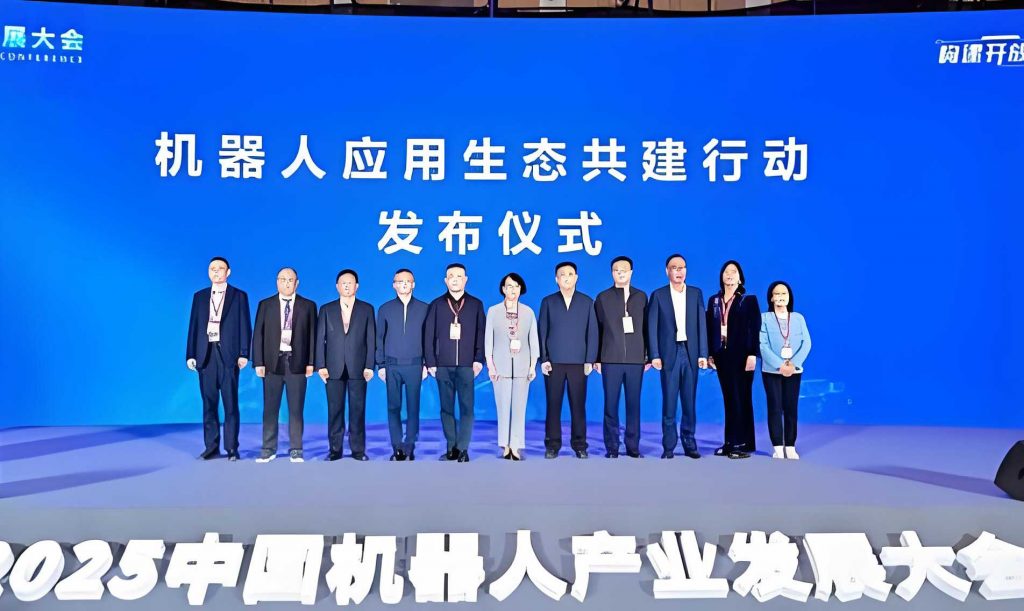
As I stood amidst the vibrant atmosphere of the 2019 World Robot Conference in Beijing, I felt a profound sense of anticipation for the era of intelligent machines. The conference, with its theme “Intelligent New Ecology, Open New Era,” brought together global experts to deliberate on the future of robotics, with a particular focus on the rise of China robots. From my perspective, the development of China robots is not just a national endeavor but a pivotal chapter in the global narrative of technological advancement. In this article, I will explore the trajectory, challenges, and opportunities for China robots, drawing from insights shared at the conference and beyond, while emphasizing the need for strategic innovation and collaboration.
The journey of China robots began with humble origins in manufacturing, but today, they are permeating every facet of human life. Traditional robots, once valued for speed and precision, are rapidly evolving into intelligent entities capable of independent decision-making and interactive behaviors. This shift is encapsulated in the transition from mechanical automation to cognitive robotics. For China robots, this evolution presents both a challenge and an opportunity to leapfrog into leadership positions. The global robot market has seen an average growth rate of 12% over the past decade, but China robots have surged at approximately 25%, consistently leading the world for eight years. This disparity highlights the dynamic potential of China robots, yet it also underscores the complexities of sustaining such growth.
From my observations, the expansion of China robots is driven by a massive domestic market, which serves as a testing ground for innovation. However, the critical task is transforming this market advantage into technological and industrial prowess. The growth of China robots can be modeled using a compound annual growth rate (CAGR) formula, which illustrates their rapid ascent. For instance, if we denote the market value of China robots at time \( t \) as \( V_t \), the CAGR over \( n \) years is given by:
$$ CAGR = \left( \frac{V_{t+n}}{V_t} \right)^{\frac{1}{n}} – 1 $$
Applying this to historical data, the CAGR for China robots exceeds 20%, far outpacing global averages. This mathematical representation underscores the momentum behind China robots, but it also hints at the need for deeper analysis into sustaining this growth. To provide a clearer picture, I have compiled a table comparing the growth trajectories of China robots versus the global market from 2010 to 2019, based on industry reports and conference discussions.
| Year | Global Robot Market Growth Rate (%) | China Robots Market Growth Rate (%) | Notes on China Robots Development |
|---|---|---|---|
| 2010 | 10.5 | 22.3 | Early adoption in manufacturing |
| 2011 | 11.2 | 24.1 | Government initiatives boost investment |
| 2012 | 12.0 | 25.8 | Expansion into logistics and services |
| 2013 | 11.8 | 26.5 | Rise of collaborative robots (cobots) |
| 2014 | 12.5 | 27.2 | Strategic focus on AI integration |
| 2015 | 13.0 | 28.0 | Surge in domestic robot production |
| 2016 | 12.8 | 26.8 | Impact of robotics development plans |
| 2017 | 13.2 | 25.5 | Increased competition from global players |
| 2018 | 12.7 | 24.9 | Focus on precision and reliability |
| 2019 | 13.5 | 26.1 | Emphasis on smart ecosystems |
This table reveals that while China robots have maintained robust growth, fluctuations indicate underlying challenges, such as dependency on foreign technology. In my analysis, the progression of China robots from low-value assembly to high-value innovation can be expressed through a technological maturity index (TMI). Let \( I \) represent innovation level, \( M \) market penetration, and \( C \) collaboration factors; then, TMI for China robots is:
$$ TMI = \alpha \cdot I + \beta \cdot M + \gamma \cdot C $$
where \( \alpha, \beta, \gamma \) are weights summing to 1. Currently, China robots score high on \( M \) but lower on \( I \), highlighting the gap in core technologies. The intelligence of modern China robots is defined by their ability to learn and adapt, which can be modeled using machine learning algorithms. For example, the decision-making capability of a China robot can be represented as:
$$ P(a|s) = \frac{e^{Q(s,a)}}{\sum_{a’} e^{Q(s,a’)}} $$
where \( P(a|s) \) is the probability of action \( a \) given state \( s \), and \( Q(s,a) \) is the learned value function. This equation underscores the shift from pre-programmed tasks to autonomous behaviors in China robots, a key area for future development.
Despite the impressive growth, I have noted that China robots face significant hurdles in core components. In traditional industrial robotics, China robots lag behind advanced nations in precision reducers, control systems, and servo motors. This dependency stifles the competitiveness of China robots on the global stage. To quantify this, consider a competitiveness score \( CS \) for China robots, calculated as:
$$ CS = \sum_{i=1}^{n} w_i \cdot S_i $$
where \( w_i \) is the weight of component \( i \), and \( S_i \) is its performance score. Based on industry data, China robots often score below 0.5 on a scale of 0 to 1 for high-precision parts. The following table breaks down the status of key components for China robots compared to international benchmarks.
| Core Component | International Advanced Level | China Robots Current Status | Impact on China Robots Competitiveness |
|---|---|---|---|
| Precision Reducer | Error < 1 arc-min, lifespan > 10,000 hrs | Error 2-3 arc-min, lifespan ~6,000 hrs; reliant on imports | High; limits precision in China robots |
| Control System | Real-time adaptive control, AI integration | Basic PID control, limited AI; developing open-source platforms | Medium; affects autonomy of China robots |
| Servo Motor | High torque density, efficiency > 90% | Moderate performance, efficiency ~85%; improving with R&D | Medium; influences energy efficiency of China robots |
| Sensors | Multi-modal sensing, high resolution | Growing capability in vision sensors, but gaps in tactile sensors | Low to medium; enhances perception for China robots |
| AI Algorithms | Deep learning models for complex tasks | Rapid adoption, but originality in algorithms needs boost | High; critical for smart China robots |
This table illustrates that for China robots to advance, breakthroughs in these areas are essential. Moreover, the产业链 of China robots is often segmented: the “brain” (core AI and control), the “body” (hardware and mechanical parts), and the “distributors” (assembly and sales). Currently, many enterprises involved with China robots focus on the latter, resulting in a concentration at the low to mid-end. From my perspective, this structure hampers the value creation of China robots. To address this, a systemic approach is needed, where innovation permeates all layers. The value chain efficiency \( VCE \) for China robots can be expressed as:
$$ VCE = \frac{Value_{output}}{Cost_{input}} \times 100\% $$
For China robots, improving \( VCE \) requires reducing import dependencies and enhancing domestic R&D. The market share of China robots in the domestic arena is around 30%, with most engaged in assembly, underscoring the urgency for upstream innovation. In global trade, the export competitiveness of China robots is modeled by the revealed comparative advantage (RCA) index:
$$ RCA = \frac{(X_{ij} / X_{it})}{(X_{wj} / X_{wt})} $$
where \( X_{ij} \) is exports of China robots from country \( i \) (China) in product group \( j \), \( X_{it} \) is total exports from China, \( X_{wj} \) is world exports in robots, and \( X_{wt} \) is total world exports. Currently, the RCA for China robots is below 1, indicating room for improvement to achieve global leadership.
Policy frameworks have played a crucial role in shaping the trajectory of China robots. The robotics development plan for 2016-2020 set clear targets, emphasizing innovation and industrialization. From my analysis, such plans are vital for aligning resources, but their success depends on execution. The goals for China robots can be summarized in the following table, which aligns with broader national strategies.
| Strategic Goal for China Robots | Timeline | Key Performance Indicators (KPIs) | Status as of 2019 |
|---|---|---|---|
| Increase domestic market share of China robots | 2020 | Achieve 50% share in key sectors | ~30%; progressing slowly |
| Enhance core technology independence for China robots | 2025 | Reduce import reliance by 40% | R&D ongoing; gaps persist |
| Foster global collaboration ecosystems for China robots | Ongoing | Establish 10+ international joint ventures | 5+ in place; expanding |
| Boost innovation output for China robots | 2030 | File 10,000+ patents annually | ~5,000 patents; accelerating |
| Develop talent pipeline for China robots | 2025 | Train 50,000 specialists yearly | Shortage of 20,000 currently |
The talent gap is a critical bottleneck for China robots. Industry reports indicate a shortage of around 200,000 professionals, which threatens the sustainable development of China robots. From my experience, education systems must evolve to nurture creativity and technical skills. The demand-supply dynamics for China robots talent can be modeled with a simple equation:
$$ Gap = D – S $$
where \( D \) is demand and \( S \) is supply. Currently, \( D \) for China robots-related roles grows at 15% per year, while \( S \) increases at only 10%, leading to a widening gap. To illustrate, here is a projection table for talent needs in the realm of China robots.
| Year | Demand for China Robots Professionals (thousands) | Supply from Education (thousands) | Estimated Gap (thousands) |
|---|---|---|---|
| 2020 | 200 | 180 | 20 |
| 2025 | 350 | 280 | 70 |
| 2030 | 500 | 400 | 100 |
Addressing this requires curriculum reforms and industry-academia partnerships focused on China robots. Moreover, innovation in China robots thrives on interdisciplinary融合, combining robotics with AI, big data, and IoT. The synergy can be expressed as:
$$ Innovation_{ChinaRobots} = f(AI, Data, Sensors, Collaboration) $$
where each variable contributes to the overall capability of China robots. I believe that fostering a culture of “free thinking and exploration,” as emphasized in discussions, is vital for China robots to break new ground. The rate of innovation \( r \) for China robots can be approximated by:
$$ r = \frac{\Delta Patents + \Delta R&D\ Investment}{Time} $$
With increased investment, China robots can accelerate their innovation cycles.
Looking ahead, the roadmap for China robots must be grounded in realism and ambition. From my viewpoint, a demand-driven approach is essential, where China robots are developed to solve practical problems in manufacturing, healthcare, agriculture, and beyond. The concept of “优生” or quality birth for China robots implies a focus on excellence from design to deployment. This involves rigorous testing and iteration, which can be quantified using reliability metrics. For instance, the mean time between failures (MTBF) for China robots should strive to match global standards:
$$ MTBF = \frac{Total\ Operational\ Time}{Number\ of\ Failures} $$
Currently, China robots have an MTBF lower than international peers, indicating room for improvement in durability. Additionally, legal and regulatory frameworks for China robots are still evolving, with issues like liability and safety awaiting resolution. A robust ecosystem for China robots requires standards that foster trust and interoperability. The development index \( DI \) for China robots, encompassing technology, market, and policy, can be defined as:
$$ DI = \frac{T + M + P}{3} $$
where \( T \) is technological advancement score, \( M \) is market maturity score, and \( P \) is policy support score. For China robots, \( DI \) is rising but needs bolstering in \( P \) to mitigate risks.
Global cooperation is indispensable for the future of China robots. No single nation can monopolize robotics innovation, and China robots must engage in win-win partnerships. The concept of a human-robot community aligns with the vision of shared progress. From my observations at the conference, collaborative projects between China robots developers and international experts are already yielding fruits, such as joint research on swarm robotics. The benefits of collaboration for China robots can be modeled using a game theory framework, where payoff \( U \) for China robots in a cooperative scenario is:
$$ U_{ChinaRobots} = \alpha \cdot Benefit_{tech} + \beta \cdot Benefit_{market} $$
with \( \alpha + \beta = 1 \). By sharing knowledge, China robots can access cutting-edge technologies while contributing their market insights. The future market share of China robots globally is projected to reach 50%, but this hinges on overcoming current limitations. I envision a world where China robots are synonymous with innovation and reliability, driving economic transformation.
In reflection, the journey of China robots is akin to a marathon rather than a sprint. While they have transitioned from “followers” to potential “leaders,” the path is fraught with challenges. The aspiration to grasp the “jewel on the crown of manufacturing” for China robots is within reach, but it demands persistent effort and strategic investments. As I conclude, I urge stakeholders to embrace a holistic strategy for China robots, one that balances self-reliance with openness, and innovation with application. The saga of China robots is still unfolding, and with concerted action, they will undoubtedly shape the future of robotics worldwide.
To encapsulate key metrics, here is a summary table of critical formulas and their implications for China robots.
| Formula | Description | Relevance to China Robots |
|---|---|---|
| $$ CAGR = \left( \frac{V_{t+n}}{V_t} \right)^{\frac{1}{n}} – 1 $$ | Compound annual growth rate | Measures market expansion of China robots |
| $$ TMI = \alpha \cdot I + \beta \cdot M + \gamma \cdot C $$ | Technological maturity index | Assesses innovation level of China robots |
| $$ P(a|s) = \frac{e^{Q(s,a)}}{\sum_{a’} e^{Q(s,a’)}} $$ | Decision-making probability in AI | Enhances autonomy in China robots |
| $$ CS = \sum_{i=1}^{n} w_i \cdot S_i $$ | Competitiveness score | Evaluates core components of China robots |
| $$ VCE = \frac{Value_{output}}{Cost_{input}} \times 100\% $$ | Value chain efficiency | Optimizes production for China robots |
| $$ RCA = \frac{(X_{ij} / X_{it})}{(X_{wj} / X_{wt})} $$ | Revealed comparative advantage | Gaages global trade position of China robots |
| $$ Gap = D – S $$ | Talent gap equation | Highlights workforce needs for China robots |
| $$ Innovation_{ChinaRobots} = f(AI, Data, Sensors, Collaboration) $$ | Innovation synergy function | Drives advancements in China robots |
| $$ MTBF = \frac{Total\ Operational\ Time}{Number\ of\ Failures} $$ | Mean time between failures | Improves reliability of China robots |
| $$ DI = \frac{T + M + P}{3} $$ | Development index | Tracks holistic progress of China robots |
In the end, the success of China robots will be measured not just by economic indicators, but by their ability to enrich human life and foster global harmony. As I look forward, I am confident that with continued dedication, China robots will emerge as beacons of innovation, guiding us toward a smarter, more connected world.