
The vast and enigmatic ocean has always been a source of inspiration and a formidable frontier for exploration. In our quest to master this domain, we have increasingly turned to its most adept inhabitants for solutions. The field of marine bionics represents a profound convergence of biology and engineering, where the evolutionary refinements of marine organisms over millions of years are deciphered, abstracted, and translated into technological innovations. At the forefront of this endeavor lies the bionic robot, a physical embodiment of this cross-disciplinary synthesis. My journey into understanding this domain reveals a dynamic landscape of global research, strategic funding, and rapid technological evolution, all aimed at creating machines that can navigate, sense, and interact with the aquatic environment with unprecedented efficiency and autonomy.
The fundamental premise is elegant: why reinvent the wheel when nature has already optimized propulsion, maneuverability, and energy efficiency through endless cycles of natural selection? A bionic robot, therefore, is not merely a machine shaped like an animal; it is a system whose design principles—its morphology, actuation, gait, and sometimes even material composition—are directly informed by the functional biology of a living counterpart. This biomimetic approach promises to overcome the limitations of traditional propeller-driven underwater vehicles, offering advantages such as lower acoustic signatures, superior agility in cluttered environments, higher energy efficiency for long-endurance missions, and reduced disruption to delicate ecosystems.
Principles of Aquatic Locomotion and Bionic Translation
The first step in creating a marine bionic robot is to understand the biomechanics of the target organism. Aquatic animals have evolved a stunning array of propulsion mechanisms, which can be broadly categorized for engineering analysis.
| Propulsion Mode | Biological Example | Key Mechanical Principle | Engineering Advantage for Bionic Robots |
|---|---|---|---|
| Body/Caudal Fin (BCF) | Tuna, Dolphin | Thrust generated by lateral body undulations and tail oscillation. | High speed and long-distance cruising efficiency. Excellent for open water. |
| Median/Paired Fin (MPF) | Ray, Cuttlefish | Thrust from wave-like motions of pectoral or dorsal/anal fins. | High maneuverability, station-keeping, low turbulence. Ideal for complex terrain. |
| Jet Propulsion | Jellyfish, Squid | Rapid ejection of water for pulsed thrust. | Simple mechanical design, potential for high efficiency at low Reynolds numbers. |
| Appendage-based (Walking/Crawling) | Lobster, Crab | Discrete, leg-like motions for substrate contact. | Superior stability and mobility on the seabed, ability to interact with objects. |
The translation from biological observation to engineering model often involves complex fluid-structure interaction analysis. Key dimensionless numbers govern this realm. The Reynolds number ($Re$) indicates the flow regime:
$$Re = \frac{\rho u L}{\mu}$$
where $\rho$ is fluid density, $u$ is velocity, $L$ is characteristic length, and $\mu$ is dynamic viscosity. A small bionic robot (e.g., a micro-robotic fish) operates at low $Re$, where viscous forces dominate, akin to a larval fish. A large vehicle operates at high $Re$, where inertial forces dominate, like a dolphin. The Strouhal number ($St$) is critical for oscillatory propulsion like BCF and MPF, relating oscillation frequency and amplitude to forward speed for optimal thrust efficiency:
$$St = \frac{f A}{U}$$
where $f$ is tail-beat frequency, $A$ is peak-to-peak amplitude, and $U$ is forward speed. Biological swimmers typically operate in an efficient range of $0.2 < St < 0.4$. A well-designed bionic robot aims to match this optimal Strouhal regime.
The Core of a Bionic Robot: From Concept to Physical Entity
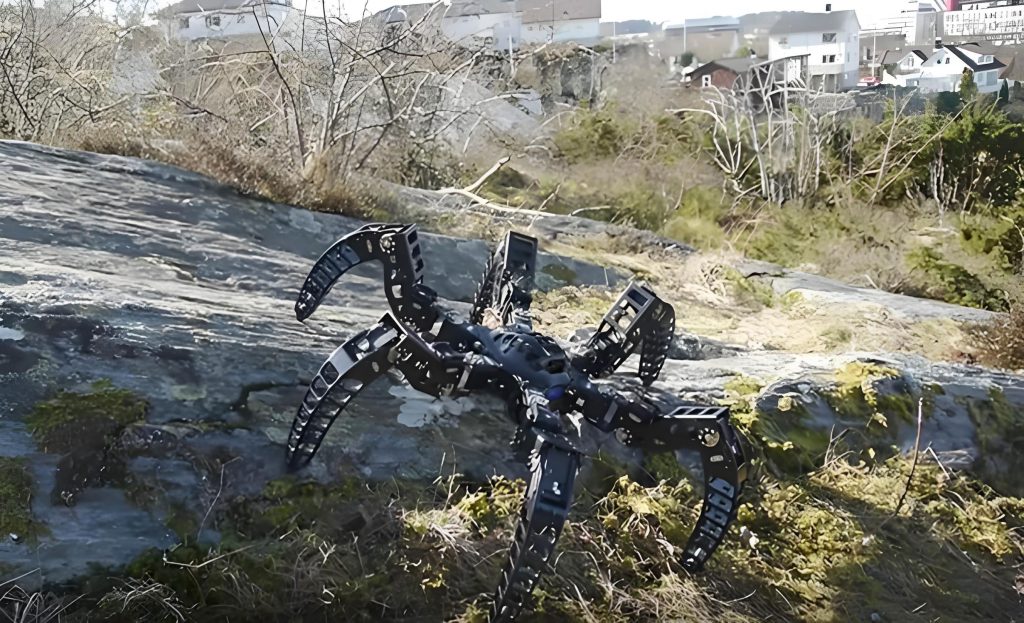
The realization of a bionic robot hinges on the integration of several core subsystems, each presenting its own research challenges.
1. Actuation and Structure: This is the “muscle and skeleton.” Early robots used rigid links with rotary motors and gears. The current trend is toward soft robotics, using compliant materials like silicone elastomers actuated by pneumatic/hydraulic channels, tendon-driven systems, or smart materials. Smart materials such as Shape Memory Alloys (SMAs), Ionic Polymer-Metal Composites (IPMCs), and dielectric elastomers allow for more biomimetic, noiseless, and direct actuation, enabling continuous bending reminiscent of real fins. The design challenge is creating a structure that is both power-dense and robust enough for the marine environment.
2. Sensing and Perception: A bionic robot must perceive its environment to navigate and perform tasks. This goes beyond traditional cameras and sonar. Bionic sensing involves mimicking the lateral line system of fish for flow sensing, using artificial whiskers for tactile perception near the seabed, or developing chemosensors for environmental monitoring. Sensor fusion algorithms are crucial to integrate these heterogeneous data streams into a coherent environmental model.
3. Control and Intelligence: Generating and controlling complex, coordinated movements like a fish’s undulation requires sophisticated controllers. Central Pattern Generators (CPGs), inspired by neural circuits in animal spinal cords, are widely used to produce rhythmic locomotion gaits. Higher-level intelligence involves path planning, obstacle avoidance, and even swarm behaviors. Machine learning, particularly reinforcement learning, is increasingly used to allow the bionic robot to optimize its gait in real-time for different conditions or to learn complex navigation tasks.
A Global Landscape of Research and Funding
The development of marine bionic robot technology is propelled by significant investment from national research agencies, often motivated by defense, environmental, and industrial applications. An analysis of publicly disclosed grants reveals a clear hierarchy of investment.
| Rank | Country/Region | Primary Funding Agency | Relative Investment Focus |
|---|---|---|---|
| 1 | United States | Office of Naval Research (ONR), National Science Foundation (NSF) | High. Dominant in both basic research (NSF) and applied, defense-related projects (ONR). Focus on autonomy, novel propulsion, and sensing. |
| 2 | China | National Natural Science Foundation of China (NSFC), National Key R&D Programs | High and rapidly growing. Broad investment across universities and CAS institutes. Strong output in academic publications. |
| 3 | European Union | European Commission Framework Programs (e.g., FP7, Horizon 2020) | Medium-High. Collaborative, transnational projects focusing on fundamental locomotion science, bio-inspired sensing, and environmental monitoring. |
| 4 | Japan & South Korea | Japan Society for Promotion of Science (JSPS), National Research Foundation of Korea (NRF) | Medium. Strong historical focus on precision actuation (Japan) and robust, application-ready systems (Korea). |
Defense-related funding, particularly from naval organizations, has been a major catalyst. The U.S. Office of Naval Research has funded countless projects exploring bionic robot applications for mine countermeasures, harbor surveillance, and intelligence gathering, where the low acoustic and visual signature of a biomimetic vehicle is a paramount advantage.
Bibliometric Analysis: Mapping the Intellectual Currents
Analyzing the scientific literature provides a complementary view of the field’s dynamics. A bibliometric study of thousands of publications shows not just where research is happening, but what specific topics are capturing the community’s attention.
Geographic and Institutional Leadership: The United States leads in total publication volume, followed closely by China. However, China has shown the most rapid growth in recent years. Key global nodes include the Massachusetts Institute of Technology (pioneering in BCF propulsion), the Chinese Academy of Sciences (particularly the Institute of Automation and Shenyang Institute of Automation, with broad work on control and system integration), and a cluster of European universities focused on bio-inspired sensing and soft robotics.
Research Topic Clusters: Co-word analysis reveals dense conceptual clusters:
- Locomotion & Hydrodynamics: The largest cluster, focused on gait generation, fluid dynamics simulation (CFD), and efficiency optimization. This is the core engineering mechanics of the bionic robot.
- Perception & Navigation: A rapidly growing cluster centered on Simultaneous Localization and Mapping (SLAM) in unstructured underwater environments, sensor fusion, and vision-based guidance.
- Smart Materials & Soft Robotics: An interdisciplinary cluster linking materials science to actuator design, emphasizing IPMCs, SMAs, and elastomeric composites for truly soft-bodied bionic robot designs.
- Intelligence & Control: Focused on CPG models, neural network controllers, and swarm algorithms for multi-robot coordination.
The following table synthesizes publication output with funding focus for selected leading institutions, highlighting their specialized niches within the broader bionic robot ecosystem.
| Institution | Publication Strength | Characteristic Research Focus |
|---|---|---|
| Massachusetts Institute of Technology | High, foundational | High-fidelity BCF dynamics, advanced manufacturing for robotic fish. |
| Chinese Academy of Sciences | Very High, broad | Integrated system development, fast-maneuvering prototypes, multi-modal control. |
| University of Zurich/ETH Zurich | Medium, specialized | Soft robotics for underwater manipulation, bio-inspired design methodologies. |
| Harvard University | Medium, pioneering | Soft material actuators, micro- and milli-scale robotic fish. |
Future Trajectories: The Next Wave of Bionic Robot Evolution
Based on the analysis of funding trends and research frontiers, the future development of marine bionic robot technology will be guided by several convergent principles:
1. From Macroscopic to Multi-Scale Mimicry: Future designs will integrate insights across scales—from the gross morphology down to the micro-texture of skin (e.g., shark denticle coatings for drag reduction) and the molecular mechanisms of adhesion (e.g., mussel-inspired glues). This holistic biomimetics will yield more capable and efficient systems.
2. From Rigid to Functional Material Integration: The paradigm is shifting from assembling rigid components to designing with functionally graded, multi-material systems. The ideal bionic robot of the future will feature structure, actuation, and sensing seamlessly integrated into a single, often soft, continuum—a true “animate” material. Energy storage (e.g., in structural batteries) may also be embedded.
3. From Pre-programmed to Cognitively Adaptive Control: Control systems will evolve beyond fixed CPG parameters. Neuromorphic computing and advanced machine learning will enable real-time adaptation of gait to currents, payload, or damage, and allow for higher-level mission reasoning. The goal is a bionic robot that learns from its environment and experience.
4. From Individual Platforms to Cooperative Swarms: Inspired by fish schools, future applications will leverage swarms of low-cost, simple bionic robot units. Through local communication and decentralized algorithms, the swarm can achieve complex objectives like large-area seabed mapping, adaptive pollutant tracking, or coordinated search missions with robustness no single vehicle could possess.
5. From External Power to Bio-Energetic Inspiration: Ultimate endurance may come from mimicking biological energy harvesting. Research into bio-fuel cells that oxidize organic matter in seawater, or systems that leverage slow, energy-efficient gaits combined with solar/salinity gradient energy, could lead to truly autonomous, long-lived bionic robot platforms for ocean observation.
The journey of the marine bionic robot from a novel concept to a transformative technology is well underway. It is a field sustained by deep curiosity about biological principles, driven by strategic national interests, and accelerated by breakthroughs in materials, computation, and fabrication. As these threads continue to intertwine, the next generation of bionic robot systems will become increasingly lifelike, intelligent, and indispensable partners in unlocking the secrets and safeguarding the future of our planet’s final frontier.