
The advancement of agricultural robotics stands as a pivotal response to the profound demographic and economic shifts characterizing modern global agriculture. As a nation with a vast population and significant agricultural output, we face escalating challenges primarily driven by an aging workforce and a pronounced rural labor shortage. Rapid urbanization and industrial development have drawn human resources away from farms, a trend projected to intensify. This exodus underscores the urgent need for technological infusion into the agricultural sector to ensure sustainability and food security. The vision of fully intelligent and unmanned farm management is not merely aspirational but a necessary evolution. Within this paradigm, the robotic harvesting of fruits and vegetables emerges as a critical research frontier. The core objective is to develop systems that dramatically enhance operational efficiency while alleviating physical labor, replacing monotonous, complex, and hazardous tasks with consistent, precise automation. The central component determining the success of such robotic platforms is the end effector—the specialized tool that interacts directly with the crop.
Current harvesting processes remain predominantly manual, leading to high labor costs, variability in quality, and physical strain. While robotic pickers promise a solution, widespread adoption is hampered by significant shortcomings in existing end effector technology. Common issues include inadequate precision, prolonged operation cycles, a high propensity to damage delicate produce, prohibitive costs, and poor adaptability to diverse crops and unstructured environments. These limitations often stem from suboptimal mechanical design, unsuitable material selection, and insufficient integration with perception and control algorithms. Consequently, dedicated research into advanced, efficient, and non-damaging harvesting end effectors is of paramount importance for realizing the potential of agricultural robotics.
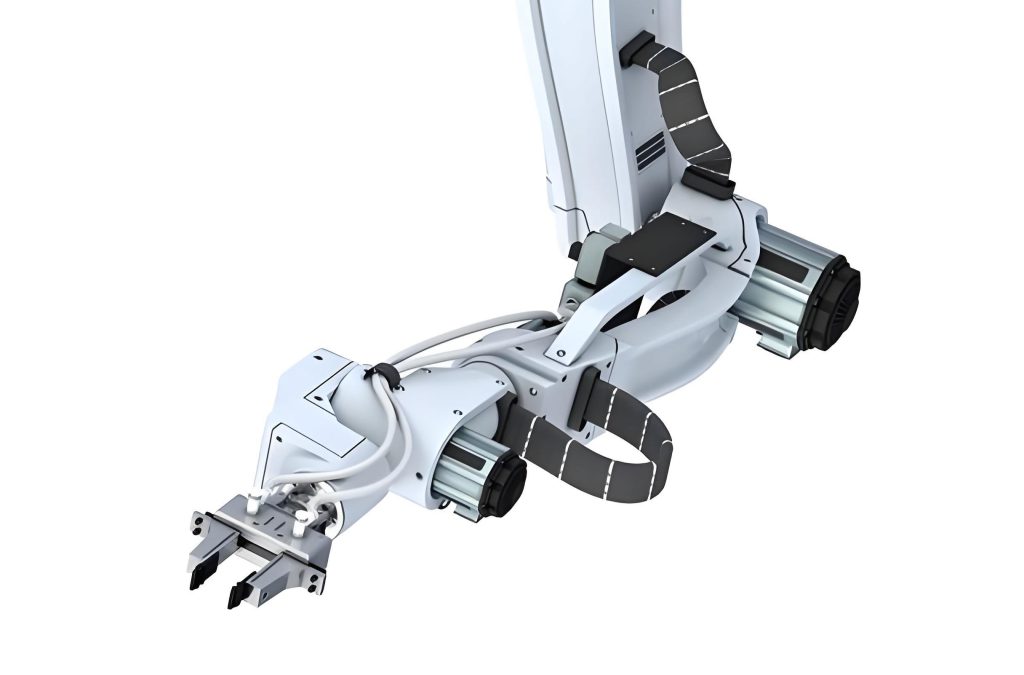
A Comprehensive Analysis of Existing End Effector Architectures
Harvesting end effectors are typically categorized by their fundamental principle of detachment and acquisition. The primary classifications are suction-based, grasping/clamping-based, and shake-and-catch mechanisms. Each paradigm presents distinct advantages and compromises related to speed, gentleness, and environmental suitability.
1. Suction-Based End Effectors
This approach utilizes pneumatic systems to create a vacuum, enabling the end effector to adhere to the fruit’s surface. Detachment is usually achieved by a combination of pulling and a twisting or stem-cutting action initiated after suction is secured.
- Principle: A vacuum pump generates negative pressure $P_{vac}$ at the orifice of a suction cup. The pressure difference $\Delta P = P_{atm} – P_{vac}$ creates a holding force $F_{hold}$ proportional to the effective area $A_{eff}$ of contact: $$F_{hold} = \Delta P \cdot A_{eff} \cdot \eta$$ where $\eta$ is an efficiency factor accounting for seal integrity and surface irregularities.
- Advantages: Potentially high-speed operation, minimal need for complex fruit orientation, and no direct compressive force on the fruit.
- Disadvantages: High energy consumption; effectiveness is highly dependent on fruit surface quality (smooth, waxy surfaces are ideal), curvature, and the presence of obstructing foliage; risk of bruising if the suction/pull force is not carefully controlled.
2. Grasping/Clamping-Based End Effectors
This is the most diverse and widely researched category. It involves physically contacting and enclosing the fruit or its stem with fingers, pads, or enveloping structures before severing it.
| Type | Description | Key Design Considerations | Typical Applications |
|---|---|---|---|
| Finger-Type (Rigid) | Utilizes two or more rigid or semi-rigid fingers actuated by motors, pneumatics, or linkages. | Gripper kinematics, contact surface geometry, controlled grasping force $F_g$ to prevent damage. Often includes an integrated cutting tool. | Apples, citrus, tomatoes, bell peppers. |
| Soft/Rigid Hybrid (Underactuated) | Employs compliant joints or flexible materials in the finger structure, allowing passive adaptation to object shape. | Mechanical compliance, force distribution, simplicity of control. Can envelop fruit without complex force sensing. | Clusters of tomatoes, eggplants, irregularly shaped fruit. |
| Soft Robotic (Pneumatic/Hydraulic) | Fingers or entire grippers made from elastomers (e.g., silicone) with internal chambers inflated by fluid pressure. | Material elasticity (Young’s Modulus, $E$), chamber design, pressure control for gentle, conformal grasping. | Strawberries, raspberries, tomatoes, delicate stone fruit. |
| Enveloping/Cup-Type | The fruit is guided into a concave cup or flexible enclosure which then closes around it. | Fruit alignment, closing mechanism (diaphragm, contracting ring), and stem access for cutting. | Mushrooms, apples, kiwifruit. |
The grasping force $F_g$ is a critical parameter. An optimal range must be identified that satisfies two inequalities: it must exceed the force required to securely hold the fruit against inertia and disturbances ($F_{hold-min}$), yet remain below the force that causes mechanical damage ($F_{damage}$).
$$F_{hold-min} < F_g < F_{damage}$$
$F_{hold-min}$ depends on the fruit’s mass $m$, acceleration $a$, and the coefficient of friction $\mu$ between the end effector material and the fruit skin. $F_{damage}$ is determined by the fruit’s bioyield pressure and skin strength, often established empirically for each crop.
3. Shake-and-Catch Mechanisms
This method involves applying mechanical vibration to the tree or plant canopy to cause fruit abscission, with fallen fruit collected on a catching surface.
- Principle: A forced vibration is applied at frequency $\omega$ and amplitude $A$. The goal is to transfer sufficient kinetic energy to the fruit-pedicle junction to exceed its failure strength. The dynamics can be modeled as a forced harmonic oscillator for the fruit mass.
- Advantages: Very high throughput for canopy-level harvesting; mechanically simpler end effector (a shaking mechanism).
- Disadvantages: Nonselective; high potential for fruit damage (bruising from falls, collisions); can damage tree limbs and buds; only suitable for fruits with a well-defined abscission layer at harvest time (e.g., some nuts, berries for processing, dates).
Critical Challenges and Performance Limitations
Despite decades of research, several interconnected challenges continue to impede the transition of harvesting robots from laboratory prototypes to robust, economically viable field machines. The end effector is frequently the bottleneck in system performance.
| Challenge | Technical Manifestation | Consequence |
|---|---|---|
| 1. Lack of Universality & Adaptability | Designs are often crop-specific and environment-specific. An end effector optimized for apples in an orchard may fail for tomatoes in a greenhouse or citrus in a dense canopy. | High per-crop development cost, inability to handle mixed crops, limited operational scope. |
| 2. Fruit Damage | Compressive stress from rigid grippers, impact from suction, puncture from sharp edges, or abrasion from rough surfaces. | Reduced market value, increased post-harvest losses, shortened shelf life. |
| 3. Insufficient Precision & Reliability | Misalignment during grasp attempt, failure to acquire the fruit securely (slip), inaccurate stem cutting, or collisions with obstacles. | Low harvest success rate (often < 80-90% in real environments), reduced effective operational speed. |
| 4. Weak Performance in Complex Environments | Difficulty navigating occlusions (leaves, branches), handling clustered fruit, adapting to varying lighting, and operating on uneven terrain. | System failures, incomplete harvesting, requirement for highly structured environments (e.g., trellised crops). |
| 5. Inadequate Durability & Cost-Effectiveness | Exposure to dust, moisture, plant sap, and UV radiation can degrade materials. Complex mechanisms are expensive to manufacture and maintain. | High initial investment, frequent downtime and maintenance, poor return on investment for farmers. |
The challenge of damage is particularly acute. The biomechanical properties of fruit tissue are complex. A simple model for compressive damage considers the stress $\sigma$ applied by an end effector finger: $$\sigma = \frac{F_g}{A_c}$$ where $A_c$ is the contact area. Damage occurs when $\sigma$ exceeds a critical yield stress $\sigma_y$ of the fruit’s epidermis or flesh. For a soft end effector, $A_c$ increases as the material conforms, thereby reducing $\sigma$ for a given $F_g$, which is the fundamental argument for compliant designs.
Future Trends: The Path Towards Intelligent and Adaptive Harvesting
The future development of harvesting end effectors is converging along two synergistic axes: (1) fundamental advancements in hardware, focusing on material science, compliant mechanisms, and novel actuators; and (2) deep integration with sophisticated perception and adaptive control algorithms powered by artificial intelligence.
1. Hardware Evolution: The Rise of Soft and Hybrid Robotics
The trend is decisively moving towards increased compliance and morphological intelligence built into the end effector itself. This is embodied in the field of soft robotics.
- Materials: Use of hyper-elastic polymers, silicone elastomers, and fabric-based composites that are inherently gentle and can deform to encapsulate irregular shapes.
- Actuation: Movement generated not by rigid motors but by pneumatic/hydraulic pressure (pneu-nets), tendon-driven systems (cables), or smart materials like Shape Memory Alloys (SMA) and Dielectric Elastomer Actuators (DEA). The force output of a pneumatic bending actuator, for instance, can be related to the input pressure $P$ and chamber geometry.
- Hybrid Designs: Combining rigid structures for support and strength with soft elements for contact and adaptation. For example, a rigid palm with soft, pneumatic fingers offers both structural stability and gentle grasping.
The compliance of a soft gripper can be characterized by its effective stiffness $k_{eff}$, which is typically nonlinear and much lower than that of a metal gripper. This allows for passive adaptation: the gripper’s shape $S$ changes in response to contact forces $F_{contact}$ from the object and environment, $S = f(F_{contact}, k_{eff})$, without explicit sensing and control for each degree of freedom.
2. Intelligence Integration: From Pre-Programmed to Cognitive End Effectors
A truly robust end effector must be part of a larger intelligent system. The key is closing the perception-action loop with advanced algorithms.
- Advanced Perception: Deep learning models (CNNs, Vision Transformers) for robust fruit detection, segmentation, and ripeness classification in highly occluded and variable lighting conditions. 3D vision (stereo, RGB-D, LiDAR) for precise localization and volume estimation, enabling the end effector to approach at the correct angle.
- Adaptive Grasp Planning: Algorithms that not only find the fruit but also calculate an optimal approach vector and grasp configuration based on real-time point cloud data, avoiding obstacles and selecting stable contact points.
- Force & Tactile Feedback Control: Implementing impedance or force control paradigms using sensors (force/torque, tactile arrays) to regulate the interaction force during grasping and detachment. The desired dynamic behavior can be expressed as a second-order system: $$M\ddot{x} + B\dot{x} + Kx = F_{ext}$$ where $M$, $B$, $K$ are the desired inertia, damping, and stiffness matrices of the end effector, $x$ is position deviation, and $F_{ext}$ is the measured interaction force. This allows the end effector to behave like a spring-damper system, reacting gently to contact.
- Learning from Demonstration & Reinforcement Learning: Training gripper policies in simulation or real-world trials to handle edge cases and improve success rates over time based on reward signals (successful pick, low damage).
| Hardware Feature | Enabling Intelligent Capability | Resultant Benefit |
|---|---|---|
| Soft, Compliant Structure | Reduces need for micron-level positioning accuracy; provides inherent safety. Allows simpler control laws to be effective. | Higher success rate in cluttered environments; significantly reduced damage risk. |
| Embedded Tactile Sensors | Provides direct measurement of contact state, slip, and fruit firmness. Enables fine manipulation (e.g., orienting for stem cutting). | Reliable grasp verification; adaptive grip force; ability to handle delicate stem detachment. |
| Modular, Reconfigurable Design | Allows an AI system to select or morph the end effector configuration (e.g., switch from a pinch to an enveloping grasp) based on perceived fruit type and context. | Increased universality across different crops and tasks within a single platform. |
3. Systemic and Pragmatic Considerations for Commercialization
Beyond core technology, successful deployment requires addressing practical constraints. Future research must focus on:
- Cost-Effective Manufacturing: Leveraging technologies like 3D printing and molded silicone for rapid, low-cost prototyping and production of soft robotic components.
- Durability & Weatherproofing: Developing robust material composites and sealing techniques that withstand the harsh agricultural environment for entire growing seasons.
- Energy Efficiency: Optimizing pneumatic systems and actuator design to minimize power consumption, a critical factor for mobile, battery-operated platforms.
- Human-Robot Collaboration (HRC): Designing end effectors and workflows where robots handle the bulk of easy-to-reach fruit, while human workers focus on complex picking scenarios, improving overall system productivity and acceptability.
Synthesis and Conclusion
The journey towards autonomous fruit and vegetable harvesting is intrinsically linked to the evolution of the robotic end effector. While significant progress has been made, current solutions often fall short in the face of the incredible biological diversity and environmental complexity found in natural agricultural settings. The predominant issues of low adaptability, high damage potential, and unsatisfactory reliability stem from a historical reliance on rigid, deterministic automation paradigms applied to a soft, variable, and living world.
The path forward is clear and compelling. It lies in the convergence of compliant mechanical design and embedded cognitive intelligenceend effectors will not be mere tools but semi-autonomous agents. They will feature soft, biomimetic structures that safely interact with produce, coupled with multi-modal sensing and adaptive control algorithms that allow them to perceive, reason, and act in real-time. This shift from precision-engineered rigidity to controlled, intelligent compliance is fundamental.
Key research thrusts must include: the development of novel, durable soft materials and efficient soft actuators; the creation of robust vision algorithms for operation in unstructured canopies; the seamless integration of tactile and force feedback for delicate manipulation; and the formulation of system-level designs that prioritize cost, durability, and ease of use. The ultimate goal is to create versatile end effectors that can be rapidly adapted to different crops with minimal reconfiguration, moving from expensive, single-purpose machines towards flexible, multi-role agricultural assistants.
In conclusion, the maturation of the robotic harvesting end effector from a research curiosity to a field-ready technology is a multifaceted challenge encompassing mechanical engineering, materials science, computer vision, and machine learning. By embracing the principles of soft robotics and artificial intelligence, we can develop end effectors that are not only effective and efficient but also gentle and adaptable. Success in this endeavor will unlock the full potential of agricultural robotics, providing a sustainable and scalable solution to one of agriculture’s most pressing human resource challenges, and taking a decisive step toward the realization of truly intelligent, unmanned farms.