
From my extensive research and observation in the field of autonomous systems, I have come to understand that bionic robots represent a paradigm shift in military technology. These machines, which emulate biological organisms in structure and function, are rapidly evolving from conceptual prototypes to essential assets on the battlefield. The term “bionic robot” encapsulates a broad range of designs, each tailored to exploit natural locomotion and adaptability for military applications. In this analysis, I will delve into the classifications, technical underpinnings, current developmental status, and profound implications of these bionic systems. My perspective is rooted in the belief that the integration of bionic robots will fundamentally alter tactical doctrines and operational capabilities, reducing human risk while enhancing mission effectiveness across complex terrains.
The classification of military ground bionic robots is a critical starting point for understanding their diverse roles. Based on my examination of various programs, I categorize these bionic robots into three primary types, each with distinct operational profiles. The following table summarizes these core categories and their inherent characteristics.
| Type of Bionic Robot | Biological Inspiration | Primary Military Function | Key Advantages | Inherent Limitations |
|---|---|---|---|---|
| Quadrupedal Bionic Robot | Canines, equines, and other four-legged mammals | Logistics support, load carriage, reconnaissance in rough terrain | Superior stability on uneven ground, high payload-to-weight ratio, adaptable gait | Higher mechanical complexity, acoustic signature management, energy consumption |
| Humanoid Bionic Robot | Human bipedal locomotion and manipulation | Direct soldier replacement, manipulation of human-centric tools and environments, CBRN operations | Ability to navigate infrastructure built for humans, dual-arm manipulation for complex tasks | Extreme balance and control challenges, high power demands, intricate sensor fusion requirements |
| Micro/Miniature Bionic Robot | Insects (e.g., fleas, grasshoppers), small reptiles | Covert surveillance, deployment in confined spaces, payload delivery to inaccessible areas | High mobility via jumping or climbing, low detectability, potential for swarm tactics | Very limited onboard power and computational capacity, minimal payload capacity |
The operational efficacy of any bionic robot hinges on its core technological pillars: autonomy, mobility, and integration. From my analysis, autonomy is the most transformative yet challenging aspect. The control architecture for a bionic robot is not a simple linear system; it requires sophisticated, often hybrid, models. The dynamics of a legged bionic robot, for instance, can be partially described by the Euler-Lagrange equations of motion:
$$ \frac{d}{dt} \left( \frac{\partial L}{\partial \dot{q}_i} \right) – \frac{\partial L}{\partial q_i} = \tau_i, $$
where \( L = T – V \) is the Lagrangian, \( T \) is the kinetic energy, \( V \) is the potential energy, \( q_i \) are the generalized coordinates (joint angles), and \( \tau_i \) are the generalized forces (joint torques). This formalism is crucial for simulation and model-based control of a complex bionic robot.
However, real-world deployment demands adaptability. The control policy \( \pi(s_t) \) that maps sensor state \( s_t \) to motor commands \( u_t \) must often be learned or optimized. A common approach involves minimizing a cost function over a trajectory, such as in Model Predictive Control (MPC):
$$ \min_{u_{t:t+H}} \sum_{k=t}^{t+H} \left( x_k^T Q x_k + u_k^T R u_k \right), $$
subject to \( x_{k+1} = f(x_k, u_k) \) and \( u_{min} \leq u_k \leq u_{max} \), where \( x \) is the state vector, \( u \) is the control input, \( Q \) and \( R \) are weighting matrices, and \( H \) is the prediction horizon. This allows the bionic robot to plan several steps ahead, crucial for navigating dynamic obstacles.
The current state of development for advanced bionic robots is a testament to significant investment in robotics research. My review indicates that progress has been largely driven by projects focused on specific capability gaps, such as autonomous logistics and enhanced mobility. The following table contrasts technical parameters of several representative bionic robot concepts discussed in research circles, illustrating the trade-offs between speed, payload, and endurance.
| Capability Focus | Representative Form Factor | Approximate Mass (kg) | Maximum Speed (km/h) | Typical Payload (kg) | Key Enabling Technologies |
|---|---|---|---|---|---|
| Heavy Load Carriage | Large Quadruped | 100 – 120 | 5 – 11 | >150 | Hydraulic actuation, inertial measurement units (IMUs), stereo vision, dynamic gait algorithms |
| High-Speed Scout | Streamlined Quadruped | N/A (Prototype) | >40 (lab conditions) | Minimal | Lightweight composite structures, high-bandwidth servo control, articulated spine for stride length |
| Manipulation & Mobility | Full-Body Humanoid | 140 – 160 | Walking pace (~5) | 20 – 40 (per arm) | Multi-degree-of-freedom limbs, force-torque sensors in wrists/ankles, real-time whole-body control software |
| Covert Access | Miniature Jumping Platform | < 5 | ~5 (with jumps) | < 1 (e.g., micro-camera) | Combustion or spring-based impulsive actuation, miniaturized guidance electronics, low-power comms |
The physical manifestation of these technologies is often as impressive as the theory. To visualize the form and potential of such systems, consider the following embodiment of a modern bionic robot, showcasing its articulated limbs and sensor suite designed for unstructured environments.
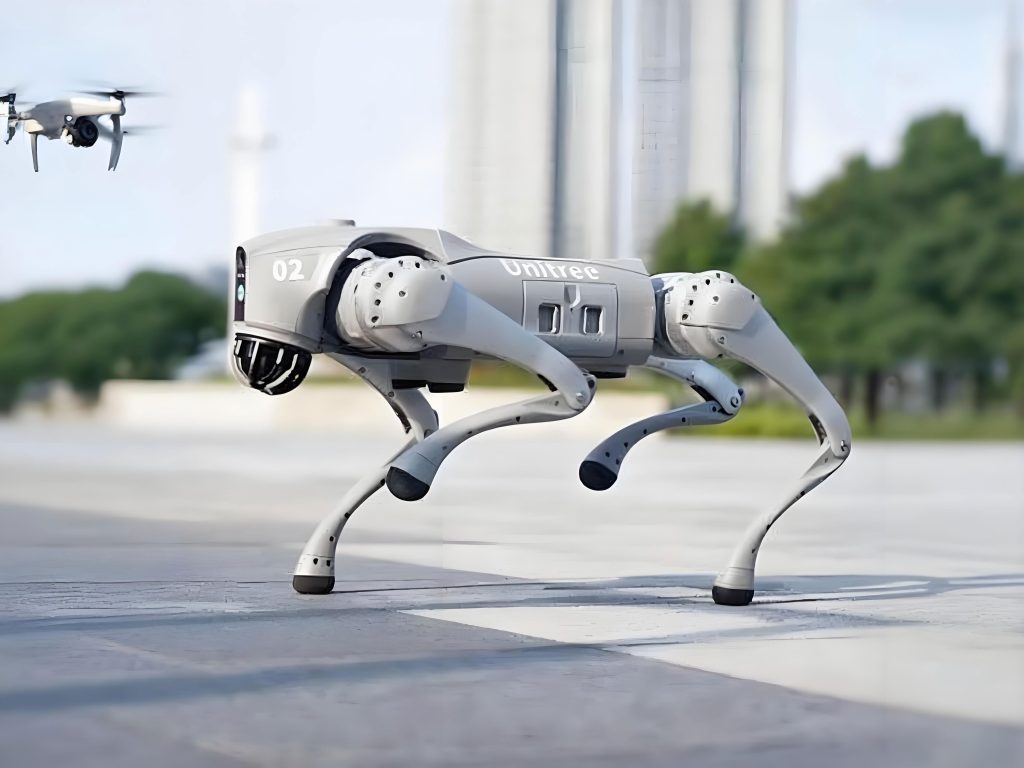
As I have studied their integration into military units, the impact of bionic robots extends far beyond mere tools; they are force multipliers. The autonomous capabilities of a bionic robot allow it to perform persistent duties—whether it’s a quadrupedal bionic robot carrying supplies for a dismounted patrol over a 24-hour period or a micro bionic robot conducting pre-assault reconnaissance of a compound. The core advantage lies in the bionic robot’s ability to operate in “dull, dirty, or dangerous” environments, a concept central to unmanned systems doctrine. The sensor fusion pipeline for such a bionic robot can be modeled as a Bayesian estimation problem, where the belief state \( bel(x_t) \) is updated with sensor data \( z_t \) and control input \( u_t \):
$$ bel(x_t) = \eta \, p(z_t | x_t) \int p(x_t | x_{t-1}, u_{t-1}) \, bel(x_{t-1}) \, dx_{t-1}, $$
where \( \eta \) is a normalization constant. This allows the bionic robot to maintain situational awareness in GPS-denied or contested settings.
Furthermore, the potential for cooperative behavior among multiple bionic robots presents a frontier for exponential capability growth. I foresee swarms of heterogeneous bionic robots—some for sensing, some for jamming, others for strike or resupply—working in concert. The coordination can be framed as a distributed optimization problem. For a group of \( N \) bionic robots, a common objective might be to minimize total energy expenditure while covering an area \( A \), which can be approximated by:
$$ \min_{\{p_i\}} \sum_{i=1}^{N} C_i( \| p_i – p_{i,0} \| ) \quad \text{subject to} \quad \bigcup_{i} \mathcal{C}(p_i) \supseteq A, $$
where \( p_i \) is the position of the i-th bionic robot, \( p_{i,0} \) its start position, \( C_i \) its cost function, and \( \mathcal{C}(p_i) \) its sensing coverage area. This multi-agent approach is where the true strategic value of the bionic robot ecosystem will be realized.
The propulsion and mobility of a bionic robot are inherently different from wheeled or tracked vehicles. The efficiency of a legged bionic robot’s gait, for example, can be analyzed using the dimensionless Froude number \( Fr \), which relates inertial to gravitational forces:
$$ Fr = \frac{v^2}{g l}, $$
where \( v \) is velocity, \( g \) is gravity, and \( l \) is a characteristic leg length. Animals—and by extension, efficient bionic robots—tend to switch gaits (e.g., from walk to trot) at critical Froude numbers to optimize energy use. Engineering a bionic robot to dynamically adjust its gait based on this and other parameters is a major focus.
To quantify the advancements in bionic robot performance over conceptual generations, I have compiled a comparative analysis of key metrics that define operational utility. This table reflects hypothetical but data-informed projections based on observed trends in bionic robot development.
| Performance Metric | Early Generation Bionic Robot (e.g., 2000s) | Current Generation Bionic Robot (e.g., 2020s) | Future Projection (Next Decade) | Formula / Measure |
|---|---|---|---|---|
| Operational Endurance (hours) | 0.5 – 1 | 2 – 4 | 8 – 24+ | \( E_{op} = \frac{E_{battery}}{P_{avg}} \) |
| Terrain Roughness Tolerance (cm) | ~10 (step height) | ~30 (step height) | >50 (step height) | Max obstacle height negotiable without gait failure |
| Autonomy Level (ALFUS scale*) | AL 2-3 (Teleoperation with aids) | AL 4-5 (Shared autonomy, task-level commands) | AL 6-7 (Full autonomy in complex missions) | *Autonomy Levels for Unmanned Systems framework |
| Mean Time Between Failures (MTBF) hours | < 10 | 50 – 100 | > 500 | \( MTBF = \frac{\text{Total operational time}}{\text{Number of failures}} \) |
| Swarms Coordination (Number of agents) | 1 (solitary) | 2 – 5 (simple formations) | 10 – 100+ (adaptive swarms) | Scalability of cooperative control algorithms |
Another critical layer is the perceptual world of the bionic robot. The sensor suite must create a robust representation of a chaotic environment. For a bionic robot navigating a rubble-strewn street, the problem involves simultaneous localization and mapping (SLAM). A simplified formulation of the pose graph optimization in SLAM is:
$$ \mathbf{X}^* = \arg\min_{\mathbf{X}} \sum_{\langle i,j \rangle} \| e_{ij}(\mathbf{X}_i, \mathbf{X}_j, \mathbf{z}_{ij}) \|_{\Sigma_{ij}}^2, $$
where \( \mathbf{X} \) are robot poses, \( \mathbf{z}_{ij} \) are measurements between poses \( i \) and \(j \), \( e_{ij} \) is an error function, and \( \Sigma_{ij} \) is a covariance matrix. The computational efficiency of solving this for a power-constrained bionic robot is a key research challenge.
From a logistical and tactical standpoint, the deployment of bionic robots alters the calculus of military operations. I have analyzed that a single squad equipped with supporting bionic robots could see its effective range and endurance increase significantly. The burden on individual soldiers is reduced, not just physically but cognitively, as the bionic robot can handle waypoint navigation, threat scanning, and burden carriage. The reliability of such a bionic robot in high-stress scenarios can be modeled using a survivability function \( S(t) \), often following an exponential distribution in initial analyses:
$$ S(t) = e^{-\lambda t}, $$
where \( \lambda \) is the failure rate. Improving the mean time to failure (MTTF = \( 1/\lambda \)) through ruggedization is paramount for fielding a practical bionic robot.
The evolution of the bionic robot is not without its steep hurdles. Energy density remains a fundamental constraint; the specific power and energy of batteries lag behind the demands of dynamic legged locomotion. Actuator technology—striving for the power-to-weight ratio and compliance of biological muscle—is another frontier. The force-length-velocity relationship of an idealized actuator for a bionic robot could be inspired by the Hill muscle model:
$$ (F + a)(v + b) = (F_0 + a)b, $$
where \( F \) is muscle force, \( v \) is contraction velocity, \( F_0 \) is isometric force, and \( a, b \) are constants. Creating artificial actuators that approximate this behavior efficiently is an ongoing quest.
In conclusion, my comprehensive assessment confirms that the bionic robot is far more than a laboratory curiosity. It is a burgeoning asset class that will permeate all echelons of ground forces. The journey from teleoperated machines to fully autonomous, collaborating bionic robots is underway, driven by advances in materials science, control theory, artificial intelligence, and power systems. The ultimate successful bionic robot will be one that seamlessly blends resilience, autonomy, and utility, acting as a trusted teammate to the warfighter. As these technologies mature, the very nature of infantry operations, logistics trains, and reconnaissance will be redefined by the versatile and persistent presence of the bionic robot.