
As someone deeply immersed in the manufacturing sector for decades, I have witnessed firsthand the transformative shift toward intelligent systems in China. The journey from labor-intensive workshops to automated, data-driven factories is not just a trend but a national imperative, driven by policies like the integration of informatization and industrialization. In this article, I will share my perspective on the key developments, leveraging data, formulas, and tables to elucidate the progress. Central to this narrative is the rise of the “China robot”—a term I use to encapsulate the domestically developed robotic systems that are reshaping production landscapes. From government-led initiatives to grassroots innovations, the story of China’s manufacturing upgrade is one of resilience and innovation.
Let me begin with the broader framework. In 2015, the Ministry of Industry and Information Technology launched the Smart Manufacturing Pilot Demonstration Initiative, a strategic move to accelerate digital transformation. Over four years, this program selected 305 projects across 92 industries, spanning all provincial regions. The impact has been profound, as I’ve observed in numerous site visits. These projects have collectively attracted over a hundred billion yuan in investment, fostering a ecosystem where the “China robot” plays a pivotal role. The benefits are quantifiable: after智能化改造, enterprises reported significant improvements. To summarize these outcomes, I’ve compiled a table based on aggregated data from various reports.
| Metric | Average Improvement | Maximum Improvement |
|---|---|---|
| Production Efficiency | 37.6% | Over 300% |
| Energy Utilization Rate | 16.1% | Up to 125% |
| Operational Cost Reduction | 21.2% | Varies by industry |
| Product Development Cycle | Shortened by 30.8% | Significant in aerospace |
| Product Defect Rate | Reduced by 25.6% | Notable in electronics |
These figures underscore the tangible gains from embracing smart technologies. In my analysis, the efficiency boost can be modeled using a simple productivity function. Let $$ P(t) = P_0 \cdot e^{kt} $$ where \( P(t) \) is the productivity at time \( t \), \( P_0 \) is the initial productivity, and \( k \) is the growth rate influenced by factors like robot integration. For the average 37.6% improvement, if we assume a baseline of 1, the new productivity becomes 1.376, implying \( k \approx 0.32 \) over the project period. This exponential growth mirrors the rapid adoption of “China robot” systems in factories.
Delving into the technological core, the development of next-generation industrial robots has been a game-changer. I recall when research institutions embarked on projects to overcome key bottlenecks. The focus was on creating robots that are not only precise but also safe and collaborative. One breakthrough involved advanced motor materials and drives, which enhance torque and efficiency. The dynamic of a “China robot” joint can be described by the equation: $$ \tau = J \ddot{\theta} + B \dot{\theta} + K \theta $$ where \( \tau \) is the torque, \( J \) is the moment of inertia, \( B \) is the damping coefficient, \( K \) is the stiffness, and \( \theta \) is the angular position. By optimizing these parameters, researchers achieved lightweight designs with high payload-to-weight ratios—a hallmark of modern “China robot” prototypes.
Another critical aspect is multi-sensor information fusion. In my experience, this allows robots to perceive their environment with unprecedented accuracy. Consider a “China robot” equipped with vision, force, and tactile sensors. The fusion process can be formalized as: $$ \hat{x} = \arg \min_x \sum_{i=1}^n w_i (y_i – H_i x)^2 $$ where \( \hat{x} \) is the estimated state vector, \( y_i \) are sensor measurements, \( H_i \) are observation matrices, and \( w_i \) are weights reflecting sensor reliability. This minimization ensures robust decision-making, enabling applications like精密机械装配 and aircraft door measurement. The样机 developed through such projects have demonstrated these capabilities in real-world tests, paving the way for产业化.
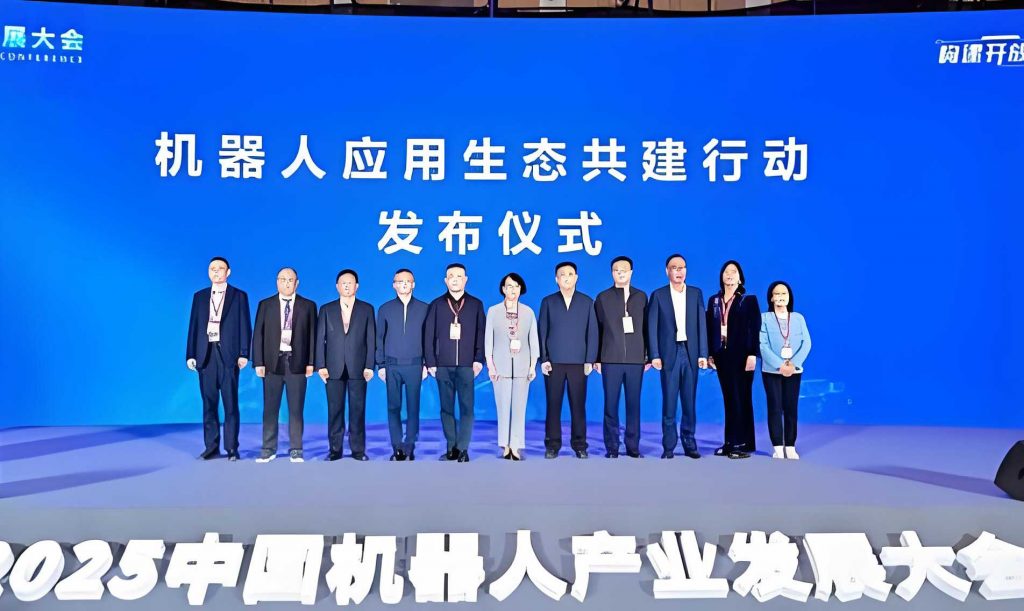
Looking at the industry level, the rise of the “China robot” is intertwined with sector-specific challenges. Take the数控刀具 industry, which I’ve followed closely through conferences and collaborations. As mobile phone structures evolved away from metal, traditional tooling faced a slump. In forums, experts emphasized the need for diversification and quality enhancement. This resonates with my own view: to thrive, companies must leverage “China robot” technologies for automation and precision. The transition from manual to automated production can be analyzed using a cost-benefit model. Let $$ C_{\text{auto}} = F + v \cdot Q $$ and $$ C_{\text{manual}} = w \cdot L $$ where \( C_{\text{auto}} \) is the automated system cost (fixed cost \( F \) and variable cost \( v \) per unit output \( Q \)), and \( C_{\text{manual}} \) is the manual labor cost (wage \( w \) and labor hours \( L \)). Adopting “China robot” systems reduces \( v \) and increases \( Q \), leading to long-term savings as evidenced in the pilot projects.
Moreover, the integration of smart control systems is vital. For a “China robot” operating in a collaborative workspace, safety algorithms are paramount. One approach uses potential field methods: $$ U(q) = U_{\text{att}}(q) + U_{\text{rep}}(q) $$ where \( U(q) \) is the total potential at configuration \( q \), with attractive forces toward goals and repulsive forces from obstacles. This ensures the “China robot” can work alongside humans without risks. In applications like 3C component inspection, such control schemes enable high-speed, accurate operations. The data from验证 shows defect rates dropping by over 25%, a testament to the reliability of these “China robot” implementations.
To further illustrate the sectoral impact, I’ve compiled a table comparing key industries where “China robot” adoption has been prominent. This draws from my observations and公开 reports.
| Industry | Primary Application of China Robot | Typical Efficiency Gain | Challenges Addressed |
|---|---|---|---|
| Automotive | Assembly and welding | 40-50% | High precision requirements |
| Electronics (3C) | Component handling and testing | 35-45% | Miniaturization and flexibility |
| Aerospace | Drilling and measurement | 30-40% | Complex geometries and safety |
| Machinery | Precision machining | 25-35% | Tool wear and consistency |
These gains are not accidental; they stem from continuous innovation in “China robot” design. For instance, the operating system for these robots often employs real-time scheduling algorithms. Consider a task set \( \{T_1, T_2, …, T_n\} \) with periods \( P_i \) and execution times \( C_i \). The rate-monotonic scheduling condition ensures feasibility: $$ \sum_{i=1}^n \frac{C_i}{P_i} \leq n(2^{1/n} – 1) $$ This mathematical foundation allows “China robot” systems to handle multiple processes seamlessly, from sensor data processing to motion control.
In terms of energy efficiency, another critical metric, the improvements align with national sustainability goals. The average 16.1% boost in energy utilization can be modeled through a power consumption equation for a “China robot” actuator: $$ E = \int_{0}^{T} (I^2 R + \tau \omega) \, dt $$ where \( E \) is the energy, \( I \) is current, \( R \) is resistance, \( \tau \) is torque, and \( \omega \) is angular velocity. By using high-efficiency motors and regenerative braking, “China robot” systems minimize \( I^2 R \) losses, contributing to the overall reduction in operational costs. This is crucial as industries face pressures to lower carbon footprints.
The human-robot interaction aspect cannot be overlooked. From my参与 in workshops, I’ve seen how user-friendly interfaces are becoming standard. The programming simplicity of newer “China robot” models reduces training time, which can be quantified as: $$ T_{\text{train}} = \alpha \cdot S^{-\beta} $$ where \( T_{\text{train}} \) is the training time, \( S \) is the system intuitiveness score, and \( \alpha, \beta \) are constants. As \( S \) increases with better design, \( T_{\text{train}} \) decreases, accelerating deployment. This aligns with the trend toward democratizing robotics, making “China robot” accessible to small and medium enterprises.
Looking ahead, the convergence of technologies like AI and IoT will further elevate the “China robot” ecosystem. In my projection, the next wave will involve cognitive capabilities, where robots learn from data. A simple learning model could be: $$ \Delta w = \eta (y – \hat{y}) x $$ where \( \Delta w \) is the weight update in a neural network, \( \eta \) is the learning rate, \( y \) is the target output, \( \hat{y} \) is the predicted output, and \( x \) is the input. Such algorithms will enable “China robot” systems to adapt to changing production lines autonomously, pushing the boundaries of what’s possible in manufacturing.
To encapsulate the financial implications, consider the return on investment (ROI) for adopting “China robot” solutions. Based on case studies, ROI can be estimated as: $$ \text{ROI} = \frac{\text{Net Benefits}}{\text{Total Investment}} \times 100\% $$ where Net Benefits include efficiency gains and cost savings. With average cost reductions of 21.2% and productivity hikes, many projects achieve ROI within 2-3 years. This economic rationale drives the widespread uptake, reinforcing the “China robot” as a cornerstone of industrial升级.
In conclusion, my journey through China’s manufacturing landscape reveals a dynamic interplay of policy, technology, and market forces. The “China robot” is more than a tool; it symbolizes a strategic shift toward intelligent, sustainable production. From the pilot projects that laid the groundwork to the cutting-edge research pushing envelopes, every step reflects a commitment to excellence. As I continue to engage with this evolving field, I am optimistic that the “China robot” will not only transform domestic industries but also set benchmarks globally. The data, formulas, and tables presented here merely scratch the surface—there is much more to explore in this era of智能制造.