
The field of robotics is undergoing a paradigm shift, moving decisively from specialized machines operating in structured environments to general-purpose humanoid robot platforms designed for the unstructured and dynamic world built for humans. This transition represents one of the most challenging and ambitious frontiers in modern engineering and artificial intelligence. The core vision is to create machines that can seamlessly integrate into human environments, utilizing the same tools, navigating the same spaces, and eventually collaborating on complex tasks. Recent breakthroughs are rapidly transforming this vision from science fiction into tangible reality, showcasing unprecedented progress in two critical, interconnected domains: individual embodied intelligence and multi-agent group intelligence. This article delves into the technical architectures, algorithmic innovations, and systemic frameworks that are driving this new era for the humanoid robot.
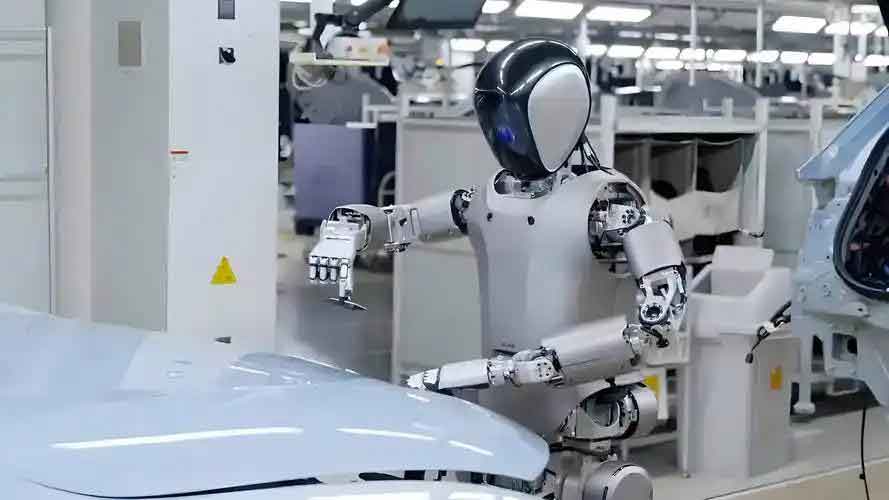
The fundamental challenge for any autonomous humanoid robot lies in mastering the art of locomotion and interaction in a world full of uncertainties. Traditional robotic control relied heavily on precise pre-programming and stable environmental conditions. The modern approach, known as Embodied AI, posits that intelligence emerges from the interaction between the robot’s body (the embodiment) and its environment. This requires a tight sensorimotor loop where perception directly informs action in real-time. The technological stack for a contemporary advanced humanoid robot can be abstracted into a hierarchical architecture, often conceptually divided into high-level cognitive functions and low-level reflexive control.
A useful model for understanding this is a dual-process system, frequently termed the “Brain” and “Cerebellum” or “Large Brain” and “Small Brain” in recent literature. The high-level “Brain” is responsible for mission planning, task decomposition, and semantic understanding of the environment. It answers the “what” and “why.” The low-level “Cerebellum” handles the “how”: the real-time coordination of dozens of actuators to maintain balance, execute fluid motions, and react to instantaneous disturbances. The communication between these layers is governed by complex state representations and optimization criteria.
We can model the overall state of a humanoid robot as a high-dimensional vector S, encompassing joint angles, velocities, torso orientation, and foot contact states. The control objective is to find a policy π that maps the perceived state St and a high-level goal G to joint torques τt that achieve stable and efficient movement. This is often framed as a constrained optimization problem solved at high frequency (e.g., 1kHz):
$$
\pi: \min_{\tau} \sum_{t=0}^{T} ( \lVert \mathbf{x}_t^{des} – \mathbf{x}_t(\tau) \rVert^2_{\mathbf{Q}} + \lVert \tau_t \rVert^2_{\mathbf{R}} )
$$
$$
\text{subject to: } \mathbf{M}(\mathbf{q})\ddot{\mathbf{q}} + \mathbf{C}(\mathbf{q}, \dot{\mathbf{q}}) = \tau + \mathbf{J}_c^T \lambda, \quad \text{and} \quad \phi(\mathbf{q}, \dot{\mathbf{q}}, \tau) \leq 0
$$
Where xtdes is the desired task-space trajectory (e.g., footstep placement, torso height), Q and R are weighting matrices, M is the inertia matrix, C contains Coriolis and centrifugal terms, Jc is the contact Jacobian, λ are contact forces, and φ represents physical constraints (joint limits, friction cones, self-collision). The breakthroughs in individual humanoid robot capability stem from dramatic improvements in solving this problem under increasingly difficult perceptual and environmental conditions.
Breakthrough 1: Vision-Based Perceptive Locomotion and Complex Terrain Negotiation
The quintessential test of a humanoid robot‘s embodied intelligence is its ability to walk on unknown, uneven terrain. The recent achievement termed “perceptive walking” marks a departure from pre-mapped or lidar-dominated navigation. Here, the robot relies primarily on visual perception (e.g., stereo cameras, RGB-D sensors) to reconstruct the geometry of the path ahead in real-time. This visual data is not processed in isolation; it is fused with proprioceptive data (joint encoders, inertial measurement units) and fed into the dual-process control system.
The “Cerebellum” (or motion controller) uses this fused perception to build a local terrain map. For stair climbing, the algorithm must detect edges, estimate step height (hstep) and depth (dstep), and classify safe footfall regions. A key innovation is the integration of perception directly into the locomotion optimizer’s cost function. The desired footstep location pfootdes is no longer just a predefined coordinate; it becomes a function of the perceived terrain features Fterrain:
$$
\mathbf{p}_{foot}^{des} = \arg \min_{\mathbf{p}} \left( \alpha E_{stability}(\mathbf{p}) + \beta E_{terrain}(\mathbf{p}, \mathcal{F}_{terrain}) + \gamma E_{effort}(\mathbf{p}) \right)
$$
Here, Estability ensures the robot’s Zero-Moment Point (ZMP) remains within the support polygon, Eterrain penalizes stepping on edges (pedge) or empty space, and Eeffort minimizes joint torque. The terrain penalty can be modeled as a repulsive field based on edge proximity and surface normals:
$$
E_{terrain} \propto \sum_{k} \exp\left( -\frac{\lVert \mathbf{p} – \mathbf{p}_{edge}^k \rVert^2}{2\sigma^2} \right) + \lambda \lVert \mathbf{n}(\mathbf{p}) – \mathbf{n}_{vertical} \rVert^2
$$
The successful navigation of complex staircases with heights up to 35cm and continuous multi-step ascents/descents in outdoor environments demonstrates that this approach has achieved high robustness. The humanoid robot can now dynamically adjust its step height, foot orientation, and torso posture in a single, fluid motion cycle based on instantaneously perceived data, eliminating the need for stop-and-plan actions.
| Terrain Feature | Perception Sensor | Key Algorithmic Response | Performance Metric |
|---|---|---|---|
| Step Edge Detection | RGB Camera, Depth Sensor | Semantic Segmentation + 3D Reconstruction | Precision >99% (No stepping on edges) |
| Step Height (h) | Depth Sensor, Stereo Vision | Real-time Plane Fitting & Difference Calculation | Accurate for h ≤ 35 cm |
| Surface Inclination (θ) | IMU fused with Visual Odometry | Adaptive Center-of-Mass (COM) trajectory planning | Stable walking for θ ≤ 30° |
| Compliant Surface (e.g., sand) | Force-Torque Sensors in Feet | Impedance Control & Foot Pressure Distribution Adjustment | Sinkage reduction >70% |
Breakthrough 2: High-Speed Dynamic Locomotion on Generalized Terrain
Moving beyond careful walking to dynamic running represents a quantum leap in mobility and energy efficiency. Running introduces periods of flight where both feet are off the ground, demanding extremely precise timing, force control, and balance recovery. The extension of this capability to non-rigid, low-friction terrains like sand, mud, and snow is a landmark achievement for any humanoid robot.
The core dynamics shift from the ZMP criterion used in walking to a focus on the whole-body centroidal dynamics and the concept of the Divergent Component of Motion (DCM) or Capture Point. The controller must manage the transfer of large momenta. The equation of motion for the robot’s center of mass (COM) during a running gait with flight phase is critical:
$$
m \ddot{\mathbf{r}}_{com} = m\mathbf{g} + \sum_{i \in \mathcal{C}} \lambda_i, \quad \text{for stance phase}
$$
$$
m \ddot{\mathbf{r}}_{com} = m\mathbf{g}, \quad \text{for flight phase}
$$
Where m is the total mass, rcom is the COM position, g is gravity, and λi are the ground reaction forces at contact points in set C. The challenge on deformable terrain is that the foot penetrates the surface, and the ground reaction force profile becomes non-linear and harder to predict. The controller must therefore be highly adaptive, using real-time feedback from joint motors and body IMU to adjust leg stiffness and touchdown angles.
The reported doubling of maximum running speed from 6 km/h to 12 km/h is significant. Speed vmax in running is limited by factors such as maximum leg swing frequency fleg, maximum actuator torque τmax, and power output Pmax. An approximate relation for a spring-loaded inverted pendulum (SLIP) model, often used for running analysis, is:
$$
v_{max} \propto f_{leg} \cdot L_{stride} \propto \sqrt{\frac{\tau_{max} \cdot \Delta \theta}{I_{leg}}} \cdot (2 L_{leg} \sin(\phi_{td}))
$$
Where Lstride is stride length, Lleg is leg length, Ileg is leg inertia, Δθ is the swept joint angle, and φtd is the touchdown angle. The speed improvement suggests major advancements in lightweight leg design (reducing Ileg), high-torque density actuators (increasing τmax), and predictive control that allows for more aggressive φtd and Δθ without losing stability.
| Terrain Type | Key Dynamic Parameter | Control Adaptation | Achieved Speed (km/h) |
|---|---|---|---|
| Flat Hard Floor | High Friction Coefficient (μ) | Standard Running Gait | 12.0 |
| Loose Sand | Low μ, High Deformation | Reduced Stiffness, Wider Stance, Flatter Foot Placement | 5.0 – 7.0 |
| Packed Snow | Variable μ, Moderate Compression | Active Slip Compensation, Predictive Force Control | 8.0 – 10.0 |
| Grassy Slope (15°) | Inclined Plane, Uneven Surface | COM Trajectory Bias, Ankle Roll/Pitch Adjustment | 6.0 |
The Next Frontier: From Single Agent to Group Intelligence
While a single, highly capable humanoid robot is impressive, the true transformative potential for industries like manufacturing, logistics, and disaster response lies in the coordinated work of multiple robots. This leap from single-agent autonomy to multi-agent group intelligence, or “Hive Mind” for humanoid robot teams, introduces a new layer of complexity involving communication, distributed task planning, role allocation, and collision-free coordination.
The pioneering work in this domain involves the development of a specialized software architecture for group intelligence. One proposed framework is a BrainNet architecture, which conceptualizes the robot collective as a network of interconnected cognitive nodes. This network features a cloud-edge hybrid structure with two primary node types: Reasoning Nodes (forming the “Super Brain”) and Skill Nodes (forming the “Smart Cerebellum”).
The “Super Brain” is responsible for high-dimensional, mission-level planning. It takes a complex, abstract command (e.g., “Assemble this vehicle door module”) and decomposes it into a sequence of sub-tasks (fetch panel, align hinges, insert fasteners) and constraints (order, timing, spatial boundaries). This requires a multi-modal reasoning model that understands geometry, physics, and process flow. The “Smart Cerebellum” focuses on the execution layer, translating sub-tasks into coordinated motions for multiple robot bodies. It handles real-time perception fusion across different robots’ sensors and manages low-level control to avoid inter-robot collisions and ensure synchronized actions.
A formal model for the group task allocation and scheduling problem can be defined as follows. Given a set of R robots, a complex task T decomposed into a graph of subtasks {ST1, …, STn} with precedence constraints P and a set of resources (tools, parts, locations) RS, the “Super Brain” must find an assignment and schedule:
$$
\min_{\mathcal{A}, \mathcal{S}} \left( w_1 \cdot \text{makespan}(\mathcal{S}) + w_2 \cdot \sum_{r \in R} \text{energy}_r(\mathcal{A}, \mathcal{S}) + w_3 \cdot \text{idle\_time} \right)
$$
$$
\text{subject to: } \mathcal{A}(ST_i) \in \text{CapableRobots}(ST_i), \quad \mathcal{S}(ST_j) > \mathcal{S}(ST_i) \ \forall (ST_i, ST_j) \in P, \quad \text{and} \quad \text{CollisionFree}(\mathcal{S})
$$
Where A is the assignment mapping, S is the schedule (start/end times), and the weights w balance completion time, energy use, and efficiency.
| Architectural Layer | Core Component | Primary Technology | Function in Group Intelligence |
|---|---|---|---|
| Super Brain (Cloud/Edge) | Multi-Modal Reasoning Model | Large Language Model (LLM) + Vision-Language Model (VLM) with Deep Reasoning | Task understanding, decomposition, high-level strategy generation. |
| Distributed Scheduler & Allocator | Mixed-Integer Programming, Market-Based Algorithms | Dynamic task assignment and temporal planning for the robot group. | |
| Smart Cerebellum (On-Robot/Edge) | Cross-Robot Fusion Perception | Transformer-based Sensor Fusion (Camera, LiDAR, UWB) | Creating a shared, consistent environmental model for all robots. |
| Multi-Robot Collaborative Control | Model Predictive Control (MPC) with coupled dynamics constraints | Coordinating movements for object handovers, co-carrying, and synchronized assembly. | |
| Skill Generator & Repository | Imitation Learning, Reinforcement Learning | Creating, storing, and sharing low-level motion skills (e.g., “tighten screw with specific torque”). | |
| Communication Fabric | IoH (Internet of Humanoids) | 5G-TSN (Time-Sensitive Networking), ROS2 Middleware | Low-latency, reliable data exchange for state sharing and command propagation. |
The Core Engine: Multi-Modal Reasoning for Embodied Agents
The linchpin enabling the “Super Brain” is the development of a specialized multi-modal reasoning model for embodied agents. Unlike generic AI models, this model is trained with a deep understanding of physical causality, object affordances (what actions an object allows), and humanoid robot kinematics. It serves as the cognitive engine that allows a group of robots to interpret a vague instruction and reason through the steps to achieve it.
For instance, when instructed to “prepare the workstation for door assembly,” the model must infer the necessary tools (screwdrivers, fixtures), parts (door panel, hinges, bolts), their locations, and the optimal sequence for fetching and arranging them by one or more robots. This requires chain-of-thought reasoning grounded in physical reality. The model might leverage a physics-based simulation engine in its reasoning loop to predict outcomes.
Formally, the model learns a joint embedding space for language (L), visual scenes (V), and actions (A). Given an observation ot = (lt, vt) (language command + current visual scene from multiple robots), it predicts a probability distribution over possible action sequences or sub-goals for the collective:
$$
P(\mathbf{a}_{t:t+K}, \mathbf{g}_{t:t+M} | \mathbf{o}_t; \Theta) = \prod_{k=0}^{K} P(\mathbf{a}_{t+k} | \mathbf{o}_t, \mathbf{a}_{t:t+k-1}, \mathbf{g}_{t:t+M}; \Theta_{\text{policy}}) \cdot P(\mathbf{g}_{t:t+M} | \mathbf{o}_t; \Theta_{\text{planner}})
$$
Where Θ represents the model parameters, a are low-level actions, and g are high-level sub-goals for the group. The training of such a model involves massive datasets of simulated and real-world task demonstrations, along with techniques for reinforcement learning from trial and error in virtual environments.
Conclusion: The Converging Path to Ubiquitous Humanoid Robotics
The trajectory of humanoid robot development is clear and accelerating. We are witnessing the convergence of several powerful technological streams: advanced mechatronics and actuator design enabling robust and agile bodies; sophisticated perception algorithms allowing for real-time environmental understanding; novel machine learning techniques for adaptive control; and now, distributed AI architectures for collective intelligence. The individual humanoid robot is evolving from a fragile research platform into a stable, capable, and versatile general-purpose agent. Simultaneously, the paradigm is expanding to consider teams of such agents working in concert, managed by a hierarchy of AI that mirrors human organizational structures.
The implications are profound for the future of work, especially in environments that are hazardous, repetitive, or require superhuman endurance. The factory of the future may feature fleets of humanoid robot workers collaborating with humans, taking on the most physically demanding or precise tasks. In search and rescue, a team of humanoid robots could navigate rubble, providing a combined sensor network and physical capability far beyond a single unit.
However, significant challenges remain on the path to ubiquity. Power density and energy efficiency need continuous improvement for viable operational durations. The cost of hardware must drop substantially. The safety and ethical frameworks for human-robot and robot-robot interaction need rigorous development and standardization. Yet, the recent breakthroughs documented here are not incremental; they are foundational leaps that prove the core concepts are viable. The age of the practical, collaborative humanoid robot is dawning, built on a foundation of embodied intelligence and elevated by the power of the collective mind.