
From a young age, I have been fascinated by the potential of robotics to transform human life. My journey began with a deep curiosity about how machines could emulate biological movements, leading me to focus on developing affordable and high-performance robotic systems. I always believed that the advancement of technology, particularly in humanoid robots, is key to unlocking human freedom and infinite possibilities. This conviction drove me to pursue a path where I could contribute to making humanoid robots accessible to everyone, not just as specialized tools but as everyday companions.
When I first started exploring robotics, the field was dominated by large, expensive systems that were out of reach for most people. I realized that for humanoid robots to truly integrate into society, they needed to be cost-effective, electrically driven, and capable of complex movements. This vision set me on a course to innovate in areas where few had ventured, focusing on lightweight designs and advanced control systems. Over the years, my work has evolved from simple prototypes to sophisticated machines that push the boundaries of what humanoid robots can achieve.
One of the core challenges in developing humanoid robots lies in the hardware-software integration. The dynamics of legged locomotion require precise mathematical modeling to ensure stability and efficiency. For instance, the motion of a humanoid robot can be described using Lagrangian mechanics, where the equations of motion account for kinetic and potential energy. Consider the general form for a robotic system:
$$ L = T – V $$
where \( T \) represents the kinetic energy and \( V \) the potential energy. For a humanoid robot with multiple joints, the equations become more complex, involving Jacobian matrices and torque calculations. A simplified version for a single leg might look like:
$$ \tau = M(q)\ddot{q} + C(q, \dot{q})\dot{q} + G(q) $$
Here, \( \tau \) is the torque vector, \( M(q) \) the inertia matrix, \( C(q, \dot{q}) \) the Coriolis and centrifugal terms, and \( G(q) \) the gravitational forces. These principles are fundamental to achieving natural movement in humanoid robots, and my research has focused on optimizing these equations for real-time applications.
In the early stages, I developed a small-scale quadruped robot that served as a foundation for later humanoid designs. This robot utilized custom-built motors and drivers, which were inspired by components used in drones. The key innovation was in miniaturizing the power units while maintaining high performance. Below is a table summarizing the evolution of key components in my robotic systems over time, highlighting how each iteration brought us closer to efficient humanoid robots:
| Component | Initial Version | Current Version | Improvement |
|---|---|---|---|
| Motor Type | Brushed DC | Brushless Outrunner | Higher torque-to-weight ratio |
| Drive System | Basic ESCs | Custom FPGA-based Drives | Faster response and efficiency |
| Control Algorithm | PID-based | Model Predictive Control | Enhanced stability and adaptability |
| Battery Life | 1-2 hours | 3-4 hours | Longer operational time |
As I progressed, the focus shifted to integrating these components into humanoid robots that could perform tasks in dynamic environments. The software aspect involved developing algorithms for balance, gait generation, and obstacle avoidance. For example, the zero-moment point (ZMP) criterion is crucial for stability in humanoid robots, and it can be expressed as:
$$ x_{zmp} = \frac{\sum m_i (g z_i – \ddot{z}_i x_i)}{\sum m_i (g – \ddot{z}_i)} $$
where \( m_i \) is the mass of each segment, \( g \) is gravity, and \( x_i, z_i \) are the coordinates. By refining such formulas, I was able to create robots that could walk on uneven surfaces without falling, a significant step toward practical humanoid robots.
The commercialization of these technologies began with a consumer-oriented quadruped robot that emphasized companionship and utility. This product was designed to follow users autonomously, leveraging wireless positioning and control systems. Its ability to maintain a steady pace alongside a person, even during running, demonstrated the potential for humanoid robots in daily life. The following table compares the specifications of early prototypes with the latest models, underscoring the advancements in humanoid robot capabilities:
| Feature | Early Prototype | Latest Model |
|---|---|---|
| Max Speed | 5 km/h | 17 km/h |
| Battery Life | 2 hours | 4 hours |
| Weight | 25 kg | 12 kg |
| AI Functions | Basic Follow | Advanced Interaction and Photography |
Throughout this journey, the goal has been to make humanoid robots a common sight in households and workplaces. I envision a future where these machines assist with tasks ranging from security patrols to personal fitness, much like how smartphones revolutionized communication. The integration of AI has been pivotal; for instance, reinforcement learning algorithms allow humanoid robots to adapt to new environments. The reward function in such learning can be modeled as:
$$ R = \sum_{t=0}^{\infty} \gamma^t r_t $$
where \( \gamma \) is the discount factor and \( r_t \) the reward at time \( t \). This approach enables humanoid robots to learn from interactions, improving their performance over time.
In terms of hardware, the development of compact, high-torque motors was a breakthrough. The torque \( \tau \) of a motor can be related to its current \( I \) and back-EMF constant \( k_e \) by:
$$ \tau = k_t I $$
where \( k_t \) is the torque constant. By optimizing these parameters, I achieved motors that are both powerful and energy-efficient, essential for the mobility of humanoid robots. Additionally, thermal management was addressed using heat dissipation models, such as:
$$ \frac{dT}{dt} = \frac{P – hA(T – T_{\text{ambient}})}{mc} $$
where \( T \) is temperature, \( P \) is power loss, \( h \) is the heat transfer coefficient, \( A \) is surface area, \( m \) is mass, and \( c \) is specific heat. This ensures that humanoid robots can operate safely under various conditions.
The software stack for humanoid robots involves real-time operating systems and simulation environments. I often use Gazebo or similar tools for testing gait patterns, which can be described using Fourier series for periodic motions:
$$ \theta(t) = a_0 + \sum_{n=1}^{\infty} \left( a_n \cos(n\omega t) + b_n \sin(n\omega t) \right) $$
where \( \theta(t) \) is the joint angle, and \( \omega \) is the fundamental frequency. This mathematical representation helps in generating smooth and efficient movements for humanoid robots.
As the technology matured, I focused on reducing costs through mass production and supply chain optimizations. The bill of materials for a typical humanoid robot includes sensors, actuators, and computing units, and by leveraging economies of scale, the price point has dropped significantly. This affordability is crucial for widespread adoption of humanoid robots. Below is a table illustrating the cost breakdown for key components over different production phases:
| Component | Prototype Cost (USD) | Mass Production Cost (USD) |
|---|---|---|
| Motor and Driver | 500 | 100 |
| LiDAR Sensor | 1000 | 200 |
| Main Controller | 800 | 150 |
| Battery Pack | 300 | 80 |
Looking ahead, I am excited about the potential of humanoid robots to revolutionize industries such as healthcare, education, and entertainment. For example, in elderly care, humanoid robots could provide companionship and monitor health metrics, using sensors to detect falls or changes in vital signs. The algorithms for such tasks might involve Kalman filters for state estimation:
$$ \hat{x}_{k|k-1} = F_k \hat{x}_{k-1|k-1} + B_k u_k $$
$$ P_{k|k-1} = F_k P_{k-1|k-1} F_k^T + Q_k $$
where \( \hat{x} \) is the state estimate, \( F \) is the state transition matrix, and \( Q \) is the process noise covariance. This ensures accurate tracking in dynamic environments, a critical feature for humanoid robots operating around humans.
In education, humanoid robots could serve as interactive tutors, adapting to individual learning styles through machine learning models. The loss function for such adaptive systems might be based on cross-entropy for classification tasks:
$$ L = -\frac{1}{N} \sum_{i=1}^N \sum_{c=1}^C y_{i,c} \log(\hat{y}_{i,c}) $$
where \( y \) is the true label and \( \hat{y} \) is the predicted probability. By continuously updating these models, humanoid robots can provide personalized experiences, making them invaluable in classrooms.
The societal impact of humanoid robots extends to environmental applications, such as disaster response where they can navigate hazardous areas. The path planning for such scenarios often uses A* algorithm or rapidly exploring random trees (RRT), with the cost function defined as:
$$ f(n) = g(n) + h(n) $$
where \( g(n) \) is the cost from the start node to node \( n \), and \( h(n) \) is the heuristic estimate to the goal. This enables humanoid robots to find optimal paths quickly, saving lives in emergencies.
Throughout my career, I have remained committed to the idea that humanoid robots should be as common as smartphones. This vision requires not only technical innovation but also a focus on user-friendly designs. For instance, the latest models feature intuitive interfaces that allow users to program behaviors without coding expertise, using graphical tools based on finite state machines:
$$ S = \{ s_1, s_2, \dots, s_n \} $$
$$ T: S \times E \rightarrow S $$
where \( S \) is the set of states, and \( T \) is the transition function based on events \( E \). This simplicity encourages broader adoption of humanoid robots.
In conclusion, the journey toward integrating humanoid robots into everyday life is filled with challenges, but each breakthrough brings us closer. From hardware optimizations to AI-driven software, the progress in this field is accelerating. I am confident that within a few years, humanoid robots will be a common sight, enhancing our daily routines and expanding what is possible. The future of humanoid robots is not just about technology; it is about creating a world where machines and humans coexist harmoniously, driven by innovation and a shared vision for a better tomorrow.
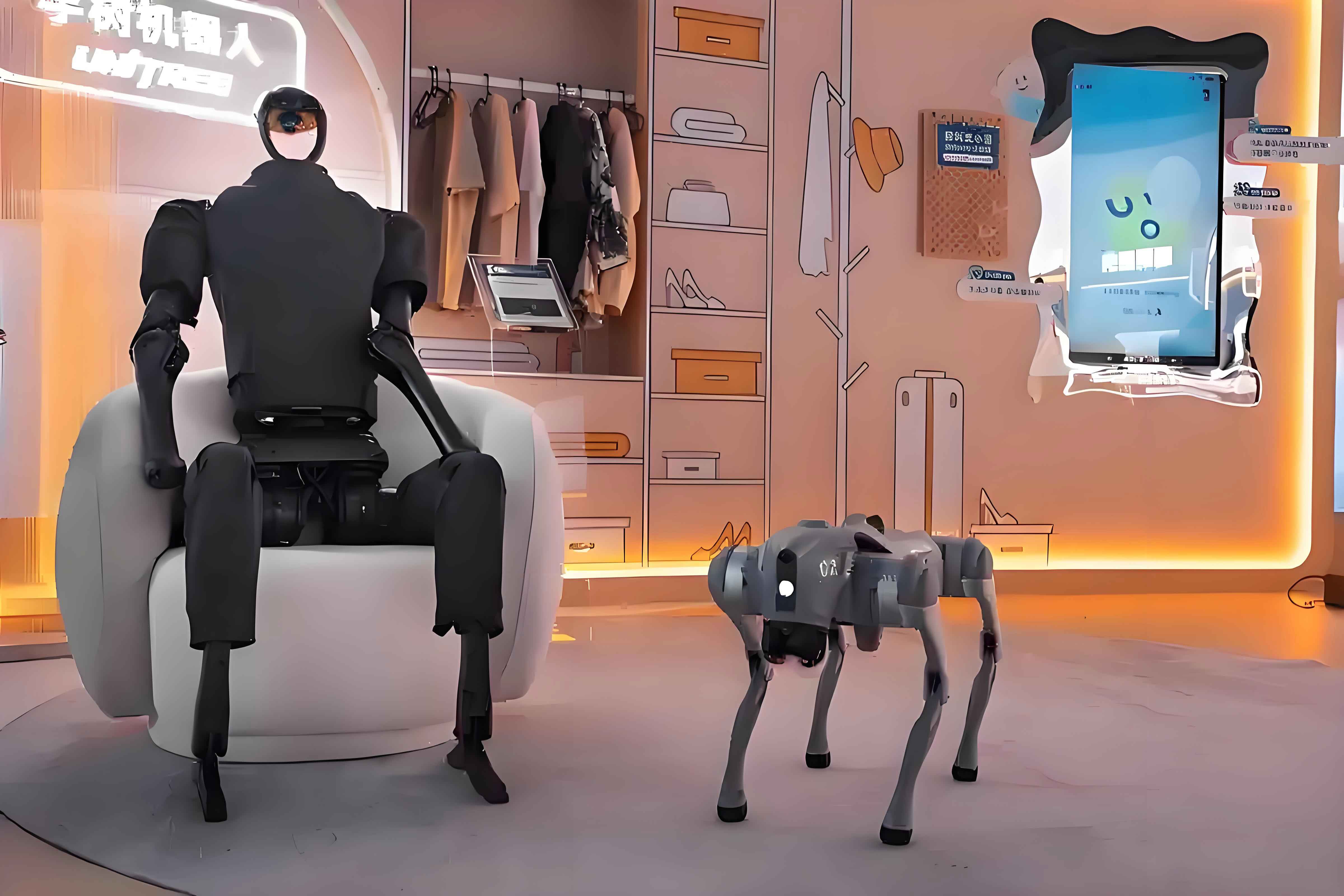
As I reflect on the milestones achieved, it is clear that the core of this work lies in making humanoid robots accessible and beneficial for all. The equations and tables presented here are not just academic exercises; they represent the foundation upon which practical humanoid robots are built. Whether through improved battery life or advanced control algorithms, every aspect contributes to the grand goal of embedding humanoid robots into the fabric of society. The excitement around humanoid robots continues to grow, and I am proud to be part of a community that pushes the boundaries of innovation, always with the aim of serving humanity in meaningful ways.