
As I reflect on the global shift toward high-quality development, particularly in healthcare, I am struck by how the “Healthy China” initiative and growing public awareness of health management have catalyzed an unprecedented demand for medical equipment. This demand is not only massive and multi-tiered but also rapidly evolving, driving the emergence of medical robots as a transformative force. In my view, medical robots are poised to break through technical barriers, address high-end gaps, and propel industrial advancement. From surgical assistants to rehabilitation aids, these machines are redefining modern medicine, and in this essay, I will explore their landscape, applications, challenges, and future from my first-person perspective.
The term “medical robot” encompasses a wide array of devices designed to enhance healthcare delivery. Based on market studies, I categorize them into four primary types: surgical robots, rehabilitation robots, service robots, and assistive robots. To better illustrate their market dynamics, I have compiled the following table summarizing their shares and key characteristics, drawing from industry data. This breakdown helps me understand why non-surgical medical robots dominate the scene, accounting for over 60% of the total market in many regions.
| Type of Medical Robot | Market Share (%) | Primary Applications | Key Advantages |
|---|---|---|---|
| Surgical Robot | ~35-40 | Minimally invasive surgeries, precision interventions | High accuracy, reduced human error |
| Rehabilitation Robot | ~20-25 | Physical therapy, mobility training | Consistent performance, personalized care |
| Service Robot | ~25-30 | Disinfection, delivery, patient assistance | Cost-effective, versatile, high adoption rate |
| Assistive Robot | ~10-15 | Diagnostic support, telemedicine, hospital management | Enhances efficiency, reduces staff burden |
In my analysis, the proliferation of medical robots, especially service-oriented ones, stems from their ability to penetrate diverse healthcare settings. For instance, disinfection and delivery robots can operate tirelessly in contaminated zones, performing tasks like sterilization or transporting medical supplies, thereby mitigating infection risks and boosting operational efficiency. This versatility makes the medical robot a cornerstone of modern healthcare infrastructure. To quantify their impact, I often consider efficiency models. One simple formula I use is the operational efficiency ratio for a medical robot:
$$ E = \frac{T_h}{T_r} \times \frac{C_h}{C_r} $$
where \( E \) represents efficiency gain, \( T_h \) is human task time, \( T_r \) is robot task time, \( C_h \) is human cost, and \( C_r \) is robot cost. A value greater than 1 indicates that the medical robot outperforms human labor, a common scenario in repetitive or hazardous duties.
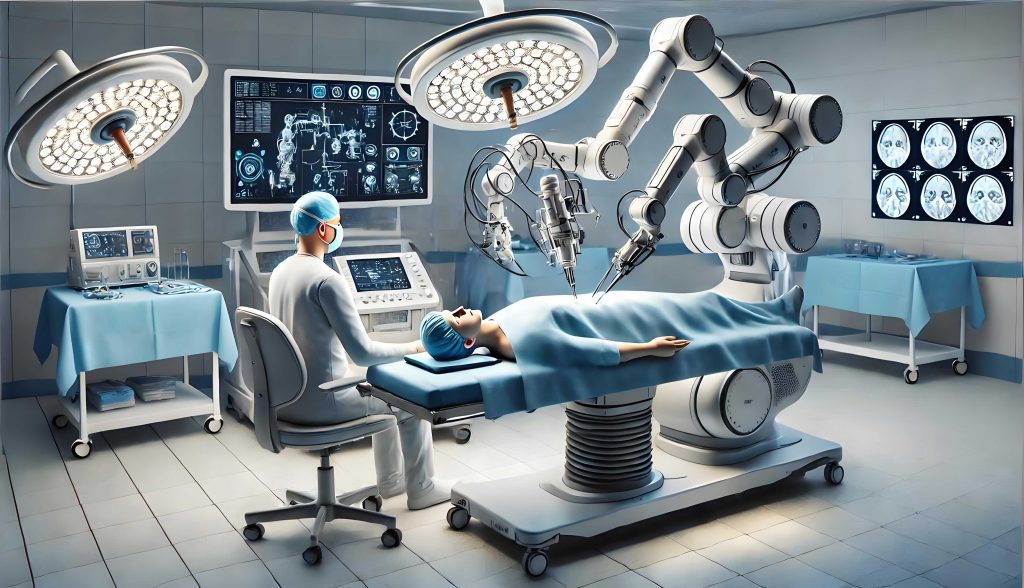
Looking deeper, the applications of medical robots extend far beyond basic tasks. Regulatory frameworks, such as those outlined in policy documents, list scenarios including remote consultation, auxiliary diagnosis, and rehabilitation training. In my experience, this diversity underscores how the medical robot is evolving into a multi-functional tool. For example, some integrated medical robots combine disinfection, delivery, and monitoring capabilities, reducing the need for multiple devices. This convergence aligns with a trend toward “all-in-one” solutions, which I believe will drive further adoption. To model this, I apply a cost-benefit analysis using a linear equation:
$$ B = \sum_{i=1}^{n} (R_i – C_i) $$
where \( B \) is net benefit, \( R_i \) is revenue from the \( i \)-th function, and \( C_i \) is associated cost. For a multi-function medical robot, \( n \) can be large, enhancing overall value.
However, developing a medical robot is fraught with challenges, particularly for high-risk categories like surgical robots. As a third-class medical device, a surgical robot must undergo rigorous testing to prove safety and efficacy before market approval. From my perspective, this process can be modeled as a probabilistic timeline. Let \( P_s \) denote the probability of safety success, \( P_e \) for efficacy, and \( T \) for time to approval. The expected duration might follow:
$$ \mathbb{E}[T] = \frac{1}{P_s \cdot P_e} \cdot T_0 $$
where \( T_0 \) is a baseline time period. In practice, \( P_s \) and \( P_e \) depend on clinical trials, often leading to delays of years or even a decade. This highlights why some firms hesitate, but upstream players offering “hardware + solution” packages can accelerate adoption, making the medical robot ecosystem more dynamic.
In terms of policy support, I observe that government initiatives have fostered a conducive environment, though market participation remains a gap. From my first-hand view, a medical robot company must carve its niche without over-relying on external aid. The key is to identify a viable business model early on. For instance, I often use a profitability index to assess a medical robot venture:
$$ PI = \frac{\sum_{t=1}^{N} \frac{CF_t}{(1+r)^t}}{I_0} $$
where \( PI \) is profitability index, \( CF_t \) is cash flow in year \( t \), \( r \) is discount rate, \( I_0 \) is initial investment, and \( N \) is project lifespan. A \( PI > 1 \) suggests sustainability, crucial for high-tech enterprises focusing on medical robot innovation.
The market potential for medical robots is immense, driven by trends like specialization. For example, puncture robots, a subset of surgical robots, are gaining traction due to automation features and falling costs from localization. In my projection, this could enable penetration into county-level hospitals, expanding access. To illustrate growth, I fit a logistic curve to medical robot adoption data:
$$ A(t) = \frac{L}{1 + e^{-k(t-t_0)}} $$
where \( A(t) \) is adoption rate at time \( t \), \( L \) is maximum market size, \( k \) is growth rate, and \( t_0 \) is midpoint. This S-shaped pattern captures the rapid uptake of medical robots in recent years.
Furthermore, the integration of artificial intelligence with medical robots opens new frontiers. I envision AI-enhanced diagnostic robots that use machine learning algorithms to analyze medical images. Their accuracy can be expressed as:
$$ \text{Accuracy} = \frac{TP + TN}{TP + TN + FP + FN} $$
where \( TP \) is true positives, \( TN \) true negatives, \( FP \) false positives, and \( FN \) false negatives. As data grows, this accuracy improves, making the medical robot smarter and more reliable.
From a supply chain perspective, the medical robot industry relies on upstream components like sensors and actuators. I have compiled a table to summarize key components and their cost drivers, which influence overall affordability.
| Component | Function in Medical Robot | Cost Percentage (%) | Innovation Trends |
|---|---|---|---|
| Sensors | Data acquisition, environment mapping | 20-30 | Miniaturization, higher sensitivity |
| Actuators | Movement and manipulation | 25-35 | Energy efficiency, precision control |
| Control Systems | Algorithm execution, real-time processing | 15-25 | AI integration, cloud connectivity |
| Software | User interface, diagnostic support | 20-30 | Modular design, interoperability |
As I delve into the future, I am optimistic about the role of medical robots in democratizing healthcare. Their ability to serve varied needs—from rural clinics to urban hospitals—aligns with global sustainability goals. In my calculations, the total cost of ownership (TCO) for a medical robot over its lifecycle is:
$$ \text{TCO} = I + \sum_{t=1}^{M} (M_t + E_t – S_t) $$
where \( I \) is initial investment, \( M_t \) maintenance cost in year \( t \), \( E_t \) energy cost, and \( S_t \) salvage value. As technology advances, TCO decreases, fostering wider deployment of medical robots.
In conclusion, the journey of the medical robot is one of continuous innovation and adaptation. From my standpoint, success hinges on balancing technical prowess with market realities. As I emphasize, a medical robot must be safe, effective, and accessible, and through collaborative efforts, this vision is increasingly attainable. The rise of the medical robot is not just a trend but a paradigm shift, and I am committed to exploring its myriad possibilities in the years ahead.