
As I delve into the fascinating world of humanoid robots, I am struck by their rapid evolution from laboratory curiosities to integral components of our智能 society. A humanoid robot, by definition, mimics the human form and integrates artificial intelligence, automated control, and bionic technologies to perform tasks such as walking, grasping, and interacting. This journey, often termed the “awakening year of humanoid robots” in 2024, reflects a global race where nations and corporations vie for dominance. In this article, I will explore the advancements across key regions, using tables and formulas to summarize the complex dynamics shaping the future of humanoid robots. By 2035, the global market for humanoid robots is projected to reach $38 billion with shipments of 1.4 million units, underscoring the urgency of this evolution.
The development of humanoid robots hinges on interdisciplinary innovations, where mechanics, AI, and sensor technologies converge. From my perspective, the core of a humanoid robot’s functionality can be modeled through kinematic equations. For instance, the forward kinematics of a robotic arm can be expressed as:
$$ \mathbf{x} = f(\mathbf{q}) $$
where $\mathbf{x}$ represents the end-effector position in Cartesian space, and $\mathbf{q}$ denotes the joint angles. This formula is fundamental for enabling precise movements in humanoid robots, such as those seen in assembly tasks. Additionally, the control of a humanoid robot often involves dynamic models, such as:
$$ \mathbf{M}(\mathbf{q})\ddot{\mathbf{q}} + \mathbf{C}(\mathbf{q}, \dot{\mathbf{q}})\dot{\mathbf{q}} + \mathbf{G}(\mathbf{q}) = \boldsymbol{\tau} $$
Here, $\mathbf{M}$ is the inertia matrix, $\mathbf{C}$ accounts for Coriolis and centrifugal forces, $\mathbf{G}$ represents gravitational forces, and $\boldsymbol{\tau}$ is the torque applied at joints. These equations highlight the computational complexity behind the seamless motion of a humanoid robot. As I analyze various countries, it becomes clear that breakthroughs in such algorithms drive progress.
To set the stage, let me summarize the global market outlook for humanoid robots in Table 1. This table encapsulates projections that inform strategic investments worldwide.
| Year | Market Size (USD Billion) | Estimated Shipments (Thousand Units) | Key Drivers |
|---|---|---|---|
| 2024 | 2.5 | 10 | Early commercialization, AI integration |
| 2030 | 15.0 | 500 | Industrial automation, cost reduction |
| 2035 | 38.0 | 1400 | Mass adoption in services and healthcare |
This growth is fueled by advancements in AI, particularly machine learning models that enable a humanoid robot to learn from its environment. For example, reinforcement learning uses a reward function:
$$ R = \sum_{t=0}^{T} \gamma^t r_t $$
where $R$ is the cumulative reward, $\gamma$ is the discount factor, and $r_t$ is the reward at time step $t. This allows a humanoid robot to optimize actions autonomously, a capability crucial for tasks like object manipulation.
Turning to regional analyses, I begin with the United States, where innovation in humanoid robot technology is particularly pronounced. The U.S. benefits from a synergistic ecosystem involving government agencies, research institutions, and tech giants. Federal support spans agencies like the National Science Foundation, which funds basic research on intelligent robots for enterprise and domestic use, and NASA, focusing on太空 robots for missions such as Artemis. This foundation enables companies to push boundaries. For instance, firms like Tesla and Boston Dynamics have pioneered商业化 efforts, while newer players like Figure AI have made strides with models like “Figure 02,” which excels in precision assembly using advanced sensors. A significant milestone was the development of the “Helix” AI model, which enhances decision-making for humanoid robots in tasks ranging from food sorting to garment folding. The U.S. edge, as I see it, stems from a strong emphasis on software and AI, allowing humanoid robots to exhibit continuous learning. To illustrate, Table 2 compares key U.S. entities and their contributions to humanoid robot evolution.
| Entity | Focus Area | Notable Innovation | Impact on Humanoid Robot |
|---|---|---|---|
| Government Agencies | Funding and research | Support for AI and space robotics | Accelerates foundational technologies |
| Tech Companies | Commercialization | Advanced AI models, sensor integration | Enables real-world applications |
| Research Universities | Algorithm development | Novel control systems | Improves autonomy and adaptability |
The progress in the U.S. is often quantified through metrics like the improvement in task success rates for a humanoid robot. If we denote the success rate as $S$, it can be modeled over time $t$ as:
$$ S(t) = S_0 + \alpha \ln(1 + \beta t) $$
where $S_0$ is the initial success rate, and $\alpha$ and $\beta$ are constants representing learning efficiency. This logarithmic growth reflects the incremental gains from AI enhancements.
In contrast, Japan presents a unique narrative in the humanoid robot saga. Historically, Japan led early研发 with milestones like “WABOT-1” in 1973 and “ASIMO” in 2000, showcasing a deep cultural affinity for robots as companions. However, from my observation, Japan’s focus has traditionally been on hardware rather than software, leading to challenges in产业化. The government’s “HRP” project in the late 1990s adopted a platform-based approach, but limited commercialization resulted in few deployments. Today, while Japan excels in industrial robots, its humanoid robot sector faces hurdles in scaling and software integration. Companies like Honda and Toyota maintain small-scale研发, whereas Kawasaki Heavy Industries advances with durable models like “Kaleido” for heavy labor. This dichotomy is summarized in Table 3, which contrasts Japan’s historical strengths with current gaps.
| Aspect | Historical Emphasis (1970s-2000s) | Current State (2020s) |
|---|---|---|
| Hardware Development | Pioneering full-body humanoid robots | Refined mechanics, but limited AI integration |
| Software and AI | Minimal focus; mechanical engineering dominance | Lagging behind U.S. in AI-driven autonomy |
| Commercialization | Government-led projects with low uptake | Slow产业化; few startups like Tokyo Robotics |
| Cultural Perspective | Robots as human partners | Continued emphasis, but practical applications delayed |
The performance of a humanoid robot in Japan can be analyzed through an efficiency metric $\eta$, defined as the ratio of task completion speed to energy consumption:
$$ \eta = \frac{v}{E} $$
where $v$ is the velocity of task execution, and $E$ is the energy used. Japanese models often score high on durability but lower on $\eta$ due to software limitations. This highlights the need for balanced innovation in both hardware and AI for a humanoid robot to thrive.
Moving to Korea, I note a concerted push via the “Humanoid Robot Alliance” that fosters产业协同. Korea boasts the world’s highest robot density, with over 1,000 robots per 10,000 employees, and government plans like the “4th Basic Plan for Intelligent Robots” aim to inject $128 million into the sector. The alliance brings together manufacturers, component suppliers, and AI firms to enhance本地化 and accelerate量产. Key players include Hyzen R&M for actuators and Doosan Robotics for协作 robots, while companies like SPG develop critical components like关节制动器. Technologically, innovations such as smart actuators with imitation learning improve precision, as seen in Neuromeka’s offerings. Korea’s strengths in semiconductors and batteries provide a solid foundation, but challenges remain in铰接式 control algorithms. To quantify progress, consider the learning curve for a humanoid robot in Korean factories, often modeled as:
$$ C(N) = C_1 N^{-b} $$
where $C(N)$ is the cost per unit after $N$ units produced, $C_1$ is the initial cost, and $b$ is the learning rate. Korea’s alliance approach aims to increase $b$, reducing costs for humanoid robot deployment. Table 4 outlines the alliance’s impact on key technology areas.
| Member Category | Representative Entities | Technological Contributions | Impact on Humanoid Robot |
|---|---|---|---|
| 整机制造 | Doosan Robotics, Rainbow Robotics | Prototype development, quadruped robots | Enhances mobility and control platforms |
| 核心零部件 | SPG, Hyzen R&M | Localized减速机, actuators | Reduces dependency, lowers costs |
| AI Software | Clobot, Neuromeka | Multi-robot control, imitation learning | Improves autonomy and safety |
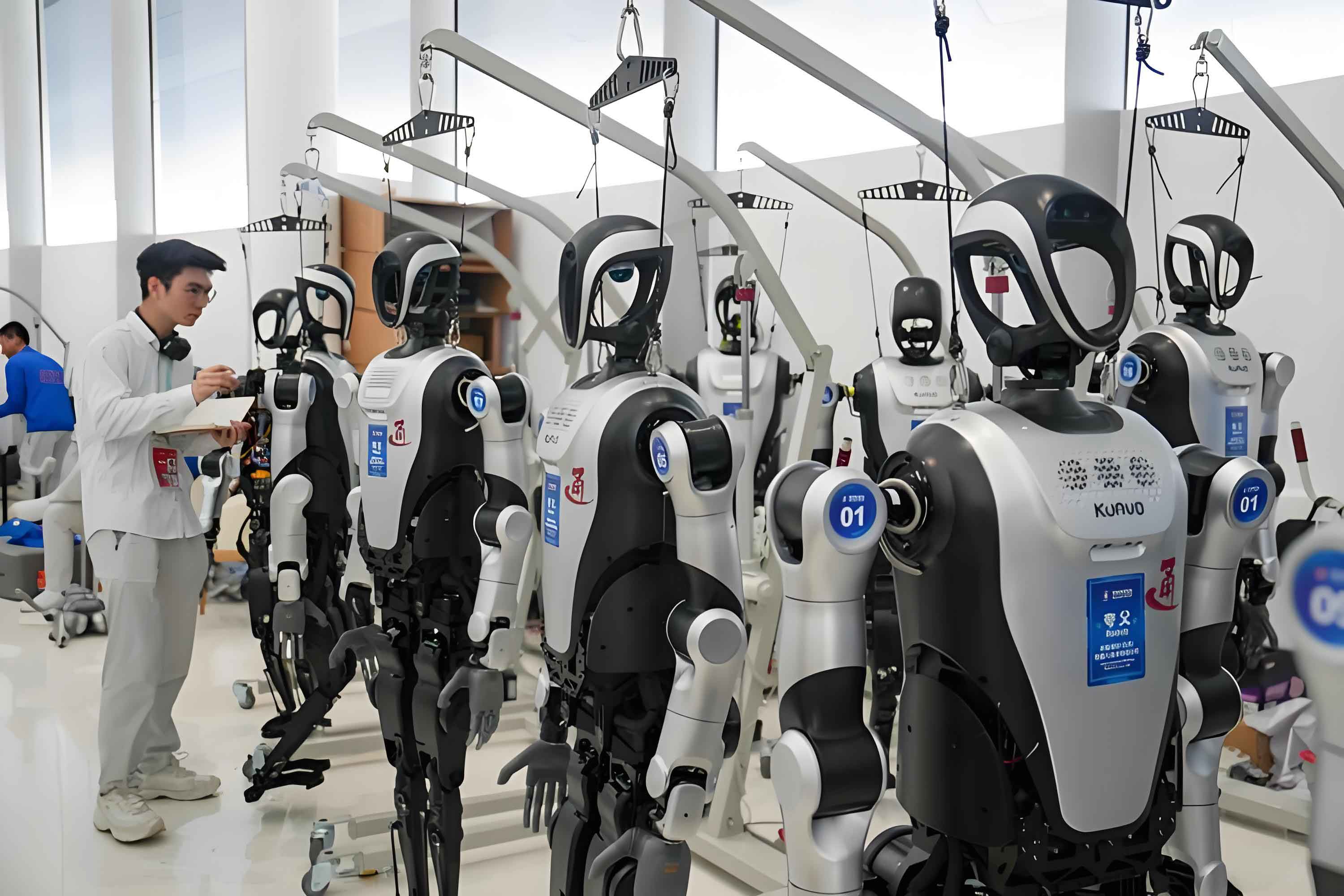
The image above illustrates the meticulous quality inspection processes that are vital for ensuring the reliability of a humanoid robot. As I reflect on this, it underscores the importance of precision manufacturing in the evolution of humanoid robots, a area where Korea excels due to its advanced制造 infrastructure. In applications like semiconductor洁净室 or automotive logistics, a humanoid robot must maintain high standards, often verified through statistical quality control models. For example, the defect rate $D$ can be expressed as:
$$ D = \frac{1}{N} \sum_{i=1}^{N} I(\text{robot}_i \text{ fails inspection}) $$
where $I$ is an indicator function, and $N$ is the number of units. Korea’s focus on本地化 components aims to minimize $D$, enhancing the overall performance of humanoid robots.
Finally, I examine Germany, where policy leadership under the EU’s “Horizon Europe” and “High-Tech Strategy 2025” has catalyzed rapid advances. With a budget of $370 million, Germany supports研发 and real-world implementation through institutes like the German Robotics Institute. A standout company is Neura Robotics, which raised €120 million and secured €1 billion in orders for its感知-capable robots. Their “4NE-1” humanoid robot, launched in 2024, features advanced sensors for vision, hearing, and touch, enabling adaptability in complex environments. The core technologies include 3D vision systems and non-contact human detection sensors, which enhance safety and precision. From my analysis, Germany’s approach emphasizes安全性 and environmental interaction, key for humanoid robot integration into industrial and medical fields. The performance of such a humanoid robot can be assessed through a multi-objective optimization function:
$$ \max \left( \lambda_1 S + \lambda_2 P – \lambda_3 C \right) $$
where $S$ represents safety score, $P$ is task precision, $C$ is operational cost, and $\lambda$ are weighting factors. German designs often prioritize $S$ and $P$, aligning with stringent EU regulations. Table 5 highlights the technical specifications of Germany’s flagship humanoid robot and its applications.
| Technology | Description | Benefit for Humanoid Robot | Potential Applications |
|---|---|---|---|
| 3D Vision System | High-resolution environment mapping | Accurate object and gesture recognition | Industrial assembly, healthcare assistance |
| Non-Contact Sensors | Human presence detection without physical contact | Ensures safe human-robot collaboration | Manufacturing floors, public spaces |
| Force-Torque Sensors | Real-time force feedback control | Improves manipulation stability | Precision logistics, rehabilitation |
The evolution of a humanoid robot in Germany is also driven by collaboration across research centers, modeled as a network effect. If $I$ denotes innovation output, it can be related to the number of collaborating entities $n$ through:
$$ I = k n^\gamma $$
where $k$ is a constant and $\gamma > 1$ indicates increasing returns. This explains Germany’s rapid progress in humanoid robot capabilities.
In conclusion, as I synthesize these global perspectives, it is evident that the humanoid robot landscape is shaped by diverse strategies: the U.S. leverages AI and software, Japan emphasizes hardware heritage, Korea fosters产业协同, and Germany prioritizes safety and policy. Each contributes to the overarching goal of creating a humanoid robot that seamlessly integrates into society. The future will likely see convergence, with公式 like the following predicting the overall advancement index $A(t)$ for humanoid robots:
$$ A(t) = A_0 \exp\left(\int_0^t \sum_i \omega_i r_i(\tau) d\tau\right) $$
where $A_0$ is the initial advancement, $\omega_i$ are weights for regions, and $r_i(t)$ are innovation rates. As a humanoid robot becomes more autonomous and affordable, its impact will expand across制造业, services, and beyond. My exploration reaffirms that the evolutionary path of humanoid robots is a testament to human ingenuity, with each nation playing a pivotal role in this transformative journey. The continued emphasis on keywords like humanoid robot throughout this discussion underscores their centrality to our technological future, and I am confident that the next decade will witness unprecedented growth in this field, driven by the very innovations I have detailed here.