
As an observer and analyst deeply embedded in the field of intelligent systems, I have witnessed a fascinating convergence of technological pathways. The rapid advancements in smart, connected vehicles (SCVs) are no longer confined to transportation; they are actively seeding the next revolution in robotics, particularly in the realm of humanoid robot development. The recent showcases by leading tech innovators are not isolated events but signposts on a shared roadmap. They reveal a future where the artificial intelligence, sensor fusion, and real-time decision-making engines refined in our cars are becoming the cognitive and perceptual core of machines designed to walk among us. This essay explores this synergistic evolution, arguing that the future of mobility and automation is intrinsically linked to the rise of capable humanoid robot platforms.
The most compelling evidence for this convergence lies in the direct technological transfer from autonomous driving to bipedal locomotion. Companies at the forefront of AI for vehicles are now explicitly channeling that expertise into building humanoid robot prototypes. The underlying challenges are remarkably similar: perceiving a complex, unstructured 3D world, making instantaneous predictions about dynamics, and executing precise physical controls. The technology stack developed for one domain offers a formidable head start for the other.
| Technology Component | Role in Smart/Connected Vehicles | Adapted Role in Humanoid Robots | Key Enabling Algorithms |
|---|---|---|---|
| Multi-modal Sensor Fusion | Combining cameras, LiDAR, radar, ultrasonics for 360° environmental model. | Fusing cameras, IMUs, force-torque sensors, LiDAR for egomotion and world model. | Kalman Filters, Bayesian Networks, Deep Sensor Fusion Nets. |
| Visual Perception & Scene Understanding | Object detection, lane tracking, traffic sign recognition, path prediction. | Terrain classification, obstacle detection, object manipulation recognition. | Convolutional Neural Networks (CNNs), Vision Transformers (ViTs). |
| Real-time Path Planning & Decision Making | Navigating road networks, adhering to rules, reacting to dynamic agents. | Footstep planning, whole-body motion planning, dynamic obstacle avoidance. | Model Predictive Control (MPC), A*/D* Search, Reinforcement Learning. |
| High-performance AI Compute (FSD/Dojo-like) | Processing sensor data for full self-driving capability in real-time. | Processing perception and executing complex control policies for balance and interaction. | Custom AI Accelerators (e.g., D1 Chip), Distributed Neural Net Training. |
The mathematical foundation for control in both domains often revolves around optimizing a cost function over a predicted horizon. In vehicles, Model Predictive Control (MPC) solves for optimal steering and acceleration. For a humanoid robot, the formulation becomes vastly more complex but follows the same principle—optimizing for stability, energy efficiency, and task completion. A simplified core of a locomotion MPC problem can be expressed as:
$$
\min_{u_{0},…,u_{N-1}} \sum_{k=0}^{N-1} \left( \| x_k – x_{ref,k} \|^2_Q + \| u_k \|^2_R \right) + \| x_N – x_{ref,N} \|^2_{P}
$$
Subject to:
$$ x_{k+1} = f(x_k, u_k) $$
$$ g(x_k, u_k) \leq 0 $$
$$ h(x_k, u_k) = 0 $$
Where \( x_k \) is the state vector (e.g., center of mass position, torso orientation, joint angles), \( u_k \) is the control vector (e.g., joint torques, ground reaction forces), \( f \) is the (non-linear) dynamics model of the humanoid robot, and the constraints \( g \) and \( h \) represent physical limits (motor torque, friction cones) and task requirements (foot placement). The matrices \( Q \), \( R \), and \( P \) are weighting matrices that prioritize different aspects of performance. The staggering complexity of the humanoid robot model \( f \) is where years of research in dynamics and control are concentrated.
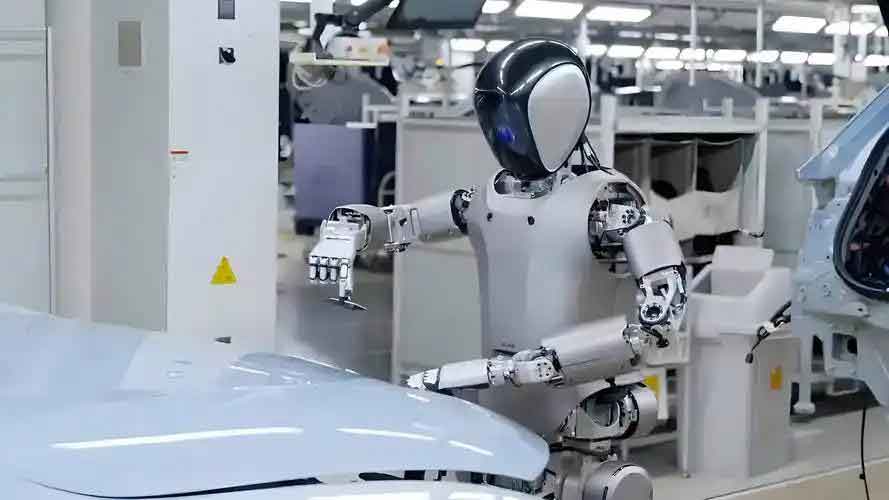
The hardware platform for a humanoid robot presents unique challenges far beyond a wheeled vehicle. The act of bipedal locomotion is inherently unstable, requiring exquisite balance and rapid force control. Two primary actuation philosophies have emerged, each with trade-offs critical for future development:
| Actuation Type | Principle | Advantages | Disadvantages | Exemplar Platform |
|---|---|---|---|---|
| Hydraulic | Uses pressurized fluid to generate high forces in cylinders. | Extremely high power/force density, dynamic performance, impact resistance. | High energy consumption, hydraulic fluid maintenance, noise, potential leaks. | Boston Dynamics Atlas |
| Electric (High-torque Motors) | Uses high-performance electric motors, often with gear reducers. | Cleaner, quieter, more energy-efficient, easier control, lower maintenance. | Lower force density than hydraulics, can be susceptible to impact damage, gearing can introduce backlash. | Tesla Bot (proposed), Agility Robotics Digit |
The choice of actuation directly influences the dynamic capabilities and practical application of the humanoid robot. The dynamic balance of a humanoid robot, regardless of actuation, is often analyzed using the concept of the Zero-Moment Point (ZMP) or the more general Divergent Component of Motion (DCM). For stable walking, the ZMP must remain within the convex hull of the foot’s support polygon. The relationship between the Center of Mass (CoM) and the ZMP is governed by the linear inverted pendulum model:
$$
\ddot{x}_{CoM} = \omega^2 (x_{CoM} – x_{ZMP})
$$
where \( \omega = \sqrt{g / z_c} \) is the natural frequency of the pendulum, \( g \) is gravity, and \( z_c \) is the constant CoM height. This simple model is the cornerstone for generating stable walking patterns for a humanoid robot, which are then refined by whole-body controllers accounting for the full dynamics.
Beyond locomotion, the next leap for the humanoid robot is dexterous manipulation in unstructured environments—a domain where vehicle-derived perception shines. Here, the fusion of deep learning and traditional control is paramount. A manipulation task can be framed as a reinforcement learning (RL) problem where the humanoid robot learns a policy \( \pi_\theta(a_t | s_t) \) mapping states \( s_t \) (joint positions, camera images, tactile sensor data) to actions \( a_t \) (joint velocities or torques). The goal is to maximize the expected cumulative reward \( R = \sum_t \gamma^t r(s_t, a_t) \). The policy gradient update, a core RL algorithm, is given by:
$$
\nabla_\theta J(\theta) = \mathbb{E}_{\pi_\theta} \left[ \nabla_\theta \log \pi_\theta(a_t | s_t) \, A^{\pi_\theta}(s_t, a_t) \right]
$$
where \( A^{\pi_\theta}(s_t, a_t) \) is the advantage function, estimating how much better a specific action is than the average. Training such policies in simulation using vehicle-scale AI infrastructure (like Dojo) and transferring them to physical humanoid robot hardware is a promising path toward adaptive and generalizable skills.
The ultimate test for any technology is its application. The evolution from smart vehicles to humanoid robot platforms suggests a dramatic expansion of automation from structured roads to the infinite complexity of human spaces. The potential applications cascade from logistical to social domains.
| Application Domain | Specific Tasks | Key Technological Enablers (from SCVs & beyond) | Primary Value Driver |
|---|---|---|---|
| Industrial Logistics & Manufacturing | Loading/unloading irregular objects, assembly line kitting, machine tending in legacy cells. | Mobile manipulation, robust 3D perception for variable objects, safe human-robot collaboration. | Flexibility in automation, reducing reliance on fixed tooling and custom jigs. |
| Emergency Response & Hazardous Environments | Search and rescue in collapsed structures, nuclear facility inspection, firefighting support. | Extreme terrain locomotion, sensor operation in smoke/dust, teleoperation with high-fidelity feedback. | Removing humans from immediate danger while retaining human-like access and dexterity. |
| Personal Assistance & Healthcare | Elderly care support, physical rehabilitation aid, household chores for individuals with disabilities. | Social AI for natural interaction, gentle and compliant force control, long-term autonomy in homes. | Addressing labor shortages in care, enhancing quality of life and independence. |
| General Service & Hospitality | Retail stock management, hotel room service, public space cleaning and guidance. | Large-scale environment navigation (like robotaxis), object recognition for thousands of items, polite social navigation. | Automation of service sector tasks in spaces built for human form and ergonomics. |
However, the path to a ubiquitous humanoid robot economy is fraught with interconnected challenges that form a multi-variable optimization problem for the industry. We can model the feasibility of a specific humanoid robot application as a function of key variables:
$$
\text{Feasibility} = f(\text{Technical Maturity}(T), \text{Cost}(C), \text{Safety \& Ethics}(S), \text{Societal Acceptance}(A))
$$
where:
- \( T \) encompasses robustness, energy autonomy, task success rate, and mean time between failures.
- \( C \) includes unit cost (scaled by production volume), operational cost (energy, maintenance), and total cost of ownership.
- \( S \) involves the reliability of safety-critical control systems, ethical decision-making frameworks, and data privacy.
- \( A \) is influenced by usability, social design, job displacement concerns, and cultural perceptions.
Progress requires simultaneous advancement on all fronts. A technically brilliant but exorbitantly expensive or socially unsettling humanoid robot will fail to achieve widespread adoption.
To navigate this complex landscape and accelerate the responsible development of humanoid robot technology, a strategic and collaborative approach is essential. Drawing lessons from the ecosystem-building of the smart vehicle industry, several imperatives become clear.
First, strengthening the industrial foundation is non-negotiable. The performance of a humanoid robot is bottlenecked by its weakest core component. This necessitates a focused effort on:
- Advanced Actuators: Developing compact, high-torque, back-drivable electric actuators and efficient hydraulic systems.
- Tactile Sensing: Creating robust, high-resolution skin sensors for safe manipulation.
- Power Systems: Innovating in energy-dense batteries and efficient power management for all-day operation.
- Real-time Operating Systems (RTOS) \& Middleware: Establishing robust, secure software frameworks for deterministic control and system integration.
National and industrial research programs must prioritize these foundational technologies as critical infrastructure.
Second, fostering deep cross-disciplinary fusion must be institutionalized. The humanoid robot is the ultimate convergent technology. We need structured mechanisms to blend expertise:
- Establishing open innovation platforms where AI researchers, control theorists, mechanical engineers, and cognitive scientists can co-develop.
- Creating shared, high-fidelity simulation environments (a “Gym for Humanoids”) to accelerate algorithm testing and reduce physical trial costs.
- Promoting standardization of interfaces for modular components (e.g., arm, hand, leg modules) to enable specialization and faster iteration.
Third, adopting a phased, application-driven development strategy is crucial for sustaining progress. The “general-purpose” humanoid robot is a distant north star. Near-term success depends on targeting specific, high-value applications that justify current costs and technical constraints. The strategy should follow a sequence:
- Controlled Environment Mastery: Perfect tasks in warehouses, factories, and labs.
- Structured Public Space Introduction: Deploy in shopping malls, airports, and hospitals with clear protocols.
- Unstructured Environment Evolution: Gradually introduce capabilities for homes and outdoor public spaces.
Each phase validates technology, builds public trust, generates revenue for R&D, and iteratively expands the capability envelope of the humanoid robot.
In conclusion, the trajectory from smart, connected vehicles to advanced humanoid robot platforms represents more than a corporate diversification; it signifies a fundamental maturation of embodied AI. The algorithms that let a car see a pedestrian, predict their path, and plan a safe route are the progenitors of the systems that will allow a humanoid robot to navigate a cluttered room, hand a tool to a worker, or support an elderly person. The challenges remain immense—a symphony of hardware durability, energy efficiency, control stability, and cognitive sophistication that we are only beginning to compose. However, the convergence of technological streams from automotive AI, robotics, and materials science is creating a powerful current. By strategically reinforcing our industrial base, architecting deep collaborative ecosystems, and pursuing pragmatic, staged development, we can steer this evolution toward a future where humanoid robot partners amplify human potential, taking on tasks that are dangerous, dull, or demanding, and in doing so, redefine the boundaries of automation and assistance in our daily lives.