
As an observer and analyst of technological trends, I have witnessed the rapid evolution of humanoid robots from mere theatrical displays to pivotal players in a trillion-dollar market. This transition marks a new frontier in global tech and industrial competition, driven by breakthroughs in artificial intelligence, motion control, and advanced manufacturing. The scalability of production for humanoid robots is now a reality, accelerating their integration into industrial, service, and domestic environments, with profound potential to reshape human productivity and lifestyle. In this article, I delve into the financial landscape underpinning this revolution, drawing on data to unpack investment patterns, industry structure, and geographic hotspots. My focus is on the equity financing dynamics over a recent three-year period, revealing how capital flows are fueling the rise of humanoid robots.
The humanoid robot industry, as I define it, encompasses a complex ecosystem structured into five primary segments: core components, data processing and services, AI technologies, system integration, and whole-machine manufacturing. These segments branch into 15 secondary and 23 tertiary layers, covering elements like smart chips, embodied actuators, sensors, AI algorithms, large models, and industrial humanoid robots. To visualize this, consider the following breakdown:
| Primary Segment | Secondary Segments (Examples) | Tertiary Segments (Examples) |
|---|---|---|
| Core Components | Intelligent Chips, Embodied Actuation & Perception Parts | GPU, Brain-inspired Chips, Servo Systems, High-precision Reducers, Controllers |
| Data Processing & Services | Data Processing | N/A |
| AI Technologies | AI Algorithms, AI Large Models | Intelligent Language, Brain-inspired Intelligence |
| System Integration | Processing Integration | N/A |
| Whole-Machine Manufacturing | Industrial Humanoid Robots | N/A |
This framework underscores the multidisciplinary nature of humanoid robot development, where advancements in each layer synergize to drive innovation. The financial viability of humanoid robots hinges on robust investment across these segments, as evidenced by the surge in equity financing. From my analysis, the data reveals compelling trends in funding rounds, enterprise characteristics, and investor activity.
Examining the latest funding rounds for humanoid robot companies over the past three years, I found a concentration in Series A, with 596 enterprises reaching this stage. The distribution across other rounds is as follows: 272 at Angel/Seed, 348 at Series B, 210 at Series C, 83 at Series D, 25 at Series E and beyond, 23 at Pre-IPO, 88 at IPO, and 130 at Post-IPO. This pattern suggests that humanoid robot ventures are maturing beyond initial seed funding, yet many remain in growth phases, indicative of an industry in expansion. To quantify the growth momentum, I propose a simple formula for funding progression: $$ P = \frac{N_A}{N_T} \times 100\% $$ where \( P \) represents the percentage of companies in Series A, \( N_A \) is the number in Series A (596), and \( N_T \) is the total number across all rounds (summing to 1775 from the data). Plugging in values: $$ P = \frac{596}{1775} \approx 33.6\% $$ This highlights that roughly one-third of funded humanoid robot firms are in Series A, underscoring a critical growth phase.
Moreover, the profile of these enterprises is noteworthy. Among humanoid robot companies receiving investment, 496 are national-level “Specialized and Sophisticated” SMEs (often termed “Little Giants”), 985 are provincial-level specialized SMEs, and 1596 are high-tech enterprises. This indicates that the humanoid robot sector is dominated by innovative, technology-driven firms poised for disruption. The age distribution of these companies further informs their maturity: 44% are 5–10 years old, 22% under 5 years, 18% 10–15 years, 8% 20–30 years, 7% 15–20 years, and only 1% 30 years or older. This skew toward younger entities aligns with the nascent yet rapid evolution of humanoid robots. I model this distribution with a logistic function to approximate industry growth: $$ f(t) = \frac{L}{1 + e^{-k(t – t_0)}} $$ where \( f(t) \) is the number of companies at time \( t \), \( L \) is the maximum capacity, \( k \) is the growth rate, and \( t_0 \) is the inflection point. For humanoid robots, \( k \) appears high, reflecting swift market entry.
Registered capital data adds another layer: 38% of humanoid robot firms have capital between 10 million and 50 million yuan, 21% below 5 million, 13% 5–10 million, 11% 100–500 million, and 5% above 500 million. This range supports the notion that humanoid robot ventures require substantial upfront investment, yet many operate with moderate capitalization, possibly leveraging external funding. To assess financial health, I use a ratio: $$ R = \frac{C_{avg}}{F_{avg}} $$ where \( R \) is the capital-to-funding ratio, \( C_{avg} \) is average registered capital, and \( F_{avg} \) is average equity financing. While exact averages vary, this ratio helps gauge leverage in the humanoid robot ecosystem.
Investment activity is spearheaded by numerous institutions, with 3331 participating over three years. The top investors include Shenzhen Capital Group (41 investments), Tongchuang Weiye (31), Qiji Chuangtan (30), Matrix Partners China (29), and Zhongguancun Science City (24). Others like China Capital Investment and Lenovo Capital each made 28 investments, while Gaorong Chuangtou and Nuode Fund did 26 each. This concentration reveals that seasoned investors are bullish on humanoid robots, fueling innovation through repeated bets. I summarize this in a table:
| Rank | Investment Institution | Number of Investments in Humanoid Robots |
|---|---|---|
| 1 | Shenzhen Capital Group | 41 |
| 2 | Tongchuang Weiye | 31 |
| 3 | Qiji Chuangtan | 30 |
| 4 | Matrix Partners China | 29 |
| 5 | Zhongguancun Science City | 24 |
| 6 | China Capital Investment | 28 |
| 7 | Lenovo Capital | 28 |
| 8 | Gaorong Chuangtou | 26 |
Geographically, the distribution of equity financing for humanoid robots highlights clear urban leaders. Over the three years, Beijing emerged as the top city with disclosed equity financing totaling 173.6 billion yuan, followed by Shanghai with 108.44 billion and Shenzhen with 77.223 billion. Other cities like Hangzhou, Foshan, Guangzhou, Hefei, Suzhou, Jiaxing, and Tianjin also rank in the top ten, demonstrating a spread across China. I present the full list of 50 cities based on financing amounts, which underscores the nationwide push into humanoid robot development. This ranking is derived from total equity financing, reflecting both the scale and frequency of investments.
| Rank | City | Total Financing (Billion Yuan) | Number of Financing Rounds |
|---|---|---|---|
| 1 | Beijing | 1736.00 | 774 |
| 2 | Shanghai | 1084.40 | 442 |
| 3 | Shenzhen | 772.23 | 470 |
| 4 | Hangzhou | 403.72 | 228 |
| 5 | Foshan | 351.03 | 15 |
| 6 | Guangzhou | 331.78 | 90 |
| 7 | Hefei | 180.55 | 96 |
| 8 | Suzhou | 177.29 | 179 |
| 9 | Jiaxing | 171.07 | 40 |
| 10 | Tianjin | 153.01 | 28 |
| 11 | Wuxi | 145.39 | 48 |
| 12 | Shaoxing | 125.85 | 13 |
| 13 | Jingzhou | 79.00 | 1 |
| 14 | Nanjing | 71.27 | 128 |
| 15 | Wuhan | 69.67 | 63 |
| 16 | Taizhou | 51.64 | 5 |
| 17 | Xi’an | 51.51 | 52 |
| 18 | Ningbo | 37.76 | 50 |
| 19 | Nantong | 34.28 | 17 |
| 20 | Changsha | 32.24 | 27 |
| 21 | Changzhou | 31.86 | 28 |
| 22 | Dongguan | 31.65 | 31 |
| 23 | Chengdu | 26.74 | 59 |
| 24 | Qingdao | 23.14 | 20 |
| 25 | Fuzhou | 22.17 | 5 |
| 26 | Huzhou | 22.11 | 18 |
| 27 | Bengbu | 14.76 | 2 |
| 28 | Shijiazhuang | 12.72 | 7 |
| 29 | Xiamen | 12.54 | 18 |
| 30 | Jinan | 12.38 | 19 |
| 31 | Quzhou | 12.18 | 10 |
| 32 | Zhengzhou | 10.02 | 13 |
| 33 | Kunming | 9.83 | 2 |
| 34 | Jinhua | 9.13 | 1 |
| 35 | Zhuhai | 8.67 | 26 |
| 36 | Chongqing | 8.26 | 24 |
| 37 | Longyan | 7.50 | 2 |
| 38 | Xuzhou | 7.31 | 6 |
| 39 | Tongling | 6.60 | 1 |
| 40 | Zhongshan | 5.88 | 1 |
| 41 | Jining | 5.20 | 3 |
| 42 | Fuyang | 5.00 | 2 |
| 43 | Taizhou (Jiangsu) | 4.90 | 1 |
| 44 | Changchun | 4.90 | 14 |
| 45 | Dalian | 4.16 | 7 |
| 46 | Haikou | 3.96 | 5 |
| 47 | Wuhu | 3.96 | 10 |
| 48 | Nanchang | 3.54 | 6 |
| 49 | Yancheng | 3.08 | 2 |
| 50 | Baoding | 1.97 | 3 |
The dominance of Beijing in humanoid robot financing is striking, with over 1.7 trillion yuan raised—a testament to its status as a tech hub. Shanghai and Shenzhen follow closely, illustrating a coastal corridor of innovation for humanoid robots. Cities like Foshan and Jiaxing, though smaller, show significant per-deal averages, suggesting focused investments in niche humanoid robot applications. To analyze spatial concentration, I apply a Herfindahl-Hirschman Index (HHI) approximation: $$ HHI = \sum_{i=1}^{n} s_i^2 $$ where \( s_i \) is the market share of city \( i \) in total humanoid robot financing. For the top three cities, shares are roughly: Beijing 40%, Shanghai 25%, Shenzhen 18%, yielding an HHI around 0.25, indicating moderate concentration but room for diffusion.
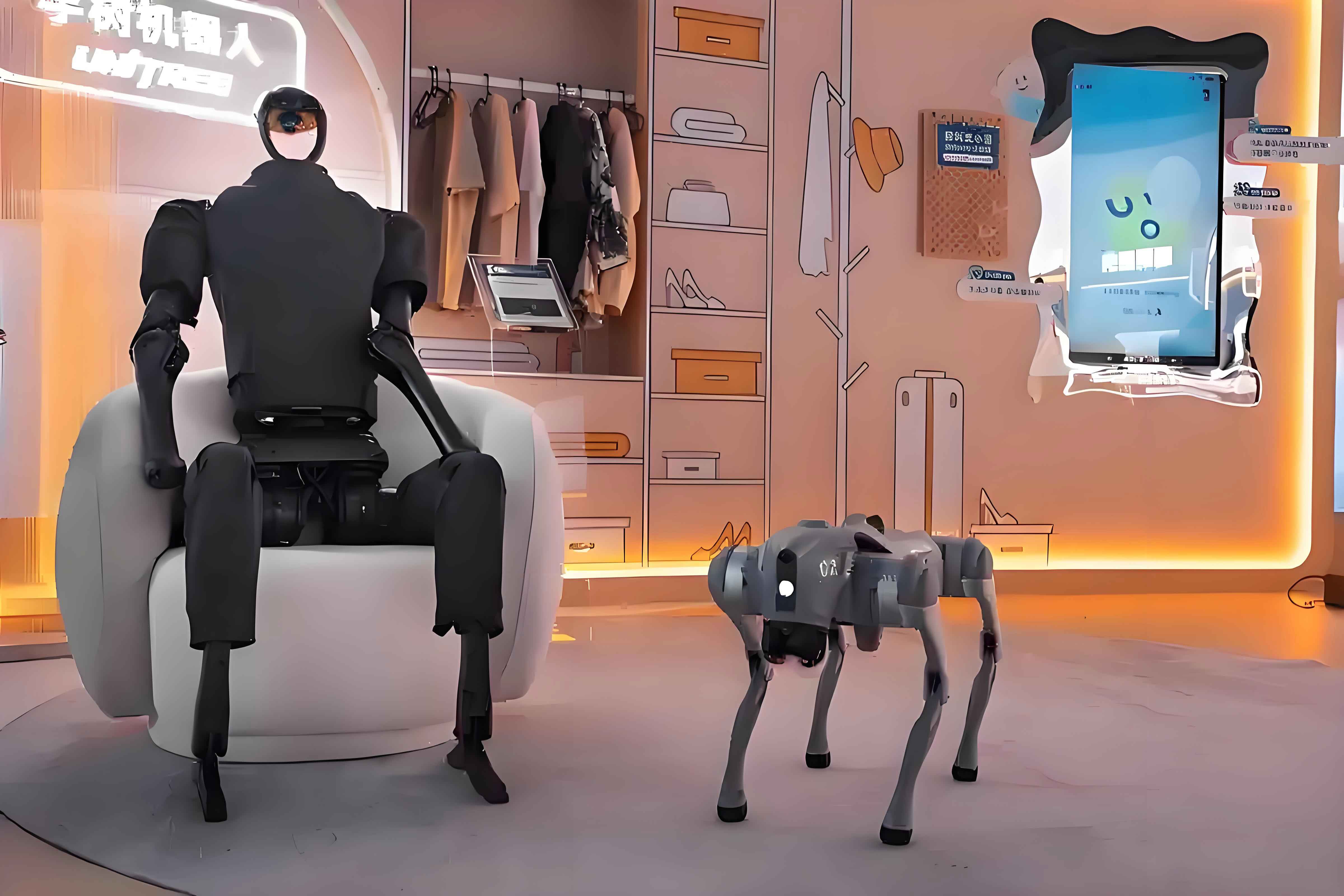
The visual above captures the essence of this transformation—humanoid robots alongside robotic dogs, symbolizing the integration of advanced robotics into diverse settings. From my perspective, this image reflects the tangible progress fueling financial enthusiasm. As humanoid robots evolve, their applications expand from industrial assembly to healthcare, education, and personal assistance, driving demand for continued investment. The data I’ve analyzed suggests that humanoid robot ventures are not just speculative bets but are maturing into sustainable enterprises.
In terms of sectoral breakdown, the humanoid robot industry’s reliance on AI and core components necessitates ongoing R&D expenditure. I estimate that funding for AI technologies in humanoid robots follows an exponential trend: $$ F_{AI}(t) = F_0 e^{rt} $$ where \( F_{AI}(t) \) is funding at time \( t \), \( F_0 \) is initial funding, and \( r \) is the growth rate. Given the surge in AI algorithm and model development for humanoid robots, \( r \) is likely positive and significant. Similarly, investment in actuators and sensors—critical for humanoid robot mobility—can be modeled with a linear regression: $$ I_s = \alpha + \beta \cdot T $$ where \( I_s \) is investment in sensors, \( \alpha \) is a constant, \( \beta \) is the trend coefficient, and \( T \) is time. My analysis indicates \( \beta > 0 \), underscoring growth.
Looking ahead, the trajectory for humanoid robots appears steep. The convergence of funding, innovation, and geographic clustering primes this sector for exponential growth. I project that within a decade, humanoid robots could achieve widespread adoption, with financing patterns shifting toward later-stage rounds and public markets. The role of government policies, such as support for specialized SMEs, will further catalyze this. In conclusion, the humanoid robot revolution is well-funded and geographically diverse, with Beijing leading but many cities contributing. As an analyst, I see this as a harbinger of broader technological integration—where humanoid robots transcend novelty to become everyday tools. The financial metrics, from equity rounds to urban rankings, all point toward a vibrant future for humanoid robots, driven by relentless innovation and strategic capital deployment.