
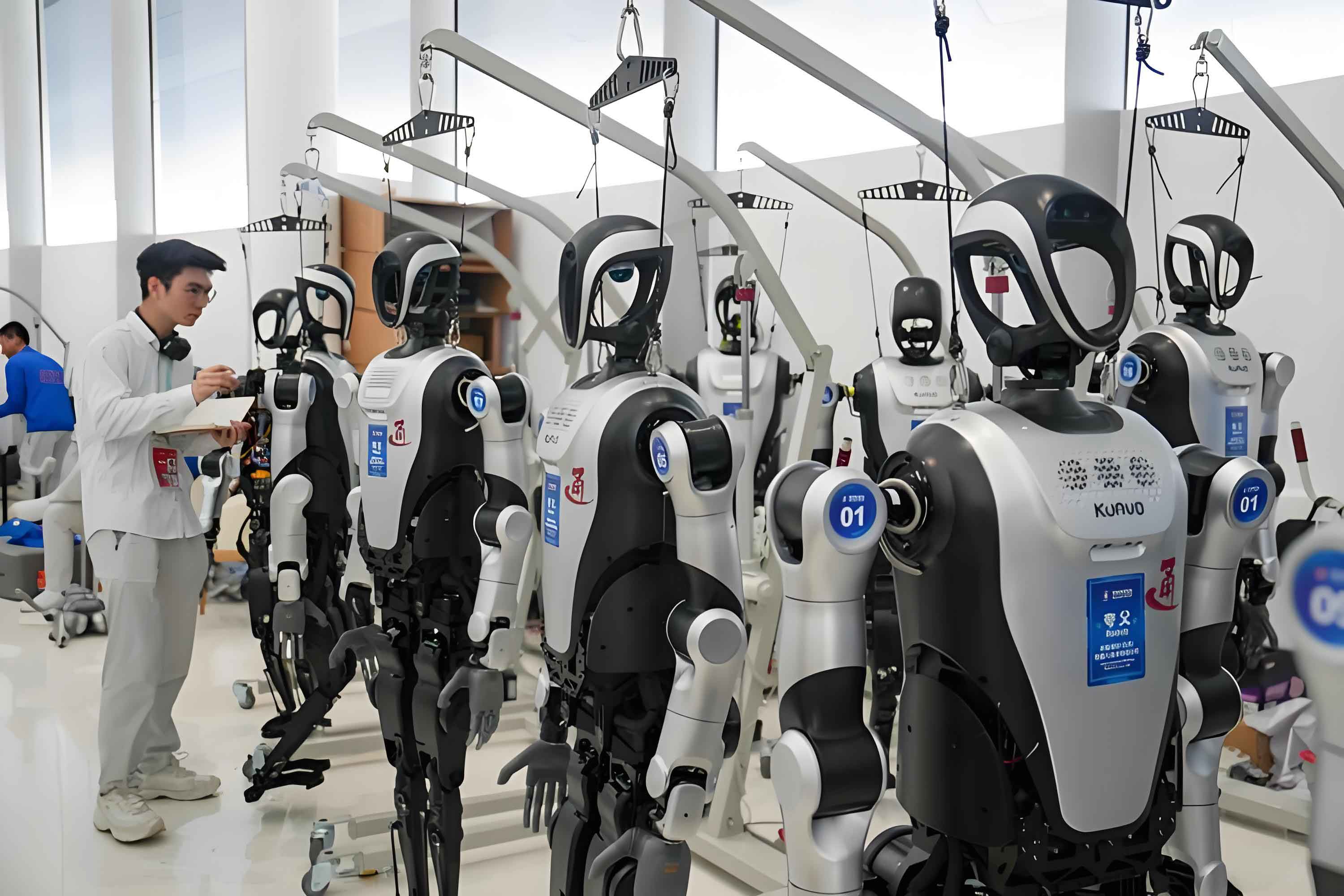
As a researcher examining the integration of advanced technologies into societal frameworks, I have witnessed a transformative shift with the emergence of humanoid robots. These machines, designed to mimic human form and interaction, are no longer confined to laboratories or industrial settings; they are permeating everyday life, from healthcare and education to manufacturing and public services. This integration fundamentally alters the dynamics of trust, a cornerstone of human social systems. Trust in humanoid robots is not merely an extension of interpersonal trust; it is a complex, evolving construct that can fission—splitting and amplifying in unpredictable ways across psychological, functional, and institutional dimensions. In this article, I explore how humanoid robot介入 triggers the evolution of human-machine relationships, the mechanisms of trust fission, and the imperative for risk governance through boundary-setting and contextualized responses. The proliferation of humanoid robot applications demands a reevaluation of trust as a relational practice, necessitating controls that prioritize transparency, accountability, and the separation of function from emotion to sustain societal resilience.
The advent of humanoid robots represents a pinnacle in anthropomorphic design, where machines are endowed with facial expressions, natural speech, and gesture-based communication to elicit human-like engagement. From my observations, this design intentionality taps into deep-seated psychological mechanisms. Humans inherently exhibit anthropomorphic tendencies, projecting intentions and emotions onto non-human entities that exhibit social cues. When interacting with a humanoid robot, our mirror neuron systems activate, fostering a sense of social presence and empathy. This neural response underpins the initial trust formation, as users perceive the humanoid robot as a relatable agent rather than a mere tool. For instance, in elderly care settings, humanoid robots providing companionship and medication reminders are often ascribed roles as “partners” or “caregivers,” despite their lack of genuine understanding. This psychological projection sets the stage for trust accumulation, but it is a fragile foundation, built on algorithmic simulations rather than conscious intent.
Trust in humanoid robots evolves through continuous interaction, where users adjust their behaviors and expectations based on the robot’s performance. I propose a model to conceptualize this process: trust generation can be represented as a dynamic function of perception, interaction frequency, and institutional reinforcement. Let $$ T(t) = \alpha \cdot P(t) + \beta \cdot I(t) + \gamma \cdot S(t) $$ where \( T(t) \) denotes trust at time \( t \), \( P(t) \) is the perceptual anthropomorphism (e.g., appearance, emotional expression), \( I(t) \) is the interaction quality (e.g., reliability, predictability), and \( S(t) \) is the institutional support (e.g., norms, regulations). Coefficients \( \alpha \), \( \beta \), and \( \gamma \) vary across contexts, reflecting the weight of each factor. Over time, as users experience consistent responses from the humanoid robot, trust solidifies into habitual dependence, often mediated by social learning—where observations and narratives within communities propagate trust norms. This underscores that humanoid robot trust is not static; it is a cumulative, socially embedded phenomenon.
To illustrate the diverse applications and trust implications of humanoid robots, I have compiled a table summarizing key scenarios. This highlights how humanoid robot integration spans multiple domains, each with unique trust dynamics and potential risks.
| Application Domain | Primary Functions of Humanoid Robot | Trust Characteristics | Potential Risks |
|---|---|---|---|
| Healthcare and Elderly Care | Emotional companionship, medication reminders, physical assistance | High emotional dependency, role attribution as caregiver | Psychological displacement, reduced human interaction, ethical dilemmas |
| Education and Training | Tutoring, social skills development for children with autism, classroom assistance | Cognitive authority, perceived understanding, peer-like bonding | Over-reliance on machine judgment, blurring of educational responsibility |
| Manufacturing and Logistics | Assembly line collaboration, picking and packing, quality inspection | Operational reliance, systemic integration, predictability-based trust | Networked failure propagation, skill degradation in human workers |
| Retail and Customer Service | Information provision, guidance, personalized recommendations | Functional efficiency trust, social presence as service agent | Misinformation spread, privacy concerns, emotional manipulation risks |
| Public Space Management | Directional guidance, crowd monitoring, emergency response support | Institutional trust extension, public reliability expectations | Systemic distrust if failures occur, surveillance ethics issues |
The structural evolution of human-machine relationships marks a shift from dyadic interactions to networked socio-technical systems. In my analysis, humanoid robots act as nodes within these networks, where trust flows and amplifies across connections. This network effect means that trust in one humanoid robot can influence trust in related systems, creating cascading potentials for both stability and disruption. The fission of trust—a term I borrow from physics to describe splitting chain reactions—becomes evident when minor deviations trigger nonlinear responses. For example, in a smart warehouse where humanoid robots coordinate logistics, a single robot’s error can propagate through the network, causing widespread operational halts and eroding trust in the entire automated system. This aligns with complexity theory, where systems exhibit threshold behaviors: trust fission occurs when accumulated stressors exceed a critical point, leading to rapid trust dissolution or reconfiguration.
I conceptualize the trust fission mechanism through a formulaic representation of its core elements. Let the trust fission risk \( R_f \) be a function of node sensitivity \( N_s \), propagation amplification \( P_a \), and institutional intervention threshold \( I_t \). We can express this as $$ R_f = \frac{N_s \cdot P_a}{I_t} $$ where higher node sensitivity (e.g., high dependency on humanoid robot in critical tasks) and greater propagation amplification (e.g., via social media or organizational gossip) increase risk, while robust institutional interventions (e.g., timely governance actions) mitigate it. This model underscores that trust fission is not random; it is governed by measurable factors inherent to humanoid robot integration. Empirically, cases like financial trading algorithms show how trust in humanoid robot-like systems can evaporate instantly after a glitch, causing market-wide panic. Thus, the humanoid robot ecosystem demands proactive monitoring of these variables to preempt trust collapses.
The vulnerability of trust in humanoid robots stems from a triad of interconnected weaknesses: psychological misplacement, functional confusion, and institutional gaps. From my perspective, these form a risk chain where each weakness exacerbates the others. Psychologically, humans tend to over-attribute agency to humanoid robots, leading to emotional attachments that blur the line between machine and companion. Studies indicate that vulnerable groups, such as the elderly or children, are especially prone to this, fostering dependencies that can result in anxiety or social withdrawal when the humanoid robot malfunctions. Functionally, the ambiguity of responsibility—who is liable when a humanoid robot errs in medical advice or educational guidance—creates confusion that undermines trust. Unlike traditional machines, humanoid robots often operate in morally laden contexts, making accountability tracing complex. Institutionally, regulatory frameworks lag behind technological deployment, leaving voids where trust fissures can widen into systemic crises. I summarize this risk chain in a table to clarify the interactions.
| Vulnerability Layer | Manifestation in Humanoid Robot Context | Impact on Trust | Examples |
|---|---|---|---|
| Psychological Misplacement | Emotional projection onto humanoid robot, anthropomorphic bias | Over-trust, emotional dependency, difficulty in disengagement | Elderly patients preferring robot caregivers over humans |
| Functional Confusion | Blurred boundaries between tool and agent, unclear decision-making authority | Erosion of reliability assessments, accountability diffusion | Robots in education making pedagogical errors with no clear recourse |
| Institutional Gaps | Absence of specific laws for humanoid robot liability, slow governance responses | Systemic trust instability, amplified fallout from incidents | Lack of standards for humanoid robot ethics in public spaces |
Governance of trust fission risks requires deliberate boundary-setting, a strategy I advocate as essential for sustainable humanoid robot integration. Boundaries must delineate what a humanoid robot can and cannot do, where responsibility lies, and how emotional interactions are limited. In functional terms, this means defining clear operational scopes—for instance, a humanoid robot in healthcare might assist with reminders but not diagnose illnesses. Responsibility boundaries necessitate transparent chains of accountability, involving manufacturers, operators, and users. Emotionally, boundaries should prevent humanoid robots from simulating deep affective bonds that could mislead users, especially in caregiving roles. I frame this through a controllability principle: trust should be rooted not in the humanoid robot’s anthropomorphic appeal, but in its designed controllability and transparency. Mathematically, we can represent effective governance as maximizing the safety margin \( M_s \) between trust and risk: $$ M_s = \frac{B_f + B_r + B_e}{R_f} $$ where \( B_f \), \( B_r \), and \( B_e \) are the strengths of functional, responsibility, and emotional boundaries, respectively. Higher boundary strengths reduce fission risk, enhancing system resilience.
Localized responses to humanoid robot governance are critical, as cultural and social contexts shape trust perceptions. In my assessment, societies like China, with collectivist values and rapid tech adoption, face unique challenges. There, a cultural tendency to view technology as a “benign tool” can foster trust illusions around humanoid robots, delaying risk awareness. However, this same context offers opportunities for embedded governance—integrating humanoid robot regulations into family networks, community oversight, and existing ethical frameworks. For example, China’s AI product备案 systems and local governance pilots, such as Shanghai’s humanoid robot guidelines, demonstrate how institutional support can be tailored. This localization emphasizes “control before trust,” ensuring that humanoid robot applications are subject to continuous monitoring and adaptive rules. I emphasize that without such contextualization, boundary-setting may fail in practice, as trust in humanoid robots is deeply interwoven with societal norms and historical tech narratives.
To operationalize governance, I propose a framework based on dynamic trust calibration, where humanoid robot interactions are continuously assessed and adjusted. This involves feedback loops where user experiences inform boundary refinements. For instance, regular audits of humanoid robot performance in public services could trigger updates to functional limits. Formulaically, we can model this calibration as a feedback system: $$ \Delta T = k \cdot (T_{target} – T_{observed}) $$ where \( \Delta T \) is the adjustment in trust parameters, \( k \) is a calibration constant reflecting governance responsiveness, \( T_{target} \) is the desired trust level based on safety norms, and \( T_{observed} \) is the measured trust from user interactions. This approach ensures that trust in humanoid robots remains aligned with societal well-being, preventing both over-reliance and unwarranted rejection. Additionally, embedding transparency mechanisms—such as explainable AI for humanoid robot decisions—can bolster trust by demystifying operations, thus mitigating fission triggers.
In conclusion, the fission of trust in humanoid robot integration calls for a paradigm shift in how we conceive human-machine relationships. As I have argued, trust is no longer a simple social heuristic; it is a complex, networked phenomenon prone to裂变 under pressure from psychological, functional, and institutional vulnerabilities. The humanoid robot revolution compels us to move beyond anthropomorphic allure and build trust on firmer grounds: institutional design, traceable accountability, and clear separations between functionality and emotional simulation. Through boundary-setting and culturally attuned governance, we can harness the benefits of humanoid robots while safeguarding social cohesion. Ultimately, the future of humanoid robot coexistence hinges on our ability to foster dynamic trust structures—ones that adapt, inform, and endure amidst technological uncertainty. This journey requires vigilance, but it promises a foundation where human dignity and innovation thrive together, anchored by trust that is earned, not merely engineered.