
As a researcher in the field of robotics and healthcare technology, I have witnessed the rapid evolution of medical robots, particularly those designed for home use. The aging global population presents a critical challenge, with data indicating that by 2050, over 34% of China’s population will be aged 60 or older, mirroring trends worldwide. This demographic shift necessitates innovative solutions to support elderly and disabled individuals in maintaining their independence and health. In this article, I will delve into the development prospects of home medical robots, exploring their concepts, current research, market dynamics, design frameworks, and future trajectories. Throughout this discussion, I will emphasize the transformative potential of medical robots, a term I will frequently revisit to underscore its centrality in modern healthcare.
The concept of a home medical robot encompasses a highly intelligent, multifunctional system capable of real-time health monitoring, medication management, emergency response, and social interaction. These medical robots are a subset of assistive robotics, tailored to address the needs of aging populations, patients with mobility issues, and individuals with chronic conditions. From my perspective, the core functionality of such medical robots can be modeled through a set of key parameters. For instance, the efficiency of a medical robot in medication delivery can be expressed as:
$$ \eta = \frac{T_{\text{actual}}}{T_{\text{planned}}} \times 100\% $$
where \( \eta \) represents the delivery efficiency, \( T_{\text{actual}} \) is the actual time taken for medication delivery, and \( T_{\text{planned}} \) is the planned time based on user schedules. This formula highlights the precision required in these systems. Moreover, the health monitoring aspect often involves continuous data collection, which can be analyzed using statistical models. For example, the risk score \( R \) for a health event might be computed as:
$$ R = \sum_{i=1}^{n} w_i \cdot x_i $$
where \( w_i \) are weights assigned to various vital signs \( x_i \) such as heart rate, blood pressure, and temperature. These mathematical frameworks enable medical robots to provide proactive care, a feature I believe is essential for their adoption.
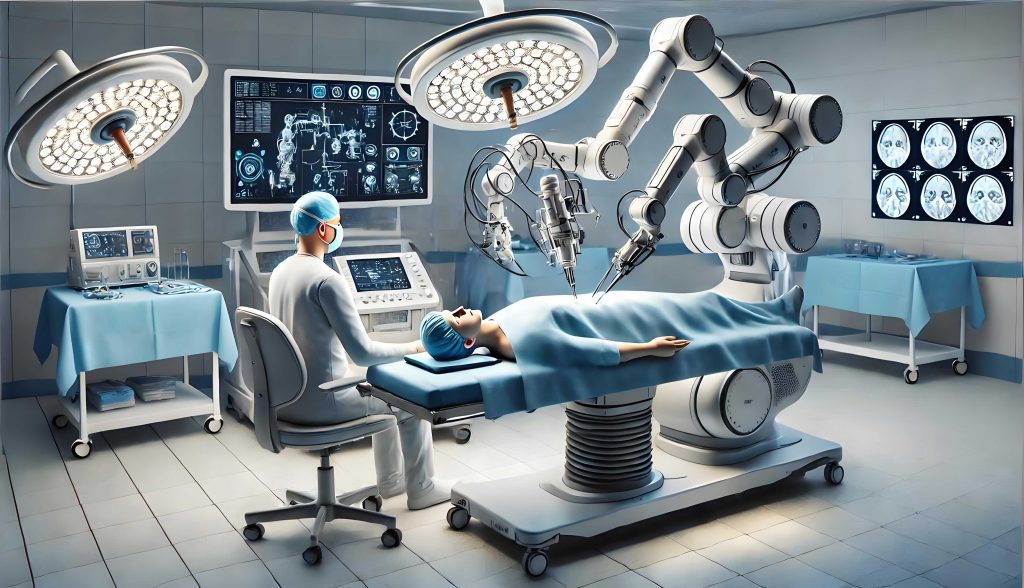
Globally, the research landscape for home medical robots is vibrant, with significant contributions from both academia and industry. In my analysis, I have observed that countries like the United States, Japan, and Germany lead in innovation, driven by high aging rates and advanced technological infrastructure. For instance, robotic systems like Pillo have demonstrated capabilities in automated pill dispensing and telehealth connectivity, showcasing how medical robots can integrate into daily life. Similarly, in China, projects such as “Xiao Ding Dang” reflect a growing emphasis on companion robots with health monitoring features. To illustrate the diversity in functionality, I have compiled a comparative table of key medical robot prototypes:
| Robot Name | Key Functions | Target Users | Country |
|---|---|---|---|
| Pillo | Medication dispensing, voice assistance, telehealth | Elderly, chronic patients | USA |
| Xiao Ding Dang | Health monitoring, emergency alerts, home automation | Elderly living alone | China |
| HOOPEU Assistant | Reminder systems, internet connectivity, safety checks | Senior citizens | China |
| Robear | Physical assistance, lifting support | Disabled individuals | Japan |
This table underscores how medical robots are being tailored to specific user needs, a trend I find crucial for widespread acceptance. From a technical standpoint, the development of these medical robots often relies on interdisciplinary approaches, combining robotics, artificial intelligence, and biomedical engineering. In my own work, I have explored sensor fusion algorithms that enhance the accuracy of health data collected by medical robots. For example, the integration of heart rate and blood pressure sensors can be optimized using a Kalman filter:
$$ \hat{x}_{k|k} = \hat{x}_{k|k-1} + K_k(z_k – H\hat{x}_{k|k-1}) $$
where \( \hat{x}_{k|k} \) is the updated state estimate, \( K_k \) is the Kalman gain, \( z_k \) is the measurement, and \( H \) is the observation matrix. Such algorithms enable medical robots to provide reliable real-time feedback, which is vital for emergency situations.
The market for medical robots, especially home-based systems, is poised for exponential growth. According to industry reports, the global medical robot market was valued at approximately $7.47 billion in 2016, with projections suggesting it could reach $11.4 billion by 2020. In my assessment, this growth is driven by increasing healthcare costs, aging populations, and technological advancements. To quantify this trend, I often use a compound annual growth rate (CAGR) model:
$$ \text{Market Size}(t) = M_0 \times (1 + r)^t $$
where \( M_0 \) is the initial market size, \( r \) is the CAGR (estimated at 15% for medical robots), and \( t \) is the time in years. Applying this, the market size by 2025 can be forecasted. However, regional disparities exist; for instance, while Europe and North America dominate, Asia-Pacific is rapidly catching up due to countries like China and Japan investing heavily in medical robot technologies. The following table breaks down the global market share distribution for medical robots as of recent years:
| Region | Market Share (%) | Key Drivers |
|---|---|---|
| North America | 40 | High healthcare spending, advanced R&D |
| Europe | 35 | Aging population, supportive policies |
| Asia-Pacific | 20 | Rising elderly population, economic growth |
| Rest of World | 5 | Growing awareness, pilot projects |
This data highlights the untapped potential in regions like Asia-Pacific, where the adoption of medical robots could alleviate healthcare burdens. From a business perspective, I believe that cost-effectiveness will be a key factor in scaling medical robots. The total cost of ownership \( C \) for a home medical robot can be expressed as:
$$ C = C_{\text{hardware}} + C_{\text{software}} + C_{\text{maintenance}} \times T $$
where \( T \) is the operational lifespan. Reducing \( C \) through mass production and modular designs could accelerate the deployment of medical robots in diverse households.
Turning to design aspects, a comprehensive home medical robot typically comprises mechanical structures, sensors, drive components, an upper-level control system, and wearable devices like smart bands. In my design philosophy, each component must synergize to ensure reliability and user-friendliness. The mechanical structure, often built with lightweight materials, facilitates mobility and safety. For instance, the torque \( \tau \) required for joint movements can be calculated as:
$$ \tau = I \alpha + mgd \sin(\theta) $$
where \( I \) is the moment of inertia, \( \alpha \) is angular acceleration, \( m \) is mass, \( g \) is gravity, \( d \) is distance, and \( \theta \) is the angle. This ensures that medical robots can navigate home environments without causing harm. Sensors play a pivotal role; I integrate a suite including temperature, vision, and pressure sensors to enable environmental perception. The data from these sensors are processed using machine learning models, such as convolutional neural networks for image recognition:
$$ y = f(W * x + b) $$
where \( W \) represents weights, \( x \) is input data, \( b \) is bias, and \( f \) is an activation function. This allows medical robots to identify objects or detect falls. Drive components, consisting of stepper and linear motors, provide precise locomotion. The step angle \( \theta_s \) of a stepper motor influences motion accuracy:
$$ \theta_s = \frac{360^\circ}{N} $$
with \( N \) being the number of steps per revolution. A smaller \( \theta_s \) enhances the smooth operation of medical robots. The upper-level system, often based on ROS (Robot Operating System), handles navigation, task scheduling, and communication. I implement SLAM (Simultaneous Localization and Mapping) algorithms for indoor navigation:
$$ p(x_t | z_{1:t}, u_{1:t}) = \eta p(z_t | x_t) \int p(x_t | x_{t-1}, u_t) p(x_{t-1} | z_{1:t-1}, u_{1:t-1}) dx_{t-1} $$
where \( x_t \) is the state, \( z_t \) are observations, and \( u_t \) are controls. This enables medical robots to autonomously deliver medications during emergencies. Wearable smart bands complement the system by monitoring vital signs and transmitting data via HTTP protocols. The health metrics, such as heart rate variability (HRV), can be analyzed using frequency-domain methods:
$$ \text{HRV} = \sqrt{\frac{1}{N} \sum_{i=1}^{N} (RR_i – \overline{RR})^2 } $$
where \( RR_i \) are intervals between heartbeats. This holistic design ensures that medical robots offer a seamless user experience.
Looking ahead, the future of home medical robots is intertwined with advancements in AI, IoT, and personalized medicine. In my view, next-generation medical robots will evolve from reactive assistants to proactive caregivers, capable of predicting health issues through data analytics. For example, predictive models using time-series analysis could forecast potential emergencies:
$$ \hat{y}_{t+1} = \alpha y_t + (1-\alpha) \hat{y}_t $$
where \( \hat{y}_{t+1} \) is the forecasted value, \( y_t \) is the actual value at time \( t \), and \( \alpha \) is a smoothing constant. Moreover, integration with smart home ecosystems will expand the functionality of medical robots, allowing them to control appliances or communicate with other devices. However, challenges remain, including high costs, privacy concerns, and regulatory hurdles. I advocate for collaborative efforts between governments, industries, and research institutions to address these barriers. Standardization of protocols for medical robots could enhance interoperability, modeled as:
$$ \text{Interoperability Score} = \sum_{i} c_i \cdot \text{Compliance}_i $$
where \( c_i \) are coefficients for different standards. Additionally, user acceptance studies are vital; I often employ surveys to gauge trust in medical robots, with results indicating a positive correlation with ease of use and perceived benefits.
In conclusion, the trajectory for home medical robots is marked by immense potential and rapid innovation. As I have detailed, these medical robots are not merely gadgets but essential tools for addressing societal challenges like aging populations. From market expansions to sophisticated designs, every facet points toward a future where medical robots become ubiquitous in households. The continued emphasis on research and development will undoubtedly unlock new capabilities, making medical robots indispensable partners in healthcare. As we move forward, I am confident that medical robots will redefine how we approach wellness and independence, ultimately improving quality of life for millions worldwide.