
As an observer deeply entrenched in the technological revolution, I witness the rapid convergence of artificial intelligence, precision manufacturing, and multi-modal perception in the realm of humanoid robots. This fusion has propelled humanoid robots to the forefront of global technological and industrial competition. Across various innovation hubs, particularly in dynamic regions, a fierce race is underway to dominate this future industry. Governments and enterprises are proactively strategizing, formulating action plans, and fostering powerful tech companies dedicated to the research, development, and market expansion of humanoid robots. One such enterprise, a leading technology company, exemplifies this trend, having emerged from a robust manufacturing base to become a pivotal player.
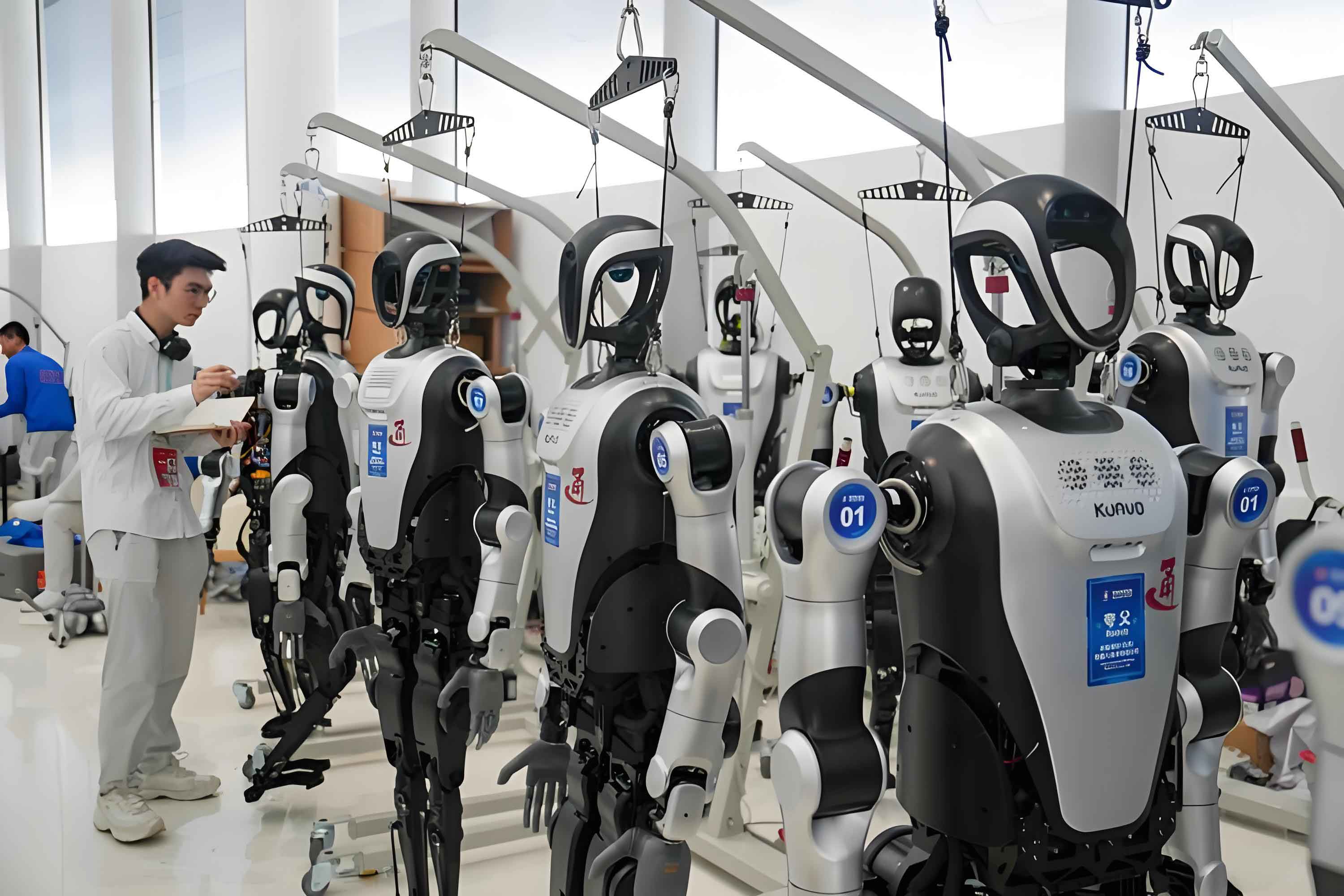
This company focuses on providing core components and system integration solutions for smart factories. Its launch of a specific humanoid robot model, dubbed “YOLO Youlong 01,” and its ambitious project for a million-unit-scale humanoid robot industrial park, serve as a critical leverage point for regional industrial upgrading and capturing a significant share in the humanoid robot赛道. The implications are profound, signaling a shift towards advanced equipment manufacturing.
The humanoid robot industry is characterized by its technology-intensive nature, systemic complexity, and application diversity. It exhibits what I term the “Three Highs” development features. These features present both challenges and opportunities for stakeholders like us.
| Feature | Description | Implication for Humanoid Robot Development |
|---|---|---|
| High Technical Barrier | Core components like reducers and sensors constitute approximately 60% of the total machine cost, with high-end parts dominated by overseas manufacturers. | Achieving cost competitiveness and supply chain security requires breakthroughs in indigenous core component technology for humanoid robots. |
| High Integration Difficulty | Mid-stream本体 manufacturing involves mechanical design, electronic control, and AI algorithm integration, requiring跨学科 collaboration and long development cycles. | Small and medium enterprises struggle with full-machine R&D success depends on strong system integration capabilities for humanoid robots. |
| High Scenario Dependency | Downstream applications necessitate定制 development, such as for industrial collaboration (high-precision handling) or特种作业 (hazardous environments), with large scenario differences and long validation periods. | The commercialization of humanoid robots hinges on developing and validating adaptable solutions for diverse, real-world scenarios. |
From a future technology trend perspective, the ultimate goal for humanoid robots is to achieve “embodied intelligence”—the capacity to autonomously perceive, decide, and act like humans. This pursuit defines the next frontier for humanoid robots. In this context, hardware components such as sensors and ball screws present significant barriers. However, the algorithmic core constitutes an even more profound technological moat. Specifically, autonomous decision-making and generalization capabilities are paramount. These capabilities directly determine whether a humanoid robot can become a true “embodied intelligent agent.” The performance can be conceptualized by a simplified relation:
$$ \text{Embodied Intelligence Score (EIS)} = \alpha \cdot \log(\text{Data Scale}) + \beta \cdot \text{Algorithmic Efficiency} + \gamma \cdot \text{Hardware Fidelity} $$
where $\alpha$, $\beta$, and $\gamma$ are weighting coefficients representing the contribution of data, algorithms, and hardware, respectively. Breaking through these core technology bottlenecks requires interdisciplinary research, accumulation of large-scale data, and upgrades in computational platforms, all centered on advancing the capabilities of humanoid robots.
Guided by national and regional industrial development plans, several cities have taken the lead in布局 the humanoid robot赛道. Therefore, it is imperative for other regions to identify differentiated pathways to actively promote this industry. The aforementioned leading enterprise, acting as a “chain leader” for humanoid robots, provides a crucial抓手 with its technical advantages and industrial influence. The strategy I advocate involves leveraging such advantages to implement a “Three-Chain Synergy” approach—simultaneously advancing the upstream core component chain, the mid-stream本体 manufacturing chain, and the downstream application scenario chain—to strengthen and expand the humanoid robot industry ecosystem.
Consolidating Core Component Advantages: Breaking Through the Upstream
The upstream segment resides at the left high point of the “Industrial Chain Smile Curve,” representing the highest value contribution. For instance, servo systems from leading companies have reached precision and stability levels接近 international advanced standards. However, critical components for humanoid robots like high-precision reducers and sensors still rely on external procurement, imposing constraints on cost and supply chain stability for humanoid robot production. My recommendation is to build upon existing servo system technology to reinforce the自主化 of upstream components like reducers and sensors specifically for humanoid robots. This can be achieved through technical collaborations or mergers and acquisitions to absorb advanced reducer technologies. Supporting local enterprises in appropriately diversifying into humanoid robot component fields is also vital—for example, a company转型 to manufacture planetary roller screws. Furthermore, establishing joint laboratories with research institutions can accelerate the成果转化 of core components for humanoid robots. The value distribution can be summarized as:
$$ V_{\text{upstream}} \approx 0.6 \times C_{\text{total}} $$
where $V_{\text{upstream}}$ is the value from upstream components and $C_{\text{total}}$ is the total cost of a humanoid robot.
| Core Component | Current Challenge for Humanoid Robots | Proposed Breakthrough Strategy |
|---|---|---|
| Reducers (e.g., Harmonic Drive, RV) | High cost, foreign dependency, precision requirements for humanoid robot joints. | Technology partnership/M&A local R&D focusing on compact, high-torque designs. |
| Sensors (Force/Torque, Vision, LiDAR) | Integration complexity, multi-modal data fusion for humanoid robot perception. | Develop specialized sensor fusion algorithms; invest in MEMS-based sensor manufacturing. |
| Actuators & Transmission (Ball Screws, Roller Screws) | Need for high efficiency, backlash control, and durability in humanoid robot limbs. | Support转型 of local precision manufacturing firms to produce高精度传动部件. |
Enhancing本体 Manufacturing Capability: Strengthening the Mid-Stream
The “YOLO Youlong 01” humanoid robot represents a successful产品化 of the robot本体, showcasing advantages in high-precision零部件. Nonetheless, continuous efforts are required in本体 cost control, multi-modal perception fusion, and AI decision generalization for future humanoid robots. I suggest using the humanoid robot industrial park as a载体 to solidify mid-stream manufacturing capabilities. This involves attracting domestic本体 manufacturing enterprises through investment promotion to foster industrial agglomeration for humanoid robots. Building a deep协作 network between the leading company and local manufacturers can promote joint development of本体 integration technologies. Additionally, supporting local enterprises in collaborating with research institutes to establish AI R&D platforms is crucial to突破泛化算法 bottlenecks, thereby enhancing the intelligence level and mid-stream competitive advantage of humanoid robots. A cost model for本体 manufacturing can be expressed as:
$$ C_{\text{本体}} = C_{\text{Material}} + C_{\text{Labor}} + C_{\text{Overhead}} + C_{\text{R&D Amortization}} $$
Optimizing this cost is essential for scaling humanoid robot production.
| Mid-Stream Focus Area | Key Task for Humanoid Robots | Expected Outcome |
|---|---|---|
| Cost Control | Reduce bill of materials (BOM) through design optimization and local供应链 for humanoid robots. | Achieve >15% cost reduction per humanoid robot unit over 5 years. |
| Perception Fusion | Integrate vision, tactile, and auditory data for robust environmental understanding by humanoid robots. | Develop a unified perception framework $P_{\text{fused}} = F(V, T, A)$ for humanoid robots. |
| AI & Generalization | Improve算法 to handle unseen tasks and environments, enabling versatile humanoid robot behavior. | Increase task generalization rate $G$ from baseline to target levels: $G_{\text{target}} > 0.8$. |
Cultivating特色 Application Scenarios: Expanding the Downstream
The downstream segment sits at the right high point of the Smile Curve, creating high added value by meeting customer needs. While potential exists in industrial automation and education, specific scenarios for humanoid robots are not yet fully mature. My proposal is to leverage existing humanoid robot products to develop localized application scenarios. Piloting humanoid robots in large enterprises for hazardous operations or精密装配 can increase industrial penetration. Promoting educational humanoid robots in universities or vocational institutions helps cultivate the local market. Exploring “humanoid robot + public service” models, such as deploying patrol robots in collaboration with municipal departments or scenic spots, can enhance urban management intelligence. The value added downstream, $V_{\text{downstream}}$, is a function of scenario customization and service integration:
$$ V_{\text{downstream}} = \int_{0}^{T} (R_{\text{service}} + \Delta R_{\text{efficiency}}) \, dt $$
where $R_{\text{service}}$ is revenue from new services enabled by humanoid robots and $\Delta R_{\text{efficiency}}$ is the economic gain from improved operational efficiency.
| Application Domain | Potential Role for Humanoid Robots | Key Performance Indicators (KPIs) |
|---|---|---|
| Industrial Collaboration | High-precision handling, assembly line assistance, quality inspection. | Task completion time, accuracy (mm), mean time between failures (MTBF). |
| 特种作业 (Hazardous Environments) | Nuclear inspection, fire response, disaster rescue. | Operational range, sensor reliability in extreme conditions, autonomy level. |
| Education & Training | Programming platform, AI/robotics research, vocational skill training. | Student engagement metrics, curriculum compatibility, API openness. |
| Public Services | Tourist guidance, park patrol, library assistance. | Public interaction satisfaction, incident detection rate, uptime. |
To empower the growth of the humanoid robot industry, continuous capital要素保障 is essential. This support should be multi-faceted, targeting direct funding, enterprise transformation,产业链基金, investment attraction, and local industry cultivation. From my perspective, a holistic financial ecosystem is key to nurturing humanoid robot innovation.
| Financial Support Mechanism | Application to Humanoid Robot Industry | Exemplary Action |
|---|---|---|
| Precision Financing for Head Enterprises | Direct investment via municipal/county industrial funds into humanoid robot projects for R&D and production line construction. | Equity investment followed by facilitating connections with external capital (e.g., provincial funds, bank capital). |
| Empowering关联 Enterprise Transformation | Supporting component suppliers in transitioning to produce humanoid robot-specific parts (e.g., roller screws). | Providing initial investment and assisting with后续市场化融资 and corporate structure optimization. |
| Building a Robot Industry Chain Fund | Establishing a dedicated fund co-founded by leading enterprises and government funds, focused on humanoid robot产业链. | Creating a fund with total scale of 10B CNY, first phase 2B CNY, targeting upstream/downstream布局. |
| Strengthening Industry Chain Investment Attraction | Supporting leading companies in introducing upstream/downstream enterprises (actuators, sensors, reducers) via joint ventures. | Providing tailored financial solutions to accelerate the agglomeration of humanoid robot supply chain projects. |
| Nurturing the Local Industry Chain | Identifying and supporting local enterprises within the humanoid robot ecosystem through名录 and dedicated funds. | Offering投融资 services, fostering collaboration between链主 and local firms to create synergy for humanoid robot development. |
From my analysis, the trajectory of a representative enterprise illustrates the potential. Since establishing a dedicated humanoid robot division, it has mastered key components like motors, encoders, and drivers, which account for a significant portion of a single humanoid robot’s value. The成立 of a separate humanoid robot company and the launch of its “YOLO Youlong 01” product mark a leap from components to full本体 for humanoid robots. Its ambitious plan involves a total investment for a million-unit annual capacity humanoid robot industrial park over six years, structured in three phases. This plan is a microcosm of the industry’s scaling ambition for humanoid robots.
| Phase | Timeline | Key Objectives for Humanoid Robots | Production Target |
|---|---|---|---|
| Phase I | Years 1-2 | Complete in-house R&D of motors, screws, actuators; cultivate sensor/reducer supply chain partners; establish柔性生产线. | Annual output: 50,000 humanoid robots. |
| Phase II | Years 3-4 | Promote industrial scenario applications; develop家庭服务机器人 prototype; acquire stakes in 2-3 upstream firms to reduce costs by 15%. | 新增 output: 250,000 humanoid robots annually. |
| Phase III | Years 5-6 | Launch proprietary brand家庭服务机器人; increase gross margin above 45%. | 新增 output: 700,000 humanoid robots annually, reaching 1 million total capacity. |
Concurrently, the enterprise fosters the transformation of associated companies to研发 critical transmission components like planetary roller screws, enhancing core component self-sufficiency for humanoid robots. The long-term vision is to leverage the产业链 advantage to协同引入上下游 enterprises, aiming to form a colossal, trillion-level humanoid robot industrial cluster. This vision underscores the transformative economic potential of humanoid robots.
The current era presents unprecedented opportunities for the humanoid robot industry. Regions can leverage existing high-end equipment manufacturing foundations, using flagship humanoid robot projects and industrial parks as牵引. By implementing the “Three-Chain Synergy” strategy—breaking upstream technical bottlenecks, strengthening mid-stream manufacturing, and expanding downstream scenarios—and overlaying robust financial要素保障, the humanoid robot industry can be forged into a new future industry赛道 and a new engine for economic growth. The journey of humanoid robots from conceptual marvels to integral parts of our industrial and social fabric is accelerating, and from my vantage point, the convergence of technology, strategy, and capital will define its trajectory. The relentless innovation in AI, embodied in these humanoid robots, promises to redefine productivity and interaction. Every technical hurdle overcome for humanoid robots brings us closer to a world where machines understand and act within our physical environment with grace and intelligence. The collaboration across academia and industry for humanoid robots is yielding richer datasets and more robust algorithms. As costs decline through scale and integration, the adoption curve for humanoid robots will steepen, unlocking value across manufacturing, logistics, healthcare, and domestic spheres. The policy frameworks evolving around humanoid robots will need to balance promotion with ethical considerations. Ultimately, the success of humanoid robots will be measured not just in units produced, but in the tangible improvements in safety, efficiency, and quality of life they enable. The road ahead for humanoid robots is long and requires sustained investment in fundamental research, talent development, and international cooperation. Yet, the potential rewards—a future where humanoid robots handle dangerous, dull, or delicate tasks—are immense. As we stand at this inflection point, the choices made today in standardizing protocols, ensuring cybersecurity, and fostering open innovation will shape the next generation of humanoid robots. The narrative of humanoid robots is being written now, through countless experiments, pilot projects, and strategic partnerships across the globe.