
As a researcher deeply immersed in the field of robotics and healthcare technology, I have witnessed the rapid evolution of medical robots over the past decades. The convergence of medicine, computer science, automation, and advanced manufacturing has propelled medical robotics into a pivotal role in modern healthcare. In this article, I will delve into the current state, technological advancements, and future prospects of medical robotics, emphasizing key areas such as surgical and rehabilitation applications, safety, effectiveness, perception, cognition, and human-robot interaction. Through detailed analysis, tables, and mathematical formulations, I aim to provide a thorough exploration of how medical robots are transforming clinical practices and paving the way for innovative solutions.
The surge in medical robotics is driven by societal demands for higher-quality health services and technological breakthroughs. Medical robots, with their precision, adaptability, and intelligence, are revolutionizing procedures from minimally invasive surgeries to personalized rehabilitation. This article will systematically address these aspects, highlighting the importance of keywords like ‘medical robot’ throughout. I will begin by outlining the foundational concepts and then progress to specific applications, challenges, and emerging trends.
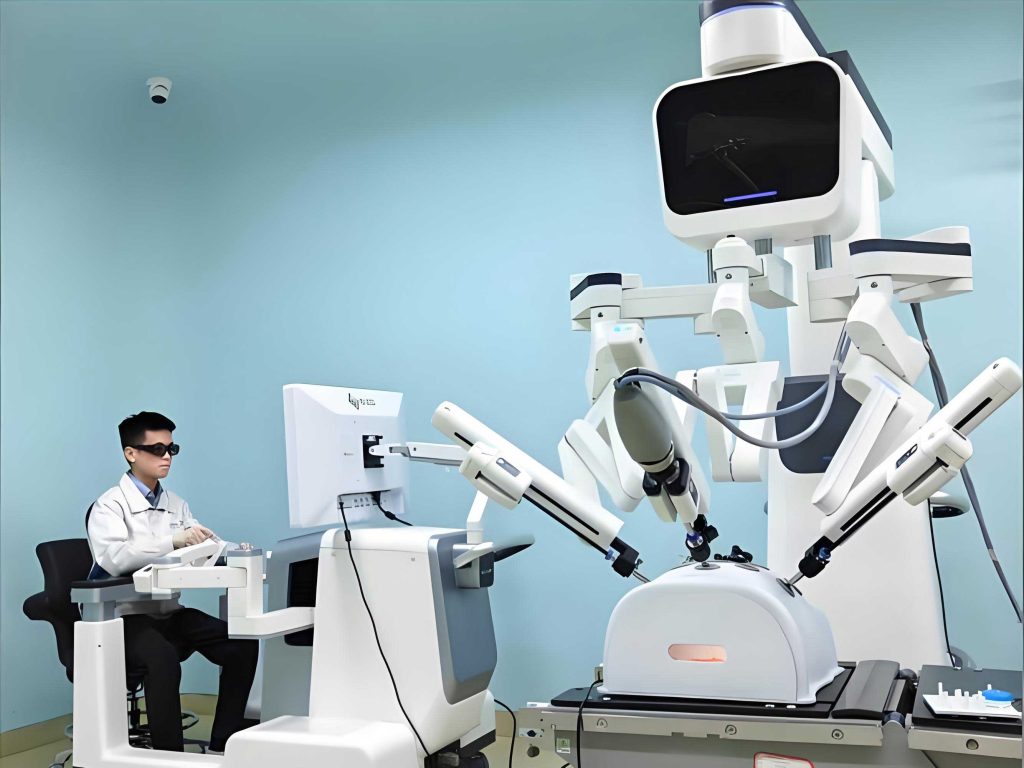
The image above illustrates a typical medical robot in action, showcasing its integration into a clinical setting. Such visual representations underscore the practical implementation of these technologies, but in this discussion, I will focus on the underlying principles and data-driven insights. Medical robots are not just tools; they are intelligent systems that enhance human capabilities, and their development hinges on interdisciplinary collaboration.
Introduction to Medical Robotics
Medical robotics encompasses a broad spectrum of devices designed to assist in diagnosis, surgery, rehabilitation, and patient care. The core objective is to improve outcomes by enhancing precision, reducing invasiveness, and personalizing treatment. From my perspective, the journey of a medical robot begins with its mechanical design and extends to its cognitive abilities, all while adhering to stringent safety standards. The following sections will break down these components, but first, let’s consider the mathematical foundation of robot kinematics, which is essential for understanding motion control in medical robots.
For a serial manipulator used in surgery, the forward kinematics can be expressed as:
$$ \mathbf{x} = f(\mathbf{q}) $$
where $\mathbf{x} \in \mathbb{R}^m$ represents the end-effector position and orientation, and $\mathbf{q} \in \mathbb{R}^n$ denotes the joint angles. The inverse kinematics, crucial for path planning, involves solving $\mathbf{q} = f^{-1}(\mathbf{x})$. In medical robots, this must be computed with high accuracy to avoid tissue damage. Additionally, the dynamics of a medical robot can be modeled using the Euler-Lagrange equations:
$$ \tau = M(\mathbf{q})\ddot{\mathbf{q}} + C(\mathbf{q}, \dot{\mathbf{q}})\dot{\mathbf{q}} + G(\mathbf{q}) + \mathbf{F}_{ext} $$
where $\tau$ is the torque vector, $M$ is the inertia matrix, $C$ represents Coriolis and centrifugal forces, $G$ is the gravitational vector, and $\mathbf{F}_{ext}$ accounts for external forces from interaction with the human body. This model underpins the control strategies that ensure safe operation.
Surgical Medical Robots
Surgical medical robots have become indispensable in procedures requiring high precision and minimal invasion. In my experience, these systems, such as those for laparoscopy, orthopedics, and interventional radiology, leverage advanced mechanisms to augment a surgeon’s skills. The benefits include reduced trauma, less bleeding, and faster recovery, but achieving this requires intricate design and control. Below is a table summarizing key types of surgical medical robots and their characteristics.
| Type of Surgical Medical Robot | Primary Applications | Key Technologies | Advantages |
|---|---|---|---|
| Laparoscopic Robots | Abdominal and pelvic surgeries | Multi-degree-of-freedom arms, 3D vision systems | Enhanced dexterity, tremor filtration |
| Orthopedic Robots | Joint replacements, spine surgery | Preoperative planning, navigational guidance | Improved implant alignment, reduced variability |
| Interventional Robots | Cardiac catheterization, neurovascular procedures | Steerable catheters, real-time imaging integration | Precise tool manipulation, reduced radiation exposure |
| Microsurgical Robots | Ophthalmic, ENT surgeries | High-magnification optics, force scaling | Sub-millimeter accuracy, minimized hand tremors |
To quantify the precision of a surgical medical robot, we can use error metrics. For instance, the positioning error $e$ between desired and actual tool tip position is given by:
$$ e = \|\mathbf{x}_{desired} – \mathbf{x}_{actual}\| $$
In practice, this error must be minimized below a threshold, often less than 1 mm for sensitive procedures. Control algorithms, such as PID or adaptive control, are employed to achieve this. Consider a proportional-integral-derivative (PID) controller for joint control:
$$ \tau = K_p e + K_i \int e \, dt + K_d \frac{de}{dt} $$
where $K_p$, $K_i$, and $K_d$ are tuning gains. For medical robots, these gains are optimized to ensure stability in contact with soft tissues, which exhibit nonlinear viscoelastic properties modeled as:
$$ F_{tissue} = k \delta + c \dot{\delta} $$
where $F_{tissue}$ is the force exerted by tissue, $\delta$ is deformation, and $k$ and $c$ are stiffness and damping coefficients, respectively. This interaction highlights the need for force feedback in surgical medical robots.
Rehabilitation Medical Robots
Rehabilitation medical robots play a critical role in restoring motor functions for individuals with disabilities or age-related conditions. From my observations, these systems utilize sensor fusion and AI to provide adaptive therapy, enabling personalized recovery paths. They range from exoskeletons for gait training to robotic arms for upper limb rehabilitation. The effectiveness hinges on real-time assessment and adjustment, which can be formulated as an optimization problem. Let’s define a patient’s progress metric $P(t)$ as a function of time, influenced by robot-assisted exercises. The goal is to maximize $P(t)$ subject to constraints like patient comfort and safety.
A common control approach in rehabilitation medical robots is impedance control, which regulates the interaction dynamics. The equation is:
$$ \mathbf{F} = K(\mathbf{x} – \mathbf{x}_d) + B(\dot{\mathbf{x}} – \dot{\mathbf{x}}_d) $$
where $\mathbf{F}$ is the force applied by the robot, $K$ and $B$ are stiffness and damping matrices, $\mathbf{x}$ is the patient’s limb position, and $\mathbf{x}_d$ is the desired trajectory. This allows the medical robot to provide assistance-as-needed, adapting to the patient’s abilities. Below is a table outlining rehabilitation medical robot applications.
| Application Area | Robot Type | Key Features | Outcome Metrics |
|---|---|---|---|
| Stroke Rehabilitation | Upper limb exoskeletons | Force assistance, biofeedback | Improvement in Fugl-Meyer score |
| Spinal Cord Injury | Lower body exoskeletons | Gait training, balance support | Walking speed, endurance |
| Neurological Disorders | End-effector robots | Repetitive task practice | Motor control accuracy |
| Geriatric Care | Assistive mobile robots | Fall prevention, daily activity aid | Independence level, quality of life |
To personalize therapy, machine learning models are integrated. For example, a reinforcement learning agent can learn optimal assistance policies. The state $s_t$ might include joint angles and forces, and the action $a_t$ is the robot’s assistance level. The reward $r_t$ could be based on movement smoothness. The Q-learning update rule is:
$$ Q(s_t, a_t) \leftarrow Q(s_t, a_t) + \alpha [r_t + \gamma \max_a Q(s_{t+1}, a) – Q(s_t, a_t)] $$
where $\alpha$ is the learning rate and $\gamma$ the discount factor. This enables the medical robot to adapt to individual patient needs over time.
Other Medical Assistant Robots
Beyond surgery and rehabilitation, medical robots find applications in various auxiliary roles, such as in dental, ocular, and diagnostic procedures. In my analysis, these systems enhance precision, reduce clinician fatigue, and lower healthcare costs. For instance, robotic systems for dental implant placement use imaging guidance to achieve sub-millimeter accuracy. The error propagation in such systems can be analyzed using statistical models. If the positioning error of each component is normally distributed, the total error $\sigma_{total}$ is:
$$ \sigma_{total} = \sqrt{\sum_{i=1}^n \sigma_i^2} $$
where $\sigma_i$ are the standard deviations of individual error sources. This emphasizes the need for high-precision components in medical robots.
| Domain | Example Medical Robot | Function | Technological Enablers |
|---|---|---|---|
| Dentistry | Robotic dental assistants | Implant surgery, tooth preparation | CBCT imaging, haptic feedback |
| Ophthalmology | Robotic microsurgery systems | Retinal surgery, cataract removal | Steady-hand technology, adaptive optics |
| Diagnostics | Automated biopsy robots | Tissue sampling, lab automation | Machine vision, precise actuators |
| Pharmacy | Dispensing robots | Medication sorting, packaging | RFID tracking, AI-based verification |
These medical robots often operate in confined spaces, requiring compact design. The kinematics of a parallel manipulator, common in such settings, can be described by:
$$ \mathbf{J} \dot{\mathbf{q}} = \dot{\mathbf{x}} $$
where $\mathbf{J}$ is the Jacobian matrix relating joint velocities to end-effector velocity. Singularities in $\mathbf{J}$ must be avoided to maintain control. This is critical for safety in medical robots interacting with sensitive anatomical structures.
Technical Challenges: Precision and Control
Safety and efficacy are paramount for any medical robot, and precision is a cornerstone. From my viewpoint, achieving precise operations in complex, narrow environments demands advanced modeling and control techniques. Even with high-quality mechanical designs, uncertainties such as tissue deformation or tool wear necessitate robust control. One approach is sliding mode control, which handles nonlinearities. The sliding surface $s$ is defined as:
$$ s = \dot{e} + \lambda e $$
where $e$ is the tracking error and $\lambda > 0$. The control law $\tau$ is designed to drive $s$ to zero, ensuring robustness. However, chattering must be minimized for medical robots to prevent vibrations.
Another challenge is force control during interaction. The desired impedance can be tuned online using adaptive laws. For example, the stiffness $K$ in impedance control might be adjusted based on force error $e_f = F_{desired} – F_{measured}$:
$$ \dot{K} = -\eta e_f \delta $$
where $\eta$ is a learning rate and $\delta$ is deformation. This allows the medical robot to maintain safe contact forces. Below is a table summarizing control methods for medical robots.
| Control Method | Application in Medical Robots | Advantages | Mathematical Formulation |
|---|---|---|---|
| PID Control | Joint position control in surgical robots | Simplicity, ease of tuning | $\tau = K_p e + K_i \int e \, dt + K_d \dot{e}$ |
| Impedance Control | Rehabilitation and soft tissue interaction | Compliant behavior, safety | $\mathbf{F} = K(\mathbf{x} – \mathbf{x}_d) + B(\dot{\mathbf{x}} – \dot{\mathbf{x}}_d)$ |
| Adaptive Control | Handling parameter variations in dynamic environments | Robustness to uncertainties | $\dot{\hat{\theta}} = \Gamma \phi e$ where $\hat{\theta}$ estimates parameters |
| Model Predictive Control (MPC) | Trajectory planning for minimally invasive surgery | Optimization over horizon, constraint handling | $\min_u \sum_{k=0}^{N-1} (x_k^T Q x_k + u_k^T R u_k)$ |
Furthermore, navigation in medical robots often relies on sensor fusion. For instance, combining encoder data with vision-based measurements. The Kalman filter is a common tool. The state update equation is:
$$ \hat{x}_{k|k} = \hat{x}_{k|k-1} + K_k (z_k – H \hat{x}_{k|k-1}) $$
where $K_k$ is the Kalman gain, $z_k$ is measurement, and $H$ is observation matrix. This enhances the accuracy of medical robot positioning.
Technical Challenges: Perception and Cognition
Medical robots must perceive their environment and understand human intentions to collaborate effectively. In my research, I’ve seen increasing integration of force, vision, and other sensors, coupled with AI algorithms for multi-modal fusion. This enables medical robots to adapt to complex tasks. For example, image segmentation in surgical scenes can be done using convolutional neural networks (CNNs). The loss function for segmentation might be cross-entropy:
$$ L = -\sum_{i} y_i \log(\hat{y}_i) $$
where $y_i$ is the ground truth label and $\hat{y}_i$ is the predicted probability. This allows the medical robot to identify tissues or instruments.
Moreover, cognitive aspects involve decoding biological signals. Electroencephalography (EEG) or electromyography (EMG) signals can be processed to infer user intent. A common method is to extract features like mean absolute value (MAV) from EMG:
$$ MAV = \frac{1}{N} \sum_{i=1}^{N} |x_i| $$
where $x_i$ are signal samples. These features feed into classifiers, such as support vector machines (SVMs), with decision function:
$$ f(\mathbf{x}) = \text{sign}(\mathbf{w}^T \phi(\mathbf{x}) + b) $$
where $\mathbf{w}$ is weight vector and $\phi$ is kernel mapping. This facilitates intuitive control of medical robots.
| Perception Modality | Sensor Type | Application in Medical Robots | AI Techniques Used |
|---|---|---|---|
| Force/Tactile | Strain gauges, capacitive sensors | Haptic feedback in surgery, grip control in rehabilitation | Neural networks for force prediction |
| Vision | Cameras, endoscopes | Anatomical mapping, tool tracking | CNNs for object detection, SLAM algorithms |
| Biological Signals | EEG, EMG, EOG | Brain-computer interfaces for prosthetic control | Signal processing, deep learning for pattern recognition |
| Auditory | Microphones | Voice commands for assistive robots | Natural language processing, speech recognition |
The fusion of these modalities can be formulated using Bayesian inference. If we have multiple sensor measurements $z_1, z_2, \dots, z_n$, the posterior probability of state $x$ is:
$$ P(x | z_1, \dots, z_n) \propto P(x) \prod_{i=1}^n P(z_i | x) $$
This enhances the reliability of perception in medical robots. Additionally, advancements in brain-computer interfaces (BCIs) enable implicit interaction, where the medical robot responds directly to neural activity. The communication rate in BCIs can be modeled by information theory metrics like mutual information:
$$ I(X;Y) = \sum_{x,y} P(x,y) \log \frac{P(x,y)}{P(x)P(y)} $$
where $X$ is intent and $Y$ is decoded output. Maximizing this improves the fluency of human-robot collaboration.
Technical Challenges: Human-Robot Interaction
Human-robot interaction (HRI) is crucial for medical robots, as they often work alongside clinicians or patients. From my perspective, moving from explicit to implicit interaction modes requires natural interfaces. HRI in medical robots involves physical and cognitive aspects. Physically, admittance control can be used where the robot moves in response to human forces. The admittance model is:
$$ \mathbf{x} = H(s) \mathbf{F}_{human} $$
where $H(s)$ is a transfer function defining the dynamics. This allows smooth collaboration during surgery or rehabilitation.
Cognitively, shared autonomy frameworks let the medical robot and human share control. The level of autonomy $\alpha \in [0,1]$ can be adjusted based on context. The combined control input $u$ is:
$$ u = \alpha u_{robot} + (1-\alpha) u_{human} $$
where $u_{robot}$ is generated by AI and $u_{human}$ from user input. This balance ensures safety while leveraging robot capabilities. Below, a table summarizes HRI paradigms in medical robotics.
| HRI Paradigm | Description | Application Example | Key Metrics |
|---|---|---|---|
| Teleoperation | Remote control with master-slave setup | Remote surgery using haptic interfaces | Time delay, transparency |
| Collaborative Control | Robot and human work simultaneously | Surgeon and robot co-manipulating tools | Force sharing ratio, task completion time |
| Supervisory Control | Human monitors, robot executes autonomously | Automated biopsy under oversight | Intervention frequency, error rate |
| Adaptive Assistance | Robot adjusts help based on user performance | Rehabilitation exoskeleton providing variable support | Learning curve, user satisfaction |
To evaluate HRI, metrics like NASA-TLX for workload or system usability scale (SUS) are used. These can be incorporated into optimization for medical robot design. Furthermore, ethical considerations arise, such as accountability in autonomous decisions. Mathematical models of trust in medical robots can be developed using differential equations:
$$ \frac{dT}{dt} = \alpha (P – T) + \beta E $$
where $T$ is trust level, $P$ is performance, $E$ is explainability, and $\alpha, \beta$ are coefficients. Maintaining trust is essential for adoption.
Advancements in Communication and Virtual Reality
The integration of 5G communication, virtual reality (VR), and augmented reality (AR) is transforming medical robotics. In my view, 5G’s low latency and high bandwidth enable reliable teleoperation for remote surgeries, expanding access to care. The end-to-end delay $D$ in a telemedical robot system can be broken down as:
$$ D = D_{transmission} + D_{processing} + D_{display} $$
With 5G, $D_{transmission}$ can be reduced to milliseconds, critical for real-time control. Additionally, VR and AR enhance surgical planning and execution. For instance, AR overlays preoperative images onto the surgical field, guided by registration algorithms. The transformation between coordinate systems can be represented by:
$$ \mathbf{p}_{patient} = R \mathbf{p}_{image} + t $$
where $R$ is rotation matrix and $t$ translation vector. This aligns virtual data with reality.
Force feedback in VR systems improves haptic realism. The rendering of forces often uses Hooke’s law for simplicity:
$$ F_{haptic} = k_{virtual} \Delta x $$
where $k_{virtual}$ is virtual stiffness and $\Delta x$ penetration depth. In medical robots, this feedback must be synchronized with visual cues to avoid cybersickness. The table below highlights technologies enhancing medical robot capabilities.
| Technology | Role in Medical Robotics | Impact Metrics | Mathematical Models |
|---|---|---|---|
| 5G Communication | Remote surgery, real-time data exchange | Latency < 10 ms, bandwidth > 1 Gbps | Queuing theory models for network traffic |
| Virtual Reality (VR) | Surgical simulation, training | Presence score, skill transfer rate | Rendering equations, kinematic models |
| Augmented Reality (AR) | Intraoperative guidance, anatomy visualization | Registration error, user accuracy improvement | Homography transformations, SLAM |
| Haptic Interfaces | Force feedback in teleoperation | Fidelity, transparency | Impedance/admittance models, wave variables |
These technologies collectively elevate the surgeon’s presence and decision-making. For example, in a telemedical robot setup, the transparency $T$ can be defined as the ratio of felt force to actual environment force:
$$ T = \frac{F_{felt}}{F_{env}} $$
Ideally, $T=1$ for perfect transparency. Achieving this requires precise modeling and control, underscoring the interdisciplinary nature of medical robot development.
Future Outlook and Conclusion
Looking ahead, the field of medical robotics is poised for exponential growth, but it remains in its nascent stages, particularly in areas like environmental perception, intent recognition, and seamless interaction. From my standpoint, future medical robots will increasingly embody artificial intelligence, enabling autonomous decision-making while maintaining human oversight. Innovations in materials science may lead to soft medical robots that better conform to biological tissues. The dynamics of soft robots can be described using continuum mechanics, such as the Cosserat rod model:
$$ \frac{\partial}{\partial s} \left( K \frac{\partial \mathbf{r}}{\partial s} \right) = \mathbf{f}_{ext} $$
where $\mathbf{r}(s)$ is the centerline, $K$ stiffness matrix, and $\mathbf{f}_{ext}$ external forces. This allows for safer interactions.
Moreover, the integration of swarm robotics could enable multiple medical robots to collaborate on complex procedures. The coordination can be modeled using graph theory, where each robot is a node and communication links are edges. The Laplacian matrix $L$ of the graph influences consensus algorithms:
$$ \dot{x}_i = -\sum_{j \in N_i} (x_i – x_j) $$
where $x_i$ is robot state and $N_i$ neighbors. This facilitates synchronized actions in multi-robot medical systems.
Ethical and regulatory frameworks will also evolve to address autonomy and liability. As medical robots become more pervasive, standards for validation and certification will be crucial. I believe that through global collaboration, we will witness medical robots becoming ubiquitous in clinics and homes, democratizing high-quality care. The journey involves continuous research and innovation, but the potential to improve human health is immense.
In summary, medical robots represent a synergy of engineering and medicine, driving toward precision healthcare. From surgical assistants to rehabilitation companions, these systems are redefining therapeutic approaches. By addressing technical hurdles and embracing emerging technologies, the future of medical robotics promises enhanced efficacy, safety, and accessibility. I am optimistic that ongoing efforts will unlock new frontiers, making medical robots integral to our healthcare ecosystem.