
Standing at the confluence of advanced mechanics, artificial intelligence, and embodied cognition, the field of humanoid robotics represents one of the most ambitious and transformative engineering endeavors of our time. As a researcher deeply embedded in this evolution, I have witnessed a remarkable shift from isolated academic prototypes to platforms driving tangible industrial and commercial exploration. The journey of the humanoid robot is no longer confined to laboratory demonstrations; it is rapidly progressing towards solving real-world problems, guided by intense global competition, strategic investment, and relentless technological iteration.
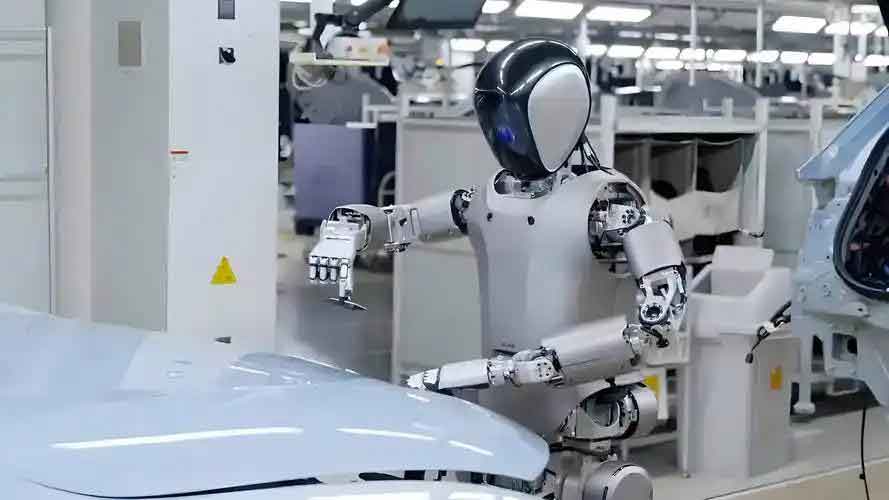
The inflection point for the modern humanoid robot can be traced to breakthroughs in key enabling technologies. High-torque-density actuators, often based on proprietary harmonic drive or custom magnetic circuit designs, have provided the necessary muscle. Concurrently, the advent of sophisticated model-based and learning-based control algorithms has endowed these machines with unprecedented agility and balance. The core kinematic and dynamic challenges of bipedal locomotion, once the domain of complex theoretical papers, are now being translated into executable code. The fundamental equation governing the balance of a humanoid robot during motion—the Zero Moment Point (ZMP) criterion—illustrates this complexity:
$$ \text{ZMP} = \frac{\sum_{i=1}^n m_i ( \ddot{z}_i + g ) x_i – \sum_{i=1}^n m_i \ddot{x}_i z_i – \sum_{i=1}^n I_{iy} \dot{\omega}_{iy}}{\sum_{i=1}^n m_i ( \ddot{z}_i + g )} $$
where \( m_i \), \( x_i \), \( z_i \) are the mass and coordinates of link \( i \), \( g \) is gravity, \( I_{iy} \) is the moment of inertia, and \( \omega_{iy} \) is the angular acceleration. Ensuring the ZMP remains within the support polygon defined by the feet is paramount for stable walking, a task requiring millisecond-level sensor fusion and actuator control.
The commercial landscape for humanoid robot development has diversified into several distinct yet overlapping tracks. The following table summarizes the primary technical and market approaches observed among leading entities:
| Development Track | Core Focus | Typical Actuation | Primary Target Phase |
|---|---|---|---|
| High-Performance Research | Maximum dynamic capability (running, jumping, complex acrobatics) | Hydraulic or high-voltage electric | Advanced R&D, DARPA-style challenges |
| Electric Commercialization | Cost-effective, reliable mobility for early industrial/consumer applications | Proprietary high-torque electric motors (e.g., proprioceptive actuators) | Pilot deployments in logistics, inspection, public interaction |
| Full-Body AI Integration | General-purpose intelligence, dexterous manipulation, and environmental reasoning | Electric with advanced force/torque sensing | Long-term goal of general-purpose service and labor |
| Industrial Evolution | Applying mobile robot autonomy from structured industrial settings towards more adaptive, human-scale tasks | Robust industrial-grade electric drives | Next-generation flexible manufacturing and warehouse automation |
The path from a dynamically stable platform to a useful humanoid robot is paved with the challenge of sensorimotor integration. The perception stack for a functional humanoid robot must process data from LiDAR, depth cameras, inertial measurement units (IMUs), and joint encoders to build a coherent model of the world. This model is then used for simultaneous localization and mapping (SLAM), obstacle avoidance, and task planning. The control law for a single joint often follows a computed-torque or impedance control scheme, such as:
$$ \tau = M(q) \ddot{q}_d + C(q, \dot{q}) + G(q) + K_p (q_d – q) + K_d (\dot{q}_d – \dot{q}) $$
Here, \( \tau \) is the commanded torque, \( M \) is the inertia matrix, \( C \) represents Coriolis and centrifugal forces, \( G \) is gravity, \( q \) is the joint angle, and \( K_p \), \( K_d \) are proportional and derivative gain matrices. Scaling this from one joint to a full humanoid robot with over 20 degrees of freedom, while managing internal forces and external disturbances, is a monumental software challenge.
The market applications for humanoid robot technology are crystallizing into clear verticals. While the ultimate vision of a domestic assistant remains on the horizon, immediate opportunities provide critical funding and real-world testing data. The progression often follows a technology readiness level (TRL) ladder:
- Research & Education: Universities and labs purchase platforms for algorithm development. This is a current, robust market demanding openness and modularity.
- Specialized Public Services: Guided tours, information kiosks, and promotional interactions in airports, museums, and malls.
- Industrial Inspection & Logistics: A natural extension from mobile robots, performing visual inspections in hazardous plants or moving boxes in warehouses not designed for wheeled bots.
- Advanced Manufacturing: The “holy grail” application—performing assembly, polish, or machine tending tasks on existing factory lines designed for humans.
The economic rationale for pursuing a humanoid robot in industry is compelling. Traditional automation is rigid and requires massive capital expenditure to reconfigure environments. A versatile humanoid robot promises to work with legacy infrastructure. The potential total addressable market (TAM) is frequently modeled as a function of labor substitution in key sectors. Conservative estimates suggest that a 1% penetration in global manufacturing and logistics could represent a market worth tens of billions of dollars annually. The race is not merely to build a capable machine, but to drive down the unit economics to a point where deployment becomes irresistible. The cost trajectory for a capable humanoid robot is expected to follow a learning curve similar to other advanced technologies:
$$ C(N) = C_0 \times N^{-b} $$
where \( C(N) \) is the cost of the \( N \)-th unit, \( C_0 \) is the cost of the first unit, \( N \) is the cumulative production volume, and \( b \) is the learning elasticity (typically between 0.1 and 0.3). Achieving volume \( N \) is thus the central challenge for all players.
The competitive dynamics in the humanoid robot sector are intense and global. While several high-profile companies in the United States have captured the imagination with videos of robots performing parkour, a vibrant and well-funded ecosystem has emerged in Asia, particularly in China. Here, companies are often characterized by rapid prototyping cycles, aggressive cost engineering, and a sharp focus on identifying near-term, monetizable applications. This pragmatic approach has allowed some startups to progress from first concept to funded commercial pilots in remarkably short timeframes, securing successive rounds of investment from venture capital and strategic industry funds. The funding environment reflects a broad consensus on the sector’s potential, though investors are increasingly scrutinizing technical differentiation and clear commercialization roadmaps over pure spectacle.
Looking forward, the key bottlenecks for the widespread adoption of humanoid robot technology are multifaceted. On the hardware side, durability, energy efficiency (often measured in watts per kilogram per meter traveled), and the cost of critical components like high-performance sensors and actuators remain hurdles. On the software side, the “brain” of the humanoid robot needs monumental advances. This goes beyond locomotion control to include:
- Dexterous Manipulation: Controlling a multi-fingered hand to manipulate tools and deformable objects with appropriate force.
- High-Level Task Planning: Breaking down a command like “clean this room” into a sequence of executable atomic actions.
- World Understanding & Common Sense: Building and maintaining a contextual understanding of environments that were built for humans.
Many experts in the field, including myself, believe that solving these software challenges is a 3-5 year problem for limited domains, and a decade-plus problem for general-purpose capability. The journey will not be linear. It will involve periods of rapid progress punctuated by plateaus where fundamental research is required. However, the convergence of large-scale embodied AI training (using platforms from companies focused on commercial humanoid robot development), improvements in simulation-to-real transfer, and continued hardware innovation creates a powerful flywheel effect.
In conclusion, the era of the humanoid robot as a viable technological and economic entity has undeniably begun. It is being built not by a single entity, but through a global, multi-front effort spanning aggressive startups, established industrial automation giants, and foundational AI research labs. The narrative has shifted from “if” to “when and how.” The companies that will lead this transformation will be those that successfully navigate the treacherous path between groundbreaking research and rugged, reliable, and economically viable deployment. They must master not only the physics of bipedal motion, encapsulated in complex differential equations, but also the market physics of supply chains, unit economics, and solving genuine customer pain points. The ultimate success of the humanoid robot will be measured not by its ability to perform backflips on a stage, but by its seamless, quiet, and indispensable integration into the daily workflows of industries and, eventually, our homes. The race to define the future of work and human-machine collaboration is on, and its primary avatar is the humanoid robot.