
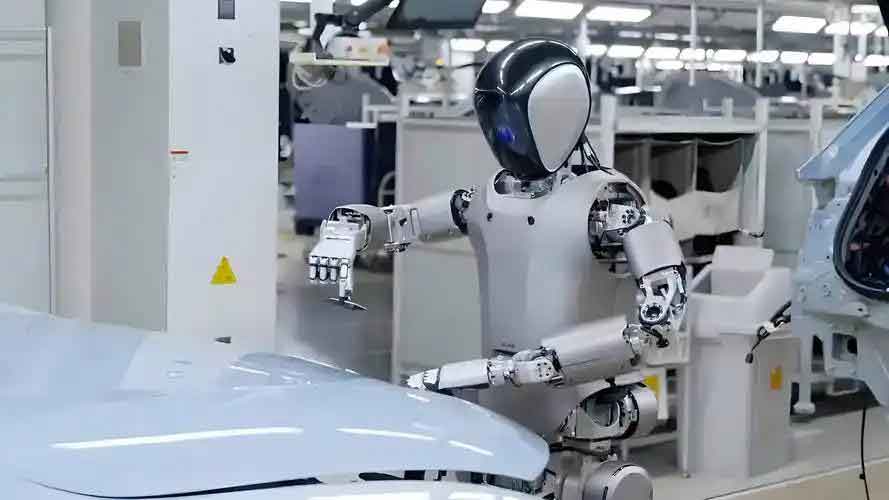
As a new engine for productive forces and a vanguard of future industries, the humanoid robot represents a convergence of artificial intelligence, advanced manufacturing, and new materials. I believe it is poised to become the next disruptive product, following in the footsteps of computers, smartphones, and new energy vehicles. The recent showcase of 27 different humanoid robot models at a major international conference underscores this momentum. Analysis from leading financial institutions suggests an accelerated development trajectory. While the journey from basic (L1) to advanced (L2) autonomy took decades, the leap to highly autonomous (L4) systems is projected to occur within a few years. There is a growing consensus that the humanoid form is the ultimate developmental goal in robotics, offering the best adaptation to human-centric environments. Empowered by breakthroughs in foundational AI models, humanoid robots are rapidly evolving from laboratory prototypes to solutions for real-world commercial applications. We are now entering the critical phase of their industrialization.
Technological Advancements Driving Rapid Development
Progress in AI, machine vision, natural language processing, and motion control is the primary engine for humanoid robot capabilities. In AI, deep learning algorithms enhance a robot’s ability to understand and predict human behavior, enabling more natural social interaction. Machine vision, particularly through 3D imaging and advanced object recognition, grants humanoid robots the ability to parse complex visual scenes. The most physically evident advances are in motion control. Improved force control and balance algorithms allow for unprecedented stability and precision in locomotion and manipulation.
These advancements can be quantified. For instance, the stability of a bipedal humanoid robot during dynamic motion can be analyzed using the concept of the Zero Moment Point (ZMP). A stable gait requires the ZMP to remain within the support polygon formed by the feet:
$$ P_{zmp} = \frac{\sum_{i=1}^{n} m_i ( \ddot{z}_i + g ) x_i – \sum_{i=1}^{n} m_i \ddot{x}_i z_i}{\sum_{i=1}^{n} m_i ( \ddot{z}_i + g )} $$
where \( P_{zmp} \) is the Zero Moment Point coordinate, \( m_i \) is the mass of link \( i \), \( g \) is gravity, and \( x_i, z_i, \ddot{x}_i, \ddot{z}_i \) are the positions and accelerations. Maintaining \( P_{zmp} \) within the support polygon’s boundaries is a fundamental challenge that advanced algorithms are now solving for highly dynamic movements.
The following table contrasts the capabilities of notable humanoid robot platforms, highlighting their specialized technological demonstrations:
| Robot Platform | Primary Developer | Key Technological Demonstration |
|---|---|---|
| Atlas | Boston Dynamics | Advanced dynamic locomotion, parkour, and complex whole-body coordination in unstructured environments. |
| Optimus | Tesla | End-to-end neural network control, emphasis on cost-effective manufacturing and real-world task learning. |
| Pepper | SoftBank | Social interaction, emotion recognition through facial expression analysis, and service-oriented applications. |
| Apollo | Apptronik | Designed for practical work in human spaces, focusing on payload, endurance, and commercial utility. |
Industrial Capital and Ecosystem Maturation
The potential of the humanoid robot has triggered an unprecedented wave of investment and strategic positioning from technology giants. Companies like Tesla, NVIDIA, and OpenAI are making significant bets, aiming to establish leadership in this nascent market. This influx of capital and expertise is accelerating the maturation of the entire supply chain. The industry is transitioning from a pure R&D phase (“0 to 1”) toward initial industrialization (“1 to N”). The ecosystem is becoming more defined, encompassing everything from core components to final system integration.
A detailed breakdown of the humanoid robot value chain reveals both progress and persistent gaps, particularly in high-performance components:
| System Segment | Core Components | Development Status & Challenge |
|---|---|---|
| Actuation & Body | Precision Reducers (Harmonic Drive, RV) | Mature but high-cost; dominated by a few international suppliers. |
| Servo Motors (Frameless Torque, Hollow Cup) | High torque-density motors are critical; performance and cost barriers remain. | |
| Linear Actuators (Planetary Roller Screws) | High precision and load capacity required; significant technical and manufacturing barriers. | |
| Sensing & Perception | Force/Torque Sensors | Essential for compliant control; high-performance variants are costly. |
| 3D Vision Sensors (LiDAR, Depth Cameras) | Rapidly evolving from autonomous vehicle industry; cost decreasing. | |
| Control & Intelligence | Central Controller (AI Chip) | Leveraging advances in AI accelerators; a key area for companies like NVIDIA. |
| Operating System & Algorithms | Fragmented landscape; move towards unified platforms (e.g., ROS) and foundation models. |
Expansive Market Potential and Emerging Demand
The addressable market for humanoid robots is vast. Leading analysts project a market ranging from billions to hundreds of billions of dollars within the next 10-15 years. This optimism is rooted in fundamental macroeconomic trends. Demographic shifts and labor shortages, particularly in manufacturing and elder care, are creating powerful demand signals. The humanoid robot‘s form factor is its key advantage, allowing it to operate tools, navigate stairs, and work in spaces designed for humans without requiring massive infrastructure changes.
A simple model can estimate potential demand in a single sector. The demand \( D \) in a specific industry can be approximated as:
$$ D = W \times R \times P $$
where \( W \) is the number of human workers in target roles, \( R \) is the potential substitution rate, and \( P \) is the average price per humanoid robot. For example, in automotive manufacturing with \( W = 3.39 \times 10^6 \) workers, a conservative \( R = 10\% \), and \( P = \$20,000 \), the potential addressable market value just in that segment would be:
$$ D = 3.39 \times 10^6 \times 0.10 \times 20,000 = \$6.78 \times 10^9 $$
This simplified calculation highlights the immense scale even at low penetration rates.
Market forecasts vary based on adoption scenarios, as summarized below:
| Source | Timeframe | Projected Market Size | Key Assumptions / Scenario |
|---|---|---|---|
| Goldman Sachs (Baseline) | 10-15 years | > $6 Billion | Slow adoption in structured commercial settings. |
| Goldman Sachs (Blue Sky) | By 2035 | $154 Billion | Rapid cost decline, broad adoption in manufacturing, logistics, and personal services. |
| Sector-Specific Analysis (e.g., Auto) | Long-term | Billions per major sector | Partial automation of roles unsuitable for traditional robots. |
Critical Challenges on the Path to Industrialization
Despite the progress, the path to widespread deployment of humanoid robots is fraught with significant hurdles that must be overcome.
1. Persistent Technical Bottlenecks: The development is asymmetric. While the AI “brain” for cognition has advanced rapidly, the “cerebellum” responsible for dexterous, robust, and low-level motor control lags behind. Achieving human-level manipulation and adaptive locomotion in truly unstructured environments remains a grand challenge. Hardware-wise, certain core components like ultra-precise force sensors and high-efficiency compact actuators still face performance and cost barriers, with supply often concentrated outside of emerging manufacturing hubs.
2. Prohibitive Cost Structure: The total cost of ownership for a humanoid robot remains a major barrier. R&D intensity is extreme, with companies often spending a significant portion of their revenue on development. The bill of materials (BOM) is dominated by expensive actuators, sensors, and compute modules. Relying on imports for key components adds tariffs and supply chain risk. The current cost \( C_{total} \) can be modeled as:
$$ C_{total} = C_{R\&D} + C_{BOM} + C_{integration} + C_{margin} $$
where \( C_{R\&D} \) is amortized development cost, \( C_{BOM} \) is the cost of components, \( C_{integration} \) is manufacturing/system integration cost, and \( C_{margin} \) is the producer’s margin. For large-scale adoption, \( C_{total} \) needs to decrease by at least an order of magnitude.
3. Slow Commercialization and Application Validation: Finding compelling, high-value applications is difficult. In many structured industrial settings, traditional robotic arms or specialized automation are more efficient and cost-effective. The general-purpose promise of the humanoid robot is not yet matched by reliable, out-of-the-box performance in complex tasks. Furthermore, societal acceptance is low. Concerns about safety, privacy, and ethical implications in shared spaces like homes and hospitals create a “trust deficit” that slows adoption.
Strategic Recommendations for Accelerating Development
To navigate this critical phase successfully, a multi-pronged strategy focusing on technology, cost, and ecosystem development is essential. The following table maps key challenges to proposed strategic actions:
| Challenge Area | Strategic Recommendation | Expected Outcome |
|---|---|---|
| Key Technology Gaps | Form industry-academia consortia for core component R&D (actuators, sensors). | Break performance bottlenecks, reduce import dependency, foster domestic supply chains. |
| Promote open-source software platforms and standard interoperability protocols. | Accelerate algorithm development, lower entry barriers for innovators, avoid vendor lock-in. | |
| High Cost | Leverage scaled supply chains from automotive/EV sectors (e.g., batteries, electronics). | Achieve economies of scale, rapidly lower BOM costs for common subsystems. |
| Invest in novel manufacturing techniques for complex structures (e.g., casting, additive manufacturing). | Reduce part count, weight, and assembly time, leading to lower production costs. | |
| Commercialization & Trust | Establish pilot programs in targeted verticals (e.g., final assembly, warehouse depalletizing). | Generate proven use-cases, ROI data, and operational knowledge to de-risk deployment. |
| Develop and certify rigorous safety standards (functional safety, human-robot interaction). | Build regulatory and public trust, ensure safe co-existence in human environments. |
The Road Ahead: Integration and Intelligence
The future of the humanoid robot lies in deeper integration and more embodied intelligence. I see the convergence with other transformative technologies as a key catalyst. The concept of the “metaverse” could provide vast simulation environments for training robot control policies, a process known as Sim2Real transfer. The training efficiency \( \eta_{train} \) in a high-fidelity simulator versus the real world can be orders of magnitude higher:
$$ \eta_{train} = \frac{N_{sim\_trials} / T_{sim}}{N_{real\_trials} / T_{real}} \gg 1 $$
where \( N \) is the number of trial iterations and \( T \) is the time required. Furthermore, advances in brain-computer interfaces (BCIs) may eventually offer more intuitive direct control paradigms or richer feedback mechanisms for teleoperation.
Ultimately, the goal is to achieve true embodied AI, where the humanoid robot is not just a pre-programmed machine but an adaptive, learning entity. This involves closing the perception-action loop through continuous learning. A robot’s ability to improve its policy \( \pi \) for a task can be represented as a reinforcement learning update:
$$ \pi_{t+1}(a|s) \leftarrow \pi_t(a|s) + \alpha \left( R(s,a) + \gamma \max_{a’} V(s’) – V(s) \right) \nabla \ln \pi_t(a|s) $$
where \( \alpha \) is the learning rate, \( R \) is the reward, \( \gamma \) is a discount factor, and \( V \) is the value function. Enabling a humanoid robot to safely and efficiently learn such policies in the physical world is the final frontier.
In conclusion, the humanoid robot stands at a pivotal juncture. The convergence of technological readiness, capital investment, and latent market demand has created a powerful impetus for industrialization. However, the journey from impressive prototypes to ubiquitous, useful partners is contingent on systematically overcoming substantial technical, economic, and social challenges. By focusing on collaborative innovation, supply chain maturation, and pragmatic application development, the industry can transition from this critical phase into a new era of robotics that fundamentally expands human capability and addresses some of society’s most pressing needs. The next decade will be decisive in determining whether the humanoid robot fulfills its promise as the next great technological platform.