
As we witness the gradual fading of the “demographic dividend” period, the phenomenon of population aging is becoming increasingly severe worldwide, particularly in regions like China where rapid urbanization and shifting family structures have led to a rise in empty-nest households. This societal shift places a significant burden on children who must care for their elderly parents, yet often cannot be physically present to meet their daily needs. Consequently, addressing the well-being of the elderly has emerged as a pressing social issue. With the swift advancement of technology, intelligent machines and artificial intelligence (AI) represent an inevitable trend in societal development. By integrating these technologies into elder care, we can potentially resolve long-standing challenges faced by the elderly, alleviate the pressures on working children, and further propel the progress of robotic intelligence. In this article, I explore the role of companion robots in transforming elderly life, drawing on research and analysis to provide a comprehensive overview.
The aging population crisis is multifaceted, involving various care models such as family-based care, state-funded welfare institutions, community-run facilities, and private elderly homes. Each model presents its own set of issues, including reported cases of elder abuse or negligence in care facilities. This underscores the urgent need for innovative solutions. Companion robots, designed to offer “LOVE” companionship—an acronym I derive for Life-assistance, Observational, Vocal, and Emotional support—can serve as a bridge, providing both companionship and domestic aid to enhance the happiness of seniors living alone. These companion robots leverage intelligent data analysis, voice interaction, and command execution to assist in daily life, family companionship, smart recording, and facilitating communication between parents and children. In institutional settings, they aid caregivers in nursing, inspection, and data analysis. The core of this technology lies in its integration with the “Internet + 5G + Big Data + Cloud Computing” paradigm, enabling functionalities that address the unique needs of the elderly.
To understand the current landscape, let us first examine the prevalent elderly care models and their challenges. The table below summarizes these models based on my analysis:
| Care Model | Description | Key Issues |
|---|---|---|
| Family-centered Care | Reliance on children or relatives for support, often in home settings. | Potential for neglect or abuse; increased burden on working children; geographical separation leading to loneliness. |
| State-funded Welfare Institutions | Facilities like nursing homes run by civil affairs departments, funded by the state. | Limited capacity; bureaucratic inefficiencies; reports of inadequate care or oversight. |
| Community-based Facilities | Centers operated by neighborhood committees or street offices, self-financed. | Resource constraints; variability in quality; may lack specialized medical support. |
| Private Elderly Homes | Institutions established by private enterprises, often fee-based. | High costs excluding low-income groups; profit motives potentially compromising care quality. |
These challenges highlight the gaps in traditional care systems, which companion robots aim to fill through innovative functionalities. I have identified five core business models for companion robots, each designed to mitigate specific problems faced by the elderly. These include reminder functions, entertainment features, detection capabilities, notification systems, and transmission abilities. Let me elaborate on each in detail.
The reminder function of a companion robot encompasses weather forecasting alerts, daily schedule prompts for meals, medication, and sleep, and safety warnings for hazardous actions. For instance, using sensors and data analytics, the companion robot can detect when an elderly person is attempting a risky movement and issue a verbal caution. This can be modeled mathematically to assess risk probability. Consider a simple formula for risk assessment: $$ R(t) = \int_{0}^{t} P_h(s) \cdot S_e(s) \, ds $$ where \( R(t) \) is the cumulative risk over time \( t \), \( P_h(s) \) is the probability of a hazardous event at time \( s \), and \( S_e(s) \) is the severity factor. The companion robot continuously monitors environmental and behavioral data to minimize \( R(t) \).
Entertainment functions are crucial for mental well-being. When the companion robot detects poor mood through voice tone analysis or activity patterns, it can initiate activities like playing music, telling jokes, or dialing family members. This emotional support mechanism can be quantified using a happiness index \( H \), defined as: $$ H = \alpha \cdot I_s + \beta \cdot C_f + \gamma \cdot E_a $$ where \( I_s \) is social interaction frequency, \( C_f \) is communication with family, and \( E_a \) is engagement in entertainment activities, with \( \alpha, \beta, \gamma \) as weighting coefficients. The companion robot aims to maximize \( H \) by optimizing these variables.
Detection functions involve regular health monitoring, such as measuring blood pressure and heart rate, and home safety checks for water leaks or electrical hazards. These data points are analyzed to assess the elderly’s physical condition. For example, a health score \( HS \) can be computed as: $$ HS = \frac{1}{n} \sum_{i=1}^{n} w_i \cdot D_i $$ where \( D_i \) represents normalized health metrics (e.g., blood pressure readings), \( w_i \) are weights assigned based on medical importance, and \( n \) is the number of metrics. Early detection of anomalies allows for timely intervention.
Notification functions provide emergency response. In case of a fall or sudden illness, the companion robot can activate alarms, contact neighbors, call emergency services (e.g., 120), and alert family members. This system’s efficiency can be evaluated using response time \( T_r \), given by: $$ T_r = T_d + T_p + T_c $$ where \( T_d \) is detection time, \( T_p \) is processing time, and \( T_c \) is communication latency. Minimizing \( T_r \) is critical for saving lives.
Transmission functions enable data sharing with family members, sending photos, videos, and health statistics to keep children informed. This fosters peace of mind and strengthens familial bonds. The data flow rate \( F \) can be expressed as: $$ F = \frac{B \cdot \log_2(1 + SNR)}{L} $$ where \( B \) is bandwidth, \( SNR \) is signal-to-noise ratio, and \( L \) is latency, ensuring seamless transmission over 5G networks.
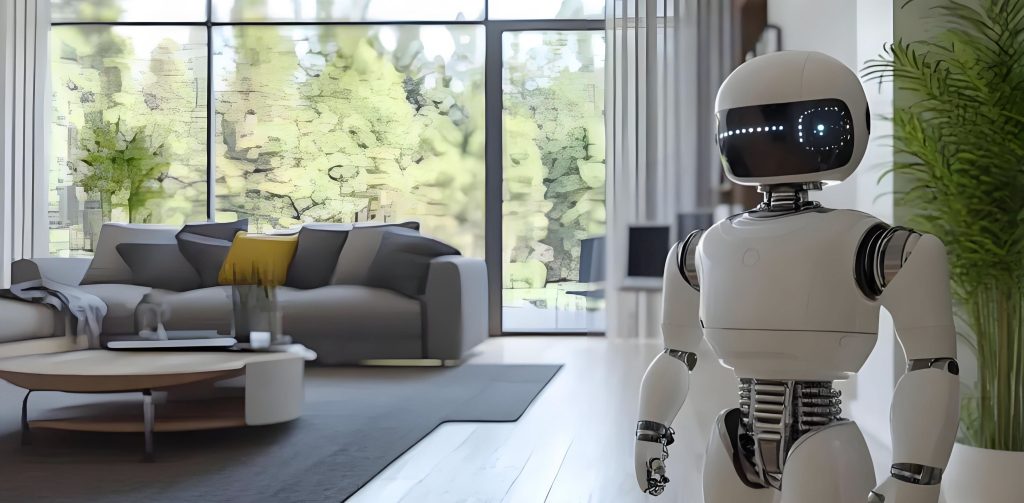
To validate these functionalities, I conducted market research through surveys targeting potential consumers. The study aimed to gauge preferences for companion robots, focusing on required features, APP interconnectivity, purchase considerations, and after-sales services. A questionnaire was designed covering aspects such as the necessity of APP linking, chat capabilities, safety services, voice functions, resemblance to family members, and health guidance. Respondents were also asked about factors like appearance, ease of use, practicality, price, and APP satisfaction. After collecting responses, I performed reliability and validity tests to ensure data quality.
Reliability was assessed using Cronbach’s alpha coefficient, a common measure for internal consistency. The formula for Cronbach’s alpha is: $$ \alpha = \frac{N \cdot \bar{c}}{\bar{v} + (N-1) \cdot \bar{c}} $$ where \( N \) is the number of items, \( \bar{c} \) is the average inter-item covariance, and \( \bar{v} \) is the average variance. For my data, the computed \( \alpha \) value was 0.839, indicating high reliability as it exceeds the 0.8 threshold. Validity was evaluated through factor analysis, with KMO (Kaiser-Meyer-Olkin) measure of sampling adequacy at 0.845 (above 0.6) and cumulative variance explained at 77.481% after rotation, confirming good validity. The table below summarizes key findings from the survey:
| Feature Category | Preferred Functions (Ranked by Importance) | Consumer Concerns |
|---|---|---|
| Core Robot Functions | 1. APP interconnection (bidirectional) 2. Chat and dialogue (humanized interaction) 3. Safety services (one-touch alarm to 120/110/999) 4. Voice capabilities (smart connectivity) 5. Health monitoring (e.g., blood pressure, heart rate) |
High price sensitivity; complexity in operation; battery life limitations. |
| APP Interconnectivity | 1. Family photo displays and dynamic albums 2. Voice and video functions for communication 3. One-touch emergency alerts 4. Medical data analysis and feedback |
Desire for intuitive interfaces; privacy issues; need for real-time updates. |
| Purchase Factors | 1. Price (average acceptable price: $9,000) 2. Ease of operation 3. Practical utility 4. Appearance design 5. APP satisfaction |
Initial pricing of $14,000 deemed too high; revised to $8,500 based on feedback. |
| After-sales Services | 1. On-site repairs 2. Mail-in servicing 3. Trade-in options 4. Technical support hotlines |
Demand for reliable maintenance and quick response times. |
The data revealed that consumer awareness of companion robots is still limited, necessitating enhanced marketing efforts. Price emerged as a primary barrier, leading to a price adjustment from $14,000 to $8,500 to align with average income levels. Additionally, users expressed difficulties with functionality operation, prompting the inclusion of user manuals, instructional videos, and remote售后 support. Concerns about battery life spurred research into wireless charging solutions. Requests for features like family photo displays and dynamic albums were noted for future iterations. Overall, the companion robot must evolve based on user feedback to better serve the elderly.
The impact of companion robots on elderly life can be analyzed through both positive and negative lenses. Positively, these robots offer a sense of realism in video calls, allowing seniors to engage in remote conversations that alleviate loneliness. With large, clear screens tailored to declining eyesight, they facilitate heartfelt exchanges. Voice chat functions provide亲切感, enabling verbal interaction that combats isolation by simulating social engagement. This can be expressed through a loneliness reduction metric \( L_r \): $$ L_r = \delta \cdot V_c + \epsilon \cdot A_i $$ where \( V_c \) is video call frequency, \( A_i \) is AI-driven interaction quality, and \( \delta, \epsilon \) are coefficients. Medical护理 professionalism is another advantage, as companion robots offer continuous health monitoring and emergency alerts, ensuring timely medical attention. For instance, a health risk index \( HRI \) can be defined as: $$ HRI = \frac{\sum_{j=1}^{m} A_j \cdot W_j}{T_m} $$ where \( A_j \) are anomaly counts (e.g., irregular heartbeats), \( W_j \) are severity weights, and \( T_m \) is monitoring duration. Lower \( HRI \) values indicate better health management. Reminder functions address memory decline, with timely prompts for medication or appointments, enhancing daily safety.
However, negative impacts must be acknowledged. Companion robots cannot fully replace human companionship; they merely mitigate issues for空巢老人 and独居老人. Children should still prioritize spending time with parents, encouraging physical exercise and regular check-ups. Moreover, high costs and售后 challenges persist, as many families cannot afford expensive models, and technical glitches may arise without prompt support. This affordability issue can be modeled with an accessibility score \( A_s \): $$ A_s = \frac{I_a}{P_r} \cdot S_q $$ where \( I_a \) is average household income, \( P_r \) is robot price, and \( S_q \) is service quality. Increasing \( A_s \) requires reducing \( P_r \) or improving \( S_q \).
To synthesize these insights, I propose a framework for optimizing companion robot design. This involves balancing functionality, cost, and user experience. A multi-objective optimization problem can be formulated: $$ \text{Maximize } Z = \lambda_1 \cdot U_f + \lambda_2 \cdot C_a + \lambda_3 \cdot R_s $$ subject to constraints such as \( P_r \leq B \) (budget limit), \( T_r \leq T_{max} \) (maximum response time), and \( H \geq H_{min} \) (minimum happiness index). Here, \( U_f \) is utility function score, \( C_a \) is cost-effectiveness, and \( R_s \) is reliability score, with \( \lambda \) weights reflecting priorities. Solving this using linear programming or heuristic algorithms can guide development.
In conclusion, companion robots hold significant potential to improve elderly life by addressing practical needs and emotional voids. Through functions like reminders, entertainment, detection, notifications, and data transmission, they offer a holistic approach to care. Market research underscores the importance of affordability, ease of use, and robust after-sales services. While positive impacts include enhanced communication, health monitoring, and safety, limitations such as incomplete substitution for human touch and economic barriers remain. Therefore, a tailored companion robot design, coupled with societal support from communities, healthcare systems, and families, is essential to achieve the goal of “老有所养、老有所为、老有所乐”—ensuring that the elderly are cared for, engaged, and joyful. As technology advances, I believe companion robots will become integral to aging societies worldwide, fostering a harmonious blend of innovation and compassion.