
As a researcher deeply immersed in the field of robotics, I have witnessed firsthand the transformative impact of sensors on bionic robot development. Bionic robots, inspired by biological systems, rely heavily on advanced sensing technologies to navigate, interact, and perform complex tasks autonomously. In this comprehensive exploration, I will delve into the intricacies of sensor applications, the challenges faced, and the future trajectories that promise to revolutionize bionic robotics. Through detailed analyses, formulas, and tables, I aim to provide a thorough understanding of how sensors are shaping the next generation of bionic robots.
The foundation of any bionic robot lies in its ability to perceive the environment, much like living organisms. Sensors act as the sensory organs, converting physical phenomena into electrical signals that enable decision-making. For instance, in a bionic robot mimicking insect locomotion, tactile sensors detect surface textures, while vision sensors map surroundings. The integration of these sensors is crucial for achieving lifelike behaviors. Consider a bionic robot designed for search-and-rescue missions; it must fuse data from multiple sensors to avoid obstacles and locate targets. This multi-sensor fusion can be modeled using Bayesian inference:
$$ P(S|D) = \frac{P(D|S) P(S)}{P(D)} $$
where \( P(S|D) \) is the posterior probability of state \( S \) given sensor data \( D \), \( P(D|S) \) is the likelihood, and \( P(S) \) is the prior. Such probabilistic frameworks enhance the reliability of bionic robots in uncertain environments.
To categorize the diverse sensor types used in bionic robots, I have compiled a table summarizing their applications and key characteristics. This table highlights how each sensor contributes to the functionality of bionic robots, from navigation to interaction.
| Sensor Type | Primary Function in Bionic Robots | Key Parameters | Example Applications |
|---|---|---|---|
| Vision Sensors (e.g., cameras, LiDAR) | Environmental mapping and object recognition | Resolution, frame rate, range | Autonomous navigation, gesture detection |
| Tactile Sensors (e.g., pressure arrays) | Surface interaction and force feedback | Sensitivity, spatial resolution | |
| Auditory Sensors (e.g., microphones) | Sound localization and voice commands | Frequency response, signal-to-noise ratio | Human-robot interaction, hazard detection |
| Olfactory Sensors (e.g., gas detectors) | Chemical sensing and leak detection | Detection limits, selectivity | Industrial inspection, environmental monitoring |
| Inertial Measurement Units (IMUs) | Motion tracking and balance control | Acceleration, gyroscopic drift | Bipedal locomotion, stabilization |
The performance of a bionic robot is often limited by sensor accuracy and stability. For example, in precision tasks like surgical robotics, even minor errors can have significant consequences. The overall error \( E \) in a sensor system can be expressed as:
$$ E = \sqrt{\sum_{i=1}^{n} (\epsilon_i^2 + \Delta_i^2)} $$
where \( \epsilon_i \) represents random noise from the \( i \)-th sensor, and \( \Delta_i \) denotes systematic drift. To mitigate this, bionic robots employ calibration algorithms that adjust readings over time. A common approach involves using a Kalman filter to estimate true states from noisy measurements:
$$ \hat{x}_{k|k} = \hat{x}_{k|k-1} + K_k(z_k – H\hat{x}_{k|k-1}) $$
Here, \( \hat{x}_{k|k} \) is the updated state estimate, \( K_k \) is the Kalman gain, \( z_k \) is the sensor measurement, and \( H \) is the observation matrix. Such techniques are vital for bionic robots operating in dynamic settings, such as those mimicking animal movement in rough terrain.
Another critical challenge is power consumption and miniaturization. Bionic robots often need to be compact and energy-efficient, especially for applications like internal inspections or wearable devices. The power dissipation \( P_d \) of a sensor module can be modeled as:
$$ P_d = I^2 R + V_{dd} I_{leak} $$
where \( I \) is the current, \( R \) is the resistance, \( V_{dd} \) is the supply voltage, and \( I_{leak} \) is leakage current. Advances in low-power electronics have enabled the development of tiny, efficient sensors that can be integrated into soft bionic robots without compromising performance. For instance, flexible sensors made from nanomaterials allow for stretchable electronic skins that conform to a bionic robot’s body, enhancing its ability to sense pressure, temperature, and strain.
Multi-modal sensor fusion is a cornerstone of intelligent bionic robots. By combining data from disparate sources, a bionic robot can build a comprehensive understanding of its surroundings. This fusion process often involves weighted averaging or neural networks. Consider a bionic robot that uses both vision and LiDAR for navigation; the fused distance estimate \( d_{fused} \) might be computed as:
$$ d_{fused} = \alpha d_{vision} + (1-\alpha) d_{LiDAR} $$
where \( \alpha \) is a weight based on confidence levels. This approach reduces uncertainties and improves robustness, enabling bionic robots to perform complex tasks like autonomous foraging or social interaction.
Looking ahead, the future of sensors in bionic robotics lies in integration, intelligence, and flexibility. Integrated sensor systems on a chip (SoC) will reduce size and cost, while AI-driven algorithms will enable adaptive sensing. For example, a bionic robot could learn to prioritize certain sensor inputs based on context, much like biological attention mechanisms. The trend toward柔性化 (flexibility) is exemplified by soft electronic skins that allow bionic robots to sense and respond to delicate touches, crucial for applications in healthcare or delicate manipulation.
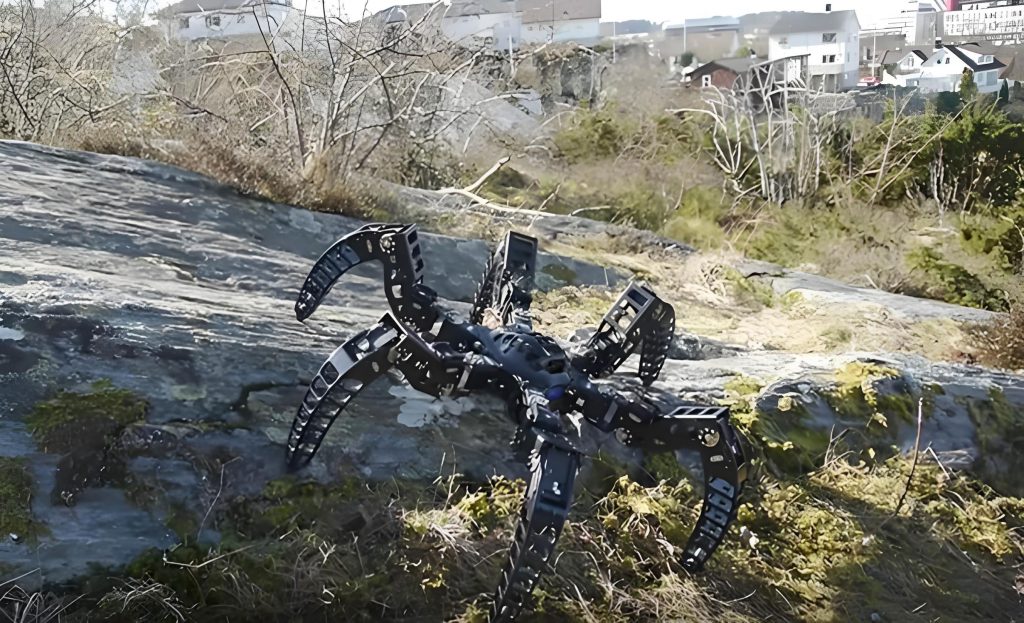
In practical applications, bionic robots are already making strides. Take, for instance, a worm-inspired soft robot designed for engine inspection. This bionic robot mimics the peristaltic motion of caterpillars, using vacuum suction to crawl through narrow spaces. Equipped with multi-parameter sensors, it can detect cracks, corrosion, and gas leaks in real-time. The control system for such a bionic robot can be described by differential equations modeling its locomotion:
$$ \frac{dx}{dt} = v \sin(\theta), \quad \frac{d\theta}{dt} = \omega $$
where \( x \) is position, \( v \) is velocity, \( \theta \) is orientation, and \( \omega \) is angular velocity. By integrating sensor feedback, this bionic robot autonomously navigates complex geometries, showcasing the synergy between bionics and sensing. The potential for such bionic robots extends to fields like aerospace maintenance, where they reduce downtime and enhance safety.
To further illustrate the advancements, consider the following table comparing traditional robots with modern bionic robots in terms of sensor capabilities. This highlights how bionic robots leverage bio-inspired sensing to achieve superior performance.
| Aspect | Traditional Robots | Bionic Robots |
|---|---|---|
| Sensor Integration | Often discrete and rigid | Highly integrated and flexible |
| Adaptability | Limited to predefined environments | Dynamic adaptation via multi-modal sensing |
| Power Efficiency | High consumption due to bulky sensors | Optimized through miniaturization |
| Application Range | Industrial automation, repetitive tasks | Healthcare, exploration, interactive roles |
The development of bionic robots also hinges on advanced materials for sensors. Piezoelectric materials, for example, convert mechanical stress into electrical signals, enabling self-powered sensing in bionic robots. The voltage output \( V \) of a piezoelectric sensor is given by:
$$ V = g_{ij} \sigma_{ij} t $$
where \( g_{ij} \) is the piezoelectric coefficient, \( \sigma_{ij} \) is the applied stress, and \( t \) is thickness. Such sensors are ideal for bionic robots that require lightweight, durable sensing elements, such as those mimicking bird wings for aerial surveillance.
In terms of data processing, bionic robots increasingly rely on edge computing to handle sensor data locally, reducing latency. The processing time \( T \) for sensor fusion can be modeled as:
$$ T = \frac{N \cdot b}{C} $$
where \( N \) is the number of sensors, \( b \) is the data bit rate, and \( C \) is the computational capacity. By optimizing this, bionic robots can react in real-time, essential for tasks like collision avoidance or interactive dialogue. For instance, a bionic robot serving as a companion for the elderly might use audio and visual sensors to detect falls and alert caregivers.
Moreover, the concept of swarm robotics introduces another dimension where bionic robots collaborate using distributed sensing. In a swarm of insect-inspired bionic robots, each unit shares sensor data to achieve collective goals, such as environmental monitoring. The coordination can be described by flocking algorithms:
$$ \vec{F}_i = \sum_{j \neq i} ( \vec{f}_{rep} + \vec{f}_{att} ) $$
where \( \vec{F}_i \) is the net force on robot \( i \), and \( \vec{f}_{rep} \) and \( \vec{f}_{att} \) are repulsive and attractive forces based on sensor readings. This decentralized approach enhances scalability and resilience, key for bionic robots operating in vast or hazardous areas.
As we push the boundaries, the convergence of bionic robots with technologies like brain-computer interfaces (BCIs) opens new avenues. Sensors that detect neural signals could allow bionic robots to be controlled by thought, blurring the lines between biology and machinery. The signal-to-noise ratio \( SNR \) in such sensors is critical:
$$ SNR = 10 \log_{10} \left( \frac{P_{signal}}{P_{noise}} \right) $$
High \( SNR \) ensures precise interpretation of intent, enabling bionic robots to assist in rehabilitation or enhance human capabilities. This aligns with the broader trend toward智能化 (intelligence), where bionic robots not only sense but also learn and evolve.
In conclusion, sensors are the lifeline of bionic robots, driving innovations that mirror biological excellence. From enhanced accuracy to flexible designs, the progress in sensing technology will continue to propel bionic robots into new frontiers. As I reflect on my research, I am optimistic that sustained investment in sensor development will unlock revolutionary applications, making bionic robots integral to our daily lives and industrial processes. The journey ahead is filled with challenges, but the potential for bionic robots to transform society is immense, fueled by the ever-advancing capabilities of sensors.