
In the ever-evolving landscape of robotics, the humanoid robot sector has captured global attention, particularly in the latter half of 2024, with intense interest yet no clear “second major player” emerging beyond the pioneer. As a leading entity in this field, our experience demonstrates that the path for humanoid robots is far from a dead-end; instead, it is paved with steady operational resilience and vibrant research advancements, sending positive signals across the industry. This article delves into our firsthand insights, exploring the technological foundations, practical applications, and future trajectories of humanoid robots, emphasizing their sustainable development and growing integration into industrial and social frameworks.
The concept of humanoid robots has long fascinated scientists and engineers, aiming to create machines that mimic human form and function. Our journey began over a decade ago, focusing on core technologies such as servo drives, which have evolved into a robust portfolio enabling stable funding for ongoing research. To date, we have designed and produced over 40 types of servo drives, spanning from small to large torque capacities, deployed across various robot series. This self-sustaining approach—where revenue from diverse applications fuels humanoid robot projects—has been crucial. For instance, early small humanoid robots allowed market validation, laying groundwork for larger-scale endeavors. The complexity of developing full-sized humanoid robots is immense, integrating multidisciplinary expertise; even seemingly simple actions like bipedal walking require months of algorithm refinement. Our work on gait planning, for example, leverages virtual foot models and inverted pendulum models to generate body and foot trajectories, enhanced by multi-dimensional force-position hybrid controllers for adaptability to rough terrains and external disturbances. This is encapsulated in the control equation for balance: $$ \tau = J^T F + M(q)\ddot{q} + C(q,\dot{q})\dot{q} + G(q) $$ where \( \tau \) represents joint torques, \( J \) is the Jacobian matrix, \( F \) is external forces, \( M \) is the inertia matrix, \( C \) accounts for Coriolis forces, \( G \) denotes gravitational effects, and \( q \) is the joint position vector.
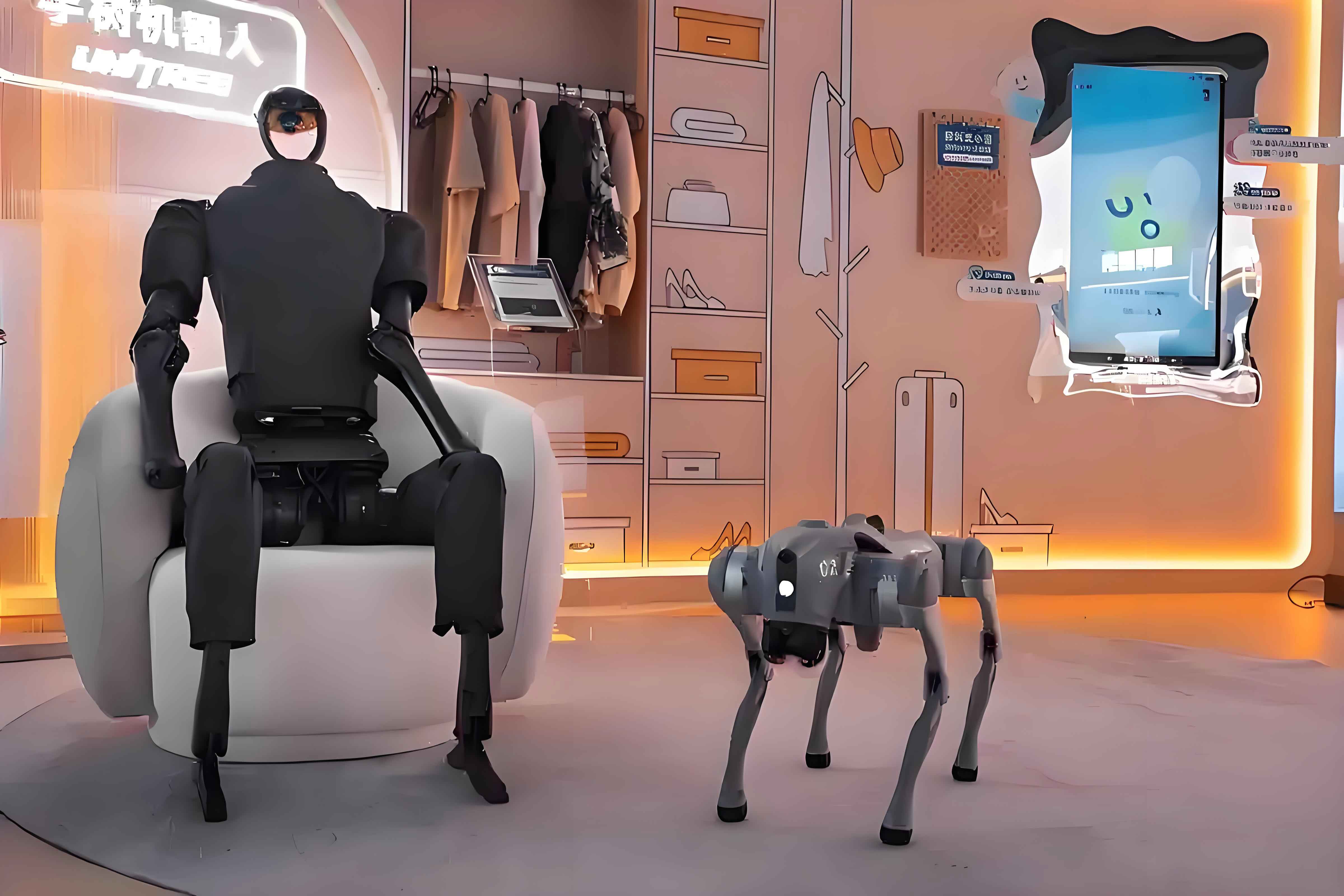
Our technological stack for humanoid robots is comprehensive, encompassing robotics, artificial intelligence, and their fusion. The table below summarizes key modules and their functions:
| Module | Description | Key Technologies |
|---|---|---|
| Motion Control | Manages locomotion and stability | Servo drives, gait planning, force control |
| Perception | Enables environment sensing | Computer vision, LiDAR, tactile sensors |
| AI Integration | Facilitates decision-making | SLAM, visual servoing, human-robot interaction |
| Autonomy | Supports independent task execution | Navigation algorithms, multimodal fusion |
This full-stack capability positions us among the few globally with end-to-end expertise in humanoid robot development. Patent analyses highlight our leadership, with top rankings in effective patents and annual filings over recent years. Looking ahead, we are targeting enhancements in size reduction, aesthetic fluidity, and power density improvements for next-generation humanoid robots.
The industrial sector, especially automotive manufacturing, serves as a critical testing ground for humanoid robots. In early July, our latest humanoid robot platform was deployed in a smart factory for tasks like bolt tightening, part assembly, and component handling. Automotive environments offer high digitalization levels, with vast datasets conducive to building large-scale models and developing embodied intelligence. As one industry expert noted, these settings provide inherent generalization advantages, allowing humanoid robots to adapt to other manufacturing scenarios. Our collaborations with multiple automotive plants underscore this trend, where humanoid robots undergo rigorous “training” to integrate into production lines. The operational workflow involves sequential task execution, modeled as: $$ T = \{t_1, t_2, \dots, t_n\} $$ where each task \( t_i \) is decomposed into subtasks via AI planning. For example, bolt tightening can be expressed as a force-control problem: $$ F_d = K_p e + K_d \dot{e} $$ with \( F_d \) as desired force, \( e \) as error, and \( K_p, K_d \) as control gains.
To address the challenge of generalization, we are heavily investing in large models and end-to-end reinforcement learning. Humanoid robots require robust decision-making modules, which benefit from multimodal perception and reasoning—areas where large models excel. By converting large models into lightweight, proprietary deep learning models, we enable humanoid robots to handle abstract task decomposition and adaptation. Recent research focuses on multimodal planning models trained on simulation and real-world data, aligning sensor inputs with robot actions. This approach enhances scene understanding and semantic extraction, allowing for more flexible planning. The reinforcement learning framework follows: $$ \pi^* = \arg\max_\pi \mathbb{E} \left[ \sum_{t=0}^\infty \gamma^t R(s_t, a_t) \right] $$ where \( \pi^* \) is the optimal policy, \( \gamma \) is the discount factor, and \( R \) is the reward function. Through parallel simulation training, we achieve fine manipulation like peg-in-hole assembly and high-performance bipedal walking. A table comparing traditional vs. AI-enhanced methods for humanoid robots illustrates this evolution:
| Aspect | Traditional Methods | AI-Enhanced Methods |
|---|---|---|
| Task Planning | Pre-programmed sequences | Dynamic adaptation via large models |
| Control | PID-based controllers | End-to-end learned controllers |
| Generalization | Limited to specific scenarios | Broad applicability across domains |
| Learning Efficiency | Manual tuning required | Scalable through simulation |
Our humanoid robot has demonstrated these capabilities in public forums, showcasing generalized grasping, object sorting, and voice interaction—a rare real-world application of “AI large model + humanoid robot” internationally.
Public validation has been instrumental in advancing humanoid robot acceptance. From large-scale performances at global events to industrial pilot programs, these exposures provide rigorous testing and awareness-building. For instance, humanoid robots have participated in high-profile ceremonies, such as stock exchange listings, requiring precise locomotion and timed actions. The technical hurdles involved rapid gait adjustments and sensor optimizations, summarized by the stability criterion: $$ \text{Stability Margin} = \min \left( \frac{\text{ZMP}_{\text{margin}}}{\text{Base of Support}} \right) > 0 $$ where ZMP denotes the Zero Moment Point. These experiences accelerate core technology breakthroughs and accumulate practical insights. Currently, we are focusing on automotive and 3C manufacturing sectors, enhancing tool operation and task execution for humanoid robots. Additionally, research is underway for home-companion humanoid robots with biomimetic designs.
The commercialization roadmap for humanoid robots is structured in three phases, detailed below:
| Phase | Timeline | Goals for Humanoid Robots | Key Metrics |
|---|---|---|---|
| Phase 1 | 2023-2024 | Entry into automotive manufacturing; testing in搬运 and inspection | Task completion rate >90%, uptime >95% |
| Phase 2 | 2025-2027 | Expansion to moderate tasks; 3-5 specialized scenarios; scale commercialization | Cost reduction by 30%, deployment in 10+ factories |
| Phase 3 | 2028-2033 | Complex task handling; >10 skill types; multi-task general-purpose industrial humanoid robots | ROI < 2 years, adaptability to 50+ scenarios |
This phased approach mitigates risks associated with high R&D costs and market uncertainties. The industry faces a paradox: while humanoid robots promise massive growth—potentially reaching billion-dollar scales—premature mass production could lead to inefficiencies. Thus, patience and strategic scaling are essential. Our projections for humanoid robot adoption in industry rely on cost-benefit analysis: $$ \text{Net Benefit} = \sum_{i=1}^n \left( \text{Productivity Gain}_i – \text{Operational Cost}_i \right) – \text{Initial Investment} $$ where \( n \) is the number of deployment years.
In summary, the journey of humanoid robots is marked by continuous innovation and practical validation. Through self-sustaining R&D, full-stack technology integration, and strategic applications in industries like automotive, humanoid robots are proving their viability beyond hype. The integration of large models and reinforcement learning further boosts their generalization, making humanoid robots more adaptable and intelligent. As we navigate this path, collaborations and public engagements remain vital for refining capabilities and driving acceptance. The future of humanoid robots is not a distant dream but an unfolding reality, with potential to revolutionize manufacturing, services, and daily life. Our commitment to advancing humanoid robot technology underscores a belief in their transformative power, ensuring that each step forward contributes to a more automated and intelligent world.